Article Contents:
- Philosophical Foundations of Russian Woodcarving
- Cosmogonic Concepts in Wooden Patterns
- Regional Specificity of Ornamental Schools
- Technical Aspects of Craftsmanship
- Wood selection and preparation
- Tools and Equipment of the Craftsman
- Basic Techniques and Methods
- Symbolism and Semantics of Ornamentation
- Plant Motifs and Their Meanings
- Zoomorphic Images in Woodcarving
- Geometric Ornamentation and Its Sacred Meaning
- Modern Interpretations of Traditions
- Adaptation of Ancient Techniques to Modern Needs
- Integration into Modern Design
- Education and Continuity of Craftsmanship
- Regional schools and their characteristics
- Northern School: The Rugged Beauty of Pomorye
- Central Russia: Festivity and Ornamentation
- Southern Regions: Influence of Steppe Culture
Do you know that every swirl, every line in Russian style in woodcarving carries not just a decorative function, but a deep sacred meaning accumulated by generations of masters? When the chisel touches wood in the hands of a true artist, it does not create merely ornament — it creates history, philosophy, the soul of the people, embodied in matter.
Woodcarving in Russian tradition has never been merely a craft or a means of decorating daily life. It is a special language of communication with the world, where each symbol, each motif had deep meaning and was passed down from hand to hand as sacred knowledge. In an era when mass production threatens to erase individuality, studying and preserving traditional carving techniques becomes an act of cultural resistance.
What makes Russian-style woodcarving recognizable among many other national traditions? What secrets of craftsmanship lie behind the apparent simplicity of folk ornamentation? And most importantly — how does ancient wood carving art find its place in the modern world without losing its authenticity and spiritual depth?


Philosophical Foundations of Russian Woodcarving




Cosmogonic Representations in Wooden Motifs
At the very core of the Russian approach to woodcarving lies a deep understanding of wood as a living being, as a mediator between worlds. Our ancestors did not merely process wood — they engaged in dialogue with it, extracting hidden images from it, liberating the beauty imprisoned within its fibers.
Solar symbols are among the oldest motifs in Russian woodcarving. Stylized suns, rosettes, and wheels of time adorned window lintels, house gables, and household items. These symbols were meant to attract solar energy into the home, protect against evil forces, and ensure family prosperity.
The Tree of Life — a central motif in Russian ornamentation — embodied ideas of generational connection, continuity of existence, and roots nourishing the crown. In carving, this could be rendered as a realistic tree, a highly stylized plant ornament, or a geometric composition readable only by initiates.
Water motifs — waves, streams, drops — symbolized life force, fertility, and purification. Masters skillfully conveyed the movement of water through rhythmic repetition of carved elements, creating a sense of flow, ripple, and the living breath of the material.
The protective function of ornament was no less important than its decorative one. Carved talismans were placed in the most vulnerable areas of the house — above entrances, around windows, at corners. Each symbol had its specific purpose: some repelled evil spirits, others attracted luck, and others protected against illness and misfortune.
Our factory also produces:


Regional specificity of ornamental schools
The vast expanses of Russia gave rise to numerous regional schools of carving, each developing its own unique artistic language. Traditional carving in the Russian style The carving traditions of the northern regions differed fundamentally from those of the south, while central regions developed their own unique aesthetics.
Archangelic carving impresses with its monumentality and harsh beauty. Here, large, expressive forms and geometric ornaments, symbolizing natural forces, dominate. Favorite motifs — suns, stars, crosses — were executed in deep relief carving, creating powerful interplay of light and shadow.
Vologda school was renowned for the refinement and elegance of its execution. Masters of this region preferred vegetal ornaments executed in openwork carving. Especially prized were items featuring motifs of northern plants — pines, spruces, birches, blueberries, and cranberries.
Kostroma carving was distinguished by its festive and decorative character. Here, multi-colored painting of carved items flourished, creating an effect of preciousness and ornamentation. Favorite subjects — birds, animals, mythical characters — were executed with great artistic skill.
The Nizhny Novgorod school contributed a special poetic quality to Russian carving. The famous Хохлома painting was complemented by delicate carving, forming a textured base for gold and red patterns. This technique required exceptional skill and artistic sensitivity.
Get Consultation
Technical aspects of craftsmanship
Selection and preparation of wood
The success of any carved item begins with the proper selection of material. Russian masters were skilled connoisseurs of wood, able to choose precisely the right blank best suited for a specific work.
Linden — the queen of wood carving — was prized for its softness and plasticity. Carvings from linden included the most complex and detailed ornaments, creating delicate openwork compositions. Linden wood is easy to work with, does not splinter, and allows for the finest nuances of form.
Aspen held a special place in the arsenal of carvers. This species possesses an extraordinary property — it practically does not rot in a humid environment, making it indispensable for outdoor work. Church domes, window casings, and porches made of aspen served for centuries.
Birch attracted masters with its beautiful texture and ability to take fine finishes. Birch carving was distinguished by exceptional refinement, and Karelian birch, with its unique grain, was considered material for elite items.
Coniferous species — pine, spruce, larch — were used for large architectural elements. The resinous wood of conifers possesses natural antiseptic properties and resists weathering well.
Wood preparation was carried out at a specific time of year, usually in winter, when sap movement was minimal. Cut trees were left standing on their roots, then slowly dried under natural conditions. This process could take several years but ensured the highest quality of material.
Tools and equipment of the master
The arsenal of the Russian carver included dozens of specialized tools, each designed for specific operations. Most tools were made by the master himself, adjusted to his hand and working style.
Carving knives — the main tool of the carver — had various shapes and sizes. Straight knives were used for rough shaping and creating basic outlines. Oblique knives allowed for precise cuts at various angles. Hooked knives were indispensable for creating semicircular recesses.
Chisels of various profiles — flat, semi-circular, angular — allowed for creating diverse surfaces and textures. Chisel widths varied from several millimeters to several centimeters depending on the scale of the work.
Klyukarzhes — chisels with curved blades — were used for working in hard-to-reach areas, creating deep reliefs, and working on internal surfaces of hollow items.
Tsaraziks — miniature chisels — were used for the finest work, for detailing small elements, and for creating textured surfaces. In the hands of an experienced master, a tsarazik could create incredibly complex and beautiful elements.
Tool sharpening — a special art requiring years of experience. A properly sharpened tool must be as sharp as a razor but not brittle. Masters kept the secrets of sharpening and passed them only to worthy apprentices.
Basic techniques and methods
wood carving art Includes numerous technical methods, each requiring years of refinement. Mastery of various techniques enabled the master to create works of astonishing beauty and diversity.
Flat relief carving — one of the oldest techniques, where ornament is formed by removing depressions from a flat surface. This technique allows creating geometric patterns of great expressiveness with relative simplicity of execution.
Relief carving creates three-dimensional compositions where individual elements project above the background surface. Low relief (bas-relief) and high relief are distinguished, where elements may project half their thickness or more.
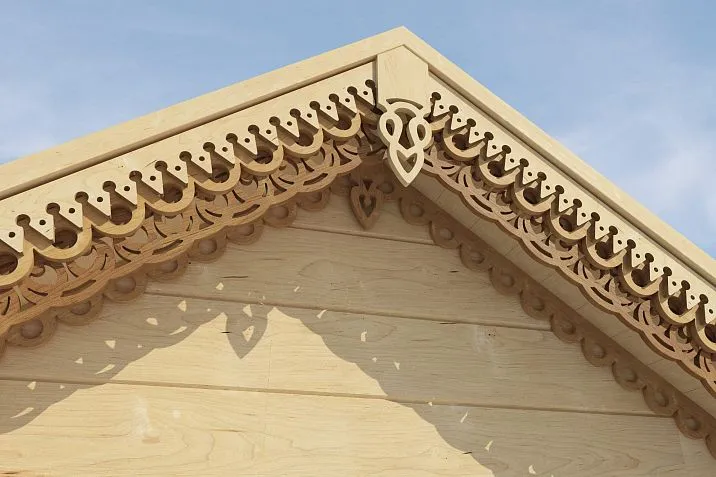
Cut-out carving, or openwork, involves complete removal of the background, resulting in a lace-like pattern. This technique requires exceptional skill and is used for creating the most decorative items.
Sculptural carving — the highest form of craftsmanship — creates three-dimensional compositions completely freed from the plane. Such carving requires not only technical perfection but also a developed artistic vision.
Contour carving is executed with fine lines of varying depths, creating a graphic effect. This technique is often combined with other carving methods to refine details and create additional accents.
Symbolism and semantics of ornaments
Plant motifs and their meanings
Floral elements in Russian carving style They were never simple decorative borrowings from nature. Each plant, each flower, each leaf carried a certain symbolic load understandable to contemporaries.
Oak symbolized strength, power, longevity. Oak leaves and acorns often adorned items intended for family heads, emphasizing their status and masculine energy. Oak motifs appeared in furniture carving, architectural elements, and weaponry.
Birch — symbol of femininity, purity, motherhood — was often depicted in carving of household items for women. Birch leaves, catkins, and trunks created an atmosphere of tenderness and coziness, characteristic of the female half of the home.
Rowan, with its bright clusters, symbolized protection from evil forces. Rowan motifs frequently appear in carving of lintels, gateposts, and other elements intended to protect the house from negative influences.
The grapevine, although not native to northern regions of Russia, entered ornamentation through Christian symbolism. Grape symbolized spiritual nourishment, communion, and connection with the divine. Grape motifs adorned church utensils and iconostases.
Hops and barley — symbols of fertility and abundance — frequently appeared in carving of items related to agriculture and household. Ears, hop cones created ornaments intended to ensure a bountiful harvest.
Zoomorphic images in carving
The animal world occupied an important place in the symbolic system of Russian ornament. Each animal possessed certain qualities that the craftsman aimed to convey to the owner of the carved item.
Horse — the main hero of Russian animal style — symbolized the sun, fertility, and martial valor. Horse panels on roof tops, carved horses on lintels and gates were meant to bring solar energy into the house and protect against enemies.
Bear — lord of the forest — embodied strength, wisdom, and practicality. Bear paws, tracks, stylized bear figures served as talismans for hunters and lumberjacks, guaranteeing luck in forest trades.
Birds — intermediaries between earthly and heavenly realms — had numerous symbolic meanings. Swan symbolized purity and fidelity, eagle — power and keenness, rooster — vigilance and bravery, owl — wisdom and secret knowledge.
Fish symbolized abundance, fertility, and vital energy. Fish motifs often adorned items related to water — buckets, eaves, washbasins. Pike was considered especially lucky fish and frequently depicted on fishing gear.
Mythical creatures — dragons, griffins, unicorns — entered Russian ornamentation from Byzantine and Western European art, but acquired a unique interpretation here. They symbolized dominion over elements, wisdom, and protection from evil.
Geometric ornaments and their sacred meaning
Geometric motifs — the oldest layer of ornamental art — retained deep connections with ancestral cosmogonic beliefs in Russian carving. Behind the simplicity of geometric forms lay a complex philosophical system.
Circle — symbol of the sun, time, eternity — appeared in carving in many variations. Simple circles, concentric rings, rosettes, wheels created solar compositions intended to bring light and warmth into the home.
Square symbolized earth, the material world, stability. Square frames, grids, checkerboard patterns created a sense of order and reliability. The combination of circle and square expressed the idea of harmony between the heavenly and earthly.
Triangle had multiple symbolism. Pointing upward, it meant fire, aspiration toward heaven, masculine principle. Pointing downward — water, feminine principle, fertility. Combinations of triangles created complex compositions expressing ideas of unity of opposites.
Spiral — symbol of development, movement of time, vital energy — frequently appeared in carving of volutes, scrolls, plant elements. Spiral motifs created a sense of dynamism, living breath of the ornament.
Cross — universal symbol of protection — appeared in Russian carving in countless variations. Simple cross, cross in circle, Maltese cross, flourishing cross — each type had its own purpose and application area.
Modern interpretations of traditions
Adaptation of ancient techniques to modern needs
Modern revival of interest in the history of Russian wooden carving This poses a complex challenge to artisans: how to preserve the authenticity of traditions while adapting them to the realities of the 21st century? The answer lies in a deep understanding of the philosophy of folk art and creative rethinking of its forms.
Modern tools open new possibilities for embodying traditional motifs. Electric chisels, milling machines, laser cutting allow achieving precision unattainable with hand tools. But the main task — to use these possibilities to enhance, not replace, the artistic concept.
New materials expand the master's palette. Modern varnishes and stains ensure the longevity of items while preserving the natural beauty of wood. Composite materials allow imitation of carving in cases where natural wood is impractical due to technical or economic reasons.
Computer modeling helps in developing complex compositions, allows calculating optimal proportions, and checking the harmony of various elements. However, the final decision always remains with the master, based on his artistic sense and understanding of traditions.
Educational programs in traditional carving are adapted to modern teaching methods. Video courses, interactive guides, and virtual masterclasses make the art of carving accessible to a broad audience while preserving the depth and systematic nature of traditional craftsmanship education.
Integration into modern design
Modern interior design increasingly turns to elements of decorative carving for furniturefinding unique originality and emotional expressiveness in traditional motifs. The designer's task is to organically integrate carved elements into the modern context.
Minimalist interiors gain a new dimension thanks to individual, yet expressive, carved accents. A single well-executed carved panel can radically change the character of the entire space, adding depth and individuality.
Eclectic styles allow more free use of traditional carving elements. Here, ancient motifs coexist with modern forms, creating intriguing and expressive compositions. The key is to find the right balance between tradition and innovation.
Ethnic interiors provide maximum opportunities for using traditional carving. Here, one can recreate the atmosphere of a Russian home with all the richness of ornamental traditions, while taking into account modern requirements for comfort and functionality.
Commercial interiors — restaurants, hotels, offices — use elements of Russian carving to create a unique image, emphasize national identity, and attract customers. Here, quality stylization is especially important, avoiding kitsch and superficiality.
Education and continuity of craftsmanship
Preservation of traditions of folk wood carving in Russia It is impossible without a system of knowledge and skill transmission from master to apprentice. Modern education in traditional crafts strives to combine the depth of traditional approaches with the effectiveness of modern methodologies.
Art schools and academies include courses in traditional carving in their programs, acquainting students with history, techniques, and symbolism of folk art. Such preparation fosters understanding of cultural context, without which authentic creations are impossible.
Private workshops and schools offer intensive courses for adults wishing to master the art of carving. Here, one can acquire practical skills, feel the material, and understand the specifics of working with various tools.
Masterclasses by renowned carvers offer the opportunity to acquaint oneself with original techniques and witness the creation process from concept to realization. Such encounters are especially valuable for novice artisans seeking their path in art.
Contests and exhibitions of traditional crafts stimulate the development of carving art, reveal talented masters, and facilitate experience exchange among representatives of various schools and directions.
Documenting traditions — creating video archives, catalogs of works, methodological guides — ensures preservation of knowledge for future generations and enables restoration of lost techniques and methods.
Regional schools and their characteristics
Northern School: the harsh beauty of Pomorye
Northern regions of Russia developed a distinctive style of carving reflecting the harsh beauty and strength of northern nature. Archangel, Murmansk, and Karelian carving are characterized by monumental forms, deep relief, and distinctive expressiveness of geometric motifs.
Pomorye carving developed under the influence of maritime elements. Wave motifs, spiral scrolls, stylized images of marine animals created ornaments full of dynamism and energy. Ship carving reached here the highest artistic level.
Lapland motifs introduced elements of shamanism and paganism into northern carving. Stylized deer, bears, birds were executed in a distinctive angular manner, evoking a sense of primal power and connection with nature spirits.
Monastic carving of the Russian North was distinguished by particular strictness and symbolic richness. Christian motifs — crosses, grapevines, flourishing trees — were executed with mathematical precision of proportions and deep understanding of theological meaning.
Peasant carving in northern regions was characterized by functionality and practicality. Each ornamental element had not only decorative but also magical purpose — to protect the house, attract luck, ensure fertility.
Central Russia: festivity and ornamentation
Central regions of Russia — Moscow, Vladimir, Yaroslavl, Kostroma — developed their own distinctive style of carving, characterized by festivity, ornamentation, and richness of ornamental motifs.
Moscow carving was influenced by capital culture and distinguished by refinement and elegance. Here, the technique of fine relief carving flourished, creating an effect of preciousness and luxury. Especially prized were items with gilding and polychrome painting.
Sergiev Posad toy school brought a particular liveliness and humor to carving. Funny animal figures, fairy tale characters, everyday scenes were executed with great skill and artistic sense.
Gorodets carving became famous for its 'don'ts' — boards for spinning wheels, decorated with complex multi-figure compositions. The themes of Gorodets carving reflected merchant life, holidays, and folk festivities.
Khokhloma carving, although primarily renowned for its painting, also had its own carving traditions. Masters created textured bases for painting, using various surface processing techniques.
Southern regions: influence of steppe culture
Southern regions of Russia — Voronezh, Kursk, Belgorod — developed their own distinctive carving style, influenced by steppe culture, Cossack traditions, Ukrainian, and Belarusian art.
Slobodskaya carving was distinguished by its particular decorative quality and love for floral motifs. Sunflowers, poppies, cornflowers, oak leaves created lush compositions full of southern warmth and solar energy.
Cossack carving bore the imprint of military culture. Military attributes — sabers, arrows, shields — were stylized into ornamental motifs. Images of horses — loyal companions of Cossacks — were especially popular.
Carving of southern regions' peasants was influenced by Ukrainian tradition. Here, contour and flat-relief carving techniques flourished, creating graphically clear and expressive ornaments.
Southern Russian monastery carving was distinguished by its particular richness and solemnity. Baroque motifs, complex floral compositions, and rich gilding created an atmosphere of celebration and spiritual uplift.
In the modern world, where mass production erases individuality, Russian style in carving it remains an island of authenticity and handcrafted beauty. This art cannot be replaced by machines, as each movement of the chisel carries the soul of the master, his understanding of beauty, his connection to centuries-old tradition.
Today we observe a remarkable phenomenon — a revival of interest in traditional crafts among the younger generation. People raised in the digital age suddenly discover the joy of working with wood, the beauty of handcrafted ornamentation, and the depth of folk symbolism. This offers hope that traditions of Russian carving will not only be preserved but also receive new development.
The future of Russian style in carving is envisioned as a harmonious blend of tradition and innovation, a creative reinterpretation of ancient motifs, and the search for new forms of expression of eternal ideas of beauty and harmony. The most important thing — to preserve the soul of this art, its connection to national culture, its ability to speak to the human heart in the language of beauty.
Company STAVROS makes a significant contribution to preserving and developing traditions of Russian wooden carving, creating modern interpretations of classical motifs and upholding the highest standards of craftsmanship. Every STAVROS product is not merely a decorative element, but a carrier of cultural memory, a link between the past and future of Russian folk art. Choosing STAVROS products, you become a participant in a great tradition that has been passed down from generation to generation for many centuries.