Article Contents:
- Wooden carved rosettes in Moscow: what tasks are they suitable for
- For ceilings and ceiling compositions
- For furniture and furniture fronts
- For walls, doors, and decorative inserts
- For decorating moldings and classic interior frames
- What is a carved wooden rosette and how does it differ from other decorative elements
- Difference from overlays
- Difference from molding decor
- When is it better to choose a rosette
- Which materials to choose: oak or beech
- When oak is better
- When beech is better
- What to consider regarding texture, tone, and durability
- How to choose a carved rosette by size, shape, and pattern
- Round, square, oval, and complex shapes
- Large and small ornamentation
- How to match a rosette to the scale of furniture or room
- How not to overload the interior
- Where carved wooden rosettes are used in interior design
- Ceiling
- Walls
- Doors
- Furniture fronts
- Fireplaces, Portals, Decorative Panels
- What Determines the Price of Carved Wooden Rosettes in Moscow
- Wood species
- Size of the item
- Complexity of Ornament
- Type of Treatment
- Ordering a Standard Model or a Custom Solution
- How to Order Carved Wooden Rosettes in Moscow
- How to Choose a Product for Your Project
- What to Prepare Before Ordering
- When It's Better to Choose a Ready-Made Model
- When Individual Selection is Needed
- How to Combine Carved Rosettes with Other Wooden Decor
- With Mouldings
- With overlays
- With cornices
- With panels and furniture decor
- Comparison of materials for carved rosettes: oak, beech and MDF
- Common mistakes when choosing carved rosettes
- Incorrect scale
- Too complex ornament for a small area
- Ignoring wood color
- Detaching the rosette from the overall room style
- FAQ: answers to popular questions about wooden carved rosettes
- Where to buy wooden carved rosettes in Moscow?
- Which carved rosettes are suitable for the ceiling?
- What is better to choose for decoration: oak or beech?
- Can wooden rosettes be used on furniture?
- What sizes do rosettes come in?
- How to choose a rosette to match moldings?
- Are carved rosettes suitable for modern interiors?
- What determines the price of a carved wooden rosette?
- How to choose an ornament for a classic interior?
- Can rosettes be ordered with delivery in Moscow?
- Summary: how to choose and where to order carved wooden rosettes in Moscow
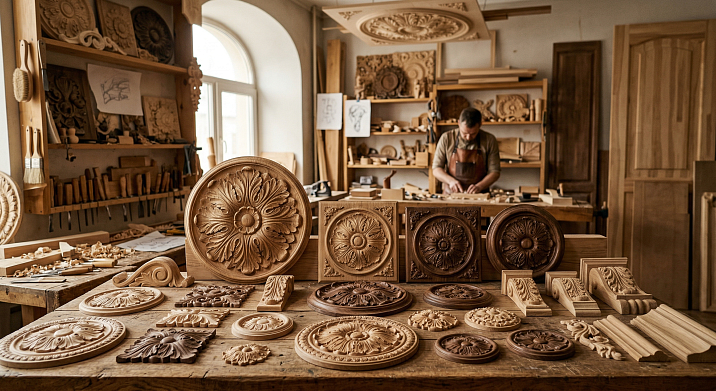
There are details that don't immediately catch the eye—yet they define the class of an interior. A carved wooden rosette is precisely such a detail. A small element, precisely placed in the right spot, can transform a ceiling, enliven a furniture facade, and give a wall depth and character. However, most people don't know where to start choosing: what to look for, how to measure, oak or beech, round or square, for the ceiling or for furniture. This article is a practical guide for those who want toorder carved wooden rosettes in Moscowconsciously, not at random.


Carved wooden rosettes in Moscow: what tasks are they suitable for
Before discussing shape and ornament, we need to answer the main question: why have a rosette at all? What does it bring to the interior besides decoration? The answer is surprisingly specific: it organizes space. A rosette is a focal point, a visual center around which the rest of the decor is arranged. Without it, even a good interior seems slightly unfinished.




For ceilings and ceiling compositions
Ceiling rosettes are a classic, historical application. In European architecture since the 17th century, a ceiling rosette marked the 'chandelier location' and simultaneously served as the main decorative accent of the entire room. This tradition persists today—but now a rosette can function even without a chandelier, simply as an architectural element defining the center of the ceiling plane.
Wooden rosettes for ceilingsmade from solid oak or beech create a sensation that polyurethane or plaster counterparts can never replicate: natural texture, living relief, the warmth of the material. With proper lighting—spotlights or track lighting directed at an angle—the carved rosette literally 'comes to life': the ornament begins to play with shadows, and the depth of the relief is revealed in full force.
Wooden ceiling rosettes work well both as a standalone accent and as part of a more complex ceiling composition: in combination with cornices, moldings, and coffered frames.
Our factory also produces:


For furniture and furniture fronts
A furniture rosette is a small but very effective tool for transforming mass-produced furniture into a piece with character. A central rosette on a cabinet front, a pair of symmetrical rosettes on buffet doors, an accent element on a chest of drawers pediment — each of these solutions works as a style statement.
An important nuance: furniture rosettes are usually more compact than ceiling ones. A diameter from 50 to 150 mm is the working range for most furniture tasks. The relief must be clear and legible even on a small scale. This is why proper detailing of the carving is especially important for furniture: an overly fine ornament on a small rosette 'blurs' and loses its expressiveness.
Get Consultation
For walls, doors, and decorative inserts
On walls, carved rosettes are used in two ways. The first is as an independent accent: a rosette is placed in the center of a rectangular molding field or in the corner of a decorative frame. The second is as a corner element of a frame composition: four corner rosettes frame a rectangular field, creating a complete architectural form.
On doors, rosettes are installed in the center of the upper panel field or in the center of each of the door's decorative panels. This is a powerful technique that turns an ordinary interior door into a piece with artistic value.Wooden decorative rosetteshere they work as a finishing touch, completing the look.
For decorating moldings and classic interior frames
This is perhaps the most 'architectural' application scenario. Rosettes at molding intersections are a classic technique, familiar from palace interiors. Where horizontal and vertical moldings intersect at a right angle, a rosette covers the joint and turns a technical intersection into a decorative accent.
Such a system works on walls when creating panel compositions and on ceilings when decorating coffers. Here, the rosette is not a single element, but part of a system — and it is within the system that it reveals its full decorative power.
What is a carved wooden rosette and how does it differ from other decorative elements
A good question that is asked more often than admitted. The market for wooden decorative items is diverse, and confusion in terminology occurs regularly.
Difference from overlays
Decorative solid wood overlays— these are typically elongated elements: rectangular, oval, arched, corner. Their task is to decorate an extended area: the center of a facade, the side of a cabinet, the surface of a door. An overlay works along a horizontal or vertical axis.
A rosette is a fundamentally centrally symmetric element. It is organized around a central point: round, square, or polygonal, but always with radial symmetry. This makes the rosette ideal for focal points: the center of a ceiling, the center of a facade, the intersection of moldings.
Difference from molding decor
Molding is a linear profile: it works in length, creates horizontals and verticals, divides zones. A rosette is a point accent. They are not competitors but partners: molding creates the structure of space, the rosette places accents within that structure.
When it is better to choose a rosette
A rosette is the right choice in three situations. First: when a visual center is needed on a ceiling or wall—a point that organizes the perception of the entire space. Second: when a compact but expressive accent is needed on furniture—without long overlays and complex compositions. Third: when it is necessary to cover a corner or central joint in a molding frame—decoratively and cleanly.
Which materials to choose: oak or beech
The question of material is not technical, but aesthetic and practical at the same time. Oak and beech are two solid woods that occupy different niches, and the choice between them depends on the task.
When is oak best
Oak is a dense, heavy wood with pronounced large grain. Solid oak rosettes have a 'substantial' visual character: the texture is visible even under the finish, the pattern looks solid and substantial. With a transparent oil finish, an oak rosette gives a warm golden-brown tone with lively variation—what is called the 'natural beauty of wood'.
Oak is the first choice for studies and libraries, for classic interiors with dark stains, for solid wood furniture where the rosette should match the material. Oak is also chosen when maximum durability is important: it is one of the hardest and most stable woods for interior use.
When is beech best
Beech is softer and more uniform. Its grain is less active, the surface is smoother. This is why carving beech allows for finer detail: small petals, thin curls, elegant transitions—all of these come out better in beech.
A beech rosette under white or cream enamel is a classic of neoclassical interiors. The uniform structure of beech provides an perfectly even paint layer without the texture 'showing through'. This is why for light interiors where rosettes are planned to be painted to match the ceiling or wall color, beech is preferable to oak. Beech is also somewhat more affordable in price with comparable quality of execution.
What to consider regarding texture, tone, and durability
If the rosette is installed in an area with a transparent finish—texture is important: oak will give an expressive 'lively' surface, beech—a more neutral one. If the rosette is fully painted—texture does not matter, only the hardness of the surface under the finish is important.
In terms of durability, both solid woods, with proper care, last for decades. Oak is slightly more resistant to mechanical stress. Both materials require stable humidity in the room—sharp fluctuations can cause cracks.
How to choose a carved rosette by size, shape, and pattern
Size and shape are parameters that cannot be 'estimated by eye'. Specifics are needed here.
Round, square, oval, and complex shapes
A round rosette is the most versatile. It is organic on the ceiling (where it repeats the shape of the chandelier), on furniture fronts (where it creates a soft accent without angularity), and in wall compositions (where it adds dynamism to a system of rectangular moldings).
A square or rectangular rosette is more strict and geometric. It works better in interiors with rectilinear architecture: Art Deco, modern neoclassicism, interiors with pronounced geometry.Geometric-type rosettesmade of solid oak and beech — a separate series specifically for such projects.
Oval rosettes are a compromise between a circle and a rectangle. They work well on doors and in vertically elongated niches. Complex 'ray' shapes with a polygonal contour are for large ceiling accents in formal rooms.
Large and small ornament
Large ornament — for large planes and distant viewing. A ceiling rosette in a spacious living room, a central element on a wide cabinet front — here you need a pattern that is legible from a distance of three or more meters. Details are not important — shape and scale are.
A small, delicate ornament—for close inspection. A rosette on a dresser door, an accent on a bed's headboard, a corner element in a molding frame—here, detailing and jewelry-like carving precision are crucial. Such a rosette reveals itself gradually, upon intimate acquaintance.
How to choose a rosette to match the scale of furniture or a room
There is a simple rule of proportions that works in most cases. For furniture fronts: the diameter (or width) of the rosette should not exceed one-third of the front's width and half of its height. For ceilings: the rosette diameter should be from 1/12 to 1/8 of the room's width.
For a standard 4×5 m room, a ceiling rosette with a diameter of 40–50 cm will look organic. For a furniture front 600 mm wide, a rosette with a diameter of 150–200 mm. These numbers are a guideline, not a strict standard, but they will save you from major mistakes.
How to avoid overloading the interior
A carved rosette is an accent element. If the interior already has active decorative surfaces (patterned wallpaper, rich parquet, patterned textiles), a large rosette with a dense pattern will add visual noise, not order.
The rule is simple: the more active the surroundings, the more modest the rosette should be. And vice versa: in a neutral, minimalist space, one strong wooden rosette can become the sole and sufficient decorative statement.
Where carved wooden rosettes are used in interiors
The scope of application is wider than many assume.
Ceiling
The ceiling is the main stage for a decorative rosette. Here it works most effectively: visible to all, attracts the eye, creates a sense of architectural completeness. If there is a chandelier, the rosette organically frames its base, conceals the mounting assembly, and sets the scale for the light fixture.
But a ceiling rosette does not have to be paired with a chandelier. In interiors with track lighting or hidden LED lines, the rosette is installed as an independent architectural element — simply because the ceiling requires a center.
Walls
On walls, rosettes create a system of accents. One large rosette in the center of the wall above the sofa is a statement. Four corner rosettes in the corners of a rectangular molding field create a system that gives the feeling of a panel without the panel itself. A rosette in the center of a mirror frame or above a fireplace is an architectural gesture that works due to precise placement.
Doors
A door leaf with carved rosettes is a level that is seen and noticed immediately. A classic technique: one rosette in the center of the upper rectangular field of the door, one in the center of the lower. Or one rosette in the center of each decorative panel. A rosette 'on a door' is not an attempt to decorate, but a deliberate architectural choice.
Furniture facades
Decorative wooden rosettes for furniture— one of the most affordable ways to give mass-produced furniture individuality. Glued on with adhesive, painted together with the facade — and now before you is not a 'standard catalog cabinet,' but a piece with character.
Rosettes on furniture work best in pairs and symmetrical groups. A single rosette looks good only in the center of a strictly symmetrical facade. Three rosettes in a row — like a decorative frieze on the upper part of a wardrobe or chest of drawers — is a strong technique for classic interiors.
Fireplaces, portals, decorative panels
A fireplace portal with carved rosettes in the corner zones is a very precise, very 'correct' solution for classic and neoclassical interiors. The rosette is placed in the upper corners of the portal, where the horizontal shelf meets the vertical pilasters. It is at this point that it works best: it covers the joint and creates a decorative accent simultaneously.
What determines the price of carved wooden rosettes in Moscow
The price range for carved wooden rosettes is from several hundred to several thousand rubles per piece. This is not a random spread: specific parameters stand behind the price.
Tree species
Oak is more expensive than beech. The difference usually amounts to 15–25% with all other parameters being equal. If the final painting is in an opaque color, the difference in the final appearance is insignificant — you can consider beech and save without losing the decorative effect.
Product size
The larger the rosette, the greater the consumption of material and machine time. A rosette with a diameter of 80 mm and a rosette with a diameter of 300 mm are different products in terms of cost, even with the same ornament. For large ceiling accents, the price is naturally higher.
Complexity of ornamentation
A simple geometric pattern with a minimal number of elements is the least labor-intensive. A complex multi-level floral ornament with fine details, requiring manual finishing after milling, is significantly more expensive. This is a fair price for craftsmanship and time.
Type of Treatment
An uncolored rosette after sanding is the base cost. Coating with oil or varnish with multi-layer application is an extra charge. Painting with enamel and primer is higher. Patination, tinting with manual blending, gilding are premium finishes. Always clarify what is included in the price.
Order a standard model or an individual solution
A serial model from the catalog is an affordable price, fast shipping. An individual rosette according to your drawing or non-standard size is more expensive, but unique. For most tasks, the serial catalog is sufficient: it contains several dozen models with different ornaments, shapes, and sizes.
How to order carved wooden rosettes in Moscow
The ordering process is not complicated but requires several steps that cannot be skipped.
How to choose a product for your project
Start with the task: what is the rosette for — ceiling, furniture, door, wall? Determine the installation area and its dimensions. Assess the interior style: classic, neoclassical, modern eclectic. After that, open the catalog of wooden rosettesand filter by shape and size. Don't rely solely on 'like/dislike' based on the photo — look at the specified dimensions and compare them with your area.
What to prepare before ordering
Before placing an order, prepare the following information:
-
exact dimensions of the installation area (for ceilings — the desired diameter of the rosette relative to the chandelier or room size; for furniture — the facade size)
-
material of the surface to which the rosette is attached (wood, MDF, drywall, concrete)
-
type of finish (transparent oil/varnish or opaque paint)
-
interior style and presence of other decorative elements (moldings, cornices, overlays)
The more accurately you prepare this information, the more precise the selection will be.
When it's better to choose a ready-made model
A serial rosette from the catalog is the right choice when:
-
Dimensions and ornament from the catalog match your task
-
No strict requirements for pattern uniqueness
-
Tight deadlines are important (serial products ship from warehouse within several business days)
-
Budget is moderate
When individual selection is needed
Custom order is appropriate when:
-
Non-standard size is needed (e.g., very large ceiling rosette or very small furniture insert)
-
Specific ornament is required for the project's particular style
-
Rosette must exactly match the ornament of already installed overlays or cornices
-
Project is implemented by a designer and precise project compatibility is needed
How to combine carved rosettes with other wooden decor
A rosette is a system element. It is most effective not in isolation, but in the context of other decorative elements. Let's examine key combinations.
With moldings
Moldings create framed fields on walls and ceilings. A rosette in the center or corners of such a field is a classic and always winning solution. The main condition: the rosette's ornament and the molding's profile should belong to the same style. A rosette with a lush Baroque ornament and a strict geometric molding is a conflict, not an ensemble.
With overlays
Overlays are elongated decorative elements that decorate extended areas. A rosette paired with overlays works as an 'anchor' element: the overlays create an axis, and the rosette completes it or marks the center. For example: a vertical overlay in the center of a facade, with a rosette at the top point of this axis—a classic furniture composition.
With cornices
Cornices and moldings made of solid woodset the horizontal lines of a space. A rosette on the ceiling above the cornice area creates a vertical accent that 'responds' to the horizontals. This play of axes works in any classical or neoclassical space.
With panels and furniture decor
Wooden decorative rosettes fit organically into the wall panel system. A rosette in the center of a panel field is a technique that looks expensive and well-thought-out even with a minimal decor budget. For furniture: if the facades have frame profiles, a rosette in the center of each frame creates a complete, systematic look.
Comparison of materials for carved rosettes: oak, beech, and MDF
| Parameter | Solid oak | Beech array | MDF |
|---|---|---|---|
| Natural texture | Pronounced, large grain | Soft, uniform | Absent |
| Under transparent coating | Excellent | Good | Not suitable |
| For enamel painting | Good | Excellent | Good |
| Thread detailing | Good | Good | Good |
| Durability | Maximum | High | Medium |
| Price level | Above average | Medium | Affordable |
| Best scenarios | Natural interior, study, classic with tinting | Neoclassical, painting, fine carving | Economical solutions for painting |
Common mistakes when choosing carved rosettes
Each of these mistakes is real—and each has cost someone extra expenses or rework.
Incorrect scale
A rosette with a diameter of 40 cm on the ceiling of a small 12 sq.m. room will loom and feel oppressive. A rosette with a diameter of 15 cm in the center of a large hall ceiling will get lost and become unnoticeable. Scale is not a matter of taste; it's a matter of proportions. Always calculate the size of the area and compare it with the size of the rosette.
Too intricate a pattern for a small area
A small rosette with a very dense, detailed pattern on a small furniture piece looks like a 'cluttered' object. The pattern 'blurs together,' details become indistinguishable—and instead of a decorative accent, you get a dark spot with an unclear texture. For small areas, choose a clear, concise pattern with space between elements.
Ignoring the wood color
Natural oak has a warm yellow-brown tone. If the walls, ceiling, and furniture are cool gray or white, an oak rosette with natural oil will clash in color temperature. In this case, either choose beech for tinting to a neutral tone, or paint the rosette to match the background color.
Detaching the rosette from the overall style of the room
A lush Baroque rosette with acanthus and scrolls—in a modern minimalist space. A strict geometric rosette—in a classic interior with rich ornamentation. Both options are mistakes. The rosette should belong to the style in which it exists.
FAQ: answers to popular questions about carved wooden rosettes
Where to buy carved wooden rosettes in Moscow?
STAVROS is a Russian manufacturer with its own production facility in Moscow. The catalog features dozens of models of carved rosettes made from solid oak and beech in various shapes, sizes, and patterns. Standard items are in stock, and custom orders are possible. You can place an order on the official website.stavros.ru.
Which carved rosettes are suitable for the ceiling?
For ceilings, round or multi-ray rosettes with symmetrical ornamentation are best suited. Size is selected based on the scale of the room: for a standard room — diameter 30–60 cm, for spacious halls — 60–100 cm or more.
What is better to choose for decoration: oak or beech?
It depends on the task. Oak is for a natural texture under transparent coating and dark tinting. Beech is for fine detailed carving and enamel painting. With full painting in an opaque color, the difference in the final appearance is insignificant.
Can wooden rosettes be used on furniture?
Yes, this is one of the most popular applications. Carved rosettes are glued onto furniture fronts and painted together with them. For furniture, compact models with a diameter of 50–150 mm with a clear, well-readable ornament are recommended.
What sizes of rosettes are available?
The STAVROS catalog features rosettes from small furniture ones (diameter from 50 mm) to large ceiling accents. Most serial models are in the range of 80–250 mm. Non-standard sizes are made to order.
How to choose a rosette to match moldings?
The rosette and moldings should belong to the same style. If the molding has a floral ornament — a rosette with a floral pattern. If the molding is geometric — a geometric rosette or one with soft neutral elements. In terms of size: the width of the rosette should not significantly exceed the height of the molding.
Are carved rosettes suitable for a modern interior?
Yes — if used consciously as the only decorative accent in a neutral space. For modern interiors, it's better to choose more laconic models with a clean ornament, without baroque complexity.
What determines the price of a carved wooden rosette?
It depends on the wood species (oak is more expensive than beech), size, complexity of the ornament, type of finish (painted or unpainted), and whether it's a series/individual execution. In the STAVROS catalog, rosettes are presented in a wide price range — from affordable series models to complex products with hand finishing.
How to choose an ornament for a classic interior?
For classic — floral ornaments with acanthus leaves, petal shapes, symmetrical curls. For neoclassical — a cleaner, simplified ornament with geometric elements. The main rule: the rosette's ornament should be coordinated with the ornament of other decorative elements in the room.
Is it possible to order rosettes with delivery in Moscow?
Yes. STAVROS provides delivery in Moscow and the Moscow region. Series products are shipped within several business days from the order placement. Individual products are manufactured within agreed-upon timeframes.
Summary: how to choose and where to order carved wooden rosettes in Moscow
Carved wooden rosettes in Moscow—is not merely a decorative element but an architectural tool. A properly chosen and correctly installed rosette organizes space, creates an accent, and sets the tone for the entire interior. An improperly chosen one—gets lost or clashes with its surroundings.
The selection algorithm is simple: first determine the task and area, then the scale and style, then the material and ornament. Not the other way around. Only then will the rosette become part of a conscious decision, not a random decoration.
Want tochoose wooden carved rosettesfor your project? Go to the fullcatalog of carved decorative items by STAVROS— there are dozens of models made of solid oak and beech, various shapes, ornaments, and sizes. Or go toSTAVROS main pageand submit a consultation request.
STAVROS is a Russian manufacturer of solid wood products with 24 years of experience. Own production, oak and beech, standard range and custom orders, delivery of a single item across Russia. Decor that endures.