Article Contents:
- What is decorative oak batten
- Why oak: breakdown of advantages
- Durability measured in decades
- Texture that cannot be copied
- Tannins as natural protection
- Versatility for any finish
- Oak vs other materials: honest comparison
- Oak and pine
- Oak and beech
- Oak and MDF
- Oak and Veneer
- Where Oak Decorative Slats Are Used
- Accent Walls
- TV Area
- Bedroom: Headboard and Bed Area
- Hallway and corridor
- Furniture fronts
- Decorative Niches and Inserts
- Commercial interiors
- Oak Slats for Walls: Secrets of Proper Layout
- Vertical vs Horizontal Layout
- Spacing Between Slats
- Layout Height
- Combination with Lighting
- How to Choose an Oak Decorative Slat: Complete Guide
- By size and cross-section
- By Profile
- By length
- By shade
- By type of re-gluing (for composite blanks)
- How to choose an oak batten to match the interior style
- Minimalism and Modern Style
- Japandi and Scandinavian style
- Neoclassicism and Modern Classicism
- Loft and Industrial Style
- Classic Interior
- What coating to choose for an oak batten
- Oil and oil-wax
- Varnish (matte, semi-matte)
- Toning + varnish
- Without coating (raw solid wood)
- Combinations of oak battens with other interior materials
- What affects the cost of oak slats
- Typical mistakes when choosing and installing
- How to care for oak decorative slats
- Slat panels and system solutions made of oak
- Who are oak decorative slats suitable for
- Briefly: when to choose oak slats
- FAQ: popular questions about oak decorative slats
- Conclusion

Oak slats are not just a finishing material. It's a statement. When the living texture of natural oak appears in an interior, the space ceases to be just a room and transforms into an environment you want to feel with your skin. That's why decorative oak slats hold a firm position in professional design—from minimalist apartments to prestigious commercial projects.
If you're reading this article, you've already taken an important step: decided on the material. Oak. Now it's time to figure out the details: which profile, which size, which finish, where to apply it, and how not to make a mistake when purchasing. Let's go through this journey together—leisurely, thoroughly, with practical advice that really works.


What are decorative oak slats
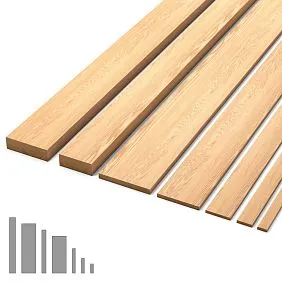
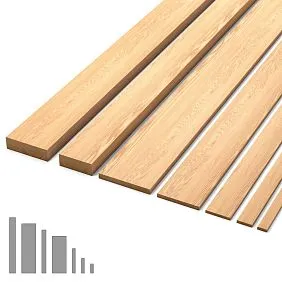
First of all—let's define the concept.Decorative oak slat— is a linear profile element made from solid oak wood with a rectangular or other cross-section, used for decorating walls, ceilings, furniture fronts, niches, and architectural surfaces. Unlike structural timber, a decorative batten primarily functions as a visual tool: it creates rhythm, depth, light and shadow, and surface texture.
Oak is a species with a density of 650–750 kg/m³, a high content of tannins, a pronounced grain pattern, and annual rings. It is precisely these properties that make it indispensable in the production of interior elements: an oak batten does not merely decorate a wall—it carries character, history, and a natural depth that cannot be replicated by artificial materials.
It is important to understand the difference: solid oak is not veneer, laminate, or MDF with a wood-grain film. It is a solid natural material, each element of which is unique in its grain pattern, tonality, and play of light.




Why oak: a breakdown of the advantages
When the choice is between wood species, oak wins not by a single parameter, but by their combination. And this combination is exceptional.
Our factory also produces:


Durability measured in decades
The bending strength limit of oak wood is about 105 MPa, and its hardness on the Janka scale is approximately 5.5 kN. This means that an oak wall batten is many times more resistant to mechanical impacts, scratches, and deformations than pine or spruce. With proper care, solid oak products retain their original appearance for 30–50 years—a fact that makes them an economically justified investment.
Get Consultation
A texture that cannot be copied
Tangential cutting of oak yields a wavy, lively pattern. Radial cutting produces a calmer one with characteristic medullary rays. No artificial material can replicate this natural uniqueness: each decorative oak batten differs from its neighbor just enough for the surface to feel alive, not look like a mass-produced stamp.
Tannins as natural protection
The high tannin content in oak wood is a natural antiseptic. Oak is resistant to fungus, mold, and insects. This is why oak slats for interior finishing last a long time even in moderately humid areas—entryways, kitchen zones, hallways.
Versatility for any finish
Oak performs equally well under clear oil, varnish, or tinting compounds. It accepts stain, acquiring shades from light honey to deep tobacco and even graphite. It is used less often under enamel—beech with its uniform structure is most often chosen for this task. But if you need an oak slat specifically for tinting while preserving the natural grain—this material has no equal.
Oak vs. other materials: an honest comparison
Before making a decision, let's examine the main competitors.
Oak and pine
Pine is an affordable and easy-to-work material, but its softness becomes a problem in use. Pine slats scratch easily, dent from mechanical impact, and require more frequent finish renewal. In this matchup, decorative oak slats win unequivocally—both in durability and visual expressiveness.
Oak and Beech
Beech is a worthy competitor in strength (bending strength limit is even higher—about 120 MPa), but falls short of oak in decorative qualities. Beech has a uniform, almost neutral grain that is less pronounced on the surface. If the goal is a lively, expressive texture under a semi-transparent finish—oak is preferable. Beech is more often chosen for enamel or painting.
Oak and MDF
MDF is an affordable option for those who work with color as the main tool. Uniform structure, perfect geometry, excellent adhesion for any paint. But MDF does not provide a living grain, does not smell like wood, and lacks the warm tactility of solid wood. Oak slats for interiors are in a different league: they work where you need not just a smooth surface, but natural aesthetics.
Oak and Veneer
Veneered slats look like solid wood but function differently. Veneer is a thin layer of natural wood over an MDF base. In case of mechanical damage or reworking, veneer cannot be restored like solid wood. Oak slats made from solid wood are a material that can be re-sanded, repainted, and have their finish renewed without replacing the element.
Where are oak decorative slats used
Decorative oak slats are a versatile element, and this is one of their main advantages. Let's consider the key areas of application.
Accent walls
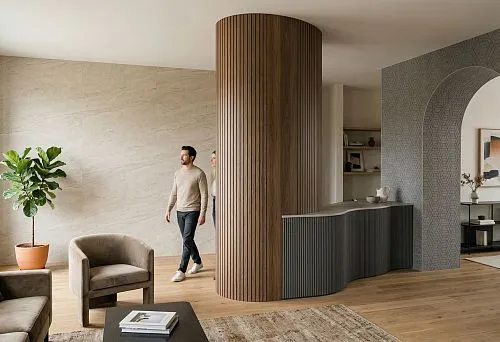
An accent wall made of oak slats is one of the most sought-after techniques in modern design. Vertical layout visually elongates the height of a room, creating a rhythmic architectural surface. It is especially effective when combined with directional or recessed lighting: light falls into the grooves between the slats and forms a soft play of shadows that evolves with the changing light throughout the day.
TV area
The wall behind the TV is one of the first focal points in a living room. Oak slats here work as both an accent and a frame: they organize the area, give it depth, and simultaneously 'soften' the heaviness of a large dark screen.
Bedroom: Headboard and Bed Area
Decorative oak slats behind a bed headboard are a classic technique for creating coziness in a bedroom. The warm texture of wood fosters a feeling of a nest, intimacy, and security—exactly what's needed in a personal space.
Hallway and corridor
The hallway is the first thing guests see. Oak wall slats here perform both a decorative and a practical function: dense wood is resistant to accidental impacts from umbrellas, bags, and children's bicycles. In narrow corridors, horizontal layout works as a technique for visual expansion.
Furniture facades
Oak slats for furniture are a separate story. Decorative inserts on the fronts of cabinets, sideboards, kitchen islands, and bar counters give furniture an architectural character. The vertical rhythm of the slats visually lightens large volumes—a massive cabinet stops feeling oppressive when its surface is lined with thin verticals.
Decorative niches and inserts
Oak slats in niches, arches, behind open shelves create an expressive background that works like a frame — it highlights the contents and adds depth to the space.
Commercial interiors
Restaurants, cafes, boutiques, office meeting rooms — wherever an atmosphere of quality and warmth is needed, oak slats are indispensable. Decorative slatted panels made of solid oak are well known to professional designers as a tool for 'instant class elevation' of an object.
Oak wall slats: secrets of proper layout
If you've decided to decorate a wall with oak slats — approach it thoughtfully. A few rules that distinguish a professional result from an amateur one.
Vertical vs horizontal layout
Vertical slats — the choice for rooms with low or standard ceilings. They visually stretch the height, giving the space a slender appearance. Horizontal slats widen the room — they are chosen for narrow corridors and elongated rooms.
Spacing between battens
The spacing affects the visual rhythm of the surface. Narrow spacing (50–80 mm) creates a dense, rich texture. Wide spacing (150–250 mm) — a more airy, light look. For small rooms, it's better to choose narrower spacing and thinner slats — this doesn't weigh down the space.
Layout height
Slats can be arranged from floor to ceiling — a full architectural wall. Or limited in height: for example, a panel zone on the lower third of the wall. The second option is often used in classic and neoclassical interiors.
Combination with lighting
Built-in lighting between slats is one of the most impressive techniques. The strip is laid in grooves from below or above. Warm light (2700–3000 K) perfectly complements honey-golden oak tones. Cool light (4000 K) — with gray and Scandinavian tints.
How to choose decorative oak slats: a complete guide
Choosing decorative oak slats involves several parameters at once. Let's examine each.
By size and cross-section
The cross-section of the slat directly affects the visual weight of the surface:
-
10×20 mm — thin, light graphics, suitable for minimalist interiors;
-
15×40 mm — medium rhythm, Scandinavian style, universal option;
-
20×40 mm — expressive texture, modern interior;
-
30×50 mm and larger — powerful verticals, loft, brutal design.
For small rooms (up to 15 m²), it is recommended not to exceed a cross-section of 20×40 mm. Large slats in a small space work against the interior — they weigh it down and compress it.
By profile
Flat rectangular profile — universal, neutral. Semi-circular profile (bead) provides a softer, more lively play of light and shadow. Beveled profile creates an additional angle for light reflection. The choice of profile is determined by the interior style and the nature of the lighting.
By length
Standard length — 2.0–4.0 m. For rooms with non-standard ceiling heights, some manufacturers offer custom sizing. When working with standard lengths, it is important to account for technological waste during cutting — allow a 10–15% surplus.
By shade
Oak — a species with a wide tonal palette:
-
Light/honey oak — warm, light, suitable for Scandinavian style, Japandi, light minimalism;
-
Medium/natural — universal, fits most styles;
-
Dark/saturated — brutal, representative, suitable for classic, loft, neoclassical. Requires spacious rooms with good lighting.
By type of finger-jointing (for composite blanks)
If the slat is made by gluing lamellas — clarify the type:
-
Under enamel - bonding without color or texture matching, suitable for opaque coating;
-
Under tinting - bonding with matching, for semi-transparent coatings preserving the pattern.
How to choose an oak batten to match the interior style
Making a mistake with style choice is easier than it seems. Here is a brief navigator to the most in-demand directions.
Minimalism and modern style
Thin battens (10×20 or 15×30 mm), light or medium oak shade, smooth profile. Coating - clear oil or matte varnish. Spacing - even, moderate. Combines with white and light gray walls, concrete surfaces, matte steel.
Japandi and Scandinavian style
Burnt oak (yakisugi) or oak in a cool gray tint. Thin vertical battens on a light background. Minimum details, maximum space between battens. Combines with natural linen, light ash or maple floors, brass details.
Neoclassicism and modern classicism
Wider battens (20–30 mm), warm or rich oak shade, possibly combined withmoldings and decorative solid wood profiles. Coating - varnish with depth or tinting under walnut, tobacco. Combines with stucco, fabric upholstery, marble.
Loft and industrial style
Powerful slats with pronounced texture, dark or medium tint, intentionally rough-hewn finish. Pairs well with exposed brick, black metal, concrete, matte glass.
Classic interior
Slats as part of a more complex systemmolding products— combined with cornices, baseboards, and architraves made from the same solid oak. The unity of material and finish creates a cohesive, complete look.
Which finish to choose for oak slats
The finish is the final touch that determines how the decorative oak slat will look in a month, a year, and ten years.
Oil and oil-wax
The most organic choice for solid oak. Oil penetrates the wood pores, nourishes it from within, and highlights the living grain pattern. The surface appears matte and is pleasant to the touch. Disadvantage: requires periodic renewal (every 1–3 years depending on intensity of use). Advantage: repairability – scratches can be fixed locally without removing the finish.
Varnish (matte, semi-matte)
A more practical option for high-traffic areas. Varnish forms a protective film on the wood surface. Modern water-based varnishes preserve the liveliness of the grain, do not yellow, and dry quickly. Polyurethane compounds provide maximum durability. 2–3 coats with inter-coat sanding (P320–P400) are recommended.
Tinting + varnish
The widest range of color solutions. The tinting composition changes the color of the oak while preserving its grain. You can achieve cool Scandinavian grey, warm tobacco, deep wenge, soft cappuccino – depending on the concentration and type of toner. A final varnish coat is mandatory after tinting.
Unfinished (raw array)
Technically possible, but not recommended for interior use. Unprotected wood quickly gets dirty, absorbs moisture and grease, and darkens unevenly. Acceptable as a temporary solution before finishing.
Combinations of oak slats with other interior materials
One of the most common mistakes is to perceive oak slats as an independent element without considering the surroundings. Combinations are what design is all about.
| Combination | Effect | Recommended oak shade |
|---|---|---|
| Oak + white walls | Freshness, cleanliness | Light/honey |
| Oak + gray walls | Modern balance | Medium/natural |
| Oak + graphite | Contrast, strength | Light or dark |
| Oak + beige/cream | Warmth, coziness | Medium/tobacco |
| Oak + black metal | Brutal elegance | Dark |
| Oak + brass | Premium quality | Warm/honey |
| Oak + stone | Naturalness | Medium |
| Oak + glass | Lightness, transparency | Any |
The main rule: do not mix more than two or three shades of wood in one space. An excess of wood textures turns the interior into a lumber warehouse, not a designer space.
What affects the cost of oak slats
The price of decorative oak slats is not a random number. It is based on several specific factors.
Wood grade. Sorting based on the presence of knots, resin pockets, and color variation significantly affects the cost. Top-grade slats 'for tinting' with color and texture matching are more expensive than blanks 'for enamel' without color selection.
Dimensions and profile. The more complex the profile, the more processing operations required. Shaped, beveled, or semi-circular profiles are more expensive than simple rectangular ones.
Humidity and stability. Properly dried solid wood (8–12% humidity) costs more than haphazardly dried material. This is an investment in the geometric stability of the product—the slat won't warp, twist, or crack during installation and use.
Quality of processing. Manufacturers offering 'Prestige' grade products with hand sanding factor not only the material but also the craftsman's labor into the price. Such a slat requires no additional work before installation.
Order volume. For bulk orders, the unit cost decreases. For private customers buying individually, the price will be higher than for studios and production companies.
Typical Errors in Selection and Installation
Practice shows: most mistakes occur not during the purchase, but at the stage of selection and design.
Mistake 1. Too dark oak in a small room. Rich wenge or dark tobacco visually shrinks the space. In rooms up to 15 m², prefer a light or medium shade.
Mistake 2. Overloading with wood texture. Oak slats on all four walls plus a wooden floor, wooden furniture, and a wooden ceiling—this isn't an interior, it's a sawmill. Wood should be an accent, not the background.
Mistake 3. Incorrect slat width. Too wide slats (30–50 mm) in a small room create a 'cage' or 'grille' effect. Choose the cross-section proportionally to the room's height and area.
Mistake 4. Choosing based only on photos. A photograph does not convey the wood's real shade, the tactility of the surface, or the scale. Whenever possible—order samples or visit a showroom.
Mistake 5. Ignoring the finish. Unprotected solid wood in a residential interior means expenses for redoing it in a year. Decide on the finish before installation, not after.
Mistake 6. Lack of a unified composition. Slats glued chaotically, without a considered spacing and boundaries, look unprofessional. Draw the layout on paper or in a program beforehand.
Error 7. Mixing wood species without a concept. Oak and pine together is a risky combination. Different densities, different tones, different reactions to finishes. Either a strict choice of a single species or a deliberate contrasting concept.
How to care for oak decorative battens
Proper care ensures that oak battens in a modern interior remain beautiful for decades.
Daily and weekly care. Dry wiping with a soft cloth or a vacuum cleaner's soft brush. Wet cleaning — with a well-wrung cloth without excess water. Aggressive cleaners, chlorine-containing compounds, and abrasive sponges are strictly prohibited.
Humidity regime. Oak is a natural hygrometer. With sharp fluctuations in humidity (especially during seasonal changes, when heating is turned on/off), minor deformations are possible. Recommended range: temperature 18–24°C, relative humidity 45–65%.
Finish renewal. Oil-wax finishes are renewed every 1–3 years depending on the intensity of use. Lacquer is restored locally: the surface is sanded (P240–P320), dusted, and coated with a new layer. Complete restoration with removal of the old finish is performed every 10–15 years.
Moisture protection. In areas with high humidity (kitchen, washbasin area in the hallway), use moisture-resistant lacquer systems. Oak is moisture-resistant due to tannins, but constant contact with water without a protective coating is unacceptable.
Batten panels and system solutions made of oak
If an oak decorative batten is a separate accent, thenSolid oak slat panelsis already a systemic architectural solution. Panels are supplied as ready-made modules with a precise batten pitch and backing, which significantly simplifies installation and guarantees precise geometry.
Flexible fabric-backed slat panels are suitable for curved surfaces—columns, arches, rounded corners. Rigid panels on MDF backing are for flat walls and furniture fronts. Both systems provide seamless module connection into a single continuous surface—the most important condition for a professional result.
For a complete interior ensemble, oak slats organically combine withsolid wood millwork—moldings, cornices, baseboards of the same wood. Material unity across all levels of the room—from baseboard to cornice—is a sign of a thoughtful, finished interior.
Who are decorative oak slats suitable for
An honest answer: practically anyone who values natural materials. But there are several categories for whom oak slats are not just a choice, but a conscious necessity.
Private clients with a demand for durability. Those who renovate once and for a long time. Oak slats are a material that doesn't need replacing after 5–7 years. It ages nobly, retains character, and allows only the finish coating to be renewed.
Designers and architects. Professionals know well: natural oak in a project is an argument at the presentation stage and a guarantee of positive feedback at the handover stage.
Furniture manufacturers. Decorative oak slats for furniture—inserts in fronts, decorative overlays, elements of open shelving—elevate the product class without significant cost increase.
Finishing and renovation studios. When working with premium segment clients, professionals choose solid oak as a material that cannot be 'cheaply redone.' This protects reputation.
Briefly: when to choose oak slats
-
If you need a premium, vibrant appearance with natural texture
-
If the renovation is done 'once and for a long time'
-
If the interior is built around natural materials
-
If the tactile quality of the surface is important, not just the visual effect
-
If you need a material that can be restored without replacement
FAQ: popular questions about decorative oak battens
What is a decorative oak batten?
It is a linear profile element made of solid oak wood, used for decorating walls, furniture, niches, ceilings, and architectural surfaces. Unlike structural material, a decorative batten primarily functions as a visual and tactile element of the interior.
How is an oak batten better than battens made from other wood species?
Oak combines high strength, expressive natural texture, resistance to biological influences (due to tannins), and wide possibilities for finishing. Neither pine, nor MDF, nor veneer provide such a combination of properties.
Are oak slats suitable for small rooms?
Yes, with the correct cross-section and shade selection. In small rooms, choose slats up to 20 mm wide, in a light shade, with vertical layout—this visually expands the space.
What coating is best for oak slats in a residential interior?
Oil-wax—for maximum naturalness and repairability. Matte varnish—for greater practicality. Toning + varnish—for a wide choice of shades while preserving the natural wood grain.
Can oak slats be used in an entryway?
Yes, and it's one of the best options. The dense structure of oak is resistant to mechanical impact. It's important to choose a coating with protection against moisture and dirt.
How often should the coating on oak slats be renewed?
With oil coating—every 1–3 years. With varnish—every 7–10 years, with local restoration as needed. Proper care significantly extends the intervals between renewals.
Can oak slats be installed on a wall independently?
Yes. Installation is done using mounting adhesive, headless finishing nails, or hidden clips. It's important to prepare a level, dry, degreased base beforehand. Flexible panels on a fabric base can even be mounted on curved surfaces.
What determines the price of decorative oak batten?
Wood grade, size and profile, type of lamination (for enamel or for tinting), sanding quality (standard or prestige), order volume. Compare offers specifically by these parameters, not just by price per linear meter.
Can oak batten be used for furniture?
Yes. Decorative inserts made of oak batten on the fronts of cabinets, chests, kitchen islands are one of the key trends in modern furniture production. Oak battens glue well, are easy to process, and accept any finish.
How to avoid overloading the interior with wood texture?
The rule is simple: choose one accent surface. There's no need to cover all four walls with battens. One accent against a neutral background always works better than 'wood everywhere'.
Conclusion
Decorative oak batten is the choice of those who think about the interior several steps ahead. Not 'how it will look immediately after renovation', but 'how it will look in ten years'. Solid wood, living texture, noble aging, the possibility of restoration — all this makes oak batten not just a finishing material, but an investment in the quality of the environment.
The right choice is a combination of size, profile, shade, and finish for a specific task. There is no 'best batten in general' — there is a batten that perfectly suits your interior, your ceiling height, your style, and your budget. That is why it is so important to work with a manufacturer who understands the material from the inside.
The company STAVROS has been engaged in the production of solid wood products for over 20 years — since 2002, when a small creative workshop in St. Petersburg began creating carved elements for historical interiors. Over the years, the company's portfolio includes the reconstruction of the Konstantinovsky Palace, work with cultural heritage sites, and thousands of private and commercial projects throughout Russia. Each product undergoes multi-stage control: from incoming wood inspection to final geometry check. Two quality levels — Standard and Prestige — allow for selecting the optimal solution for any task.
Decorative batten RK-001 made of solid oakfrom STAVROS — is a specific product with confirmed quality, shipping from one piece, and delivery across all of Russia. If you're looking for oak slats for walls, furniture, or accent decor — this is exactly the place to start.