












































































Article Contents:
- Wall interior finishing: why texture wins over flat surfaces
- Material classification: what exactly forms the surface
- Painting-grade MDF: precision, color, freedom
- Solid oak: natural texture as a statement
- Structural types of slatted wall panels: four solutions for different tasks
- Rigid panels on MDF backing
- Flexible panels on fabric base
- Half-round molding: rigid and flexible formats
- Acoustic solutions with filling
- Slat profile: three geometries — three atmospheres
- Rectangular profile: architectural clarity
- Half-round profile: natural plasticity
- Trapezoidal profile: volume and dynamics
- Slat spacing in interior finishing: rhythm as an architectural parameter
- Slat orientation: how direction governs space
- Color in slat wall panel systems for interior finishing
- Monochrome: architectural silence
- Tonal accent: a restrained statement
- Saturated accent: boldness with intent
- Two-color system: depth through contrast
- All spaces: where slat wall panels work for interior finishing
- Living room: the architectural center of the space
- Bedroom: an intimate surface behind the headboard
- Hallway: The First Architectural Statement
- Office and work area
- Children's room
- Kitchen and kitchen island
- Staircase flight
- Bathroom
- Restaurant, Cafe, Commercial Space
- Office, reception, meeting room
- Interior Styles and Slatted Wall Panels: Perfect Harmony
- Minimalism
- Scandinavian Style
- Japandi
- Neoclassicism and Modern Classicism
- Loft
- Organic modern interior
- Finishing System: How to Achieve Architectural Completeness
- Lighting as an Essential System Element
- Technical checklist: eight parameters before ordering
- Installation: From Substrate Preparation to Final Element
- Six Mistakes That Ruin the Result
- Calculating Panel Quantity for Interior Wall Finishing
- About the Company STAVROS
- FAQ: Answers to Popular Questions

Interior wall finishing is not just a final coat of paint or a choice of wallpaper. It is an architectural statement. What your space's walls are made of determines not only its appearance but also how you feel within it: relaxed or tense, focused or distracted, at home or in transit.
Slatted wall panels for interior wall finishing are a material that doesn't just cover a surface but recreates it. Rhythmic linear relief, interplay of light and shadow, natural or engineered texture—all together form a surface with character. The very character that distinguishes an interior 'with soul' from one that is 'merely renovated'.
Over the past few years, this material has evolved from a narrow professional niche to a widespread design practice. Today, slatted panels can be found in one-room apartments and country villas, in meeting rooms and restaurants, in children's rooms and offices. The reason is simple: the ratio of visual result to cost for this solution is one of the best among all available interior finishing methods.
But 'buy and install' is not a strategy. Slatted wall panels for interior wall finishing only work when chosen correctly: considering material, profile, spacing, orientation, lighting, and the system of adjacent elements. This is exactly what this article breaks down—comprehensively, honestly, with specific technical parameters and practical examples.


Interior Wall Finishing: Why Texture Wins Over Flat Surfaces
Let's start with a fundamental question: why have texture on a wall at all? What does it offer beyond what a quality painted or wallpapered surface provides?
The answer lies at the intersection of physics and psychology. A smooth wall, under any lighting, remains a plane—it reflects light uniformly across its entire area, and the eye glides over it without stopping. It's a neutral background. Not bad—just silent.
Slatted wall panels for interior wall finishingadd a third dimension. Each slat, under side or directional lighting, casts a shadow into the gap—creating a continuous rhythm: light, shadow, light, shadow. The surface gains perceived depth. The eye, which previously glided, now 'catches' on the rhythm and reads the space behind the wall. A sense of volume arises—and the room appears larger than it is.
This is not a designer's metaphor. It's architectural mechanics that humanity has used for millennia: ancient colonnades, coffered ceilings, Baroque pilasters—all operate on the same principle. The slatted wall panel is its modern, accessible, scalable embodiment.
To the spatial effects, an acoustic one is added: a textured surface scatters sound waves instead of reflecting them directly, reducing reverberation. In rooms with hard floors, large windows, and flat ceilings, this is a tangible improvement in acoustic comfort.




Material Classification: What Exactly Forms the Surface
Before choosing a profile and pitch — you need to choose the material. This is a fundamental decision that determines everything else.
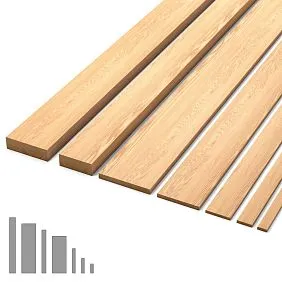
Our factory also produces:
MDF for painting: precision, color, freedom
MDF (Medium Density Fiberboard) with a density of 750–850 kg/m³ is a pressed wood fiberboard with a homogeneous, defect-free structure. No natural variations: no knots, no resin pockets, no zones with different densities. Perfect geometry, perfect surface for painting.
The main advantage of MDF in the context of slatted panels: absolute color freedom. Any shade from the RAL catalog — over 200 standard colors. Any shade from NCS. Monochrome 'wall matching the panel tone'. Precise corporate color. Two-color system 'slats one tone, backing another'.
Important practical property: MDF panels can be repainted without dismantling. After three, five, ten years — light sanding, new primer, new color. The concept has changed — the surface is updated, not redone.
Get Consultation
Solid oak: natural texture as a statement
Oak with a density of 700–750 kg/m³ is a species with a rich grain pattern, natural tactility of open pores under oil, and long service life with proper care. Each slat carries a unique pattern. A surface made of oak battens is living, variable, natural.
Oak is chosen not because it's 'more beautiful than MDF' — that's the wrong way to frame the question. Oak is chosen because a natural material with its tactility and variability carries a meaning that synthetics cannot reproduce. It's a philosophical position — 'I want real wood in my home'.
| Parameter | MDF for painting | Solid oak |
|---|---|---|
| Homogeneity of structure | Complete | Natural variability |
| Color freedom | Any RAL/NCS | Natural tints |
| Tactile | Homogeneous | Living, open pore |
| Repainting | Yes, without dismantling | No |
| Focus on material | No | Present |
| Perfect style | Minimalism, office, corporate | Scandinavian, japandi, organic |
Structural types of slatted wall panels: four solutions for different tasks
Not all slatted panels are constructed the same way. The structural type is a choice made based on the surface geometry and the nature of the task.
Rigid panels on MDF backing
The slats are fixed with factory precision on a rigid MDF base. The module is flat, stable, and geometrically precise. This is the standard solution for 90% of tasks: straight walls, partitions, furniture fronts.
The rigidity of the substrate is a structural advantage, not a limitation. It maintains geometry regardless of wall quality (within reasonable limits) and ensures seamless joining of modules with factory spacing.
The key parameter of a rigid panel is the precision of the slat spacing. A professional manufacturer guarantees a deviation of no more than 0.5 mm. With unstable spacing, module joints are visible—and this cannot be corrected by any installation skill. Explicitly demand this parameter from the manufacturer.
Flexible panels on a fabric base
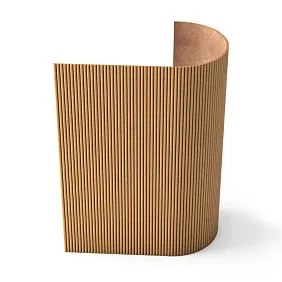
The slats are attached to a fabric mesh base, which allows the panel to bend with a radius from 100–150 mm. The slats themselves do not deform—only the base provides flexibility. The panel wraps around columns, arches, rounded corners, and wave-shaped partitions without breaking the pattern.
If your project has at least one curved surface—a flexible panel is needed for it. A rigid MDF module will fail on a radius: this is the physics of the material, not a matter of skill.
Semi-circular batten: rigid and flexible formats
A separate category by batten profile. A semi-circular cross-section creates soft, diffused shadow—without the sharp lines of a rectangular profile. Available in both structural formats. For residential spaces with a warm atmosphere, it is the most organic profile among the available options.
Acoustic solutions with infill
A structure with a technical gap filled with acoustic material (foam, mineral wool, acoustic panels). The battens mechanically scatter sound, while the infill absorbs it in the gap. Used in meeting rooms, conference halls, and restaurant spaces.
Batten profile: three geometries—three atmospheres
The profile—the cross-section of the batten—determines the character of interaction with lighting. This is the first thing to decide after selecting the material.
Rectangular profile: architectural clarity
Sharp straight edges. Clear, rigid linear shadow with side or directional lighting. The surface is strict, disciplined, and architecturally precise.
Areas of application: minimalism, loft, study, meeting room, office, kitchen fronts, modern classic in a restrained interpretation. A rectangular profile in white monochrome achieves a level of 'expensive simplicity' unattainable by other means.
Semi-circular profile: natural plasticity
Rounded edges. Light diffuses along a curve — shadows are smooth, soft, without sharp boundaries. The surface is warm, organic, natural even in painted MDF.
Areas of application: bedroom, living room with a soft character, children's room, home library, any living spaces with a cozy atmosphere.
Trapezoidal Profile: Volume and Dynamics
Extension to the base creates a multi-level, volumetric shadow. The surface is dynamic, with pronounced decorative weight.
Areas of application: restaurant, showroom, lobby, boutique, commercial spaces with high decorative intensity.
Slat spacing in interior finishing: rhythm as an architectural parameter
Spacing — the distance between the centers of adjacent slats. This technical parameter directly controls the atmospheric character of the surface.
15–20 mm (dense rhythm). Saturated, active surface. 'Vibrates', attracts the eye. Creates decorative tension. For spacious rooms with large accent planes. In small rooms — visual noise.
25–35 mm (medium rhythm). Balanced, universal surface. Moderate decorative activity. Works in most residential and commercial applications.
40 mm and more (wide rhythm). Airy, monumental, 'breathing' surface. For small spaces and delicate accent solutions. Depth without tension.
Rule of spatial scaling: the smaller the room — the wider the spacing. An aggressive narrow rhythm in a small room creates a feeling of tightness.
Slat Orientation: How Direction Governs Space
Slat orientation—vertical, horizontal, or diagonal—alters the spatial perception of a room. It's a free architectural tool: simply rotating the module 90° during installation.
Vertical orientation guides the eye from bottom to top. The room appears taller. For apartments with standard 2.7 m ceilings—the most valuable visual technique. The standard for most residential and commercial applications.
Horizontal orientation guides the eye left-right. The room appears wider. For end walls of narrow corridors, small rooms lacking width—an effective visual correction without physical changes. In Japandi and Scandinavian style—a symbol of the natural horizon, a meditative rhythm.
Diagonal orientation creates dynamism and kinetics. For commercial spaces with non-standard architectural concepts.
Color in the Slat Wall Panel System for Interior Finishing
Working with color on MDF slat panels is a tool for managing atmosphere. Let's consider four working strategies.
Monochrome: Architectural Silence
The panel matches the wall color exactly. Color unifies the surfaces. The relief lives only through shadow. With frontal lighting—an almost uniform surface. With side lighting—a sculptural play. This is one of the most sophisticated and professionally looking interior techniques. Requires side or directional accent lighting—without it, monochrome installation loses its purpose.
Tonal Accent: A Restrained Statement
Walls in a light neutral tone. The panel is 2–3 shades darker. The relief is perceived through both shadow and color contrast simultaneously. A restrained, professional, flawless solution.
Saturated accent: boldness with intention
Neutral walls. The slatted panel is in a deep, decisive color: Anthracite, Bottle Green, Navy, Burgundy, Terracotta. One surface transforms the entire interior.
Two-color system: depth through contrast
The slats and the backing are painted in different colors. White slats on a black backing — maximum graphic quality. Gray slats on a dark blue backing — complex spatial depth. Beige slats on a terracotta base — warm, earthy expressiveness.
All spaces: where slatted wall panels work for interior finishing
Living room: the architectural center of the space
An accent wall behind the sofa or in the TV area is a classic and most effective scenario. One slatted plane gives the space a semantic center: the gaze finds a reference point, and the interior 'comes together' around it. Oiled oak with side lighting — natural classic. Anthracite MDF behind the TV in a white interior — a strict, modern, memorable image.
Bedroom: an intimate surface behind the headboard
Semi-circular profile, neutral warm tone, moderate spacing of 30–35 mm. LED strip along the lower perimeter of the panel. Upward soft lighting emphasizes the relief and creates a sense of depth behind the headboard. This is a technique that works equally well in a 30-square-meter apartment and in a country house.
Hallway: The First Architectural Statement
A person enters — and the first seconds shape the impression of the entire interior.Slatted wall panels for interior wall finishingIn the hallway — it's an immediate response about the character of the space. For a narrow corridor: horizontal slats on the end wall visually widen it. For a square hallway: vertical slats — height and architectural grandeur.
Office and work area
The wall behind the desk — the most important surface in the study. Dark tone, rectangular profile, directed lighting. Status, concentration, acoustic comfort. A professional background for video calls. The slatted relief reduces reverberation — sound comfort in work is noticeably improved.
Children's room
MDF for painting with non-toxic water-based enamels (emission class E1 and below). Semi-circular profile without sharp edges — safety. Pastel tones for younger ages, more active ones — for teenagers. The main thing: they grew up — repainted without dismantling. This is the only finishing material that 'grows' with the child without replacement.
Kitchen and kitchen island
Slatted island fronts made of MDF for painting to match the kitchen furniture. Horizontal orientation visually stretches the island horizontally. Precise color according to RAL ensures consistency with the fronts, countertop, backsplash. An area without direct contact with splashes and steam — a condition for durability.
Staircase flight
Vertical slats accompany the movement from bottom to top. The staircase flight transforms from a technical passage into an architectural route. Next tobalusters for staircasesmade of solid oak — a unified wooden theme, connecting the levels and creating a continuous natural narrative.
Bathroom
Only moisture-resistant MDF (MDFV) with a moisture-resistant coating. Forced ventilation in the technical gap. With proper execution of materials — a durable, stylish surface. A mistake with the material — deformation within a few months.
Restaurant, cafe, commercial space
Atmosphere is the main product in the restaurant business. Warm oak, directed lighting, acoustic diffusion. Slatted wall panels for interior finishing in a restaurant manage the guest experience through space. This is what builds loyalty.
Office, reception, meeting room
Corporate RAL on the reception wall. Business-like meeting room image. Acoustics. Branding through surface architecture — without posters, banners, or applied decor.
Interior styles and slatted wall panels: a perfect match
Minimalism
MDF for painting. Monochrome. Rectangular profile. Side or directed lighting. A space where only architecture speaks: form, shadow, proportion. Slatted panels in minimalism — maximum effect with a minimum of decorative elements.
Scandinavian style
Light oak with oil finish or MDF in linen/off-white tones. Vertical slats, semi-circular profile. Warm lighting 2700–3000 K. Natural warmth, functional honesty, coziness without sentimentality.
Japandi
Oak with grey tint. Horizontal orientation — a meditative horizon. Rare spacing of 35–40 mm. Semi-circular profile. Natural adjacent materials: raw concrete, linen textile, matte ceramics.
Neoclassicism and modern classicism
MDF for painting in a warm neutral tone or oak with a classic tint.Wooden moldings and cornicesAround the perimeter of the slatted plane.wooden baseboardSolid wood. A complete architectural system 'cornice — slatted field — skirting board' — a modern interpretation of classic paneled walls.
Loft
Dark oak with matte varnish or MDF in anthracite. Large rectangular profile. Industrial metal nearby. Slatted wall panels in a loft — a tough, self-sufficient, characterful object.
Organic contemporary interior
Oak in a natural tone with a semi-circular profile. Natural adjacent materials: stone, handmade ceramics, jute. The slatted panel is one voice in the natural chorus.
Finishing system: how to achieve architectural completeness
Slatted wall panels for interior wall finishing work most effectively within a system of coordinated elements. Here's how this system is built step by step.
Molding along the upper perimeter — a horizontal architectural boundary that completes the slatted field from above. Without it, the border between the relief and the smooth wall appears random.wooden moldingfrom the same wood species creates a unified material language. MDF molding for painting in the same color — an architecturally precise, but visually 'dissolving' boundary.
Floor skirting board — the lower boundary of the system.Buy solid wood skirting boardfor an oak slatted system — means creating a unified natural image from the floor to the upper boundary of the panel.buy MDF skirting boardfor painting for an MDF system — a monolithic white or dark system without material breaks.
Extension slat for non-standard sections.wooden plankfrom the same solid oak — for corner transitions, reveals, window framings. An inconspicuous organic extension that completes the system where a standard module doesn't fit.
Decorative overlays. In neoclassical and contemporary classic stylesDecorative Insertscreate horizontal and vertical framing for the slatted field — a full-fledged architectural 'frame' that transforms a beautiful wall into an architectural panel system.
Furniture handles. Slatted furniture fronts plusFurniture Handlesin a coordinated material — a complete furniture look without random accents.
Elements for stairs. Slatted wall panels in a stairwell combined withbalusters for staircasesfrom the same solid oak create a unified vertical wooden theme that leads from one level to another.
Classic Furniturewith wooden elements next to an oak slatted panel — mutual enhancement of natural materials. The slatted background enriches the value of the furniture, the furniture enriches the meaning of the panel.
Lighting as an essential element of the system
To talk about slatted panels for interior finishing without discussing lighting is to talk about half the system. Slatted relief and lighting are inseparable.
Directional spotlights at a 30–45° angle to the surface provide clear, sculptural shadows. The relief is maximally expressive. Adjustable spotlights allow changing intensity depending on the scenario.
LED strip behind the molding (downward light) creates a soft, diffused halo. For bedrooms and living spaces with an intimate atmosphere.
LEDs in the gaps between slats — backlighting from inside the panel. Creates the effect of a 'glowing' surface. An architectural, stage technique for commercial spaces and accent walls in residential interiors.
Color temperature: for oak — warm light 2700–3000 K, enhancing the natural warmth. For paintable MDF in neutral tones — neutral 3500 K. Cold light on oak creates a 'lifeless', warmth-deprived look — a typical beginner's mistake.
Technical checklist: eight parameters before ordering
Before ordering slatted wall panels for interior finishing — eight questions for the manufacturer:
-
Density of MDF substrate and slats — not less than 750 kg/m³;
-
Step accuracy — no more than 0.5 mm;
-
End treatment — sealed with primer or film;
-
Presence of a primer layer (for paintable MDF) — saves your time;
-
Base type — MDF (straight walls) or fabric-backed (curved surfaces);
-
Slat profile — check the catalog;
-
Slat orientation — vertical or horizontal;
-
Availability of coordinated running footage from the same production program.
Installation: from base preparation to finishing element
Base preparation. The wall is dry, clean, degreased. Plane deviation up to 3–5 mm — adhesive installation. More than 5 mm — frame installation on metal CD-profile with 400–600 mm spacing.
Adhesive installation. Mounting adhesive applied in a snake pattern on the underlay. Panel is pressed and held for 5–10 minutes. Finish nails around perimeter in areas hidden by molding and baseboard — for insurance.
Frame installation. CD-profile is attached to the wall, panels are fixed with screws through underlay into profile. Laser level — mandatory. Allowable plane deviation: 2 mm per 2 m.
MDF painting — before installation, by spraying. After installation with roller — uneven coverage in gaps. Professional result — only spraying before installation.
Joining. Butt joint without gap. With factory precision of 0.5 mm step — monolithic surface through any number of joints.
Finishing elements. Molding along the top edge. Baseboard at the bottom. Corner connections — 45° on a miter box. Acrylic sealant on joints with smooth walls in coating color.
Six mistakes that ruin the result
Mistake 1. Loose MDF with density less than 700 kg/m³ — unstable material with swelling edges and poor fastening.
Error 2. Rigid panel on a curved surface — will break. Only flexible fabric-based panel.
Error 3. Unstable factory pitch — visible joints, unfixable after installation.
Error 4. Lighting after installation — slatted relief without side lighting is invisible. Lighting is planned before installation.
Error 5. Painting MDF after installation with a roller — uneven coverage in gaps.
Error 6. Heterogeneous moldings from different production programs — destroys the material consistency of the system.
Calculation of the number of panels for interior finishing
Wall area (minus openings) ÷ area of one module = number of modules. Round up, add 10–15% reserve. Example: three living room walls with a total area of 18 sq.m. Module 0.6 × 2.4 m = 1.44 sq.m. 18 / 1.44 = 12.5 → 13 modules. 15% reserve = 16 modules.
About the company STAVROS
Slatted wall panel for interior finishing is a product where invisible production parameters determine the visible result. Pitch accuracy of 0.5 mm, MDF density of 750–850 kg/m³, closed ends, coating stability — all this cannot be assessed from a photograph. It only becomes obvious six months after installation: either the system works, or it doesn't.
STAVROS — Russian manufacturer of MDF and solid wood products for interior finishing and furniture production. Slatted panels of all structural types and profiles (rigid and flexible, rectangular, semicircular, trapezoidal bead), full line of coordinated moldings, decorative overlays, elements for stairs, furniture decor and fittings. Over 4000 models, 20,000 modifications, 39 product groups.
MDF from European suppliers with a density of 750–850 kg/m³, climatic wood drying chambers, two-level quality control system (Standard and Prestige), manual processing of decorative elements. Shipment from one piece. Delivery throughout Russia. Specialist consultation before placing an order.
FAQ: Answers to popular questions
How do slatted wall panels differ from PVC panels?
PVC panels are a synthetic material without natural texture, with a characteristic plastic sheen and a limited color palette. Slatted MDF panels offer exact RAL/NCS colors, matte or semi-matte finish, and repaintability. Oak panels feature natural texture, tactile feel, and durability. The comparison is incorrect: these are different categories in terms of result level.
Are slatted wall panels suitable for rental properties?
Ideal installation is adhesive mounting on a flat wall with spare anchors for safety. If necessary, frame mounting can be used, which can be dismantled without damaging the base. Painted MDF can be repainted when tenants change.
How long do slatted wall panels made of MDF last?
With proper installation, normal humidity, and care: MDF under a high-quality paint coating lasts 10–15 years before coating renewal. Solid oak with care has virtually unlimited service life.
Can slatted panels be used in rooms with underfloor heating?
Yes, provided the wall surface temperature does not exceed +40°C — standard underfloor heating systems do not reach this threshold.
How to calculate the required number of panels?
Wall area (excluding openings) ÷ area of one module, round up, add 10–15% margin for cutting.
Do you need professional painting or can you paint it yourself?
Professional result: spray painting in a workshop before installation. DIY: aerosol or spray gun, before installation, with end grain priming. Roller after installation — uneven result in gaps.
How to care for oak slat panels?
Dry or slightly damp cloth for dust. Oil renewal every 3–5 years (depending on load). Abrasive products are not allowed. If a single slat is damaged — replace only the damaged batten, not the entire panel.


