







































Article Contents:
- The hallway as a design challenge: why it's more complicated than it seems
- Why slats work better in hallways than any other finish
- Verticality as an architectural tool
- Rhythm as the organization of chaos
- Depth without area
- Reflection and amplification of light
- Materials for slatted panels in hallways: what can withstand real loads
- Moisture-resistant MR-class MDF: the workhorse of the hallway
- Wood array with proper coverage
- MDF for painting: exact color for custom solution
- Thermowood: for hallways with 'outdoor' microclimate
- What definitely doesn't suit a hallway
- Color solutions for slatted panels in hallways: palette for different tasks
- White and cream: classic expansion
- Light oak: warmth without heaviness
- Dark tones: for spacious hallways with decisive character
- Gray: neutral universal
- Slatted panel configurations in hallways: eight working schemes
- Scheme 1: One wall floor to ceiling
- Scheme 2: L-shaped structure
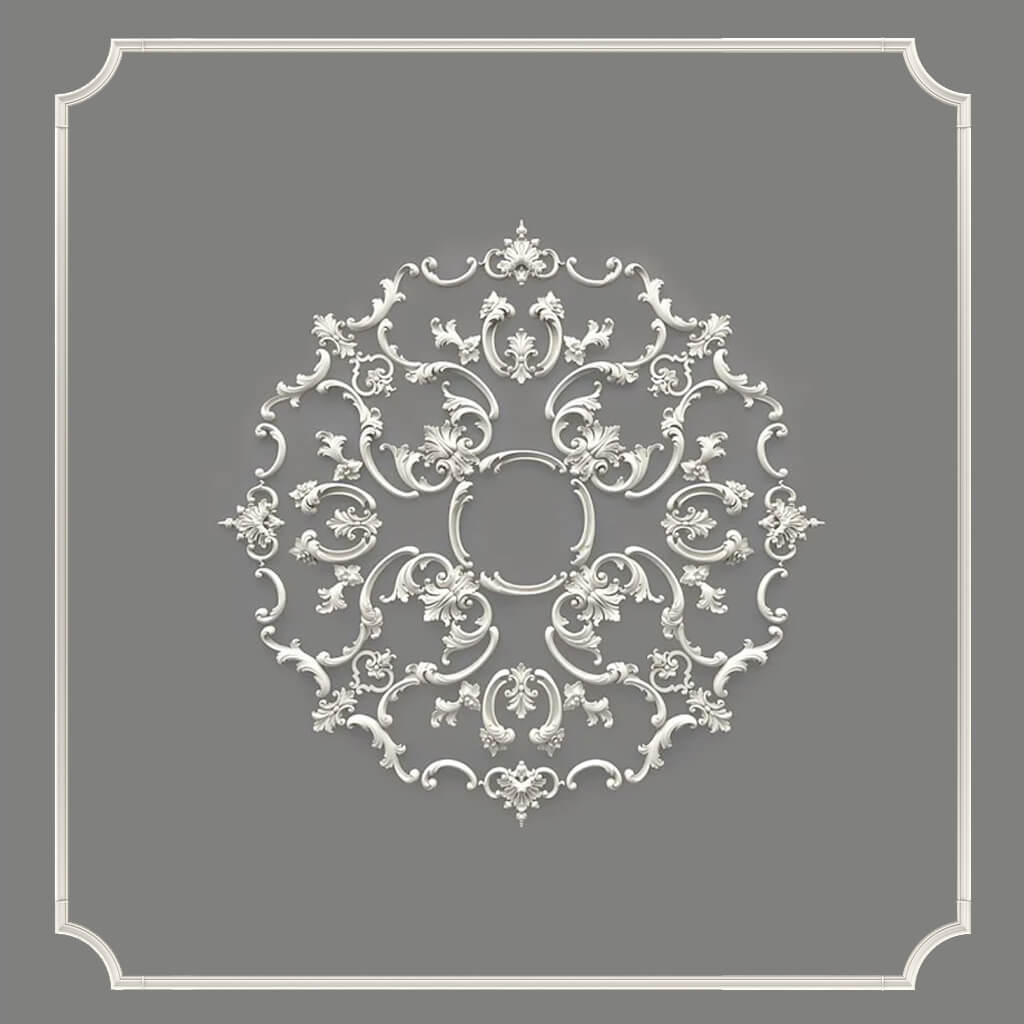
- Scheme 3: Panel scheme with molding
- Scheme 4: Slatted wall with integrated mirror
- Scheme 5: Slatted 'portal' of the entrance door
- Scheme 6: Slatted ceiling above the entrance area
- Scheme 7: Niche with slatted background
- Scheme 8: Slatted panel as a replacement for a door leaf
- Hallway styles with slatted panels: from minimalism to classic
- Scandinavian hallway
- Minimalism and Japandi
- Modern classicism
- Loft and Industrial
- Eco-style
- Functional Integration: When a Slat Wall Becomes Part of Storage
- Built-in Hooks
- Floating Shelves
- Built-in Shoe Rack Under Slats
- Mirror in a Slat Frame
- Lighting as a Functional Element
- Technical Parameters of Slat Panels for the Hallway: Selection Table
- Installation of Slat Panels in the Hallway: Specifics of Narrow Space
- Preparation: A Mandatory Stage
- Acclimatization in a confined space
- Working in tight spaces
- How to install slatted panels in the hallway: the load-bearing system
- Joining slatted panels with a door portal and flooring
- DIY slatted hallway: step-by-step logic
- Lighting a slatted hallway: three scenarios for three tasks
- Common mistakes when decorating a hallway with slatted panels
- Mistake 1: Horizontal slats in a small hallway
- Mistake 2: Dark slats without sufficient lighting
- Mistake 3: Slats without protection from mechanical damage in the contact zone
- Error 4: Ignoring the smell
- Mistake 5: Lack of finishing elements
- Error 6: Incorrect size calculation
- Decorative slatted wall panels for the hallway: ready-made concepts
- Concept "White Forest"
- Concept "Warm Nordic"
- Concept "Urban Loft"
- FAQ: answers to popular questions about slatted panels in the hallway
- About the Company STAVROS

There are rooms that people underestimate for years. The hallway is exactly that. Its area rarely exceeds 6–8 square meters, the ceilings here seem lower, there is less light, and there is catastrophically not enough space. Guests are not invited here to 'sit', evenings are not spent here. Came in — took off shoes — moved on.
But it is the hallway that is the first thing a person sees when entering your home. And the last thing they see when leaving. This room forms that very first impression, which later cannot be corrected. And it is here that slatted panels in the hallway interior accomplish what other finishing materials simply cannot: they turn a cramped functional 'airlock' into an architectural statement.
How? Why exactly slats? And what do you need to know to avoid mistakes when choosing and installing? Let's break it all down — in detail, honestly, with specific solutions.

The Entryway as a Design Challenge: Why It's More Complex Than It Seems
The entryway is the most challenging room in an apartment from a design perspective. Not the living room with its spaciousness and unlimited imagination. Not the bedroom where you can experiment with soft solutions. It's precisely the entryway—because several strict constraints converge here simultaneously.
Limited area. In most city apartments, the entryway is 4–9 m². A space where you need to fit simultaneously: an entrance door, a sliding wardrobe or coat rack, a shoe cabinet, a mirror, sometimes a wardrobe niche. At the same time, two people dressing at once should feel comfortable in the entryway.
Lack of natural light. Entryways in apartments are almost always windowless. Artificial light is the only source. This means the finishing material must interact with light correctly: reflect it, diffuse it, not absorb it.
Mechanical load. The entryway is the most heavily used room in an apartment in terms of wall contact. Backpacks, umbrellas, bags, coats, strollers—all these regularly touch the walls. The material must withstand this.
Humidity and temperature fluctuations. In autumn and winter, damp cold air regularly enters through the door. Meanwhile, the radiator heats the space. Temperature and humidity fluctuations are constant. Many finishing materials here begin to deform after just a few seasons.
Visual chaos. By its nature, the entryway is a place where things accumulate. Hooks, shelves, mirrors, shoes. Any finishing material competes with this visual noise.
Slatted panels in interior designBatten panels solve most of these problems at once—due to their architectural nature: rhythm, depth, verticality.




Why batten panels work better in the entryway than any other finish
Every material has its own 'character'. Wallpaper—softness, but lack of volume. Paint—neutrality, but flatness. Tile—functionality, but coldness. Decorative plaster—texture, but solidity. And only batten panels provide what the entryway needs most acutely—rhythm and depth with minimal area.
Our factory also produces:
Vertical as an architectural tool
Vertical slats from floor to ceiling are an optical elevator for low rooms. The eye, catching vertical lines, automatically slides upward. The ceiling 'rises'. The room 'stretches'. This effect works even in a hallway with a height of 2.5 m — and in apartments with ceilings of 2.7–3.0 m, it creates a feeling of an enfilade.
Get Consultation
Rhythm as the organization of chaos
The repeating rhythm of slats — slat, gap, slat, gap — creates a visual order that psychologically 'calms' the space. Against the backdrop of a slatted wall, even an abundance of items on shelves and hooks is perceived as part of an organized space, not as chaos.
Depth without area
A slatted structure is not a flat surface. It is a three-dimensional system: the slats protrude 14–20 mm above the supporting base. This slight depth creates a play of shadows that changes depending on the angle and light source. The hallway gains volume that physically isn't there.
Reflection and amplification of light
Light-colored slats made of white MDF or light oak combined with properly positioned light fixtures create diffused light that envelops the entire space. A spotlight directed at a slatted wall creates an endless play of vertical shadows — and the space begins to 'breathe'.
Materials for slatted panels in the hallway: what can withstand real loads
The hallway is not a living room. Here, the material faces requirements that simply don't arise in other rooms. Let's examine each option.
Moisture-resistant MR-class MDF: the workhorse of the hallway
slatted MDF panelMR-class moisture-resistant MDF is the optimal choice for the hallway with proper coating. Specifically MR, not regular MDF: the green edge when cut is a visual marker of moisture resistance. With humidity fluctuations (which are inevitable in the hallway — from -5°C outside to +22°C inside), regular MDF begins to delaminate at the edges after 2–3 seasons.
What to choose:
-
Density: not less than 780 kg/m³
-
Slat thickness: 16–18 mm — stronger under impact loads
-
Coating: two-component polyurethane varnish or 2K acrylic enamel — not single-component water-based acrylic
-
Surface type: matte or semi-matte — hides fingerprints, which are inevitable in the hallway
MDF Slatted Wall PanelWith 2K polyurethane coating in the hallway — this is 15–18 years without degradation under normal use.
Solid wood with proper coating
Wooden slat panelsMade from hardwood in the hallway — a choice for the premium segment. Oak, ash, beech. Coating: UV varnish (pencil hardness 2H–3H, maximum resistance to scratches from keys, belt buckles, metal clothing elements) or two-component oil-wax with annual renewal.
Oak in the hallway provides both visual warmth and a declaration of quality. The living grain pattern, unique texture, and feel of a natural material are things a guest will remember even at a glance.Oak Slat PanelThe hallway reveals more about the owner than any designer accessory.
Important: wooden slats in the hallway require sealing of the lower ends (area of possible contact with moisture from wet shoes) with neutral silicone.
MDF for painting: precise color for custom solutions
paintable slatted wall panelsPrimed MR-MDF — for design projects where the exact shade is of fundamental importance. On-site painting with two-component polyurethane enamel in RAL color. Possibility of repainting when changing the concept.
In the hallway for painting: a two-component composition is mandatory — single-component acrylic paint on MDF ends under fluctuating humidity conditions will crack within 1–2 years.
Thermowood: for hallways with an 'outdoor' microclimate
For hallways in private houses, townhouses, apartments with vestibules — thermally modified wood (ash, pine, birch). Water absorption reduced to 2–4% compared to regular wood. Biostability — class 1 (not susceptible to rot or fungus). Minimal deformation during seasonal humidity fluctuations.
A dark, rich tone of thermowood without additional tinting — chocolate brown or dark gray — creates a strong visual effect in the hallway. This is a material that looks expensive and performs reliably.
What is definitely not suitable for the hallway
Regular MDF without moisture resistance — degrades at the ends. Veneer without a moisture-resistant coating — peels off. PVC slats — a soft material, easily scratched by keys and metal elements. Untreated solid wood without coating — absorbs moisture and odors.
Color solutions for slatted panels in the hallway: a palette for different tasks
Color in the hallway is not just about aesthetics. It's a tool for managing space. The right tone for slatted panels solves the problem of limited area and lack of natural light.
White and cream: classic expansion
White vertical slats are the absolute leader for small, dark hallways. Matte white coating reflects light evenly, without glare. The space visually expands.white slatted wall panelIn a hallway of 4–5 m² — this is a solution that 'adds' a sense of meters without a single square meter of actual area.
Supporting base behind white slats: white (neutral effect) or black (slats 'float' in space — a dramatic, modern technique).
Light oak: warmth without weight
Slats in natural or bleached oak tone are the optimal choice for hallways in Scandinavian, classic, and eco-style. The warm amber tone adds coziness, while the light palette doesn't 'eat up' space.
Combination: oak slats + light floor (laminate, porcelain stoneware under light stone) + spotlights 2700 K. Result: the hallway feels significantly more spacious than its actual square footage.
Dark tones: for spacious hallways with a decisive character
Anthracite (RAL 7016), dark walnut, graphite, bottle green — for hallways from 8 m² with good artificial lighting. A dark slatted wall requires thoughtful lighting: at least three sources, one of which is directed directly at the slatted surface.
Dark slats create a 'tightening' effect — the room seems more intimate and dense. For a country house with a spacious hall — an ideal solution. For a city apartment of 5 m² — risky.
Gray: neutral universal
Gray palette (light gray, warm gray-beige, cool gray) — for interiors where the slatted panel should become a background, not an accent. Furniture, mirror, lighting — the heroes of the space. Slats — architectural context.
Configurations of slatted panels in the hallway: eight working schemes
Scheme 1: One wall floor to ceiling
The most popular configuration. The wall opposite the entrance door or a side wall — a full-height slatted structure. The remaining walls — solid finish in the color of the slat base.
Parameters for a standard hallway 5–8 m²: slat width 40–55 mm, gap 12–15 mm, vertical direction. Coating: matte enamel or natural oak.
Scheme 2: L-shaped construction
Slatted panels on two adjacent walls — end and side. The angle between them runs continuously (slats go around the corner using corner elements or special joining profiles). Creates a feeling of 'wrapping' space — the hallway is perceived as a thoughtful interior, not a set of surfaces.
Scheme 3: Panel scheme with molding
Batten construction at a height of 1.4–1.6 m — the 'panel' zone. Above: solid matte plaster or paint. Border: horizontal molding fromsolid wood trim— a clear architectural transition line. More cost-effective than full height. Visually — works just as well.
Scheme 4: Batten wall with integrated mirror
Batten construction with an 'inlaid' mirror — one large or several vertical sections. The mirror is mounted into the load-bearing base flush with the surface of the battens — the battens continue above and below it. Effect: the mirror becomes part of the wall's architecture, not just a 'nailed-on object'.
Scheme 5: Batten 'portal' for the entrance door
Batten construction framing the door opening on three sides (top and sides). Battens run vertically on the posts and transition into a horizontal row at the top. The hallway gets a 'portal' — an architectural element accentuating the transition from one space to another.
Scheme 6: Batten ceiling above the entry zone
Batten 'island' on the ceiling above the shoe removal zone (0.8–1.2 m × width of the hallway). Integrated spotlights or LED strip. Creates a light accent above the functional zone — logical and beautiful.
Batten panels for ceilingsin the hallway — a solution that is used the least often, although its effect is one of the strongest.
Scheme 7: Niche with slatted background
If there is a wardrobe niche in the hallway, the back wall of the niche, clad with slatted panels, creates depth and visually 'pushes' the space forward. Slats in a niche with lighting are one of the most effective and budget-friendly solutions.
Scheme 8: Slatted panel as a door leaf replacement
A slatted 'partition' instead of a full door between the hallway and corridor — in apartments with an open layout. Slats with a wide gap (20–25 mm) allow light and air to pass through, creating visual separation without a physical wall.
Hallway styles with slatted panels: from minimalism to classic
Scandinavian hallway
White slats, light oak, white ceiling, natural materials — a coarse linen rug, a wooden hanger, woven baskets. Lighting: several sources at 2700–3000 K. No gloss. No complex shapes. Only material, light, and rhythm.
Wall finishing with slatted panelsIn Scandinavian style — it's the belief that beauty lives in the honesty of the material. Wood as wood. White as white. No imitations.
Minimalism and Japandi
Wide slats 70–90 mm with a narrow gap of 8–10 mm. Dark tone or natural wood with a gray stain. Floor — large-format porcelain tile without pattern. Furniture — minimal: only what is essential. A single light fixture — recessed into the ceiling or integrated into the slatted structure.
Slatted panels in the hallway interiorIn the Japandi concept, this is intentional slowness. The slats here don't shout, but quietly exist. You don't notice them immediately—and that's precisely why you remember them.
Modern classic
MDF slat panels in dark walnut or milky white tones with golden accents—cabinet handles, light fixtures, a mirror in a gold frame. Moldings fromsolid wood trim—a horizontal transition at a height of 1.5 m. The floor is marble or marble-look.
A slat wall in a classic hallway is not a contrast, but a continuation. The slats complement the classic proportions without disrupting them.
Loft and industrial
Dark slats in anthracite or matte black. Concrete or dark floor. Metal hooks with exposed fasteners. Brick or concrete side wall. The slat panel on the end wall is the only 'warm' surface in the cold space.
Eco-style
Solid ash or oak with clear oil—natural wood grain pattern. Plants on a shelf by the mirror. A woven rug. A wooden shoe rack. In an eco-hallway, the slat wall is not a decoration; it's a material philosophy. Natural material in the place where every day begins and ends.
Functional integration: when the slat wall becomes part of the storage
The hallway is a space where every centimeter must work. With proper design, a slat structure becomes not just wall cladding, but part of the storage system.
Built-in hooks
Metal hooks mounted into the load-bearing base of the slat structure between the slats—a place for outerwear, hats, umbrellas. Hooks made of brass, matte nickel, or black metal—depending on the style. Load capacity: up to 5–8 kg per hook with proper fastening into the load-bearing wall.
Important nuance: the hook must be attached to the load-bearing base of the structure (plywood or MDF 10+ mm) and through it—into the wall. Attaching only to the slat is insufficient.
Floating shelves
Solid wood shelves, mounted into the load-bearing base of the slatted structure before installing the slats. Brackets are attached to the load-bearing base or directly to the wall through the structure. Slats run around the shelves on both sides. The shelves 'grow' organically from the slatted wall—there is no feeling of nailed-on foreign objects.
Built-in shoe rack under the slats
Slatted panel that starts not from the floor, but from a height of 30–35 cm—a hidden niche for shoes with a flip-down front runs between the floor and the bottom slat. Space-saving: no separate shoe rack protruding into the walkway.
Mirror in a slatted frame
Large vertical mirror (1.8–2.0 m × 0.5–0.6 m), 'inserted' into the slatted structure so that the slats frame it from the top, bottom, and sides—forming a frame from the wall material itself. Double effect: the mirror physically enlarges the space by reflecting the opposite slatted wall; and visually becomes part of the architecture, not a separate object.
Lighting as a functional element
LED strip behind the bottom row of slats (directed downward, onto the floor)—guidance night light. Perfect for an entryway: you come in at night without turning on the main light—a soft strip of illuminated floor shows where to go. LED strip behind the top row of slats—accent lighting on the ceiling. Spot LED downlights in the load-bearing base at the level of the middle row of slats—'task' lighting for the mirror area.
Technical parameters of slatted panels for the entryway: selection table
| Parameter | Small hallway (up to 6 m²) | Medium hallway (6–12 m²) | Large hall (12+ m²) |
|---|---|---|---|
| Slat width | 35–45 mm | 45–65 mm | 60–90 mm |
| Gap | 10–14 mm | 12–16 mm | 14–20 mm |
| Slat thickness | 16 мм | 16–18 mm | 18–20 mm |
| Direction | Vertical only | Vertical/diagonal | Any |
| Structure height | Floor to ceiling | Floor to ceiling or panel | Any scheme |
| Tone | Light | Any | Dark tones are acceptable |
| Material | MDF MR or solid wood | MDF MR, solid wood, thermo | Solid wood, thermowood |
Installation of slatted panels in the hallway: specifics of narrow space
The hallway creates specific installation conditions that need to be considered in advance.
Preparation: a mandatory stage
Before installation — a utility detector. In the walls of typical apartment hallways, there often run: intercom cable, telephone cable, doorbell cable, sometimes — electrical wiring for entrance lighting. Drilling without checking is a risk.
Walls in the hallway — often plaster from the Soviet period of uneven thickness. It is mandatory to tap the wall for voids with a hammer: areas with a ringing 'hollow' sound — there is poor adhesion. In these spots, screws without additional reinforcement (chemical anchor) will not hold.
Acclimatization in narrow space
Unfolding panels 2.4–2.8 m long in a hallway 1.2 m wide is a non-trivial task. Acclimatize the panels in a horizontal position in another room of the apartment (living room, bedroom) for 48–72 hours, then move them directly to the installation wall.
Working in tight spaces
Installation in a narrow hallway requires special tools: an angled drill attachment (for horizontal drilling along the wall), a shortened bit. A miter saw in the hallway often simply cannot be positioned — make cuts in another room.
How to install slatted panelsIn the hallway: load-bearing system
For the hallway, a load-bearing system made of PS/PN 60×27 mm metal profile is preferable: it does not react to seasonal humidity fluctuations and maintains a perfect plane. Stud spacing: 400 mm. Mandatory alignment in the vertical plane with a 360° laser level — without this, the slatted structure in a narrow space will appear "crooked" when viewed along.
Gap behind the structure: 15–20 mm. In a hallway with seasonal humidity fluctuations — at least 20 mm. Ventilation gaps at the bottom and top of the structure: leave 10–15 mm for air circulation.
Joint of the slatted panel with the door portal and floor covering
Upper end of the slatted structure: ceiling molding or overlay strip made of the same material. Lower end: baseboard made ofsolid wood trim— height 60–80 mm. Joint of the slatted structure with the door portal: end strip (casing) made of the same material. All joints with the floor covering: neutral silicone, inconspicuous on dark and transparent on light covering.
Detailed technologyinstallation of slatted panels— from wall preparation to finishing of joints.
DIY slatted hallway: step-by-step logic
DIY slatted panelin the hallway is a quite feasible project for a person with basic construction experience. The area of one hallway wall is typically 5–9 m²: a volume that one person can handle in 1–2 days.
Stage 1: Measurements and Material Calculation.
Precise wall measurements accounting for all cutouts (outlets, switches, door opening). Calculation of the number of slats: (wall width / (slat width + gap)) + 10% reserve. Calculation of the load-bearing base. Finishing elements: baseboard, molding, end strips.
Stage 2: Purchase and Acclimatization.
Order all materials from the same batch. Acclimatization for 48–72 hours in the installation room.
Stage 3: Wall Preparation.
Detector check. Leveling critical irregularities (more than 5 mm) with putty or accounting for them during lathing installation. Priming.
Stage 4: Installation of the Load-Bearing System.
Laser marking. Installation of guide profiles. Plane verification.
Stage 5: Installation of Slats.
Starting strip. Each slat — with a spacer template (an MDF scrap of the required width) to maintain the gap. Fastening: clips or finishing nails through the end.
Stage 6: Finish.
Baseboard. Moldings. Sealing joints. Removing mounting adhesive and contaminants.
Complete step-by-step instructions — in the guide for installing slatted panels.
Lighting a slatted hallway: three scenarios for three tasks
Light in a hallway with slatted panels is a separate topic that cannot be ignored. Slats and light interact in a special way: each light source at an angle to the slatted surface creates vertical shadows in the gaps — and the surface 'comes alive'.
Scenario 1: Coming home (full brightness). All light sources are on. Overhead ceiling fixture + accent light on the slatted wall + mirror area lighting. Maximum brightness for quick orientation.
Scenario 2: Working day (ambient light). Only backlighting behind the slats — LED strip with brightness adjustment. Soft diffused light without harsh shadows.
Scenario 3: Night (guidance light). Only the lower LED strip (from the floor) — minimum brightness, guidance outline.
Color temperature for the hallway: 2700–3000 K. Cool white (4000 K and above) in the hallway creates a 'hospital' effect, negating the warmth of wood.
Adjusting all light sources to a dimmer is a mandatory condition for full use of lighting scenarios.
Common mistakes when decorating an entrance hall with slatted panels
Mistake 1: Horizontal slats in a small entrance hall
Horizontal slats 'expand' the space horizontally but 'lower' the ceiling. In an entrance hall with a ceiling height of 2.5–2.7 m, horizontal slats visually create a pressing, low effect. Only vertical slats are recommended for standard entrance halls.
Mistake 2: Dark slats without sufficient lighting
A dark slatted wall without proper lighting turns a narrow entrance hall into a 'burrow'. If dark tones are desired, the lighting plan must be developed in parallel with material selection: at least three light sources.
Mistake 3: Slats without protection from mechanical damage in the contact zone
The lower part of the slatted structure (up to 80–100 cm from the floor) is the zone of active contact with shoes, bags, and umbrellas. For this zone: a harder coating (2K polyurethane with pencil hardness H–2H), thicker slats (18–20 mm). Alternative: decorate the lower third of the entrance hall with another material (tiles, decorative plaster), and start the slatted panel from a height of 90–100 cm.
Mistake 4: Ignoring the odor
Freshly painted MDF slats using one-component paints have an odor that can linger for weeks in a closed entrance hall. Two-component systems after full curing (72 hours) are practically odorless. On-site painting with one-component compositions is only possible with through ventilation for at least 72 hours.
Mistake 5: Lack of finishing elements
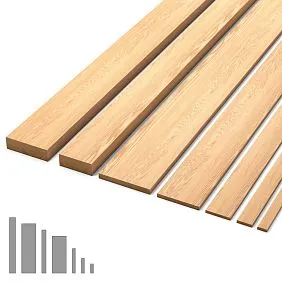
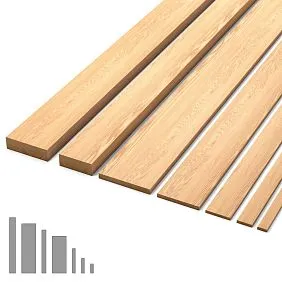
"Installed the slats — and that's enough." Without skirting boards, moldings, and end caps, a slatted structure looks unfinished. Finishing elements fromsolid wood trim— this is 5–10% of the budget that provides 30–40% of the final effect.
Mistake 6: Incorrect size calculation
The standard module of a slatted panel is 600 mm wide. If the width of the hallway is not a multiple of 600 mm (and it almost never is), the last module requires trimming. Trimming with a standard miter saw is a normal operation. But this needs to be thought about in advance: symmetrical trimming on both sides looks much better than a narrow strip on one side.
decorative slatted wall panelshallway: ready-made concepts
Concept "White Forest"
White vertical MDF slats, 45 mm, with a 12 mm gap on a black supporting base — full height. Floor: matte dark gray porcelain stoneware. Ceiling: white with two built-in spotlights. Mirror: vertical, 1.8 m, frameless. The only color accent: copper metal of hooks and light fixture.
Result: a 5 m² hallway looks twice as spacious. White and black — balance without overload.
Concept "Warm Nordic"
Slats made of natural oak, 50 mm, gap 14 mm, supporting base — warm beige. Floor: light oak laminate. Coat rack: wooden, in the same oak tone. Skirting board and molding: fromsolid wood trimOak. Lighting: one 'Scandinavian' pendant lamp above the mirror, 2700 K.
Result: a country house atmosphere in a city apartment. The tactility of wood and warm light — an entrance hall you want to step into.
Concept: 'Urban Loft'
Slats anthracite RAL 7016, 40 mm, gap 10 mm, load-bearing base — dark gray. Height: 1.6 m, above — concrete decorative plaster. Molding — steel angle 20×20 mm. Floor: dark concrete or large gray porcelain stoneware. Light fixture: industrial track spotlight.
Result: a compact, characteristic, memorable entrance hall. For those who know what they want.
FAQ: answers to popular questions about slatted panels in the entrance hall
Can slatted panels be used in a Khrushchyovka apartment entrance hall with a 2.5 m ceiling?
Yes, and they are especially effective here. Full-height 2.5 m vertical slats — with a width of 40–45 mm — visually 'stretch' the ceiling. Choose a light tone and matte finish.
Are slatted panels in the entrance hall practical or just beautiful?
Practical with the right material choice. MR MDF with two-component coating can be wiped with a damp cloth, is resistant to mechanical contact, and not afraid of moderate humidity. This is significantly more practical than wallpaper or decorative plaster.
How long does it take to install a slatted panel in a 6 m² hallway?
Professional crew (2 people): 4–6 hours. DIY with first-time experience: 1–2 days. Add 48–72 hours for material acclimatization before starting work.
Do walls in the hallway need to be leveled before installing slatted panels?
Critical unevenness over 15–20 mm requires preliminary leveling — either with plaster or by accounting for it during lath installation (using spacers of varying thickness). Minor unevenness up to 10–12 mm — compensated by adjusting the lath.
How do slatted panels interact with shoes and bags (contact in the lower zone)?
The lower zone (0–90 cm from the floor) is the most vulnerable. Use thicker slats (18–20 mm) and a harder coating. Alternative: finish the lower zone with tile or plaster, start the slatted structure from the 90 cm level.
Batten panels for ceilingsIn the hallway — is that not too visually heavy?
A slatted ceiling across the entire hallway area — indeed heavy. But a slatted 'island' 0.8–1.0 m × the width of the hallway above the mirror zone — is a light accent that creates a focal point without pressuring the space.
HowWall slat panels in interiorIn the hallway, do they combine with a stretch ceiling?
They combine excellently. The slatted structure is installed before the stretch ceiling. The upper edge is concealed under the fabric or under a ceiling plinth. Maintain an 8–10 mm gap between the top of the structure and the fabric — the fabric 'moves' with temperature changes.
Should old wallpaper be removed before installing slatted panels?
Preferably. Wallpaper under the load-bearing base is an unstable layer that may peel off over time along with the structure. If the wallpaper cannot be removed (permanently glued to the plaster) — apply a deep-penetration primer, ensure adhesion, then attach the lathing with dowels into the wall (not into the wallpaper).
Which baseboard to choose for a slatted hallway?
Baseboard matching the color of the slats from solid wood trim with a height of 60–80 mm is optimal. Aluminum baseboard — for loft/minimalist concepts. A tall baseboard of 80–100 mm in a narrow hallway additionally 'lifts' the gaze vertically.
About the company STAVROS
The hallway is not a room where compromises in material quality are appropriate. Here, the slatted panel will last for decades, withstanding daily loads. This is precisely where documentation for the material, the correct MDF class, and professional coating are not an option but a necessity.
STAVROS is a Russian manufacturer of architectural wooden elements for interiors. Full-cycle in-house production: chamber drying, CNC milling with ±0.1 mm precision, application of two-component coatings in factory conditions (dust-proof painting chambers, consistent temperature, no random contamination). Laboratory moisture control at every stage. Declaration of conformity, E1 class, MR moisture resistance class — documentation with each batch.
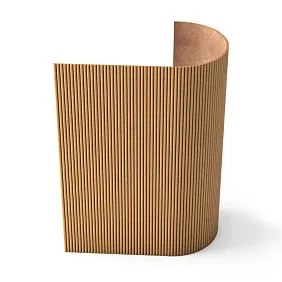
For your hallway in the STAVROS catalog:Slatted wall panelsmade of oak and ash with UV varnish;MDF Slatted Wall Panelmoisture-resistant MR class;slatted modular wall panelfor quick installation;Wooden slat panels — natural solid wood with a live grain pattern;paintable slatted wall panels for precise RAL color;soft slat panels for radius elements;decorative slatted wall panelsfor DIY projects;Pogonazh iz massiva— skirting boards, moldings, architraves for a finished result.
Free consultation on material selection, parameters, and installation technology for your hallway. STAVROS — when material quality works quietly but noticeably. For years.