Article Contents:
- Kitchen and slatted panels: why this combination works
- Five reasons to choose slatted panels for the kitchen
- Natural rhythm in a space with daily stress
- Visual zoning without partitions
- Acoustics: slats absorb kitchen noise
- Hidden utilities behind slatted systems
- Transformability of appearance
- Materials for slatted panels in the kitchen: what will withstand real conditions
- Moisture-Resistant MDF (MR-MDF): The Best Balance for the Kitchen
- Solid Wood with Proper Coating
- PVC: Practicality for Work Areas
- WPC: For Kitchens with Direct Access to the Terrace
- Kitchen Zoning with Slatted Panels: Specific Solutions
- Kitchen-Living Room: Slatted Accent Behind the Dining Area
- Kitchen with a Bar Counter: Slatted Partition Instead of a Wall
- Compact Kitchen 8–12 sq. m: Slatted Accent on One Wall
- Kitchen with an Island: Slatted Wall as a Background Accent
- Slatted Panels in the Kitchen: Styles and Looks
- Modern minimalism
- Scandinavian Style
- Loft and Industrial Style
- Neoclassicism and Modern Classicism
- Japandi (Japanese minimalism + Scandinavian functionality)
- DIY slatted panels for the kitchen: what's important to know
- Surface Preparation
- Ventilation gap
- Sealing ends in work areas
- Installing slatted panels in the kitchen: order of actions
- Lighting for slatted panels in the kitchen: enhancing the look
- Built-in LED strip behind the slats
- Track lights above a slatted wall
- Hidden light cornice
- Color solutions for slatted panels in the kitchen
- White slats: universal lightness
- Natural oak: warmth and naturalness
- Dark tones: a bold choice for the self-confident
- Color matching the furniture
- Mistakes when choosing slatted panels for the kitchen
- Care for slatted panels in the kitchen
- Slatted panels in the kitchen: inspiring solutions for specific situations
- Kitchen without a window: slats that 'add' light
- Kitchen by the balcony: slats as an extension of the outdoor space
- Studio kitchen of 20–25 sq. m: a three-zone slatted solution
- Frequently asked questions about slatted panels in the kitchen
- Can slatted panels be used as a kitchen backsplash?
- How often should wooden slatted panel finishes be updated in the kitchen?
- Are slatted panels practical in a kitchen with small children?
- Which slatted panels are better for the kitchen: MDF or wood?
- How to join slatted panels with tiles in the kitchen?
- How much does it cost to finish a kitchen with slatted panels?
- How to install slatted panels in the kitchen yourself?
- Conclusion

The kitchen is the most lively place in the house. Life literally boils here: smells, steam, oil splashes, daily mechanical contact with surfaces. That's why most people, when choosing kitchen finishes, take the path of least resistance: tiles, painted walls, PVC wall panels. Reliable. Practical. Predictable.
And boring.
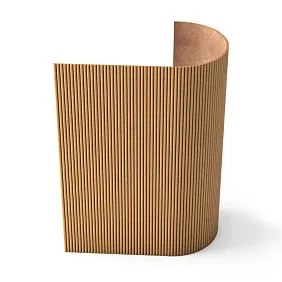
Slatted panels in the kitchen interior are a solution for those tired of 'reliable and boring.' For those who want the kitchen to be not just a functional space, but a place with character, naturalness, rhythm. A place that's pleasant to be in—not only while cooking, but also during morning coffee and evening conversations.
But the kitchen is not a living room. Here, materials are tested for durability every day. So the discussion aboutslatted panels in the kitchen— this is a conversation about both aesthetics and common sense. About beauty that withstands real life.

Kitchen and slatted panels: why this combination works
The first question any reasonable person asks: why have slats in the kitchen at all? Isn't that too difficult to maintain? Isn't it too 'risky' for an area with steam and grease?
The answer depends on exactly where in the kitchen you plan toSlatted wall panelsand what material they're made of. The kitchen is not a monolithic space. It's several functional zones with fundamentally different operating conditions:
Cooking zone (by the stove and sink) — maximum aggression: steam, splashes, grease deposits, sharp temperature fluctuations. Here, slatted panels made of natural wood are questionable. Moisture-resistant MDF, PVC, or ceramic are the right choice.
Dining area (table, chairs, breakfast area) — moderate conditions. Splashes are rare, no direct contact with steam. Here, natural oak with proper coating orslatted MDF panelswork excellently.
Wall opposite the kitchen set (in a kitchen-living room) — practically residential conditions. Slatted panels here are a full-fledged interior element without significant material restrictions.
Kitchen ceiling — steam rises upward. Without forced ventilation, it's a problematic area for wood and MDF. For a kitchen with a powerful hood —Batten panels for ceilingsmoisture-resistant materials are quite applicable.
Understanding this zoning — you're already halfway to the right solution.




Five reasons to choose slatted panels for the kitchen
Why slats specifically, and not classic tiles or painted walls? There are five solid reasons — not marketing ones, but practical and aesthetic.
Our factory also produces:


Natural rhythm in a space with daily stress
The kitchen is a zone of increased mental load: cooking against the clock, washing dishes, organizing the chaos of groceries. Natural material on the walls (or its high-quality imitation) reduces the emotional 'noise' of the space. The wooden rhythm of slatted panels is not just decor, but a physiologically justified solution: natural forms and warm tones calm the nervous system better than white tiles or gray concrete.
Get Consultation
Visual zoning without partitions
In a kitchen-living room, a slatted panel is one of the best ways to designate a dining or living area without a physical partition. Vertical slats behind the dining table create a 'background' surface that psychologically separates the dining area from the kitchen work zone.
Acoustics: slats absorb kitchen noise
The kitchen is an acoustically aggressive space: the sound of water, running appliances, clinking dishes, the extractor hood.Wooden slat panelsThose with felt or acoustic backing absorb some of the sound energy, reducing the 'hum' in the room. In a 25–40 sq. m kitchen-living room, this makes a noticeable difference.
Hidden utilities behind a slat panel system
A slat panel system on battens creates a space between the wall and the decorative surface. This space is a natural place for concealed cable routing, LED lighting, and sometimes even utility lines.
Transformability of the look
Repainting MDF slat panels is easier and cheaper than replacing tiles or re-wallpapering.paintable slatted wall panels— an investment in a system that can be 'rebooted' with a cosmetic renovation in a few years. Change the color, and the kitchen becomes a different one.
Materials for slat panels in the kitchen: what can withstand real conditions
Choosing the material for slat panels in a kitchen interior is a key decision. A mistake here is costly: poor-quality material in kitchen conditions degrades quickly and unattractively.
Moisture-resistant MDF (MR MDF): the best balance for the kitchen
Moisture-resistant MDF is the most sensible choice for most kitchen areas. A special binder formula makes it resistant to moderate humidity. The surface accepts any paint coating: matte enamel, semi-matte varnish, decorative film.
Competitive advantage: moisture-resistant MDF features geometrically precise slats in any RAL color, resistant to kitchen humidity fluctuations. Ideal for dining areas and walls in kitchen-living rooms.
Limitation: not for direct contact with water. A work apron near the sink made from moisture-resistant MDF without sealed edges is a risk.
Detailed technical specifications and application options are covered in the article about MDF slatted panel for walls.
Solid wood with proper coating
Natural oak, larch, thermally treated birch — with proper coating, they work well in kitchen areas with moderate humidity. Key point: the coating must be water-resistant, not just varnished.
Polyurethane varnish (2–3 layers) — creates a water-resistant film over the wood. The wood doesn't "breathe," but is protected from splashes, moisture, and grease buildup. Cleans with a damp cloth.
Oil-wax with water-repellent additives — a more natural result, but requires regular renewal (every 1–2 years in kitchen conditions). For those willing to maintain it for natural tactile feel.
Thermally treated wood — a natural high-temperature treatment process significantly increases wood's moisture resistance. Thermally treated oak or ash with water-resistant oil coating is one of the best natural options for kitchens.
Wooden slat panelswith the right finish — for the dining area and kitchen island, where naturalness is important and direct splashes are excluded.
PVC: practicality for work zones
PVC slatted panels — completely waterproof, resistant to cleaning agents. For the kitchen backsplash (area by the sink and stove) — a technically correct choice when desiring a slatted look.
Limitation: PVC looks 'plasticky' up close and lacks natural tactility. For areas not accessible to touch (backsplash behind the stove, high wall sections) — quite acceptable.
WPC: for kitchens with direct access to a terrace
Kitchens combined with a veranda or terrace — a special case. Here WPC (wood-polymer composite) can be used both outside and inside as a unified system.Slatted Façade PanelsWPC outside + MDF slatted panels inside in the same tone — a professional solution for continuous space.
Zoning the kitchen with slatted panels: specific solutions
The most interesting part. How exactly to useslatted panels in kitchen interiors— not abstractly, but in actual layout scenarios?
Kitchen-living room: slatted accent behind the dining area
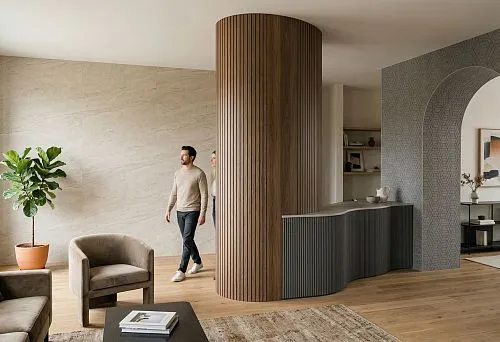
The most popular scenario. Kitchen-living room 30–45 sq. m, open layout. The dining table is positioned between the kitchen set and the living area. The wall behind the dining table is the prime candidate for a slatted panel.
Parameters for such a solution:
-
Slat width: 35–45 mm — expressive enough for an open space
-
Gap: 18–22 mm — airiness without sparseness
-
Material: MDF with matte enamel or natural oak with oil
-
Height of the slatted field: from floor to ceiling — maximum effect in an open space
-
Orientation: vertical — 'pulls' the ceilings upward
Color solution: slats matching the kitchen fronts or in a contrasting neutral tone. White slats against a dark wall backing with a gray kitchen — a clean, modern look. Slats of natural oak with a white kitchen and white walls — a warm, natural accent.
Kitchen with a bar counter: slatted partition instead of a wall
A bar counter separating the kitchen from the living room is a popular layout technique. If a half-wall or decorative partition is planned above the bar counter, a slatted system works effectively here.
slatted modular wall panelwith a wide gap (25–35 mm) as a partition above the bar counter — this is an 'openwork' screen that visually divides the space while maintaining visual connection and light flow between zones. Light passes through the gaps — the space remains unified.
For this solution — slats made of natural oak with an oil finish. The natural warmth of wood in contact with the bar counter and kitchen set creates a biophilic image of a modern kitchen.
Compact kitchen 8–12 sq. m: slatted accent on one wall
A small kitchen requires a delicate approach. Here, slatted panels on all walls would be overwhelming. One slatted accent is correct.
The best place in a compact kitchen: the wall opposite the kitchen set (usually in single-row galley kitchens). Or the end wall at the end of the kitchen row — it 'closes' the perspective.
Parameters for a small kitchen:
-
Slat width: 20–25 mm — a delicate rhythm, does not 'overload'
-
Gap: 12–15 mm — a dense pattern
-
Color: light (white, bleached oak) — expands the space
-
Height: from floor to ceiling — eliminates the 'horizontal break,' making the ceiling appear higher
Wall finishing with slatted panelsIn a small kitchen — one of the few ways to add architectural interest without losing space: the slats recede into the wall rather than 'protruding' into the room.
Kitchen with an island: slatted wall as a background accent
Kitchen with a central island — typically spacious (from 20 sq. m). The island is the main focal point. The background wall behind the cabinetry or the end wall can become a slatted surface, serving as a 'stage backdrop.'
Slats matching the island's cabinet fronts or contrasting — depends on the concept. Dark slats (anthracite, wenge) behind light cabinetry — a dramatic contrast. Light 'natural oak' slats behind dark matte cabinetry — a natural counterbalance.
In kitchens with an island, the slatted wall often 'echoes' the island's finish. If the island's cabinet front is natural oak, a slatted wall in the same tone creates a natural 'system.'
Slatted panels in the kitchen: styles and looks
Slatted panels in the kitchenThey work across a wide stylistic range — with correctly chosen parameters.
Modern minimalism
White or light gray MDF slats with a matte finish. Narrow gaps (12–15 mm). Slat width 30–35 mm. Backing matching the slats or dark — for a delicate contrast.
Pairs with: white or light gray matte kitchen, concrete or stone countertop, light floor. Ceiling — smooth white orBatten panels for ceilingsmatching the wall color.
Vibe: cold, clean, architectural. Kitchen as a laboratory.
Scandinavian style
Light battens made of natural birch or ash with white oil. Thin battens 20–25 mm. Narrow gap 12 mm. Natural wooden rhythm against white walls.
Pairs with: light kitchen made of birch or ash, wooden stools, linen curtains, potted plants. Natural vibe of a northern house.
decorative slatted panelsmade of light wood in a Scandinavian interior — this is not 'decor', but an organic part of the natural system: wood on the wall, wood on the floor, wood in the furniture.
Loft and industrial style
Dark battens (anthracite, wenge, black) made of MDF with a matte finish. Wide battens 45–55 mm. Wide gaps 20–25 mm. Dark backing.
Pairs with: kitchen in a black-and-white palette, metal elements (black metal on faucets, curtain rods, bar stools), brick or concrete surfaces in adjacent zones.
Vibe: brutal, graphic, modern. Kitchen as a statement of character.
Neoclassicism and modern classicism
Battens in the lower wall zone (wainscoting, height 90–110 cm). Natural oak with 'tobacco' or 'walnut' stain. Batten width 35–45 mm. Horizontal molding at the border of zones.
Pairs well with: kitchen in cream and milk tones with patinated handles, herringbone parquet, and plaster cornices.
Solid wood moldingon the horizontal boundary of wainscoting — an essential element in the classical concept. Without it, the slatted field looks 'unfinished'.
Japandi (Japanese minimalism + Scandinavian functionality)
One of the main trends is Japandi. Dark narrow slats (20–25 mm wide) made of stained oak in 'tobacco' or 'dark ash'. Narrow gap of 12–15 mm. Natural-colored felt underlay.
Pairs well with: kitchen in black and beige palette, handmade ceramics, wooden accessories, dark parquet.
The Japandi aesthetic is built on contrast: dark thin slats, light surrounding walls, natural accents. The slatted surface in Japandi is a meditative rhythm that doesn't 'shout' but 'speaks softly'.
DIY slatted panels for the kitchen: what's important to know
Installing slatted panels in the kitchen has specificities compared to other rooms. Let's consider the key points.
Surface preparation
Kitchen walls are often uneven (tiles under drywall, uneven plaster). For mounting a slatted system on battens — wall unevenness is not critical: wooden or metal battens level the plane. For adhesive mounting directly on the wall — the wall must be level (deviation no more than 3 mm over 2 m).
Surface for batten system: dry, dust-free, without grease deposits. Kitchen walls are often greasy. Degreasing before installation is mandatory.
Ventilation gap
When installing batten panels in the kitchen on battens, the ventilation gap between the wall and the panel backing is critically important. Kitchen steam penetrates everywhere. Without ventilation, condensation accumulates behind the battens, and mold appears. Ventilation gap: minimum 20–25 mm.
The bottom edge of the batten frame does not reach the floor by 50 mm: air enters from below and exits above (above the cornice). Natural convection.
Sealing ends in work areas
Seal MDF batten ends in moderate humidity areas with moisture-resistant silicone or special edge material. An open MDF end at the baseboard in the kitchen is a potential swelling point upon contact with cleaning water.
installation of slatted panelsIn the kitchen: order of actions
-
Marking the batten frame with a laser level – strictly vertical
-
Installing the batten frame (spacing 400–500 mm) with a ventilation gap
-
Acclimatizing battens in the room for 48–72 hours
-
Installing the first batten along the laser vertical line
-
Installation with template spacers for uniform gap
-
Fastening battens with adhesive + hidden clips or finish nails
-
Installation of bottom skirting board with end sealing
-
Installation of top cornice
-
Installation of LED lighting (if provided)
-
Final surface cleaning
Step-by-step guide for DIY installation of slatted panels— in a detailed professional guide.
Lighting for slatted panels in the kitchen: enhancing the image
Slatted panels in the kitchen and proper lighting — this is a synergy that greatly enhances the image.
Built-in LED strip behind battens
LED strip in the gaps behind battens is one of the most spectacular kitchen lighting techniques. In the evening, with the overhead light off and the backlighting behind the battens on, the surface 'glows' through the gaps. With light battens on a dark background: the dark lines of the gaps turn into glowing slits.
Light temperature behind battens in the kitchen: 2700–3000K — warm, homely light. For evening lighting of the dining area. 4000K — neutral, 'daylight'. For the work zone.
Important parameter: gap for LED backlighting — minimum 20–22 mm. Narrow 12 mm gaps 'dampen' the light — the strips are barely visible.
Track lights above a batten wall
Directional track light at a 30–40° angle to the batten surface creates expressive chiaroscuro in the gaps. This works independently of built-in backlighting: the gaps themselves turn into shadow stripes, enhancing the three-dimensionality of the surface.
For natural wooden battens — track lighting at 2700–3000K is especially effective: warm light brings out the golden tone of oak, makes the grain 'come alive'.
Hidden light cornice
a polyurethane cornicewith a groove for an LED strip along the top edge of the batten field — a professional technique. Light 'flows' from top to bottom along the battens, creating the sensation that the batten wall itself is 'glowing'. For the kitchen dining area — one of the coziest lighting techniques.
Color solutions for batten panels in the kitchen
Choosing the color of batten panels in the kitchen is choosing the mood of the entire space.
White slats: universal lightness
White wall slat panel— the most common solution for kitchens. White expands space, reflects light, and pairs with any color of kitchen set. The dark backing behind the white slats creates a black-and-white graphic contrast.
Shades of white for the kitchen: pure white (RAL 9003) — strict, modern. Warm white (RAL 9010) — softer, homier. Ivory (RAL 1013) — classic, delicate.
Natural oak: warmth and naturalness
The tone of natural oak is the most requested. The warm amber tone with a natural grain 'enlivens' the cold kitchen environment. Especially effective: a white kitchen + natural oak on a slatted wall behind the dining table. A natural counterpoint to white functionalism.
Dark tones: a bold choice for the self-assured
Dark gray (anthracite), dark green, graphite slats — for those who want a kitchen with character. DarkDecorative slatted wall panelsIn the kitchen-living room, it's a bold designer statement. It requires more natural light and thoughtful lighting.
Color matching the kitchen set
Reiki in the exact color of the kitchen set — a monochrome solution. The color 'flows' from the cabinets to the wall — the space becomes unified, the set 'blends' into the wall. A technique from professional design studios.
Mistakes when choosing slatted panels for the kitchen
An honest conversation about what goes wrong. These mistakes happen more often than we'd like.
Mistake 1: Natural wood in the stove area without moisture-resistant coating. Oak slats with oil finish near a gas stove — within a year they will yellow and 'grease up' from kitchen steam. For the stove area — only polyurethane varnish, moisture-resistant MDF or PVC.
Mistake 2: Too wide slats in a small kitchen. Slats 55–60 mm in a kitchen of 8 sq. m — visually 'overwhelm'. For small kitchens — no wider than 30–35 mm.
Mistake 3: Installation without a ventilation gap. Without air circulation behind the substrate in kitchen steam conditions — condensation and possibly mold will appear within a year.
Mistake 4: Ignoring gaps when calculating the number of slats. A classic miscalculation: wall width 3600 mm, slat 40 mm — 'so, 90 slats will fit'. No: 3600 ÷ (40+18) = 62 slats. Account for the gap.
Mistake 5: Slats without perimeter finishing. A slatted surface without a cornice at the top and a plinth at the bottom — unfinished. It is the finishing that creates the feeling of an 'expensive' result.solid wood baseboardanda polyurethane cornice— mandatory elements of the system.
Care for slatted panels in the kitchen
Slatted panels in the kitchen require specific care — but less complicated than it seems.
MDF with lacquer or enamel coating: wipe with a damp cloth along the grain. For grease deposits — use a neutral detergent without abrasives. Do not wet the edges.
Natural wood with oil: quarterly — treatment with a special maintenance oil. Fresh grease stains — remove immediately. Avoid soaking.
Natural wood with lacquer: wipe with a damp cloth, use a neutral agent to remove grease. Scratches — local polishing.
PVC: any detergents without abrasives. The most low-maintenance option.
Slatted panels in the kitchen: inspiring solutions for specific situations
Kitchen without a window: slats that 'add' light
A kitchen without a window is not uncommon in city apartments. Here, white glossy or semi-matte slatted panels serve as a 'light reflector': the light surface multiplies the light flux from artificial lighting. Slats with built-in LED lighting in the gaps — an additional source of soft, diffused light.
Kitchen by the balcony: slats as an extension of the outdoor space
A kitchen with access to a balcony or loggia — here, slatted panels create visual continuity between the kitchen and the outdoor space. Inside: MDF slats in 'dark oak' tone. Outside on the loggia: DPC in a similar tone. With balcony doors open — the space 'flows', the boundary disappears.
20–25 sq m studio kitchen: three-zone slatted solution
Three zones — three 'stories' with slats:
-
Wall behind the sofa in the living area: wide 45–50 mm slats, floor-to-ceiling height
-
Slatted partition above the bar counter: thin 20 mm slats with wide 30 mm gaps
-
Slatted ceiling above the dining 'island': thin slats perpendicular to the table axis
All three elements — in one tone or close tones from one system. Result: a unified natural environment where cooking, dining, and relaxation are connected by a common material language.
Frequently asked questions about slatted panels in the kitchen
Can slatted panels be used as a kitchen backsplash?
For the area directly behind the stove and sink — only PVC with moisture-resistant coating or special moisture-resistant MDF with complete sealed edge coating. Natural wood without special protection — not recommended.
How often should the coating of wooden slatted panels in the kitchen be renewed?
Wood with oil finish: refresh every 1–2 years in an active kitchen. Wood with polyurethane varnish: 5–7 years without refresh with careful care. MDF with enamel: does not require coating refresh with proper use.
Are slatted panels practical in a kitchen with small children?
MDF with matte enamel is quite practical. The surface is washable and resistant to mechanical impact. PVC is even more practical. Natural wood with oil finish requires regular maintenance and is vulnerable to scratches. For families with small children, MDF with varnish or enamel coating is optimal.
Which slatted panels are better for the kitchen: MDF or wood?
Depends on the application area and priorities. For work zones with moisture—moisture-resistant MDF. For the dining area and kitchen-living room—natural oak with proper coating gives a more 'lively' result.Wooden slat panelsIn the breakfast or dining table area—naturalness where it is most important for psychological comfort.
How to connect slatted panels with tiles in the kitchen?
Professional technique: the border between slatted panels and tiles is covered with a corner profile made of stainless steel or aluminum. This is an 'honest' demarcation of two materials. No 'transition'—a clear line dividing the zones. The transition height is along the line of the upper edge of the kitchen backsplash (usually 600–650 mm from the countertop).
How much does it cost to finish a kitchen with slatted panels?
The cost depends on the material, area, and complexity of installation. MDF with coating is more economical than natural oak. Natural oak with oil finish is more expensive but gives a natural result that 'ages' beautifully. Consultation and calculation based on specific parameters—from the manufacturer.
How to install slatted panelsin the kitchen by yourself?
Basic tool set: laser level, miter saw, nail gun (or screwdriver), spacer templates for gaps, construction adhesive. Lathing made of 40×20 mm wooden beams or metal profiles. Detailed step-by-step instructions are in theslat panel installation guide.
Conclusion
Slat panels in the kitchen interior are not a trend that will pass in a season. It is a natural material that responds to a deep human need for warmth and a living rhythm around oneself. The kitchen is a space where a significant part of home life takes place. And it deserves an image that inspires, not just 'withstands use.'
The correct choice of material, application zones, and slat parameters is a professional task, solved once and for years to come.Slatted wall panelsmade of natural wood in the dining area,MDF Planks for Paintingin laconic monochrome solutions,modular slat panelsfor quick installation — all this is in the full range of STAVROS company.
STAVROS — production of slat panels made of natural oak, ash, pine, and birch with professional tinting and moisture-resistant coating. A complete finishing system: from slats towooden baseboards, cornices made of polyurethaneandwooden furniture handlesfor a unified natural kitchen aesthetic. Consultation on material selection, parameters, and color solutions — because a slatted kitchen should not only look beautiful in photographs but also be convenient in everyday life.