












































































Article Contents:
- What are slatted panels and what types exist
- Types of Slatted Panels by Construction
- Materials for slatted panels
- Slat sizes and proportions: how they affect interior design
- Popular colors for slatted panels
- Design techniques with slatted panels
- Accent wall: creation rules
- Slat direction: vertical, horizontal, diagonal
- Slatted panel lighting: how to achieve proper illumination
- Space zoning with slats
- Combining slat panels with other materials
- Slat panels in living room interior: ideas and solutions
- Slat panels in TV zone
- Slat panels behind sofa
- Slat partitions in living room
- Slats on living room ceiling
- Slat panels in living room: styles and color solutions
- Slat panels in bedroom interior: ideas and solutions
- Slat panels as bed headboard
- Slatted panels with lighting in the bedroom
- Slatted panels for zoning in the bedroom
- Slatted panels in a small bedroom
- Colors and styles for the bedroom
- Slatted panels in hallway interior: ideas and solutions
- Slatted panels on an accent wall in the hallway
- Slatted panels with a mirror in the hallway
- Slatted panels with a hanger and functional storage
- Slatted panels in a narrow and small hallway
- Slatted partition between the hallway and living room
- Slat panel lighting in the hallway
- How to choose slat panels for interior: checklist
- Mistakes when using slat panels in interior
- Design mistakes
- Errors in installation
- Material Selection Errors
- Trends 2025–2026: slat panels in modern interior
- Cost of wall finishing with slat panels
- Material Costs
- Installation Costs
- Calculation example for a 6 m² accent wall
- About the Company STAVROS
- Frequently Asked Questions
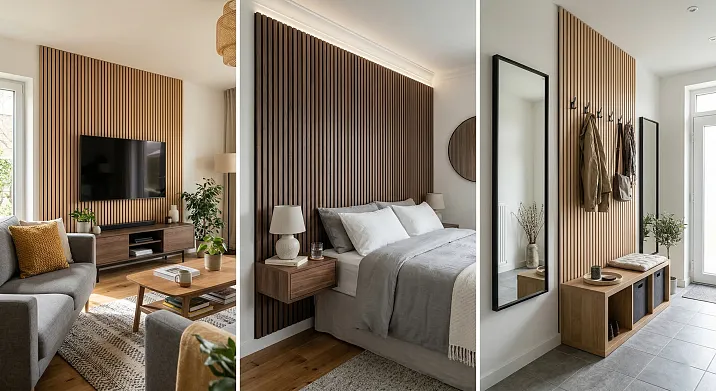
There are finishing materials that come and go with seasonal trends. And there are those that take space and change it in the most literal sense — remove blandness, add depth, shape character. Slat panels in interior belong to the second category. The vertical rhythm of slats, the play of light and shadow between battens, the warm texture of wood or the strict monochrome of MDF — all this is not decoration for decoration's sake, but a meaningful architectural tool. That's why over three years, slat walls have transformed from a niche designer technique into a standard of good taste in any price category.
This article is a detailed practical guide for those planning to useslatted panels for wallsin the living room, bedroom, or hallway. Here: how to choose slats for a specific room, how to arrange them, what to combine them with, how to organize lighting, what mistakes ruin the result, and how much it costs.
What are slatted panels and what types are there
Before moving on to ideas and inspiration, it's important to understand exactly what product you're working with. 'Slatted panels' is a general term for an entire group of constructions united by one principle: the uniform rhythm of elongated slats forming a linear relief on the surface.




Types of slat panels by construction
Panels on a substrate (modular sections) – slats are glued onto an MDF base with equal spacing. Mounted as a single module: quickly, precisely, without individually fitting each slat. Optimal for large, flat walls.
Individual battens (piece-by-piece installation) – each slat is attached to the lathing or base independently. Allows for creating any non-standard spacing, combining widths, and working on curved surfaces. Installation takes longer, but flexibility is maximized.
3D slatted panels – slats of varying height, depth, or at an angle create a pronounced three-dimensional relief. Effective in accent zones, sensitive to light direction.
Slatted partitions (openwork) – slats are mounted without a solid substrate, creating an openwork structure that divides space without blocking light. Ideal for zoning without losing visual volume.
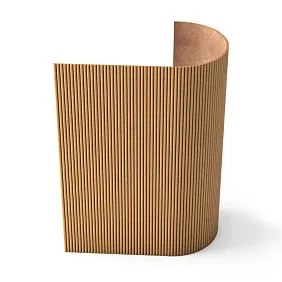
Flexible panels on a fabric base – instead of a rigid board, the base is a durable fabric, allowing the panel to wrap around columns, arches, and rounded corners without visible seams. This exact solution is available in the catalogSTAVROS– a rare option among manufacturers, critically important in design projects.
Our factory also produces:
Materials for slatted panels
| Material | Pros | Best rooms |
|---|---|---|
| Oak solid wood | Living texture, durability, tactile value | Living room, bedroom, restaurant |
| MDF for painting | Any RAL color, clean relief, repainting | Living room, bedroom, hallway |
| MDF veneered | Natural look, lower price than solid wood | Bedroom, living room, office |
| PVC | Moisture resistance, low price | Bathroom, balcony |
| Aluminum | Non-flammability, lightness | Ceiling, high-tech |
| WPC (composite) | Outdoor durability | Facade, balcony |
For living spaces — living room, bedroom, hallway — solid oak, paintable MDF, and veneered MDF are optimal. They provide a sense of quality that is perceived at first glance.
Get Consultation
Dimensions and proportions of slats: how they affect the interior
Choosing the width of the slat and the spacing between lamellas is one of the most important design decisions. This is not a technical issue; it is a matter of the character of the space.
Slat width:
-
Narrow (20–40 mm) — refined, graphic rhythm; a sense of lightness and air; suitable for minimalism and Japanese styles; do not overwhelm in small spaces
-
Medium (40–80 mm) — universal format; well-readable from a distance; balance between detail and volume
-
Wide (80–120 mm and more) — monumental character; closer to 'planks' and 'board-like' covering; relevant in the 2024–2026 trend; require spacious rooms
Spacing between slats:
-
Dense (5–10 mm) — the surface appears almost solid; thin stripes of shadows
-
Medium (15–25 mm) — classic slatted rhythm; the wall 'breathes'
-
Sparse (30 mm and more) — airy, openwork structure; light passes through
Slat height/depth (profile):
The higher and deeper the slat, the more pronounced the shadow it casts. Semi-circular and beveled profiles give a soft shadow; rectangular — a clear, contrasting line. Soft shadows work better in the bedroom, while more pronounced ones are better in the TV area.
Popular colors of slatted panels
Color is the second most important choice after proportions. Several reliable solutions:
-
Light oak, ash, birch — Scandinavian minimalism, Japanese style, eco-interior; work in any room, don't overwhelm the space
-
Honey, caramel oak — warm, cozy atmosphere; especially good in the bedroom
-
Walnut, wenge, dark brown — intimacy, elegance; require good lighting
-
White, cream paintable — monochrome relief; maximum purity of visual image
-
Black, anthracite — maximum contrast; TV area, office, meeting room
-
Colored (terracotta, olive, dusty pink) — current trend for 2024–2026; bold accent, requires a clear color concept
Design techniques with slatted panels
Knowing the material is not enough. It's important to understand exactly how slats work in a space.
Accent wall: creation rules
Accent (focal) wall — the central design technique with slatted panels. The essence is that one wall stands out against the others and becomes the visual anchor of the room.
How to choose the right wall:
-
The wall you see first when entering the room
-
The wall behind the sofa or behind the bed (always in view)
-
The wall behind the TV — combines function and decor
-
Wall with a window — more challenging, but possible with side rail placement
Full-wall rails from floor to ceiling provide maximum effect and architectural quality. A panel (not the entire wall, but a part of it) — a lighter option, suitable for small spaces. The lower third of the wall plus a horizontal molding — a classic technique with historical roots, relevant in modern execution.
Rail direction: vertical, horizontal, diagonal
This is perhaps the most frequent question: which way to mount the rails? The answer — depends on the geometry of the room.
Vertical rails — the choice for most cases. Lines stretch upward, the eye follows them, the room appears taller. Especially important with ceilings below 2.7 m. Works in living rooms, bedrooms, hallways, corridors.
Horizontal rails — expand the space along the wall. Work well in narrow corridors, creating an illusion of greater width. Used less frequently in living rooms — only if the ceiling height allows not to fear a 'grounding' effect.
Diagonal rails — dynamism, movement, non-standard. Used rarely, require confidence in the design concept. Work well on small accent fragments, but not on entire walls.
Transition from wall to ceiling — one of the most effective modern techniques. Continuous rails 'flow' from the vertical plane to the horizontal, creating an effect of architectural envelopment. Requires ceilings from 2.7 m and precise planning of corner joints. In a living room with high ceilings — an absolute top for design effect.
Lighting of slatted panels: how to get the right light
Lighting is not a mandatory element, but where it is present, it works as an effect multiplier.
Types of lighting:
-
LED strip behind the panel — the most common option; the strip is mounted in the space between the backing and the wall or behind the panel edge; light 'bursts' from the bottom or top like a halo; creates a floating surface effect
-
LED strip between slats — mounted in an aluminum profile in the groove between the slats; even light strips between the slats; requires a diffuser, otherwise — blinding spots
-
Spotlights in a slatted wall — embedded directly into the backing; technically more complex, but the effect is of built-in lighting as if from the surface itself
Color temperature selection:
-
2700 K (warm white) — bedroom, living room, restaurant; relaxation, coziness
-
3000 K (soft warm) — universal residential option
-
4000 K (neutral) — kitchen, work area, office
-
RGB and Tunable White — TV area, gaming, smart home
Critically important: wiring must be installed BEFORE mounting the panels. This is a basic rule that is constantly violated — and then follows the dismantling of already installed slats.
Space zoning with slats
Slatted partitions are a modern answer to the request to 'divide space without losing light.' Transparent (openwork) slats delineate zones visually, without blocking light or air.
Where it works best:
-
Living room + kitchen (open space) — an openwork partition sets a boundary between zones without a solid wall
-
Entryway + living room — the entrance area is separated from the living area without losing volume
-
Bedroom + study or walk-in closet — light separation in a studio or small apartment
Combining slatted panels with other materials
Slats are not a monopoly covering. They work best in dialogue:
-
Slats + decorative plaster (microcement) — a relevant combination; textured mineral surface as a background for linear slats; organic + geometry
-
Slats + painting — the most common; part of the wall in color as a background behind slats in the same or contrasting tone
-
Reiki + natural stone — stone wall and slatted accent panel; powerful material contrast
-
Reiki + mirrors — mirror is embedded in a slatted frame or alternates with slatted sections; especially effective in the hallway
-
Reiki + soft wall panels — in the bedroom; headboard with a soft panel framed by slats on both sides
-
Reiki + wallpaper — rare but possible; geometric wallpaper pattern should not compete with the rhythm of the slats
Slatted panels in living room interior: ideas and solutions
The living room is the face of the apartment. It's where guests are received, where the family spends time together, and where the interior should be both expressive and comfortable. That's why wall slatted panels are most commonly found in living room interiors — they instantly elevate the space, turning the wall into an event rather than just a background.
Slatted panels in the TV area
TV area — top 1 in frequency of slatted panel use in the living room. And it's no coincidence: slats solve several tasks simultaneously.
First — they create an expressive background for the screen. A TV hanging on a white wall looks like a technical device. A TV on a dark slatted panel in anthracite or wenge decor is already an architectural object, part of the interior concept.
Second — they hide cables. Wires from the TV, set-top box, and sound system are hidden in the space between the backing and the wall through technological holes — and no longer spoil the view.
Third — they allow you to embed shelves, niches, and cabinets directly into the slatted surface. An open shelf between the slats looks different than a wall-mounted shelf on a smooth wall.
Fourth — slatted panels in a living room interior with a TV, combined with lighting, reduce visual discomfort from a bright screen in a dark room. LED backlighting behind the panel creates soft backlighting around the screen — this is essentially bias lighting, recommended by cinema technologies.
Optimal TV zone parameters:
-
Dark decors (graphite, anthracite, wenge, black) — hold the background behind the screen well
-
Width of the slatted panel — not less than the width of the TV + 40–60 cm on each side
-
Height — full wall or from floor to ceiling (if height allows)
-
Lighting — warm or neutral LED, 2700–3000 K
Slatted panels behind the sofa
An accent wall behind the sofa is the second most popular technique after the TV zone. Here, the slats work as an architectural background: this is the wall most people see when entering the room, and it forms the first impression of the interior.
Slatted panels in a living room interior behind the sofa are more often chosen in light decors — oak, ash, light gray MDF. This creates a warm, cozy background on which paintings, posters, plants, and decorative objects look good.
Height variations:
-
Full wall (floor to ceiling) — maximum architectural effect
-
Panel (limited area) — lighter, better for small living rooms
-
Half wall from the bottom (panel row) + neutral upper part — a classic technique, doesn't overwhelm the space
Slats with shelves — a functional option: built-in wooden shelves between slat sections provide space for books, decor, houseplants, without adding bulky furniture to the wall.
Slatted partitions in the living room
In an open-plan living room, a slatted partition serves a zoning function without losing the sense of a unified space. Slatted screens between the living room and kitchen create a visual boundary that allows kitchen smells and noise to 'stay there,' while light and air circulate freely.
For such a partition, the following are important:
-
A stable frame made of metal profile, secured to the floor and ceiling
-
Slat spacing from 30 mm — so the space doesn't look solid
-
Full-height for the entire opening — otherwise, the partition reads as a temporary solution.
-
Unified decor with an accent wall — partition slats and wall slats in the same material and tone.
Slats on the living room ceiling.
Slatted ceiling or slatted insert on the ceiling — a technique for those who want more than just an accent wall. Ceiling slats work as zoning: the section above the sofa area highlights it as an independent space within the open living room. If the slats continue the vertical panel from the accent wall, the 'wrapping' effect creates a sense of an architectural shell — the room literally embraces.
Technically: MDF ceiling slats are attached to a metal profile frame, hidden LED strips in the gaps between the slats create soft top lighting.
Slatted panels in the living room: styles and color solutions.
Scandinavian style — light slats in birch or whitewashed oak colors, white walls, minimal decor, natural materials. Simplicity that looks expensive.
Minimalism — MDF painted to match the wall color. A monochrome wall with the relief of slats: no color noise, only lines and light and shadow. One of the most elegant techniques.
Loft — dark slats (anthracite, black, dark walnut) against a brick or concrete wall. Metal elements, rough textures. The slatted panel here is a 'civilized' accent among raw materials.
Japanese style (Japandi) — thin slats with minimal spacing, muted neutral tones (gray oak, mocha, warm beige), no fuss in decor. Solid oak slats work flawlessly in this style.
Eco — natural wood, live plants on a slatted wall, natural fabrics. Slats as part of the 'natural' layer of the interior.
Slatted panels in bedroom interior: ideas and solutions
The bedroom is a different space with different requirements. Here, quiet, warmth, coziness, and a sense of security are important. Slatted panels in the bedroom address these tasks better than most other finishing materials: wood and MDF work with warmth and texture, acoustic slats with felt backing reduce reverberation, and built-in lighting creates soft light that doesn't strain the eyes before sleep.
Slatted panels as a bed headboard
This is the most popular use of slatted panels in bedroom interiors — and perhaps the most striking. The wall behind the bed is the first thing that catches your eye every time you enter the bedroom or wake up. It sets the mood for the entire room.
Slatted panels above the bed completely replace a bulky upholstered headboard and create an architectural accent of incomparably greater scale.Wooden slat panelsSolid oak in 'Scandinavian gray' or 'honey oak' finishes — exactly the combination you can find in the best design projects today.
Design options:
-
Slats across the entire wall behind the bed — from floor to ceiling, wall to wall. Maximum effect, requires confidence in scale.
-
Slats as a panel — the slatted area only matches the width and height of the bed headboard. Elegant, suitable for small bedrooms.
-
Slats + transition to the ceiling — continuous slats flow onto the ceiling above the bed, creating an alcove-like space effect. Intimacy, enclosure, a sense of 'your own' place.
-
Reiki + soft headboard — a combination of two materials: a soft panel in the center, framed by slatted sections on both sides. A hybrid of coziness and architectural style.
Optimal proportions: the width of the slatted zone is the width of the bed + 20–40 cm on each side; height — from the mattress level to the ceiling for maximum effect.
Slatted panels with lighting in the bedroom
Lighting in the bedroom is not about a 'brightly lit room.' It's about scenario lighting: in the evening — soft warm glow behind the slats for relaxation, at night — minimal orientation lighting, in the morning — gradual increase in brightness via smart home.
Slatted panels with lighting in bedroom interiors are most often organized via an LED strip behind the panel backing. Light 'seeps' between the slats from below and above, creating a soft diffused halo around the entire slatted zone. Temperature — strictly warm, 2700 K. Cold light in the bedroom physiologically disrupts melatonin production and interferes with falling asleep.
Alternative to bedside lamps: LED is integrated directly into the side posts of the slatted panel at headboard level. Each sleeper gets personal reading light without disturbing their partner.
Slatted panels for zoning in the bedroom
In small apartments or studios, the bedroom is often combined with a work area or walk-in closet. A slatted partition here is the perfect tool: it separates functional zones without creating a feeling of tightness. Slatted panels with a 20–30 mm gap allow light to pass through but create a psychological boundary between the 'sleep zone' and the 'work zone'.
Slatted panels in a small bedroom
A small bedroom is not a contraindication for slatted panels. You just need to follow a few rules:
-
Only one accent wall – slats on multiple walls create a 'cage'
-
Vertical direction – draws the eye upward, visually raises the ceiling
-
Light and neutral tones – white, light oak, ash; they don't feel oppressive
-
Narrow slats with wide spacing – a feeling of lightness and airiness
-
Mirror opposite the slatted wall – doubles the volume of the room
-
No dark colors – wenge and anthracite in a small bedroom without good lighting will create a crypt-like feeling
Colors and styles for the bedroom
For a relaxing effect: light oak, ash, bleached wood, white MDF. Calm neutral tones reduce visual noise.
For a warm, cozy feeling: honey oak, caramel walnut, amber. Warm wood toning in the enclosed space of a bedroom works like a physical source of warmth.
For elegant intimacy: dark walnut, mocha, deep gray-brown. Only with sufficient quantity and quality of lighting.
Styles: Scandinavian (light wood + white + gray), Japanese/Japandi (thin slats, neutral, natural materials), boho (natural wood color, macrame, textiles), minimalism (painted MDF, monochrome).
Slatted panels in hallway interiors: ideas and solutions
The hallway is a space with a paradoxical character. It is the first to greet and the last to say goodbye. It forms the first impression of a home before a guest has seen anything else. And yet, most often it is small, narrow, and dark—a triple 'pain point.' Slatted panels in hallway interiors solve all three problems at once: they add style, visually expand the space, and allow for hidden lighting where there is no natural light.
Slatted panels on an accent wall in the hallway
The wall opposite the entrance door is the main canvas of the hallway. It is what you see when you step over the threshold. This is where a slatted panel creates the maximum first impression.
Slats on this wall from floor to ceiling—an instant transformation of the entry zone from a bland 'passage' into a full-fledged space with character. Combining a slatted panel with a built-in key shelf, a decorative light fixture above, and a small mirror is already a complete design solution that requires no other accents.
Partial slatted panel (lower third or middle zone of the wall) combined with paint or plaster above—an option for those who do not want to overload a small space but want to give it character.
Slatted panels with a mirror in the hallway
Mirror and slats are one of the most winning combinations for a hallway. They work toward the same goal: expanding the space.
Options:
-
Mirror in a slatted frame—slats form a frame around a large mirror; the mirror then looks like a built-in architectural solution, not a purchased accessory.
-
Mirror flush with slatted panel — the panel occupies part of the wall, the mirror occupies another part; a unified horizontal mounting level creates a sense of a well-thought-out ensemble
-
Mirror opposite a slatted wall — the slatted surface is reflected, doubling the visual volume
Slatted panels in an interior hallway with a mirror work as a space multiplier: both elements individually create an effect, together — the effect is squared.
Slatted panels with a coat rack and functional storage
The hallway is a space where functionality is no less important than aesthetics. The slatted wall organically incorporates:
-
Clothes hooks — mounted directly into the panel substrate or between the slats; wooden or metal hooks in the color of the slats look like part of the system, not like a hanging element
-
Shelves — an open shelf at eye level for keys, glasses, hats; integrates into the slatted construction without visible brackets
-
Shoe cabinet — a floor cabinet in the same finish as the slatted panel; creates a unified furniture-decorative ensemble
-
Built-in bench — at the base of the slatted wall, with a soft seat; the hallway turns into a full-fledged 'schooner'
Slatted panels in a narrow and small hallway
A narrow corridor with a low ceiling is the most common entryway in urban apartments. Slats work especially well here—if applied correctly.
Working techniques:
-
Vertical slats on the end wall—the gaze stretches into the depth of the corridor, creating an illusion of length.
-
Horizontal slats on the long side wall—visually expands the narrow space.
-
Light shades are a must in a windowless corridor.
-
Backlighting behind the slats compensates for the lack of natural light.
-
Slats only on one wall—the other side remains neutral, 'resting'.
-
A mirror opposite the slatted wall doubles the volume.
What to avoid in a small entryway:
-
Dark-toned slats—without good lighting, they create a sense of narrowing.
-
Recessed lighting on two or more walls — a 'cage' effect that enhances claustrophobia
-
Horizontal recessed lighting with ceilings below 2.5 m — further 'grounds' the space
Recessed partition between the hallway and living room
Apartments with a combined entrance and living room are a popular layout. A recessed partition here is the best solution for zoning: the hallway gets its own area, and the living room retains its volume. Recessed lighting with a 20–30 mm spacing allows light from the living room to pass into the hallway — eliminating that 'dark corridor' effect. A metal profile frame ensures rigidity and durability of the structure. The decor of the recessed partition matches the decor of the accent wall in the living room — the space reads as a cohesive whole.
Backlighting of recessed panels in the hallway
In a windowless hallway, recessed lighting in slats isn't just decor—it's a necessity. An LED strip behind the slatted panel provides soft, diffused light, fundamentally different from harsh overhead lighting. This light is more pleasant, more beautiful, and feels 'homely'—an important sensation for the space that greets you at the door.
Practical solution: a motion sensor connected to the LED strip behind the recessed panel. You enter — the backlight turns on. You leave — it turns off. No buttons, no switches.
How to choose recessed panels for your interior: a checklist
Before purchasing, answer these questions in order:
-
Room. Living room, bedroom, or hallway? Dry or high humidity? Small or spacious?
-
Accent wall. Which wall should be the focal point? Decide before purchasing materials.
-
Construction. Panels on backing (quick installation) or individual battens (flexibility)?
-
Material. Solid oak (tactile value, durability), MDF for painting (color freedom), veneered MDF (balance of price and aesthetics)?
-
Color. Matches the floor, doors, furniture. One of three strategies: matching tone + 1–2 shades lighter/darker, contrast, monochrome.
-
Proportions. Slat width and spacing — based on room area and desired rhythm.
-
Direction. Vertical (raise the ceiling), horizontal (expand the space), transition to the ceiling (architectural).
-
Lighting. Planned? If yes — wiring is laid before installation.
-
Combinations. What will be on the adjacent walls? Plan an ensemble, not just a single element.
-
Quantity. Area of accent wall + 10–15% reserve. From one batch.
Mistakes when using slatted panels in interior design
Design Mistakes
Slats on all walls. The most common mistake. Instead of a cozy, rhythmic space, you get a 'wooden cage.' One accent wall is the maximum. In very spacious rooms, two adjacent walls, but with moderate decor on the others.
Inappropriate scale. Wide slats (100–120 mm) in a small bedroom are like elephant-sized furniture in a cramped room. For small spaces, use narrow slats (20–40 mm).
Dark slats without lighting. Wenge and anthracite are beautiful finishes in a well-lit living room. In a small, dark hallway without windows, they become a visual trap.
Horizontal slats with low ceilings. Ceilings of 2.4 m + horizontal slats = the room appears lower. Only vertical slats in such cases.
Style conflict. Slatted panels + classical molding + coffered ceiling = stylistic chaos. Slats are for modern, minimalist design.
Mounting errors
No ventilation gap. Panels mounted flush against the wall without a gap can cause mold behind the backing due to condensation—a problem discovered too late.
Uneven battens. If the battens are not level, the panels follow the curvature—creating a 'wave' on the wall visible from any angle.
Forgotten wiring. Wiring for LED lighting was not installed before mounting the panels. Result: dismantling the finished wall.
Installation on a damp base. MDF mounted on a wall with unsealed moisture absorbs it from below through the backing and warps.
Errors in material selection
Cheap PVC in the living room. PVC battens are suitable for the bathroom and balcony. In the living room, they look like a 'cheap solution' — tactilely hollow, visually synthetic.
MDF without moisture protection at the entrance door. In winter, temperature fluctuations at the entrance door create condensation. Regular MDF in this area is a risk. Moisture-resistant HMR-MDF or solid hardwood is needed.
Soft pine in the hallway. Pine is 2–3 times softer than oak. In an area where walls receive daily mechanical loads, pine battens will become dented within a year.
Trends 2025–2026: batten panels in modern interior
The batten trend is not standing still — it is evolving. What is relevant right now:
-
Wide battens (80–120 mm) — replacing narrow beading. Monumentality, planks, architecturality
-
Colored battens — terracotta, olive, dusty pink, deep blue. Monochrome color becomes a decorative accent
-
Dark monochrome interiors — batten walls in anthracite, black MDF, dark oak as the main character of the room
-
Wall + ceiling transition — continuous battens wrap around the corner; architectural 'shell' of the room
-
Batten panels + microcement — combination of mineral texture and wooden linear rhythm
-
Minimum gap between slats — almost a solid surface, only narrow shadows; smooth transition to 'plank' covering
-
Flexible panels on curved surfaces — arches, columns, rounded corners; niche but growing demand
-
Slatted panels with integrated furniture — slats as part of built-in wardrobe, cabinet, kitchen island
Cost of wall finishing with slatted panels
Cost of materials
| Material | Price (approximate) |
|---|---|
| MDF slatted panels on substrate | from 900–2500 rub./m² |
| MDF for painting (modular panels) | from 800–2000 rub./m² |
| Veneered MDF battens | from 3000–7000 rub./m² |
| Buffers made of solid oak | from 5000–15,000 rub./m² |
| LED strip for lighting | from 300–1500 rub./linear m. |
| Aluminum profile for LED | from 150–400 rub./linear m. |
| Lathing, fasteners | 600–1500 rub./per wall |
Installation cost
Installation of slatted panels by a professional master — 800–2500 rub./m² depending on region, complexity of work, and presence of lighting.
Example calculation for a 6 m² accent wall
| Option | Material | Installation | Total |
|---|---|---|---|
| Budget (laminated MDF) | ~7,500 RUB | ~4,800 RUB | ~12,300 RUB |
| Mid-range (MDF veneer + lighting) | ~18,000 RUB | ~6,000 RUB | ~24,000 RUB |
| Premium (solid oak + lighting) | ~54,000 RUB | ~9,000 RUB | ~63,000 RUB |
With self-installation, the budget is reduced by approximately 30–40%.
About the company STAVROS
If the interior of a living room, bedroom, or hallway is not just about 'delaying the next renovation longer,' but an investment in quality of life for the next 20 years, the choice of panel manufacturer is no less important than the choice of design concept.
STAVROS is a Russian manufacturer with a full production cycle of solid oak and MDF products. The catalog includesSTAVROS slatted panelsrigid modular panels on an MDF substrate, flexible panels on a fabric base for curved surfaces, solid oak panels for tinting and varnishing, and MDF for painting with perfect slat geometry. Production is carried out under strictly controlled microclimate conditions: temperature 20–24°C, humidity not less than 40% — this guarantees product stability under any operating conditions.
STAVROS works withwood and MDF productsin more than 39 product categories — from slatted panels to furniture legs, decorative moldings, carved architraves, and staircase elements. Shipping from 1 piece: convenient for both individual designer orders and large projects.
View the slatted panel catalog
Frequently asked questions
Are slatted panels still in style?
Yes. In 2025–2026, slatted surfaces remain one of the enduring trends. The details change—the width of the slats, color schemes, ways of combining with the wall and ceiling—but the technique of vertical linear rhythm remains relevant. It solves too many design problems at once to disappear with a single season.
Can wooden board panels be used in a small room?
Yes. The main thing is not to overload: slats only on one wall, vertical orientation of the slats, light or neutral tones, narrow slats with wide spacing. Add a mirror on the adjacent wall and lighting—and a small room with a slatted panel will look significantly more spacious.
Which direction is better for the slats—vertical or horizontal?
Vertical visually raises the ceiling—suitable for most living spaces. Horizontal expands a narrow space (a long corridor, an entrance hall along a wall). With ceilings below 2.5 m, horizontal slats are not recommended.
What do slatted panels pair best with?
With painted walls, decorative plaster, microcement, natural stone, mirrors, soft wall panels. Avoid busy wallpapers—they compete with the linear rhythm of the slats and create visual noise.
How to install lighting for slatted panels?
Mount the LED strip behind the panel or in an aluminum profile in the groove between the slats. The wiring must be laid before installing the panels—this is crucial. Use warm light 2700–3000 K for living spaces.
Which material for slatted panels is best for the living room?
Solid oak or veneered MDF — for maximum aesthetics. Laminated MDF with wood finish — for a budget option without losing visual appeal. MDF for painting — for monochrome designer interiors. PVC in the living room — not recommended.
Which material is best for the hallway?
MDF with moisture-resistant coating or solid hardwood (oak, beech). The hallway requires durability — slats must withstand accidental impacts. Pine and softwood are not the best choice. For the area near the entrance door (condensation in winter) — moisture-resistant HMR MDF.
On the entire wall or on part — which is better?
In a spacious living room with high ceilings — on the entire wall. In a small bedroom or narrow hallway — on part of the wall or as a panel. Partial coverage reads lighter and doesn't 'overwhelm' a small space.
Slats on the wall and ceiling — won't it be overloaded?
No, if conditions are met. The technique of 'transition from wall to ceiling' works: with ceiling heights from 2.7 m, on one wall transitioning to an adjacent part of the ceiling. In low rooms, it's better to limit it to just the wall.
How much does it cost to decorate one wall with slatted panels?
Budget option (laminated MDF, 6 m² wall) — from 12,000 rubles turnkey with installation. Mid-range (veneered MDF + lighting) — from 24,000 rubles. Premium (solid oak, lighting, professional installation) — from 60,000 rubles and above.
What width to choose for wall slats?
For small rooms (up to 15 m²) — narrow 20–40 mm. For medium rooms (15–30 m²) — medium 40–80 mm. For spacious living rooms (from 30 m²) — wide 80–120 mm. The slat size should match the scale of the room.
Slatted panels for the full height of the wall or up to a certain level?
Full height — maximum effect in spacious rooms. Up to a level of 120–150 cm (like a panel row) + a neutral upper part — an option for small rooms and hallways; visually 'unloads' the space.


