












































































Article Contents:
- Why wood grain works in interiors forever
- The neural nature of warmth
- The versatility of tone
- Relief as visual dynamics
- Which wood-look panels appear truly convincing
- Solid wood slats: nature without intermediaries
- MDF with veneer: solid wood in a democratic format
- Painting-ready MDF: slats as a blank canvas
- WPC (Wood-Polymer Composite): for wet areas
- Polyurethane wall decor: architectural framework of a warm space
- What polyurethane wall decor does
- Moldings: lines that organize space
- Door trims and frames: the door as an architectural event
- Cornices: the finishing touch without which the ceiling 'falls'
- Warm texture and clear architectural graphics: how these two coexist
- The principle of contrast as a stylistic choice
- The principle of monochrome as an alternative
- The rule of scale harmony
- Room-by-room approach: what works where
- Bedroom: warmth without overload
- Living room: balance of expressiveness and tranquility
- Study: concentration through texture
- Entryway and hallway: slatted rhythm in transitional space
- Kitchen: wooden texture in a high-demand zone
- Mistakes of cheap imitation: how not to ruin the idea
- First mistake: laminated film instead of veneer or solid wood
- Second mistake: excess of dark wood texture in a small space
- Third mistake: slats with improperly matched coating tone
- Mistake four: polyurethane decor out of place
- Mistake five: lack of finishing elements
- Technical selection parameters: table
- Installation: what's important to know before starting work
- Frequently Asked Questions (FAQ)
- STAVROS: warmth that never goes out of style
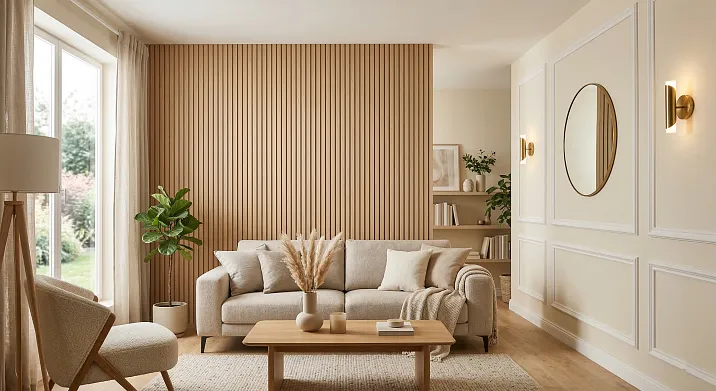
Warmth in an interior isn't about air temperature. It's what you feel from the threshold: a material that breathes, a color that doesn't overwhelm, a texture that draws the eye, not repels it. It's this very sensation that millions of people seek when choosing finishes for their homes. And that's why wooden textures on walls remain one of the most enduring demands in interior design—regardless of changing trends, regardless of the popularity of Scandinavian minimalism or industrial loft style.
Wood-look slatted wall panels are the answer to this demand in its most convincing form. Not a wooden imitation on wallpaper, not a laminated film on drywall, but a three-dimensional rhythmic relief of slats with a natural or nature-like texture. And alongside—Polyurethane wall decor: moldings, cornices, trims, frame elements that transform a warm surface into an architecturally organized space.
Together—it's not just a renovation. It's an interior system capable of working in any room, at any scale, in any style—from a rustic chalet to urban neoclassicism.




Why the wooden pattern works in interiors forever
Before discussing materials and techniques, it's worth answering a fundamental question: why does wood grain continue to work? Why, in an era of concrete surfaces, metal accents, and monochrome minimalism, does wooden texture remain in fashion?




The Neural Nature of Warmth
The human brain is evolutionarily tuned to react positively to natural materials. A wooden surface is not an abstract pattern but a biologically familiar texture associated with shelter, protection, and nature. Neuroscience has long confirmed: the presence of natural textures in living spaces reduces cortisol levels, slows the pulse, and improves the subjective feeling of safety.
This is not an aesthetic judgment—it's physiology. That's why wooden walls in a bedroom work differently than painted concrete: not better or worse in the abstract, but precisely differently—on a bodily level, not just the mind.
Our factory also produces:


The Universality of Tone
The warm tones of wood—from light ash to dark wenge—cover practically the entire spectrum of interior neutral colors. Oak fits into neoclassicism, Scandinavian style, organic modernism. Dark larch or wenge—into art deco, eclecticism, modern classicism. Light pine or birch—into Provence, chalet, rustic. It is this chromatic richness within one natural family that makes wood a material without boundaries of application.
Get Consultation
Relief as Visual Dynamics
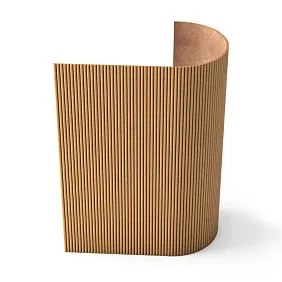
A wall covered with slatted wood-look panels is not a flat plane. It is a surface with vertical or horizontal rhythm that creates dynamics in the space. Even without additional lighting, shadows in the gaps between the slats add depth to the wall. With grazing side light, this depth is multiplied many times over. The wall comes alive—and it is precisely this feeling of a living surface that cannot be reproduced with wallpaper or paint.
Which wood-look panels appear truly convincing
The market for slatted wood-look panels is divided into several categories with fundamentally different quality of results. Let's analyze honestly—without advertising phrasing.
Solid wood slats: nature without intermediaries
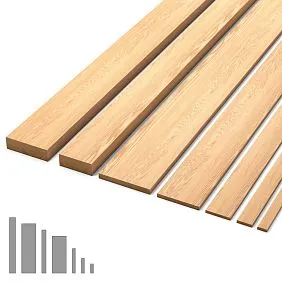
Wooden slat panelsSolid wood — oak, ash, cedar, pine — is the only category where the 'wooden look' is not imitated but is an actual property of the material. Each slat is a unique combination of annual rings, resin channels, and density variations. No printing technology can replicate this character.
Technical specifications of solid wood wall slats:
-
Moisture content after kiln drying: 8–12%
-
Hardness (Brinell scale): oak — 3.7, ash — 4.0, pine — 1.8
-
Density: oak — 680–750 kg/m³, ash — 650–700 kg/m³
-
Reaction to humidity changes: linear (predictable, compensated by proper installation)
-
Service life under normal conditions: 30–70 years
It is solid wood that delivers that very 'living' result, visible in photos and tangible to the touch.Slat panel textureOak is not a film print; it's a three-dimensional structure of the wood itself, changing depending on the cut angle: tangential cut—wide soft bands of annual rings, radial cut—narrow thin pattern with characteristic 'mirrors'.
MDF with veneer: solid wood in a democratic format
MDF slat panels for wallsWith veneer—this is a structural alternative to solid wood. The MDF base (density 700–800 kg/m³) is faced with a thin layer of natural veneer: oak, ash, walnut, cherry, wenge. The veneer preserves the natural texture and tone of real wood, but the MDF base eliminates seasonal movement and ensures perfect geometry.
For interiors where installation precision and dimensional stability are important (especially relevant for non-standard slat lengths), MDF with veneer is often preferable to solid wood.
Limitation: veneer is a thin layer (0.3–0.6 mm), not allowing deep mechanical processing or repeated sanding. If the surface is damaged—replace the slat.
MDF for painting: slat as a blank canvas
paintable slatted wall panels—this is a separate category that does not aim to imitate wood, but creates slat relief in any color. White slats on a white wall—pure geometry, shadow relief. Dark green slats on a dark green wall—monochrome depth. Slats in wood color on a painted background—synthetic imitation, but with the right tone selection—quite convincing.
MDF for painting also allows repainting when changing interior design: new color—new wall without dismantling the slats.
WPC (wood-polymer composite): for wet areas
DCP slatted panels— wood-polymer composite with imitation wood grain — perform in high humidity conditions: bathrooms, pools, saunas, open loggias. The natural pattern is reproduced through surface texturing during extrusion: embossing depth is 0.5–1.2 mm, providing a tactilely recognizable wood texture.
For residential interiors with normal humidity, DCP is less preferable than solid wood or veneer — due to less convincing visual naturalness. But for areas with water exposure, it is the only material in the 'wood-look' family that ensures durability.
Polyurethane wall decor: the architectural framework of a warm space
A slatted surface with wood texture is a lively, natural, expressive element. But without architectural organization, it remains merely a texture — rich but unstructured.Polyurethane wall decor— moldings, cornices, casings, framing elements — these are what transform a textured surface into an architecturally structured space.
What polyurethane wall decor does
Imagine a wall without any organizing elements. The slatted surface occupies the entire field — from baseboard to ceiling. This can be beautiful. But it's a statement without punctuation: powerful but lacking structure.
Now imagine the same wall with a horizontal molding at 100 cm height, dividing the lower slatted section and the smooth upper part. With a cornice at the ceiling, creating a clear horizon. With a framing molding around the perimeter of the slatted field. This is no longer just a surface — it's an architectural page with margins, a header, and paragraphs.
Polyurethane wall moldingperforms exactly this function: organizes, frames, highlights. Does not compete with wood texture — creates context for it.
Moldings: lines that organize space
A horizontal wall molding is a horizon. A line that the eye perceives as a spatial reference point. At a height of 90–110 cm (table height, windowsill height, chair back height), the molding creates a 'belt' — a visual separation between the lower, heavier part of the wall and the upper, lighter part.
For a wall with wood-look slatted panels, the molding serves another purpose: it fixes the upper boundary of the slatted field, turning it into a clearly defined architectural element, rather than a 'blurred' wooden surface without borders.
Molding width for a wall with slats: proportional to the slat width. Thin slats (20–30 mm) — molding 40–60 mm. Wide slats (50–80 mm) — molding 80–120 mm. Proportion rule: the molding should not be narrower than the slat and should not exceed twice the slat width.
Door Casings and Trims: The Door as an Architectural Event
Polyurethane decorative molding for wallsincludes elements for framing openings — casings, corner blocks, keystones. In a space with wooden slatted panels, a door opening without a casing is an unfinished detail. A polyurethane casing with a classic profile transforms a door from a technical hole in the wall into an architectural portal.
The combination of a warm wooden wall surface and a white classic casing is one of the most enduring design techniques. White decor on warm wood — a contrast of cold and warm, precise and organic — creates that very 'interior formula' which is easy to replicate but hard to ruin.
Cornices: The Finishing Touch Without Which the Ceiling 'Falls'
The junction of the wall and ceiling without a cornice is a technical, rough transition. Especially jarring when the lower part of the wall is rich with the texture of wooden slats: the wooden surface deserves a worthy finish, not a ragged edge.
A polyurethane ceiling cornice at the transition height creates a horizontal architectural accent, 'closing' the slatted wall from above and 'opening' the ceiling. It is precisely the cornice — that element which completes the vertical story of the wall and begins the horizontal story of the ceiling.
For walls with wooden slats: cornice in white or cream tone (contrasting) or in wood-tone finish (monochromatic). White cornice is a classic. Wood-tone cornice is a more complex, introverted solution.
Warm texture and clear architectural graphics: how these two coexist
This is the main design tension when working with wooden slats and polyurethane decor. Wood is living, organic, with natural variability. Polyurethane molding is precise, geometric, uniform. How to reconcile two such different participants in the spatial dialogue?
The principle of contrast as a stylistic choice
The contrast between the living and the precise is a conscious technique that creates tension, which reads as architectural complexity. A wooden slat with the living texture of oak framed by precise white molding is a dialogue between nature and architecture. They do not match—they complement each other.
This principle works in neoclassicism: warm wooden slats on the lower part of the wall, white cornices and moldings creating an order system. The naturalness of wood does not conflict with the classical precision of decor—it humanizes it, makes the space living, not coldly academic.
The principle of monochrome as an alternative
Alternative approach: molding in wood tone. Cornice painted in the same warm cream shade as the slat finish. Molding in a shade echoing the color of wooden frames. Here, contrast is removed—the decor 'dissolves' into the overall warm background, creating monochromatic depth.
This approach is preferable for bedrooms, where peace is important, and for studies, where concentration is needed. Too active decorative contrast in a rest space creates constant visual stimulation—monochrome removes it.
The rule of scale harmony
Thin battens (20–25 mm) require thin, delicate decor: molding 40–50 mm, cornice 60–80 mm, trim 50–60 mm. Wide battens (60–80 mm) are compatible with more developed decor: molding 100–130 mm, cornice 120–160 mm. A scale mismatch—thin battens with heavy plaster cornices or wide battens with toy-like molding—creates dissonance that undermines the concept.
Room-by-room approach: what works where
Each room imposes its own requirements for combining wooden battens and polyurethane decor. One system—different adjustments.
Bedroom: warmth without overload
slatted panels in the bedroom— one of the most in-demand requests in residential design. A wooden wall behind the bed headboard creates a 'forest cabin' effect—security, coziness, natural tranquility.
Recommended solution for the bedroom:
-
Wall behind the headboard: vertical ash or oak battens with oil finish in a light natural tone. Batten width—30–40 mm, gap—8–10 mm. Height—from floor to ceiling, or a zoned belt 120–150 cm high.
-
Molding around the perimeter of the batten field (if a zoned belt): white or cream, width 60–80 mm.
-
Ceiling cornice: thin, 60–80 mm, without complex ornamentation. Matte white.
-
Side walls: neutral warm tone (cream, baked milk, warm gray). No additional relief.
What to avoid: dark battens in a small bedroom — they feel oppressive. Wide horizontal battens behind the headboard — they 'horizontalize' the space, creating a sense of a low ceiling.
Living room: a balance of expressiveness and tranquility
Slatted panels in the living room interiorwith a wooden texture work on two fundamentally different walls: the wall behind the sofa and the TV wall.
The wall behind the sofa is the main decorative scene of the living room. Vertical oak or ash battens in a natural tone across the full width and height. Horizontal molding near the ceiling, a cornice with a classic profile.
TV wall — a functional and aesthetic task simultaneously. Dark battens behind a dark screen create a unified dark accent: the screen doesn't stand out from the wall but 'grows' out of it organically.slatted panel for the televisionwith a wooden texture — this is both function (to hide wires and a bracket in the wooden relief) and aesthetics (to create a natural background for a technical object).
Polyurethane decor in a living room with wooden battens: a ceiling cornice around the entire perimeter — mandatory. A horizontal dividing molding — desirable. Pilasters on smooth side walls — with ceilings from 2.9 m. A ceiling rosette — if there is a central chandelier.
Study: concentration through relief
A study with wooden batten panels — a space where natural texture creates the feeling of a 'library study': seriousness, depth, concentration. Dark battens (walnut, wenge, dark oak) on two walls,Decorative slatted wall panelswith a characteristic texture — this is a visual code of status and focus.
Polyurethane decor in the study: a coffered ceiling made of frame moldings is one of the most effective techniques. It organizes the ceiling, adds monumentality, and creates a sense of a 'work hall' rather than just a room with a computer.
Hallway and corridor: slatted rhythm in a transit space
Slatted panels in the hallway interior— a task with specific conditions. The hallway is a narrow, often low room where every square centimeter counts. Wooden slats work here in two ways:
-
Full height on one wall (the long wall of the corridor) — vertical rhythm stretches the space upward, visually increasing the height
-
Lower belt 90–100 cm + divider molding + smooth upper part of the wall — a classic 'two-tier' system that provides structure without overload
Polyurethane decor in the hallway: a thin cornice at the ceiling (creates an upper line that organizes the transit space), horizontal molding at the dividing line between the slatted belt and the smooth wall. Door trims on doorways are mandatory if there are several doors: without them, the hallway looks like a set of holes in the walls.
Kitchen: wooden texture in a high-demand zone
Slatted panels in the kitchen— wood-like — a common request requiring a special response. The kitchen is an environment with grease vapors, steam, and temperature fluctuations. Wooden slats in the dining area of the kitchen are quite appropriate provided proper coating (polyurethane varnish or wax oil — at least three layers). Slats in the work area above the stove are undesirable: grease mist penetrates the gaps, and regular cleaning of the slatted surface is labor-intensive.
Compromise:Wooden slat panels— in the dining area + neutral finish in the work area. A divider molding between the zones marks the boundary and creates clarity.
Mistakes of Cheap Imitation: How Not to Ruin an Idea
Wood texture in interior design is a powerful tool. But it is precisely this element that reacts most painfully to execution errors. Cheap wood imitation looks worse than an honestly painted surface. Let's examine typical mistakes.
First mistake: laminated film instead of veneer or solid wood
Slats with laminated film featuring a printed 'wood-like' pattern are the most common and most destructive mistake. The film imitates the wood grain pattern, but not its texture: the surface is smooth, glossy, or semi-glossy. Under side lighting, the film's glare immediately reveals its synthetic nature.
Furthermore, laminated slats often have a repeating pattern: the same fragment of the design is reproduced every 50–80 cm. On a long wall, this is noticeable—and looks like a cheap deception.
If the budget is limited and solid wood is not an option—it's better to use MDF slats for painting in a neutral color than laminated imitation. An honest material is always more convincing than a fake one.
Second mistake: an excess of dark wood texture in a small space
Dark walnut or wenge in a small room of 14–18 m² is an aesthetic courage that requires professional design. Without sufficient lighting, without light compensating surfaces, without properly chosen furniture—dark wood slats on three walls will create a cave-like feeling, not a cozy space.
Rule: dark wood texture—on one accent wall. The remaining surfaces—light and neutral. Ceiling—white or light cream. Compensation for the dark relief—multi-layered lighting with accent fixtures.
Third mistake: slats with an incorrectly selected coating tone
Ash slats coated with 'golden oak' stain are an attempt to achieve a warm tone through coating rather than the material's natural properties. The result is often unnatural: stained ash does not look like oak—it looks like ash in the 'wrong' color.
Rule: staining should reveal the natural texture, not mask it. 'Light walnut' oil on oak brings out the wood's natural golden tone. The same oil on birch creates a synthetic 'candy-like' effect.
Fourth mistake: polyurethane decor that doesn't fit the theme
Wooden slats in Scandinavian style (light ash, minimalist shapes) and a heavy Baroque cornice with acanthus leaves—this is a clash of two incompatible cultures. Scandinavian style requires a thin, almost invisible cornice or its complete absence. Classic style with wide slats requires an elaborate cornice with ornamentation.
Polyurethane decor should be stylistically consistent with the character of the slat panels, not chosen based on 'looking beautiful on its own.'
Fifth mistake: lack of finishing elements
A slatted surface without baseboards, without a ceiling cornice, without door/window casings—is an unfinished job. Every untreated joint screams that the renovation wasn't completed. PreciselyPolyurethane wall moldingin the form of baseboards, cornices, moldings—this is the finishing layer that gives the entire system completeness.
Technical selection parameters: table
| Parameter | Solid oak/ash | MDF with veneer | MDF for painting | DPC |
|---|---|---|---|---|
| Natural texture | Genuine | Natural (veneer) | No | Embossing |
| Moisture resistance | Medium | Low–medium | Low | High |
| Durability | 30–70 years | 15–25 years | 15–20 years | 25–40 years |
| Reaction to humidity | Present | Minimal | Minimal | No |
| Repainting | No | No | Yes | No |
| Repairability | High | Medium | High | Low |
| Price | High | Medium | Medium–low | Medium |
Installation: what's important to know before starting work
Wall finishing with slatted panelsunder wood is a process that requires preparation, which cannot be shortened without losing the quality of the result.
Acclimatization. Solid wood slats are kept in the room without packaging for 48–72 hours before installation. This allows the material to reach equilibrium moisture content under specific conditions and avoid deformation after installation. For MDF, acclimatization is less critical but still recommended — 24 hours.
Wall preparation.How to install slatted panelsCorrect? The first condition is a clean wall without dust and peeling layers. The wall is primed with deep-penetrating primer. For significant unevenness (more than 5–7 mm) — installation on a frame to level the geometry.
Fastening method. Solid wood — clips on a frame (compensate for seasonal movement). MDF — MS-polymer adhesive + finishing nails. Important: the first and last slats are always additionally secured — they bear greater load during deformations.
Installation of polyurethane decor. Moldings and cornices are glued with acrylic mounting adhesive. Corner joints of cornices — at 45° (strictly, otherwise a gap in the corner). For long runs of molding (more than 3 m) — additional fastening with dowel-nails every 60–80 cm.
Finishing of joints. After installation, all joints between molding and wall, between cornice and ceiling — are sealed with acrylic sealant. Sealant — not just for aesthetics: it prevents dust and moisture from entering the joints.
Frequently Asked Questions (FAQ)
Can wood-look slatted panels be used in a children's room?
Yes, and it's an excellent solution. Natural wood texture in a children's room creates a calm atmosphere. Solid pine is an eco-friendly option with a natural scent. MDF for painting allows updating the color as the child grows. Important: the coating on slats in a children's room — only non-toxic water-soluble oil or certified acrylic lacquer without formaldehyde.
Are wood-look slatted panels suitable for rental housing?
Installation with adhesive in rental housing is not advisable. Alternative:slatted modular wall panelon a frame with dry installation — can be dismantled without damaging the wall. Polyurethane decor in rental housing is categorically impractical: removal without traces is impossible.
How to care for wooden slatted panels on walls?
Wipe with a damp (not wet!) cloth as needed. Gaps between slats - use a soft brush or vacuum with an attachment. Renew oil finish - every 5-7 years. Lacquer finish requires no maintenance except wiping.
Does a wooden slatted surface affect room acoustics?
Yes, positively. Wooden slats with gaps act as an acoustic diffuser: they reduce reverberation and eliminate 'echo' in the room. For additional acoustic effect, sound-absorbing material (acoustic mineral wool or felt) is placed behind the slats.
How much does wall cladding with wood-look slatted panels cost?
Guidelines: solid oak slats - from 1500 to 5000 rub./linear m. MDF with veneer - from 600 to 2500 rub./linear m. MDF for painting - from 300 to 1200 rub./linear m. Polyurethane molding - from 300 to 2000 rub./linear m. Installation - from 800 to 2000 rub./m². Budget for a complete 'slats + decor' system for a 25 m² living room - from 80,000 to 350,000 rub. depending on chosen materials.
Is a vapor barrier needed behind wooden slats on walls?
In living spaces with normal humidity (up to 60%) - no. A vapor barrier is only necessary in rooms with constantly high humidity (bathroom, sauna) - but there, WPC or aluminum is used instead of wooden slats. In bedrooms and living rooms, a vapor barrier behind wooden slats is not needed.
STAVROS: warmth that never goes out of style
Wood texture in interior design is a choice in favor of the natural. A choice in favor of a material that doesn't lose value over the years, but rather gains it. The patina of time on a wooden surface is not wear, it's a biography.
STAVROS producesRafter panelsmade from solid oak, ash, cedar and other species with precise control of humidity, geometry, and finish. Each slat is ready for installation, ready for life in an interior that doesn't need to be changed in three years.
STAVROS producespolyurethane decorative molding for walls— cornices, moldings, trims, baseboards — with casting precision sufficient for a classic interior of any complexity level.
Warm wood-look slats plus precise polyurethane decor — this is not a random combination. It is a system that STAVROS creates with the understanding that a good interior begins with the right materials.
STAVROS. Nature, organized by architecture.


