Article Contents:
- Why slatted panels and wooden skirting are better chosen together
- Types of slatted panels: solid wood, MDF, interior slat
- Slatted panels made of solid oak
- Primed MDF slatted panels
- Interior slat
- Which wooden skirting suits slatted panels
- Solid wood skirting: oak, beech, hardwoods
- Skirting height: from 60 to 150 mm and above
- How to match skirting height to slat width and rhythm
- Batten width and skirting proportion
- Vertical battens and high skirting: when it works
- How to combine color, texture and wood tone
- Three color combination strategies
- White battens and wooden skirting
- How to design the joint between batten panel and skirting
- Three abutment node options
- Where this solution works best
- Living Room: Accent Wall and TV Zone
- Bedroom: tranquility and proportionality
- Entryway: First Impression
- Study: rigor and materiality
- Columns, niches, arches
- Mistakes that make the interior look random
- Mistake 1: different wood tones for battens and baseboard
- Mistake 2: baseboard too low for tall battens
- Mistake 3: too frequent batten spacing in a small room
- Mistake 4: unaccounted gap between batten and baseboard
- Mistake 5: mixing decor styles
- Mistake 6: ignoring corners
- MDF and solid wood in one interior: can they be combined?
- Installation: what's important to know at the planning stage
- Slatted panels and wooden skirting: application styles
- Modern classicism
- Minimalism and Scandinavian style
- Neoclassicism
- Eco-style and natural materials
- FAQ: answers to common questions
- Conclusion: a system that works
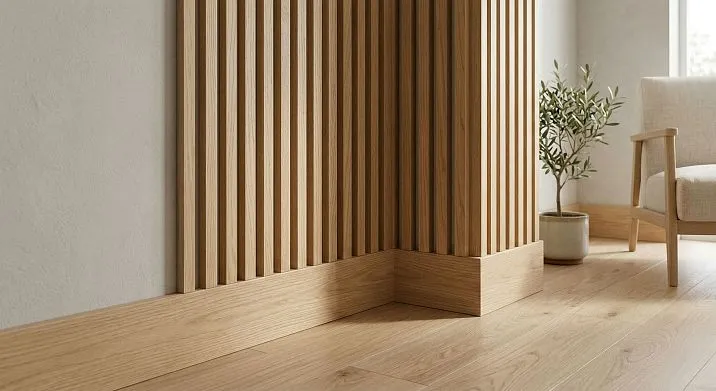
There is one question almost everyone asks when starting a slatted finish: 'What kind of skirting should I put with them?' It sounds simple, but behind it lies a whole system of decisions—about height, tone, material, the joint detail, and how to keep it all from falling into disarray. When slatted panels and wooden skirting are chosen correctly, the interior reads as a single architectural idea. When they're not—the wall lives on its own, the floor on its own, and no expensive finish will save the situation.
In this article—a professional breakdown: how to combinesolid wood and MDF slatted panelswith wooden skirting, how to choose proportions, how to design the floor joint, and what mistakes ruin the whole concept even at the selection stage.




Why it's better to choose slatted panels and wooden skirting together
Many start with the panels, order the slats, install them—and only then think about the skirting. This is the wrong sequence. Not because it can't be done, but because in this case the skirting will always be 'catching up' to the already-made decisions on color, texture, and proportions. The result is a visual break between the wall and the floor, which is felt even when you can't put it into words.
The correct logic is different: wall slatted panels and skirting are a single horizontal system. The skirting is the lower boundary of the wall. The slats are its vertical rhythm. If the boundary and the rhythm speak different languages, the space loses its integrity.
Let's consider specifically what this means:
-
By height: a tall, wide baseboard sets the scale for the battens. Under a low baseboard, battens look 'lost'.
-
By tone: the baseboard and battens don't have to be identical, but should be within the same tonal range.
-
By material: solid wood to solid wood, MDF to MDF — this rule isn't strict, but breaking it requires a conscious approach.
-
By profile: the baseboard profile determines how the bottom joint of the batten panel looks. An incorrect profile creates a gap, shadow, or sloppy abutment.
Understanding this changes the approach to purchasing:solid wood baseboard— it's not an 'add-on' to the finish, but its structural part.




What types of batten panels exist: solid wood, MDF, interior batten
Before choosing a baseboard, you need to clearly understand what type of batten panels you're working with. This affects everything: the choice of baseboard material, its height, and the method of finishing the bottom joint.
Our factory also produces:

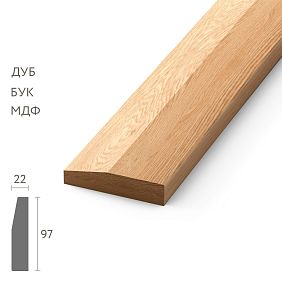


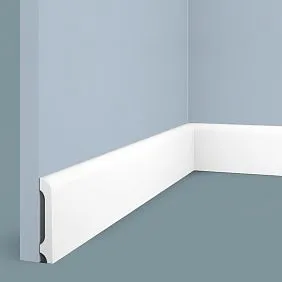
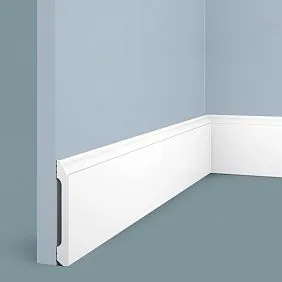
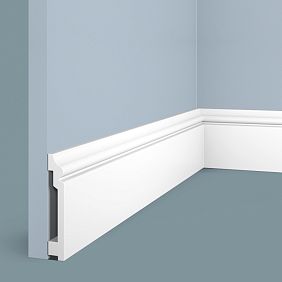
Solid oak slat panels
This is the most noble and durable option. Oak solid wood battens have an expressive natural texture that reveals itself differently with various finishing methods: with oil, wax, varnish, stain. Oak is a hardwood; battens made from it practically don't deform with humidity changes if installation conditions are met.
Solid wood slatted panels are installed on walls, furniture fronts, columns, niches, and arches. When arranged vertically, the slats create a visual effect of stretching the space upward. When arranged horizontally, they expand the room and add a sense of calm.
For solid oak, it is logical to choose a wooden floor skirting made from the same material—oak. This ensures not only visual but also material unity: the same texture character and an identical reaction to tinting.
Get Consultation
Primed MDF slatted panels
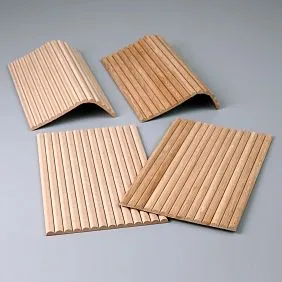
MDF panels are a structure of slats on a backing, where the slats are made of MDF or have a veneer coating. Primed panels are supplied for painting, which opens up wide possibilities for color tinting. White slatted panels are one of the most popular modern requests.
Rigid slatted panels on an MDF backing ensure maximum geometric accuracy and allow working with flat walls without a frame. They are used for finishing living rooms, bedrooms, studies, and furniture fronts. For MDF slats intended for painting, it is logical to choose an MDF skirting or a wooden beech skirting with subsequent painting in the same color—this creates the effect of a monolithic wall bottom line.
Interior slat
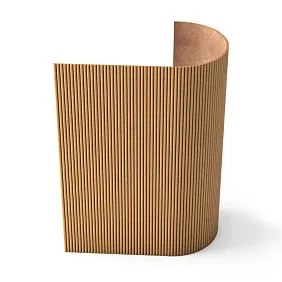
An interior slat is a separate wooden plank that is mounted on a wall with a specified spacing. Unlike a panel, it is not a ready-made module but an individual assembly. The advantage is the freedom to choose the spacing, width, and height of the slats, as well as the ability to work on non-standard surfaces: columns, curved walls, arches.
Interior slats made of oak or beech provide maximum control over the result but require precise installation. The bottom joint is especially important: how the slat ends at the floor and how the skirting adjoins it.
For detailed information on the types, construction, and application of slatted panels, see the article "Wall Slatted Panels in Interior Design"— scenarios for the living room, bedroom, hallway, and TV zone are also covered there.
Which wooden skirting board suits slatted panels?
Choosing a skirting board is the first professional question after determining the type and material of slatted panels. Here, it's important to understand several things simultaneously: material, height, profile, and mounting method.
Solid wood skirting board: oak, beech, hardwoods
solid wood baseboard— it's not just a 'strip along the floor.' It is both a structural and decorative element simultaneously. It conceals the technological gap between the wall and the floor covering, forms the lower horizontal boundary of the wall, and sets the scale for the entire vertical solution.
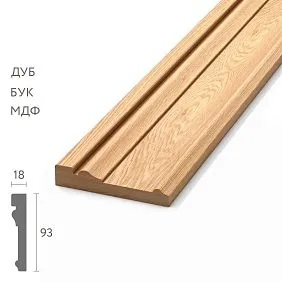
In the STAVROS catalog, wooden skirting boards are available in several profile variants:
-
Classic European profile with soft roundings — for classic and neoclassical styles
-
Modern rectangular profile with sharp edges — for modern classic and minimalism
-
Profile with decorative grooves and protrusions — for interiors with a pronounced architectural character
-
Triangular skirting board — for creating special accents in the area where the wall meets the floor
Oak skirting board is the most sought-after option in the natural wood segment. It has a characteristic, easily recognizable texture, takes well to tinting, and lasts for decades without losing its appearance. Beech skirting board is more uniform in structure, softer in visual character, ideal for interiors in the Scandinavian spirit or modern neutral classic.
Skirting board height: from 60 to 150 mm and above
Height is the key selection parameter. It determines how the skirting board will relate to the height of the slatted panels and the height of the room.
Practical guidelines:
| Ceiling Height | Recommended skirting board height |
|---|---|
| Up to 2.5 m | 60–80 mm |
| 2.5–2.8 m | 80–100 mm |
| 2.8–3.2 m | 100–130 mm |
| 3.2 m and above | 130–150 mm and more |
If the slatted panels cover the entire wall height from floor to ceiling — the skirting board can be slightly above standard to emphasize the lower boundary. If the slats go up to a height of 1.2–1.5 m as a lower panel — the skirting board should be proportionate to that panel: a wide skirting board with low slats will create visual overload.
How to match skirting board height to slat width and rhythm
This is the question most people answer incorrectly: 'choose a tall skirting board, it's always better.' Not always. A tall skirting board works well precisely when it is proportionate to the other elements. If the slats are narrow (20–25 mm) and placed frequently — a wide, massive skirting board starts to compete with them. A conflict of scale arises.
Slat width and skirting board proportion
Narrow slats (15–25 mm) with a frequent pitch (30–40 mm) create a fine rhythm. Such a surface is perceived as a texture, not as a set of individual planks. A medium-height skirting board (80–100 mm) with a simple, unpretentious profile works well with such a rhythm. It holds the lower boundary without overpowering the fine rhythm of the slats.
Wide slats (40–60 mm) with a sparse pitch (50–80 mm) create a large, calm rhythm. Here, a tall skirting board (100–150 mm) with a more pronounced profile is appropriate. The proportions match — and this creates a sense of proportionality.
Vertical battens and high skirting: when it works
Vertical battens draw the eye upward. A high wooden skirting at the bottom balances this dynamism—it creates a visual 'anchor' that prevents the space from 'flying' vertically upward. This is especially important in rooms with a ceiling height of 3 meters or more: there, vertical battens without a wide skirting create a sense of slight discomfort—the space seems unstable.
Trim products made of oak, beech, and MDFIn the STAVROS catalog, they are presented in a wide range of heights—from modest 60 mm to expressive 150 mm. This allows for precise matching of the desired proportion regardless of the room's parameters.
How to combine color, texture, and wood tone
Color is not just about aesthetics. It's also an SEO question: 'how to match the color of the skirting to the battens' is one of the most frequent queries on this topic. Because it's precisely with color that most people make mistakes.
Three color combination strategies
Strategy 1: Tone-on-tone.
Battens and skirting in the same wood shade—the most calm and fail-safe solution. If the battens are oak, tinted medium-brown, a skirting made of oak in the same tone creates a monolithic surface. The eye doesn't catch on the transition—it perceives the wall and floor as a single volume.
Strategy 2: Contrast in tone.
Dark battens and a light skirting (or vice versa)—this is a deliberate architectural gesture. It works in modern and Scandinavian interiors, where contrast is part of the design language. White batten panels and a dark wooden skirting—a classic pair for a modern minimalist interior. Dark oak battens and a white skirting—also a viable option, but requires precise 'fitting' at the transition.
Strategy 3: Close but different shades.
This is the most difficult and often unsuccessful strategy. Oak-look slats and walnut-look skirting are two similar warm browns that slightly diverge. It creates a feeling of 'missed the mark,' even though each element is beautiful on its own. If you are not sure the tones will match exactly — choose either the same material with the same tint, or a deliberate contrast.
White slats and wooden skirting
It's worth examining today's most popular combination separately: white MDF slatted panels and solid wood skirting in a natural tone. This combination works brilliantly — the white slats create a light, airy rhythm on the wall, while the wooden skirting at the bottom 'grounds' it, adding warmth and materiality. The key condition: the skirting must be clean, without stains or dark streaks — the wood grain should be uniform and expressive.
How to design the joint between a slatted panel and skirting
This is a technical but extremely important question. It is precisely in the joint area between the slat and the skirting that most installation errors are concentrated — and it is here that the interior can visually 'break down'.
Three options for the abutment joint
Option 1: Classic separate installation.
The skirting is attached to the wall at the floor. The slatted panel is installed above — starting from the top edge of the skirting. Between the skirting and the bottom end of the slat — there is either a zero gap (the slat rests on the skirting) or a small technical offset of 5–10 mm.
This is the simplest solution. Works well if the skirting has a flat top surface and the slats are aligned precisely. With a crooked wall or imprecise installation, it creates a gap that is clearly visible under angled lighting.
Option 2: Integrated system.
The skirting board serves as the bottom guide for the slats. Grooves are milled into its top surface with a pitch corresponding to the pitch of the slats. The lower ends of the slats are inserted into the grooves and secured. This is a monolithic system without visible joints — the cleanest and most professional solution.
Technically requires planning at the stage of selecting the skirting board: its top surface must be horizontal and wide enough for milling grooves. A wide wooden skirting board (from 100 mm in height) provides the necessary area for this.
Option 3: Finish transition molding.
If a gap has formed between the lower edge of the slatted panels and the upper edge of the skirting board — it is covered with a small horizontal molding. This is a 'secondary' solution, but with the right choice of molding, it can become a decorative element, not just a cover-up.
Decorative wooden inlaysand moldings from the STAVROS catalog can be used precisely in this role — as a finishing element completing the lower node of the slatted system.
For details on working with floor and wall geometry — in the article"Floor and Wall Geometry: Working with Skirting Boards, Slats, and Profiles": specific technical solutions for different types of junctions are discussed there.
Where this solution works best
Batten panels with wooden skirting — a versatile tool, but it works differently in every room. Let's break down the key scenarios.
Living room: accent wall and TV zone
Living room — the main place for applying batten panels. The most common scenario is an accent wall behind the TV. Vertical battens from floor to ceiling or up to a height of 2.4–2.6 m, with a wide wooden skirting board along the lower perimeter.
For the TV zone, the joint between the battens and skirting is especially important: the TV is a low accent, the gaze drops to the lower part of the wall, and any carelessness in the abutment joint becomes obvious. An integrated skirting-guide in this scenario is the most professional solution.
As for color: warm oak tones in the living room work flawlessly. Solid oak battens, tinted in medium honey or deep cognac, paired with an oak wooden skirting in the same shade — this is a winning pair for a living room in the style of modern classic or neoclassicism.
Bedroom: silence and proportion
In the bedroom, batten panels and skirting work in a mode of calm. Here, dynamism and saturation are not needed — soft texture is important here. MDF battens for painting in shades of 'white linen' or 'pearl gray', beech skirting in a natural tone or also painted — this pair creates a feeling of air and tranquility.
The height of the skirting in the bedroom is moderate. 80–100 mm is enough. An excessively high skirting in a small bedroom puts pressure on the space.
Entryway: first impression
Hallway — the zone of first contact with the home. It is here that vertical battens work for maximum effect: they visually stretch the ceiling, adding a sense of spaciousness. Batten panels in the hallway often run along the entire perimeter — and in this case, a continuous wooden skirting that 'ties' all the walls into a single contour is especially important.
A detailed breakdown of the application of batten panels in the hallway — in the article "Batten panels in the interior of the hallway: the architecture of first impression"where the best materials, shades, and solutions for the entrance area are discussed.
Study: Strictness and Materiality
In the study, solid wood slatted panels are the most organic choice. Oak with a rich stain or natural tone creates an atmosphere of substance and seriousness. A solid wood floor skirting board is a mandatory element in this scenario. Here, the skirting is perceived as a plinth, the base of the wall, and its materiality matters.
The height of the skirting in the study is from 100 mm. The profile is strict, with clear horizontal divisions. The slats can run from the skirting to the cornice or molding belt at a height of 2.1–2.4 m.
Columns, Niches, Arches
These are special zones where slatted panels work under non-standard conditions. On cylindrical columns, interior slats are used—flexible or cut to size to fit the curvature of the surface. How to decorate arches with moldings and decorative elements is covered in a separate article."How to Decorate Arches with STAVROS Moldings".
In niches and reveals, slatted panels create a special effect: the depth of the niche becomes an expressive element, and the slats enhance its three-dimensionality. In such cases, the skirting can run around the perimeter of the niche or end at its threshold—both solutions are acceptable.
Mistakes That Make an Interior Look Random
This is practically the most important section for those who have already seen beautiful pictures with slats and want to reproduce them in their own home. The gap between 'a beautiful picture' and 'a beautiful result in my home' is almost always explained by one of these mistakes.
Error 1: different wood tone between slats and baseboard
Slats in 'natural oak', baseboard in 'bleached oak' — two different oaks in one space. Even if each element is good on its own, together they create a feeling of 'unfinished'. The tone should be either identical or intentionally contrasting — there is no place for half-tones here.
Error 2: baseboard too low for tall slats
If slat panels run from floor to ceiling, a baseboard 40–50 mm high disappears against a three-meter slat surface. It ceases to be a structural element and turns into an invisible technical strip. The baseboard should be noticeable — it holds the lower boundary of the wall.
Error 3: slat spacing too frequent in a small room
Frequent spacing with narrow slats creates visual 'noise' in small rooms. A fine rhythm fragments the space. In rooms up to 12–14 sq. m, a wide slat spacing (from 60–80 mm between slats) and a larger cross-section of the slats are recommended.
Error 4: unaccounted gap between slat and baseboard
If the slat ends 10–15 mm above the baseboard — visually this is a gap. It is especially noticeable with side or floor lighting. Solution: either the slat sits tightly on the top end of the baseboard, or the gap is intentionally covered with a horizontal molding.
Error 5: mixing decorative styles
Slats in a Scandinavian spirit, a baseboard with a classic shaped profile, overlays in Baroque style — all of this in one space creates stylistic confusion. A decorative element should belong to one stylistic register.Decor for Moldingshould be chosen in the same style as the slats themselves.
Mistake 6: ignoring corners
The corner is the most vulnerable point of a slat system. How do slats join at an internal corner? How do they navigate an external corner? If there's no answer before installation — gaps, misalignments, and cuts are inevitable in the corners. Planning corner solutions is part of preparation, not on-site improvisation.
MDF and solid wood in one interior: can they be combined?
This is a practical and frequent question. Can you use MDF slat panels on the walls and a solid wood baseboard at the floor?
Answer: yes, provided tonal and stylistic consistency is maintained. MDF and solid wood are different materials with different textures. If both are painted the same color (e.g., matte white) — the difference is practically unnoticeable. If the MDF is painted and the solid wood baseboard is left in its natural tone — an interesting contrast arises: a cold wall plane and a warm, living lower border.
Important: if the MDF slats are painted, then the solid wood baseboard under the same color must be painted the same way — matte to matte, satin to satin. Different levels of sheen create the effect of 'different materials,' even if the color is identical.
The specifics of combined use of MDF baseboards and natural wood slats are detailed in the article"MDF Baseboards and Natural Wood Slats".
Installation: what's important to know at the planning stage
Installation of slatted panels and wooden skirting boards is a topic covered in detail in separate guides. Here we will only outline the key points that affect the final appearance:
Installation sequence. First the skirting board — then the slats. This is the rule. The skirting board defines the lower horizontal line from which the slats are aligned. The reverse sequence leads to having to 'fit' the skirting board after the fact — and this is always worse.
Wall leveling. Solid wood skirting board requires a level base at the floor. If the wall is uneven — the skirting board either gaps or pulls away. Leveling with putty or underlayment is a mandatory step.
Acclimatization of solid wood. Solid wood skirting board and solid wood slats should spend 2–3 days in the room before installation. This allows the material to adapt to humidity and temperature, avoiding subsequent deformations.
Fastening. Solid wood skirting board is fastened with liquid nails and/or finish nails with a nail setter. Slatted panels — on a frame or directly on the wall depending on the type of construction. Tips on installation techniques and working with wood are collected in the section"Finishing and Installation Tips".
Slatted panels and wooden skirting board: style applications
One of the strengths of this finishing system is its stylistic versatility. Slatted panels paired with a wooden skirting board work in very different design directions.
Modern classic
Vertical solid oak slats, wide wooden skirting board with a European profile, warm walnut-honey toning. This is an interior that is both warm and architectural. The slats provide rhythm, the skirting board provides a base, together they create a wall with 'weight' and character.
Minimalism and Scandinavian style
White or light gray MDF slatted panels, beech wooden skirting board in a natural or slightly bleached tone. Minimum details, maximum purity of lines. Here it is important that the skirting board has a strict rectangular profile — any figured relief will disrupt the laconicism.
Neoclassicism
In neoclassical style, slats can alternate with molding frames on the walls. The wooden baseboard is tall (100–130 mm), with a pronounced profile. It organically adjoinsDecorative wooden inlayson furniture and doors — a unified ornamental language permeating the entire space.
Eco-style and natural materials
Slats in natural wood without staining or with minimal oil treatment, a wooden baseboard in the same spirit — natural texture, almost without artificial intervention. Such an interior breathes; it conveys the authenticity of the material. This is the most honest and durable solution from an aesthetic standpoint.
FAQ: answers to frequently asked questions
Which wooden baseboard is best to choose for slatted panels?
It depends on three parameters: interior style, slat height, and material tone. For solid oak slats — an oak baseboard of the same or similar tone. For white MDF slats — either a white MDF baseboard or a wooden baseboard in a natural tone for contrast. Baseboard height — from 80 mm with a standard ceiling height.
Can MDF slats be combined with a solid wood baseboard?
Yes, this is a workable combination. The main thing is to coordinate the color and degree of matte finish. MDF for painting and solid wood under the same paint look organic in the same space.
Is a wide baseboard needed for tall slats?
For slats covering the entire wall height (2.4–3 m), a wide baseboard (from 100 mm) is essential — it serves as a visual anchor. For slats up to 1.5 m high — the baseboard can be more modest (60–80 mm) to avoid overloading the lower zone.
How to choose a skirting board color to match the slats?
Three strategies: tone-on-tone (foolproof), deliberate contrast (striking), close but different tones (risky). Do not choose 'similar but not the same'—either match exactly or contrast intentionally.
What to do in corners where slatted panels meet?
Internal corners—slats are cut at 90° and butted together, the gap is covered with corner molding. External corners—slats are cut at 45° or covered with a corner cap. Plan corner solutions before installation begins.
How to finish a slatted panel at the floor?
The optimal option is a skirting board as the lower boundary, with the slats resting on its top edge. For an integrated system—a skirting board with grooves, slats are inserted into the grooves. For separate installation—the gap between the slat and skirting board is covered with horizontal molding.
What slat spacing is better for a small room?
For rooms up to 14 sq. m—spacing of at least 50–70 mm between slats with a slat width of 30–40 mm. Close spacing with narrow slats fragments the space. A larger rhythm 'expands' the walls.
Wooden floor skirting board—which material is more reliable?
Oak—the most durable, resistant to mechanical impact. Beech—softer, slightly less wear-resistant, but more uniform and better for painting. For high-traffic areas (hallway, entrance)—oak is preferable.
Where to buy solid wood floor skirting board?
In the STAVROS catalog, solid wood skirting board is available in a wide range of profiles and heights — from standard to non-standard. Delivery throughout Russia and CIS, order from one linear meter.
Can wooden slats and wooden skirting board be combined with laminate or engineered board flooring?
Yes, and it's a very popular combination. Oak or beech slats on the wall, oak engineered board on the floor, oak solid wood skirting board as the connecting element between wall and floor. A system of three materials from the same wood species is the most harmonious solution.
Conclusion: a system that works
Slatted panels and wooden skirting board in the interior are not two separate choices. It is a unified system for finishing the wall and floor, which either creates a cohesive space or breaks it into fragments. Everything depends on how consciously decisions are made about height, tone, material, and the abutment detail.
Properly selected vertical slats with solid wood skirting board transform an ordinary room into an architecturally precise space. This works in the living room, bedroom, hallway, and study. The main thing is to think systematically, not detail by detail.
The company STAVROS manufactures wooden slatted panels, solid oak and beech skirting boards, moldings, decorative overlays, and millwork products — over 4000 models in 39 product groups. All STAVROS products are made from properly dried wood in a controlled microclimate, ensuring dimensional stability and durability. Production standards are confirmed:the quality of materials and manufacturing approachesare open for review.
Buy wooden slat panels,solid wood baseboardand all related items — from moldings to decorative overlays — can be purchased online with delivery across Russia and CIS countries, directly from the manufacturer.