Article Contents:
- What are slatted furniture panels and why are they underestimated
- Fundamental difference from wall slatted panels
- What are slatted furniture panels made of
- Where slatted furniture panels are used: from kitchen to dressing room
- Kitchen fronts
- Sliding wardrobes and built-in dressing rooms
- Commodes and cabinets
- TV stands and media boxes
- Bar counters and kitchen islands
- How polyurethane decor works on furniture
- What is polyurethane furniture decor
- Types of polyurethane furniture decor
- Color and finish of polyurethane decor
- When combining slats and polyurethane decor is justified
- First condition: scale of the item
- Second condition: stylistic context
- Third condition: hierarchy of elements
- Materials and coatings: what really matters for durability
- Wood: choosing wisely
- Coatings: what protects and what only decorates
- Polyurethane: Parameters Determining Quality
- Subject Decor Mistakes: What Not to Do
- First Mistake: Transferring Wall Logic to Furniture
- Second Mistake: Wrong Glue for Polyurethane
- Third Mistake: Decor on an Unprepared Surface
- Fourth Mistake: Slats Without Acclimatization
- Fifth Mistake: Decor Without a Unified Finishing Concept
- Combinations That Work Flawlessly: Decision Table
- Practical Cases: Three Items — Three Characters
- First Case: 12 m² Kitchen in Organic Neoclassical Style
- Case two: bedroom with a dresser in Japanese-Scandinavian style
- Case three: built-in wardrobe in a classic study
- DIY installation: the sequence that must not be broken
- Polyurethane and wood: two different times in one object
- Frequently Asked Questions (FAQ)
- STAVROS: when the object is more important than the interior
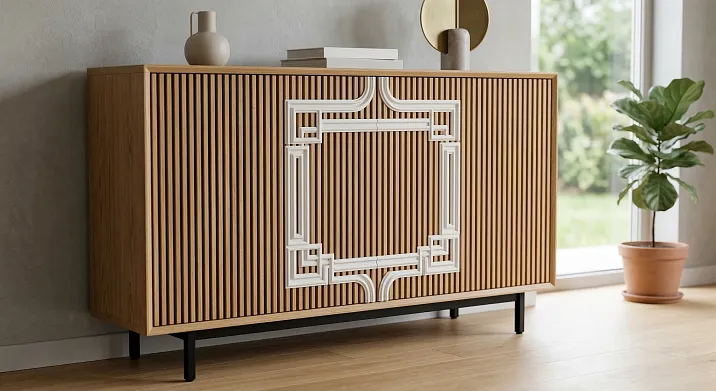
Most people, when starting a renovation or interior update, think about walls, floors, and ceilings. Furniture is perceived as a given—it's bought ready-made, placed in spots, and left untouched. But it is furniture that occupies the central place in the visual field of every room. It is what hands touch, what is seen in the first second upon entering a space. And it is here that a huge potential for transformation lies hidden—without replacing cabinets, without major renovations, without a designer charging by the hour.
Slatted furniture panelsanddecoration for polyurethane furniture—these are two tools that work not with space, but with the object. They complicate the surface, add character to it, make it tell a story—about taste, about style, about the fact that behind this interior stands a person with intention, not just a set of randomly purchased items.
This article is not about how to decorate furniture. It's about how to think of furniture as an architectural object, and how two specific materials help achieve this.



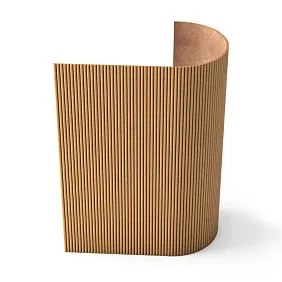
What are slatted furniture panels and why are they underestimated
The term 'slatted panels' is most often associated with walls and ceilings—horizontal or vertical strips of wood on finishing surfaces. But a slatted furniture panel is a different story. Here, the same principle—parallel slats combined into a single system—is applied to the scale and logic of a furniture piece.
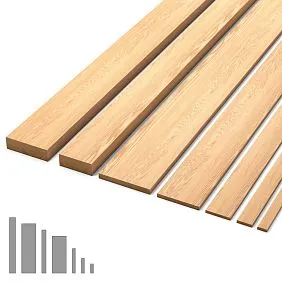
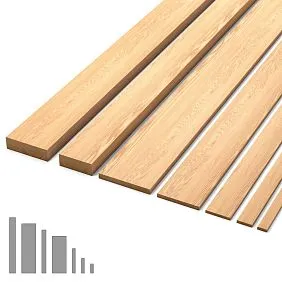
A slatted furniture panel can be a monolithic product: slats already assembled on a common base with a fixed pitch, ready for installation on a facade. Alternatively, these are individual slats made of solid wood or veneered MDF, which are assembled directly onto the base during furniture manufacturing or renovation. In both cases, the result is the same: a facade with a rhythmic, lively, textured surface that carries the natural character of wood.
This tool is underestimated for a simple reason: its visual effect is not obvious in words. Until you see it, you don't understand. But once you see howslatted furniture paneltransforms a wardrobe, chest of drawers, or kitchen facade—there's almost no going back to smooth surfaces. Because smooth looks poor after slatted.




Fundamental difference from wall slatted panels
Wall slatted panels are designed for large planes and function as architectural room finishing. Furniture slatted panels are a different scale. Here, the proportion of the slat to the door size, the precision of the pitch, the quality of the end cut, and compatibility with furniture hardware and hinges are important. A wall slat can be 60–80 mm wide—and that's normal. A furniture slat 60 mm wide on a 45 cm door creates too coarse, fragmented rhythm.
For furniture, the optimal slat width is from 20 to 50 mm. The pitch between slats is from 8 to 20 mm. These parameters provide a rhythm that is neither overloaded nor empty—exactly the kind where the surface is perceived as complex but not heavy.
Our factory also produces:


What furniture slatted panels are made of
Solid wood—an honest, natural material with a lively texture. Oak, ash, birch, walnut, pine, beech—each species with its own character. Solid wood requires acclimatization, finishing, and an understanding that wood is alive: it changes size with the seasons and reacts to humidity. For quality furniture slats, wood with a moisture content of 8–12% is used.
MDF with veneer - MDF slats faced with natural veneer. Less sensitive to moisture and temperature fluctuations than solid wood. Preserve natural texture on the outside with stable geometry inside. A good compromise for mass furniture production.
Painted MDF - MDF slats coated with paint. Fully synthetic nature, but impeccable geometry and rich color selection. Popular in monochrome interiors where color is more important than texture.
WPC - wood-polymer composite - for bathroom furniture, kitchen fronts near the sink, any areas with high humidity. Complete water resistance while maintaining wooden aesthetics.
Get Consultation
Where slatted furniture panels are used: from kitchen to walk-in closet
The scope of application is significantly wider than it seems at first glance. Slatted furniture panels integrate organically into a wide variety of object contexts.
Kitchen fronts
Kitchen - the first place where slatted furniture panels provide maximum visual effect with minimal investment. Lower cabinets with slatted fronts made of wood or painted MDF instantly elevate a kitchen from 'standard' to 'custom-designed'.
Practicality is important here: kitchen fronts come into contact with steam, grease, and accidental splashes. Wooden slats in the kitchen require high-quality varnish or oil coating with a high degree of protection. An alternative is MDF with veneer in matte varnish: such a surface is easy to wipe clean and maintains its appearance for years.
Horizontal arrangement of slats on kitchen fronts is especially good for island kitchens and kitchens with high ceilings - horizontal lines expand the space and add calmness to the interior.
Sliding wardrobes and built-in walk-in closets
A built-in floor-to-ceiling wardrobe occupies an entire wall. When that wall is slatted - it ceases to be a storage wall and becomes an architectural element.Slatted furniture panelsIn wardrobes, they primarily work vertically: slats from bottom to top visually raise the ceiling, add lightness, and make a massive cabinet less bulky.
A fundamental detail: in wardrobes with slatted fronts, a monochrome solution—slats the same color as the carcass—creates the strongest possible effect. A unified color plane with textural relief looks like architecture, not furniture.
Chests of drawers and cabinets
This is one of the most unexpected and convincing contexts for a slatted furniture panel. A chest of drawers with slatted drawer fronts is an item viewed up close, approached every day. It is here that the quality of the slat—the texture, precision of spacing, quality of the end finish—is perceived in detail, and it is here that it makes the greatest impression.
Horizontal slats on dresser drawers create an effect reminiscent of Japanese furniture tradition: strict, natural, minimalist. Vertical slats are more dynamic and better suited for modern interiors with an active rhythm.
TV stands and media boxes
A TV stand is an item at eye level in the relaxation area. It is constantly seen and sets the tone for the entire lower part of the living room. The slatted front of the stand creates a visual rhythm that echoes the vertical geometry of the television screen. Dark wood slats on a light carcass—a graphic, restrained, very modern technique.
Bar counters and kitchen islands
The side panels of a bar counter or kitchen island, clad with solid wood slatted panels, is a powerful design technique that makes the kitchen resemble a restaurant space. Wooden slats on the vertical plane of the island add a natural character and tactile appeal.
How polyurethane decor works on furniture
If a slatted furniture panel is about rhythm and texture, then decoration for polyurethane furniture— it's an accent and an ornamental statement. Two completely different tools that operate on different levels of perception and yet complement each other perfectly.
What is polyurethane furniture decor?
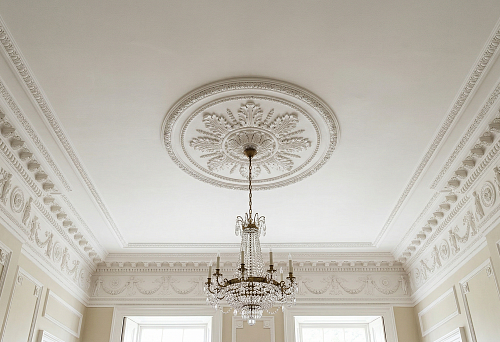
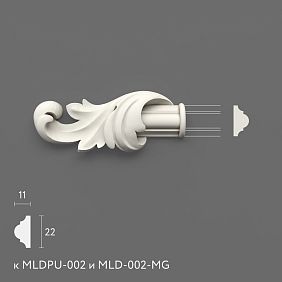
These are overlay elements — medallions, cartouches, corner overlays, moldings, pilasters, friezes, keystones — made from high-quality polyurethane foam through pressure casting. The form reproduces historical stucco with an accuracy of up to 0.5 mm. At the same time, the material weighs 6–8 times less than plaster, is not afraid of vibrations, does not crumble, and is compatible with any acrylic paints.
These are fundamental properties for furniture. Furniture is not a wall. Cabinet doors open and close hundreds of times a year, creating vibrations. Dresser drawers are pulled out and pushed in. Plaster cracks and crumbles under such conditions. Polyurethane does not.
Types of polyurethane furniture decor
Medallions — round or oval ornamental elements mounted in the center of a facade. Diameter from 5 to 40 cm. Used on cabinet doors, dresser fronts, bed side panels.
Corner overlays — triangular or L-shaped ornamental elements for corner areas of a facade. Create a frame effect around the central field without using continuous molding.
Moldings — linear profiles used as frames around the perimeter of a door or as dividing elements between facade sections. Classic, smooth, geometric — for any style.
Cartouches — decorative shields with ornamentation, rectangular or irregular in shape, with floral or geometric motifs. A strong accent element for classic and baroque furniture.
Pilasters — vertical decorative elements imitating columns. Installed between cabinet sections or on vertical surfaces of the body.
Cornices are horizontal profiles along the top edge of a cabinet or dresser. They complete the piece, making it monumental and architectural.
Color and finish of polyurethane decor
Buy polyurethane furniture decorcan be in basic white—and it is in white that it reaches most customers. White is neutral, works in tone with a white body, and requires no additional processing. But the possibilities of polyurethane are much broader:
-
Gilding with gold leaf or acrylic composition—for classic and art deco styles
-
Silver plating—for modern neoclassicism and eclecticism
-
Patination (darkening in the recesses of the ornament)—creates the effect of antique stucco
-
Painting to match the wood tone—for creating a unified wooden surface with different textures
-
Painting to match the facade color—for monochromatic solutions
An important practical rule: polyurethane decor on wooden furniture can be painted simultaneously with the main facade, achieving an absolutely uniform coating. This opens up the possibility of monochromatic solutions, where rails and ornaments are made from different materials but look like a single surface.
When the combination of slats and polyurethane decor is justified
The question of appropriateness is key in any design work. Combining a slatted panel and polyurethane decor on a single piece is a complex decision that requires understanding several conditions.
First condition: the scale of the piece
A small piece — a nightstand, a small chest of drawers — cannot accommodate two decorative levels without becoming overloaded. The slatted surface is already sufficiently rich on its own. Adding polyurethane decor to a small slatted front creates visual noise. On such pieces, choose one: either slats or decor.
A large piece — a built-in wardrobe, a large wardrobe, a kitchen unit — can accommodate both levels. The slatted surface creates a base texture, while the polyurethane decor adds accents without competing with the slats.
Second condition: stylistic context
In a minimalist interior, a slatted furniture panel without decor is the ideal solution. Clean rhythm, natural material, no ornaments. Minimalism does not tolerate excess. Adding polyurethane decor to a minimalist context violates the basic principle of the style.
In classic, neoclassical, and eclectic styles — the combination is fully justified. It is in these styles that ornament is part of the design code, and a slatted surface can serve as a 'field' for decorative elements.
Third condition: hierarchy of elements
When two decorative levels work on a single front, one of them must be dominant. Either the slats — then the decor merely completes the frame or places a focal point in the center. Or the decor — then the slats serve as a background, and their rhythm is deliberately calm, non-competitive.
Hierarchy error - when both levels claim dominance. Large active slats plus a large ornamental medallion - this is conflict, not dialogue.
Materials and finishes: what really matters for durability
The beauty of a furniture facade is fleeting if it's not backed by the right material and proper processing. Let's examine the technical aspects that affect how many years your slatted facade will delight you.
Wood: choosing wisely
Oak is the most sought-after material for furniture slats. Hard, durable, with expressive radial or tangential grain. Takes oil, wax, varnish, stain, and paint well. Not prone to excessive resin exudation. Durable with proper treatment.
Ash - similar in hardness to oak, but with a more neutral, slightly fibrous texture. Excellent for Scandinavian and Japanese aesthetics. Takes bleaching and pigmented oils well.
Birch - affordable, light-colored, with a fine texture. Takes paint well. Less hard than oak - prone to scratches with intensive use. Good for children's rooms and bedrooms with light loads.
Walnut - dark, oily, with a rich texture. An expensive material for prestigious interiors. Doesn't require staining - the natural color is expressive enough.
Pine - affordable, lightweight, with characteristic knots. Suitable for rustic and country styles. In kitchens and bathrooms requires enhanced protection - pine is more porous and sensitive to moisture than hardwoods.
Finishes: what protects versus what only decorates
Water-based oil — a penetrating coating that nourishes wood fibers from within. Preserves a matte, tactile surface. Slightly enhances the natural color. Requires renewal every 1–2 years. Ideal for bedrooms, living rooms, studies.
Oil with hard wax (OSMO, Rubio Monocoat and similar) — forms a light protective film over the oil layer. More resistant to moisture and mechanical impact. Recommended for kitchen fronts.
Water-based varnish — a polymer film on the surface. Offers higher protection levels than oil. Visually gives a more glossy appearance even in matte versions. Less tactile than oil. Good for bathrooms and kitchens.
Acrylic paint — completely covers the wood grain while preserving the relief texture. Wide choice of colors. Eco-friendly, dries quickly. Requires priming MDF and sanding between coats.
Polyurethane: parameters determining quality
Not allbuy polyurethane furniture decor for furniturecan be done with the same result. Polyurethane quality is determined by material density, casting precision, and stability under heat.
Density: quality polyurethane — 130–180 kg/m³. It does not dent when pressed with a finger, the cut is smooth and dense. Cheap polyurethane with density below 80 kg/m³ is soft, easily deforms, loses shape when heated above 50°C (which is quite realistic for furniture near a radiator).
Casting precision: good polyurethane decor reproduces the ornament with clear edges and deep retro-reflections. Cheap — with blurred contours and smoothed details. The difference is noticeable to the naked eye.
Temperature stability: under normal room conditions (15–25°C) quality polyurethane does not deform. Under prolonged exposure to direct sunlight (surface temperature up to 60–70°C) — slight shrinkage may occur in low-quality products. For furniture near a window, choose polyurethane with density not below 150 kg/m³.
Object decor mistakes: what not to do
Knowing mistakes is a warning. In object decor with slatted panels and polyurethane, there are several systemic misconceptions that regularly lead to unsatisfactory results.
First mistake: transferring wall logic to furniture
Wall slatted panels work from a distance of several meters. A furniture facade is perceived up close—at a distance of 50–100 cm. These are fundamentally different perception distances. Slats 80 mm wide with a large pattern, which look great on a wall, appear coarse and disproportionate on a furniture facade. Furniture scale requires small, thin elements with high precision of execution.
Second mistake: incorrect glue for polyurethane
Polyurethane decor cannot be glued with silicone (slips before setting), solvent-based liquid nails (can dissolve the polyurethane surface), or epoxy resin (too rigid a seam; under vibration, the decor peels off along with a fragment of the base). The correct options are acrylic-based mounting adhesive like 'liquid nails' or special polyurethane adhesive. Both provide an elastic seam that withstands vibration from door openings.
Third mistake: decor on an unprepared surface
Polyurethane decor glued onto laminated chipboard without prior degreasing and sanding—holds poorly. The laminate surface is smooth and contains technological lubricant. Before installation, the surface should be matted with 80–100 grit sandpaper, wiped with acetone or mineral spirits, and a thin layer of acrylic primer applied. After this, the adhesive holds firmly.
Fourth mistake: slats without acclimatization
A solid wood slatted furniture panel installed without acclimatization in the room is a blank for future deformation. Wood during transportation and in storage has a moisture content different from that of your home. By placing the slats in the room for 48–72 hours, you allow them to reach equilibrium moisture content. After that—installation. Without this step, the slats warp, the adhesive tears, and the spacing between slats is disrupted.
Fifth mistake: decor without a single finishing concept
A polyurethane medallion glued onto a slatted facade and left white—while the slats are coated in dark oil and the cabinet is beige—creates not an accent, but an absurdity. Decor should be organically integrated into the item's color scheme. Either it contrasts (white decor on dark slats), harmonizes (decor matching the slats' tone), or serves as an independent color accent (gold on white). The third option—'just whatever'—does not exist.
Combinations that work flawlessly: decision table
| Interior style | Slats | Polyurethane decor | Color of the solution |
|---|---|---|---|
| Scandinavian minimalism | Narrow, light ash | Not used or thin molding | White, cream, gray-beige |
| Neoclassical | Vertical, oak or painted MDF | Perimeter molding, small medallion | White, ivory |
| Classic | Vertical, dark walnut or oak | Medallions, cartouches, cornice, pilasters | White gold, anthracite |
| Loft | Horizontal, thermowood | Not used | Dark brown, graphite |
| Eclectic | Any direction | Medallion or corner overlays | Contrasting or patinated |
| Art Deco | Horizontal, dark wood | Geometric molding, cartouche | Black, gold, bronze |
| Rustic | Uneven, pine with knots | Not used | Natural, unpainted |
Practical cases: three items — three characters
Case one: 12 m² kitchen in organic neoclassical style
Task: lower cabinets have smooth white fronts made of painted MDF. The client wants to make the kitchen more 'lively' without completely replacing the furniture.
Solution: vertical slats made of veneered MDF (ash, width 30 mm, spacing 10 mm) covered with matte acrylic lacquer in ivory color are glued onto each kitchen front. Around the perimeter of each door — a thin polyurethane molding with a simple profile, painted in the same color. The carcass remains white. Result: the kitchen began to resemble custom-made joinery, although the carcasses were not changed.
Case two: bedroom with a chest of drawers in Japanese-Scandinavian style
Task: a chest of drawers from IKEA with smooth white drawer fronts is perceived as temporary furniture. It needs to be turned into a permanent element of the interior.
Solution: horizontal slats made of solid birch, 25 mm wide with an 8 mm gap, finished with natural water-based oil. The ends are covered with a narrow MDF strip matching the cabinet color. Polyurethane molding is not used — adhering to the pure Scandinavian principle of 'less is more'. Result: the chest of drawers is perceived as Japanese handcrafted furniture. Budget — minimal.
Case three: a built-in wardrobe in a classic study
Task: a floor-to-ceiling wardrobe in a study with oak floors and library shelves. The goal is to create the feeling of furniture with a history, made to look 'antique'.
Solution: vertical slats made of oak in a natural tone (45 mm wide, 15 mm gap), treated with oil containing a dark pigment — 'antique oak' color. Around the perimeter of each door — polyurethane molding with a classic egg-and-dart profile, painted in a cream color with a light patina. Polyurethane pilasters between sections, a cornice along the top edge. Result: a wardrobe that could be mistaken for antique furniture. A detail that completes the study as a cohesive architectural statement.
DIY installation: a sequence that must not be broken
For those who decide to work independently, the sequence of steps is crucial. Violating the order leads to rework.
Step 1 — Base preparation. MDF or plywood is sanded with 80-grit sandpaper, then 150-grit. The surface is cleaned of dust. If necessary — leveled with wood filler.
Step 2 — Marking. A centerline is marked on the base. From the centerline, the slat spacing is marked out in both directions, accounting for their width and the gap. The outermost slats must be equidistant from the edge of the facade.
Step 3 — Acclimatization of slats. Solid wood slats are laid out in the room for 48–72 hours without packaging.
Step 4 — Applying adhesive. Adhesive (water-based parquet adhesive or D3 PVA) is applied to the back of the slat with a notched trowel or in dots every 15–20 cm.
Step 5 — Installing the slats. Slats are laid according to the markings, pressed down, and secured with 1.6×35 mm finishing nails with countersunk heads. The nails additionally secure the slat until the adhesive sets.
Step 6 — Curing time. 24 hours minimum. 48 hours is better. Do not load or expose to moisture.
Step 7 — Sanding. The entire surface is sanded along the grain with 180-grit sandpaper, then 240-grit.
Step 8 — Applying the finish. Oil, varnish, or paint — in 2–3 coats with intermediate sanding.
Step 9 — Installing polyurethane trim. After the final coating of the slats. Apply adhesive to the back of the trim, press it, and secure with painter's tape for 4–6 hours.
Step 10 — Painting the trim. After the adhesive has fully set — acrylic paint in the color according to the concept.
Polyurethane and wood: two different times in one object
There is something philosophical in this combination. Wood is natural, grown in a forest, carrying in its fibers the traces of time, climate, seasons. Polyurethane is artificial, created by humans, precise, unchanging. Together they create a furniture piece in which nature and culture, organic forms and geometry, warmth and precision coexist simultaneously.
It is precisely in this dialogue that what we call a 'complex object' is born. Not complex in the sense of being overloaded, but complex in the sense of being multi-layered — carrying several meanings, several characters, several stories at once.
The slatted furniture panel speaks of nature and craftsmanship. The polyurethane ornament speaks of tradition and architectural culture. Together they create furniture that becomes not just a storage item, but an object worthy of contemplation — again and again, in different light, from different distances.
Frequently Asked Questions (FAQ)
Can polyurethane decor be glued onto a laminated chipboard (Laminated Particleboard) surface?
Yes, but the surface must be prepared first: sand it with sandpaper (80–100 grit), degrease with acetone, and apply a thin layer of acrylic primer. Without preparation, the adhesive will not provide reliable adhesion.
Which slats should I choose for kitchen fronts?
MDF with veneer in a matte lacquer is the optimal choice for the kitchen. It does not warp from steam and wipes clean easily. Solid wood is acceptable with high-quality protective treatment (oil with hard wax or high-strength lacquer).
How to cover the ends of a slatted furniture front?
The neatest method is overlay slats made of the same material, screwed or glued onto the end. Polyurethane moldings, overlay wooden corner pieces, or flexible veneer are also used.
Can a solid wood slatted front be painted white after assembly?
Yes. Sand the surface (180, then 240 grit), then apply one coat of acrylic primer, followed by 2–3 coats of white acrylic paint with intermediate sanding. The result is a matte white surface with pronounced slat relief.
How to calculate the number of slats for a front?
Divide the front width by the sum of the slat width and the gap. For example, front 60 cm, slat 30 mm, gap 10 mm: 600 / (30+10) = 15 slats. Check that the edge gaps from the front edge are symmetrical.
Does polyurethane decor need to be varnished?
No need — high-quality polyurethane does not require additional protection. However, if you painted the decor with acrylic paint, a final coat of matte acrylic varnish will protect the paint from abrasion in areas of frequent contact.
Can polyurethane decor be removed without damaging the facade?
Difficult, but possible. A nichrome wire or thin metal string is used, which is pulled between the decor and the surface. Adhesive residue is removed with a heat gun and a putty knife. On a wooden surface, local sanding will be required after removal.
STAVROS: when the object is more important than the interior
There are manufacturers who make materials. And there are those who understand that materials create an environment — and the environment determines the quality of life. STAVROS is among the latter.
Eachfurniture slat panel from STAVROS undergoes control in three parameters: geometry, moisture, surface. This means: the slat is straight, the size is stable, the surface is ready for coating. Without knots in inappropriate places, without resin pockets, without warping.
Each elementfurniture decor made of polyurethane is cast from a dense, stable material while preserving the precision of the ornament. Detailing — like real stucco. Weight — like plastic. Durability — like an architectural element.
STAVROS creates materials for people who think of furniture as architecture. Who understand that an item in an interior is not a purchase, but a decision. And who want that decision to look strong, honest, and beautiful—today, in a year, and in twenty years.
Make the item the main focus. STAVROS will help.