Article Contents:
- Where to buy a slatted partition in Moscow and what to check before ordering
- Assortment and formats
- Material
- Geometric precision
- Selection for apartments and offices
- What is better for zoning: individual slats or a ready-made slatted panel
- Individual slats: when it is justified
- Ready-made slatted panel: when it is more convenient
- Fundamental difference between the two formats
- How to choose slats for apartment zoning
- Studio: zoning without walls
- Kitchen-living room: separation without isolation
- Living room: functional and decorative zoning
- Entrance hall: meeting the home
- Bedroom: a subtle boundary of privacy
- How to choose a slatted partition for an office
- Open space: structuring without walls
- Meeting zones
- Reception and waiting area
- Offices within open space
- How to choose slat spacing and thickness
- What is slat spacing
- Wide and narrow spacing: what's the difference
- Slat thickness: how it affects the visual
- How not to overload the space
- Wooden slat partition or MDF: what to choose
- Wooden slat partition: living texture
- MDF: stability and color freedom
- Final Comparison
- Where a slat partition works best
- Between kitchen and living room
- In the entryway
- In the bedroom
- In the study
- In Commercial Spaces
- In the TV area
- Common mistakes when choosing a slat partition
- Error 1: too dense spacing in a small room
- Error 2: too massive slat for a modest interior
- Error 3: inconsistency with the overall style
- Error 4: incorrect height
- Error 5: trying to solve everything with one partition
- Mistake 6: Ignoring Lighting
- Do you need a DIY slatted partition?
- Additional scenarios: slatted panels on walls and ceilings
- Slatted panels on the wall
- Plank ceilings
- Furniture facades
- FAQ: frequently asked questions about slatted partitions
- Conclusion
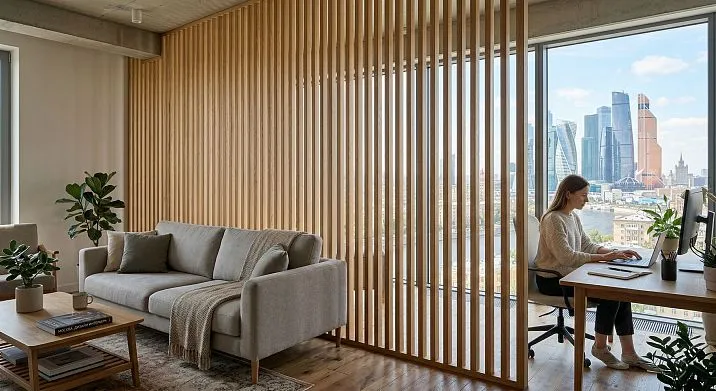
Moscow is a city where apartments with open floor plans have long ceased to be a rarity, and studios and lofts have become the norm for hundreds of thousands of residents. And it is here that the slatted partition has gained particular popularity: as a zoning tool that does not cut the space with a solid wall, but delicately divides it, preserving light, air, and a sense of volume.
You can buy a slatted partition in Moscow today in a variety of formats — from individual wooden blocks for self-assembly to ready-madeof slatted panelsones on an MDF backing or fabric base, which are mounted as a single module. But making the right choice means understanding exactly what is needed: what spacing, what slat thickness, what material, what construction format, and for what interior style.
A slatted partition is not a single product, but an entire concept. It can be load-bearing or decorative, transparent or dense, wooden or MDF, a ready-made panel or assembled by hand. That is why its selection should be approached systematically — with an understanding of the task, not just 'like the neighbor's'.
This article is a complete practical breakdown for those looking forslats for zoningan apartment or office in Moscow and wants to make an informed choice.


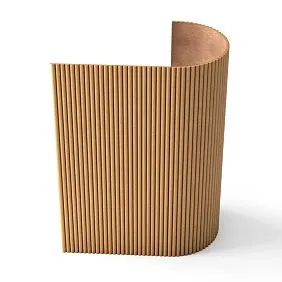
Where to buy a slatted partition in Moscow and what to check before ordering
The market for wooden decor in Moscow is extensive. Yet, when choosing a supplier for slatted partitions, it's worth looking not only at the price per linear meter but also at the combination of parameters that determine the quality of the finished result.




Assortment and formats
The first thing to check: whether the supplier offers several solution formats.
Individual slats – timber or profile of a specific cross-section, used to assemble the partition frame. This option requires more design decisions: spacing, fastening, height, and connection to the ceiling and floor must be calculated.
Ready-made slatted panels – products with slats already fixed to a backing (MDF or fabric). This is a fundamentally different product: it is installed as a single module, the geometry is already maintained during production, and the customer gets a predictable result without needing to manually calculate spacing.
A wooden slatted partition in Moscow from a professional range should include both formats – because tasks vary.
Our factory also produces:





Material
Solid oak – dense, heavy, with a lively texture. Does not warp if properly dried. Accepts oil, wax, varnish, stain. An expensive and long-term choice.
MDF – stable, even, lightweight. Ideal for painting in any color from the RAL catalog. Does not react to humidity fluctuations like solid wood.
A slatted partition in Moscow can be made from both materials – the choice depends on interior style, budget, and durability requirements.
Get Consultation
Geometric accuracy
Any slatted structure requires perfect geometry: slats must be straight, of uniform thickness and height, without axial twisting. Check: whether geometric tolerances are specified in the product specification. For professional production, this is standard.
Selection for apartments and offices
It is important that the supplier can offer:
-
multiple options for slat spacing and cross-section
-
several panel heights
-
several species and types of coating
-
technical consultations on installation
This is a sign of working with a professional assortment, not with limited warehouse stock.
What is better for zoning: individual slats or a ready-made slatted panel
This is a question asked by every second customer. And the correct answer is 'it depends on the task.' But there is a clear logic for choosing.
Individual slats: when it is justified
Individual slats provide maximum design freedom. You determine yourself:
-
spacing between slats
-
cross-section and profile
-
height of the structure
-
angle of inclination (if a non-standard option is needed)
-
connection with ceiling, floor, walls
This format is appropriate when the partition is non-standard in size, has a complex configuration, or is integrated into a custom design project.
However, individual slats have a significant drawback: the geometry of the entire structure depends on the accuracy of installation. The slightest deviation in spacing, a warped slat, uneven fastening — and the partition 'lives' chaotically, not rhythmically. Professional installation is mandatory here.
Ready-made slat panel: when it's more convenient
Rack panelon an MDF backing or fabric base — this is a ready-made module where the slats are already fixed with precise spacing. The geometry is maintained during production, and during installation, you only need to mount the panel evenly.
Ready-madeslat panelsare convenient in several scenarios:
-
Flat walls and partitions — rigid panels on an MDF backing are mounted as a solid module, the result is neat and predictable
-
Radius and curved surfaces – flexible fabric-based panels are designed for them, wrapping around curved surfaces without gaps or deformations
-
Furniture fronts – rigid slatted panels can be used as front elements for cabinets, chests, built-in niches
-
Ceilings – a slatted ceiling made from ready-made panels is installed significantly faster than from individual slats
Fundamental difference between the two formats
| Parameter | Individual slats | Ready-made slatted panel |
|---|---|---|
| Design flexibility | Maximum | Limited by panel formats |
| Installation speed | Slower | Faster |
| Geometric precision | Depends on the installer | Maintained in production |
| Application on radius surfaces | Difficult | Possible (flexible panels) |
| Suitable for DIY | Yes (with skill) | Simpler |
How to choose slats for zoning an apartment
Apartments are the primary environment for slatted partitions in the Moscow housing market. It is here that the task of zoning becomes acute: open layouts require separating functional areas without losing the sense of space.
Studio: zoning without walls
A studio is the most challenging and simultaneously the most rewarding case for a slatted partition. The task: to separate the living and working or sleeping areas while preserving the flow of light and the sense of volume.
Solution:slats for zoningIn a studio, they should be airy — a wide pitch (60–100 mm between slats), relatively thin slats (20–30 mm). Such a construction visually marks the zone but does not cut up the space.
The partition height can be partial — from the floor to 2/3 of the ceiling. This is especially effective: there is a boundary, but the ceiling is unified.
Kitchen-living room: separation without isolation
A partition between the kitchen and living room is one of the most in-demand scenarios. The task here is twofold: to visually mark the boundary of the food preparation area and at the same time not block the living room from the kitchen light.
A slatted partition for a kitchen-living room should be semi-transparent: pitch — 40–80 mm, slats — 25–40 mm wide. This provides sufficient density for visual zoning but preserves air exchange and light flow.
An important nuance: in the kitchen, humidity and temperature fluctuations are higher. For this zone, MDF will be more stable than solid wood — it reacts less to changes in the microclimate.
Living room: functional and decorative zoning
A slatted partition in the living room can serve two roles at once: dividing zones (e.g., a TV area and a dining area) and acting as an accent decorative element.
A more expressive rhythm is appropriate in the living room: slats can be wider (40–60 mm), the spacing — tighter (30–50 mm). This creates a more 'filled' visual plane — the partition becomes an architectural accent, not just a divider.
A tall slatted structure from floor to ceiling in the living room is one of the most impressive design techniques. Especially when combined with backlighting behind the slats.
Hallway: meeting the home
In the hallway, a slatted partition separates the entrance area from the living room or living space. It is a functional and aesthetic barrier at the same time.
A tighter spacing is suitable for the hallway — the structure should create a sense of privacy. Height — full, from floor to ceiling. Solid oak slats with natural oil work well: they create a warm 'welcome home' effect.
Bedroom: a subtle boundary of privacy
In the bedroom, a slatted partition can separate the wardrobe area, a reading nook, or a work corner. Delicacy is important here: the partition should not be a dominant element — it creates a quiet boundary, nothing more.
For the bedroom — narrow slats (15–25 mm), wide spacing (80–120 mm), neutral or warm shade. Solid oak with white oil or beech with a natural finish — delicate, natural solutions.
How to choose a slatted partition for an office
Office space is a fundamentally different environment. Here, a slatted partition solves tasks that are not relevant in residential interiors: managing people flow, visual privacy without acoustic isolation, creating concentration zones within an open space.
Open space: structuring without walls
In an open-plan office, slatted partitions allow creating an 'archipelago' of work zones without building walls. Key tasks:
-
Visually delineate the boundaries of work groups
-
Reduce the level of visual distractions
-
Preserve the feeling of a unified space and light permeability
For open space, moderate density of the slatted structure is recommended: spacing 40–60 mm, slats 25–35 mm. Height — 1.5–1.8 m (not up to the ceiling) to preserve the feeling of openness.
Meeting zones
A meeting zone within an open space is a separate task. Here, a greater sense of privacy is needed: denser spacing (25–40 mm), height up to the ceiling or close to it.Wooden planksor MDF for painting in the brand's signature color — both options are appropriate.
Reception and waiting area
A slatted partition at the reception desk serves as both a functional divider and a branding element. Key considerations here:
-
A unique profile that supports the brand's stylistic identity
-
Precise geometry — everything must be perfectly vertical
-
Tinting or painting in the brand's signature color
Offices within an open space
If the goal is to create a sense of an office without full sound insulation, a slatted partition with a tight spacing (20–35 mm) and floor-to-ceiling height will achieve this visually. It won't provide acoustic isolation, but it will create the architectural feeling of a private space.
How to choose slat spacing and thickness
Spacing and thickness are the two main parameters that define the visual character of a slatted structure. An error in either one — and the partition either turns into a solid wall or appears too sparse and unfinished.
What is slat spacing
Spacing is the distance between the centers of adjacent slats (or between the free gaps—check with the manufacturer for the definition used). The spacing affects:
-
Degree of transparency of the structure
-
Visual 'density'
-
Sense of rhythm
Wide and narrow spacing: what's the difference
Narrow spacing (20–40 mm between slats)—a dense structure with a high degree of visual closure. Suitable for meeting areas, offices, hallways, where privacy is important.
Medium spacing (40–80 mm)—a universal range. The partition zones but does not isolate. Works in living rooms, kitchen-living rooms, office spaces.
Wide spacing (80–120 mm and more)—an airy structure with a minimal sense of barrier. This is more of a decorative accent and zone marker than an actual partition. Good for studios and open living spaces.
Slat thickness: how it affects the visual
The thickness of the slat (its cross-section in plan) determines the "mass" of the structure.
| Slat thickness | Visual effect | Where it is appropriate |
|---|---|---|
| 15–20 mm | Light, delicate | Scandinavian style, studios |
| 25–35 mm | Balanced | Modern, neoclassical, office |
| 40–60 mm | Expressive | Classic, large spaces |
| 60 mm and above | Heavy, architectural | Only in large spaces |
Thin slats in a large room with high ceilings look disproportionate—they get lost. Thick slats in a small room create a oppressive feeling. Proportions decide everything.
How to avoid overloading the space
The main rule: the total area of the slats (height × thickness × quantity) should not exceed 40–50% of the visible area of the partition. If this ratio is violated, the partition turns into a solid wall, losing its main purpose: semi-transparent zoning.
Detailed recommendations for selecting slat parameters depending on interior style and room type are in the article aboutInterior plankson the website.
Wooden slatted partition or MDF: what to choose
This comparison arises almost every time you make a choice. Both materials are good—but in different contexts.
Wooden slatted partition: living texture
Wooden slat partition made of solid oak is the maximum of naturalness. Each slat has a unique grain pattern, natural shades, a living surface. This cannot be imitated—it can only be made from real wood.
When to choose solid wood:
-
Interior with parquet, engineered board made of natural wood
-
Classical or natural style
-
Request for durability and surface renewability
-
High-end segment — country house, premium apartment
Solid wood features in partitions:
-
Oak slats need acclimatization before installation (48+ hours in the room)
-
Solid wood may slightly "move" with humidity changes — within normal limits with proper drying
-
Surface accepts oil, wax, tinting, varnish
PanelPAN-001is available in both MDF and solid oak versions — this is fundamentally important for those who want natural texture in a finished panel format.
MDF: stability and color freedom
MDF slatted panel is a geometrically perfect product with zero deformation during use. The surface is primed and ready for painting in any shade.
When to choose MDF:
-
Requires precise color coordination with doors, walls, furniture
-
Interior with complex wall tones (gray, dark blue, graphite) — slats are painted to match
-
Spaces with unstable humidity
-
Modern, office, minimalist interior
Primed MDF slatted panel— ready for any finish paint, mounts on flat surfaces, furniture fronts and ceilings.
Final Comparison
| Parameter | Solid oak | MDF |
|---|---|---|
| Natural texture | Yes | No |
| Geometry stability | High (with dry storage) | Maximum |
| Painting in any color | Through stain / tinting | Yes, any RAL |
| Combination with parquet | Ideally | Good (tinted) |
| Durability | 30+ years | 15–20 years |
| Price | Higher | Below |
Where a slatted partition works best
This is a practical block about the spaces where a slatted structure maximizes its potential.
Between the kitchen and living room
A slatted partition between the kitchen and living room is a solution that addresses several tasks at once:
-
Visually hides kitchen surfaces during cooking
-
Does not block light and ventilation
-
Creates an architectural accent at the zone boundary
-
Serves as a backdrop for a bar counter or dining area
Recommended parameters: spacing 40–70 mm, slats 25–40 mm, height — full or up to 2/3 of the wall with a top gap.
In the hallway
In the hallwaywall slatscreate the first impression of the house. A slatted partition between the hallway and living room is a warm welcome: it doesn't close off the space but creates a sense of 'entry.' Natural oak slats with oil are especially appropriate here — the warm natural surface sets the tone.
In the bedroom
In the bedroom, a slatted structure can separate the dressing area, cover the headboard as a decorative screen, or divide the relaxation zone and the work corner. Light step, neutral shades, minimalist profile.
In the study
In a home office, a slatted partition creates a psychological boundary for the workspace — especially in apartments where the office isn't separated by a wall. Dense spacing (30–50 mm), height up to the ceiling, dark tone (wenge, coffee, graphite) — the workspace gains the necessary seriousness.
In commercial spaces
Restaurants, cafes, hotel lobbies, coworking spaces —wooden partitioncreates atmospheric zones with a natural character. Here you can be bolder with scale: wide slats, large spacing, floor-to-ceiling height, built-in lighting.
In the TV area
A slatted panel behind the TV is a classic modern technique. It's not a partition in the full sense, but a slatted solution that creates an accent plane and 'fits' the TV zone into the architectural context of the wall. Both rigid panels on an MDF base and solid oak slats work excellently here.
Common mistakes when choosing a slatted partition
Practice shows: most mistakes when choosing slatted partitions are not technical but conceptual. People choose 'beautiful' without thinking about proportions, style, and purpose.
Mistake 1: too dense spacing in a small room
In a 15–18 sq. m room, a dense slatted partition with a 20–25 mm spacing turns into a wall—just a wooden one. Zoning disappears, the space shrinks. In small rooms—only wide spacing and thin slats.
Mistake 2: slat too massive for a modest interior
A 60×60 mm slat in a 35 sq. m studio is an architectural misunderstanding. Such a profile requires space, ceilings from 3 m, and a large-scale interior. In a standard Moscow apartment—maximum 30–40 mm.
Mistake 3: inconsistency with the overall style
Rough dark slats in a white Scandinavian interior—a conflict of material and style. Classic shaped slats in a loft—the same thing. Always start from the room's stylistic concept.
Mistake 4: incorrect height
A partition that stops at a height of 1.2 m looks like unfinished construction. If the structure doesn't reach the ceiling—it should end at a visually justified height: 2/3 of the wall or at a horizontal molding. Random trimming is a mistake.
Mistake 5: trying to solve everything with one partition
Sometimes the task requires not a partition, but a slatted panel on the wall, or a slatted ceiling, or simply an accent screen. Not every zoning task needs to be solved with a through structure from wall to wall.
Mistake 6: Ignoring lighting
A slatted partition without thoughtful lighting is half the effect. Backlighting between the slats from bottom to top or built-in spotlights radically change the perception of the structure. Plan for the possibility of lighting at the design stage.
Do you need a slatted partition DIY?
Many people ask this question — and it's a fair one. A DIY slatted partition is quite feasible if:
-
You have basic experience working with wood or MDF
-
The design is simple: straight, floor-to-ceiling, on flat surfaces
-
Pre-made slats with precise geometry are used
-
You have time for careful installation, leveling each slat
If the design is complex, the space is non-standard, or you need a professional result without errors — it's wiser to choose ready-made slatted panels, which are installed much more easily. A ready-made panel module already has a verified pitch and professional geometry.
A detailed step-by-step breakdown — design, marking, frame, slat installation, finishing, and typical installation mistakes — in a separate article about a slatted partitionon the website.
Additional scenarios: slatted panels on walls and ceilings
It's important to understand: slatted solutions aren't just partitions. The same panels and slats work in other formats that may be relevant to your project.
Slatted wall panels
wall slats— an accent wall cladding that creates texture and rhythm without building a partition. This is a solution for those who don't need physical separation but value visual richness of the surface.
A slatted wall panel is mounted with adhesive and fasteners, requires no frame, and takes up minimal space. Rigid panels on an MDF backing are for flat walls. Flexible ones on a fabric base are for radius niches and columns.
Slatted ceilings
A slatted panel on the ceiling is a modern and functional technique. The slats conceal utilities, create a warm wooden surface overhead, and pair well with spot lighting between the slats.
Furniture facades
Furniture fronts made from slatted panels — a wardrobe, cabinet, or built-in wall unit with a slatted pattern. A rigid slatted panel on an MDF backing is mounted onto the front as a decorative element. This is a quick and effective way to 'revitalize' furniture.
FAQ: frequently asked questions about slatted partitions
Where to buy a slatted partition in Moscow?
From a manufacturer with a full range: individual slats of various profiles and ready-made slatted panels on MDF backing and fabric base. It's important to have several wood species and coating types available, as well as the possibility of technical consultation.
What is better for an apartment: individual slats or a panel?
For most residential projects, a ready-made slatted panel is more convenient: consistent geometry, quick installation, predictable result. Individual slats are for non-standard structures and custom projects.
Which slats are suitable for zoning a room?
Spacing 40–80 mm, slats 20–35 mm — a universal range for living spaces. Adjust according to room size and ceiling height.
How to choose the spacing between slats?
Focus on the degree of privacy: narrow spacing (20–40 mm) — for offices and meeting rooms, medium (40–80 mm) — for living rooms and kitchen-living rooms, wide (80–120 mm) — for studios and decorative accenting.
What thickness of slat is better for a partition?
25–35 mm — the optimal range for most tasks. Thinner (15–20 mm) — for lightweight openwork structures, thicker (40–60 mm) — for classic styles and large spaces.
Is a slatted partition suitable for a kitchen-living room?
Yes, it is one of the most successful scenarios. Important: in the kitchen area, MDF is preferable due to more stable behavior with humidity fluctuations.
What is better: wood or MDF?
Solid oak — for natural interiors with parquet, classic styles, and country houses. MDF — for modern urban interiors, precise color matching, and spaces with unstable microclimates.
Can you build a slatted partition yourself?
Yes, with experience and a simple design. For complex projects, pre-made slatted panels with factory geometry are much easier to install. A detailed installation guide is available in a separate article on the website.
Conclusion
A slatted partition is one of the few interior tools that simultaneously solves a practical task (zoning) and creates the visual character of a space. Properly chosen slats for zoning an apartment or office are not just wooden beams between the floor and ceiling. They are architectural rhythm, natural texture, and a play of light and shadow.
Choosing between individual slats and a ready-madeslatted panel, between solid oak and paintable MDF, between narrow and wide spacing — each of these decisions has its own logic. And this logic becomes clear when you have a precise vision of the task: the zone, style, room scale, and materials of the floor and doors.
If the task is a partition between the kitchen and living room in a modern Moscow apartment, it's most likely an MDF panel with a neutral shade and medium spacing. If the task is a classic living room with parquet and oak doors, it's solid oak slats with a shaped profile and deep tinting. If it's an open-space office, it's an MDF panel painted in the brand's corporate color.
Each of these scenarios is in the catalog, where you can choose a ready-made solution, get a consultation, and order delivery in Moscow.
The company STAVROS manufactures wooden and MDF slatted panels, slats for zoning and partitions, millwork decor, and architectural interior details. Own production with precision geometry, proper solid wood drying, and a full range of formats — from individual slats to ready-made panel systems for walls, ceilings, and facades. Delivery in Moscow and Russia directly from the manufacturer.
STAVROS — slat solutions for the space you create.