Article Contents:
- When a passage between zones is better designed with slats rather than a solid wall
- Why slats win over a solid wall in most scenarios
- Where a slat partition works best
- What role does an architrave play in such a passage
- Architrave as an architectural vertical
- Framing an opening with architraves: what changes
- Wide and narrow architrave: how to choose
- Why MDF skirting is not a secondary detail here
- What happens without skirting in a passage between zones
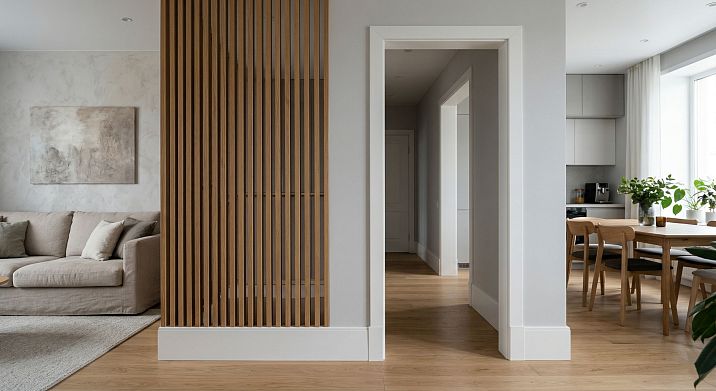
There comes a moment in apartment or house design when you realize: you need a boundary between two zones—but not a wall. A boundary that won't steal light, won't create a feeling of tightness, and won't turn an open space into a corridor with doors. It's precisely at this moment that the need for a slatted partition arises—a semi-transparent structure that marks the transition between zones while preserving air and light flow.
But a slatted partition is only part of the system. A passage between zones without a heavy wall looks truly complete when the architectural trio works within it: the slats set the rhythm and semi-transparency,Wooden casingcollects and accentuates the vertical of the opening, andMDF Skirting Boardcloses the bottom line—cleanly, precisely, without gaps.
Three elements—one logic. And if even one of them is chosen incorrectly or is missing altogether, the entire structure loses its completeness. We'll break down each of them in detail: how to choose, how to combine, and what mistakes to avoid.




When a passage between zones is better designed with slats than with a solid wall
Let's start with a question often asked even at the design stage: is a partition even needed? Maybe just put up a wall and close the issue?
A wall is a radical solution. It provides complete privacy and acoustic isolation, but simultaneously cuts off light, compresses space, and creates the need for a door. In most modern residential and office spaces, this is excessive.
A slatted partitionis a fundamentally different solution. It acts as architectural punctuation: not a period, but a comma. There is a boundary—but it breathes.




Why slatted walls beat solid walls in most scenarios
Preserving light. Even with closely spaced slats, natural light passes through the structure. This is especially critical for apartments where windows are concentrated on one side: a slatted partition allows light to 'flow' between zones.
Visual depth. The next zone is visible through the slats — not completely, but enough for the space to be perceived as deep. This is psychologically important: we don't feel a wall behind our back.
Zoning without isolation. The kitchen and living room remain in visual contact — the host cooks and simultaneously participates in the conversation in the living room. The hallway is separated from the living area, but the home doesn't break up into isolated rooms.
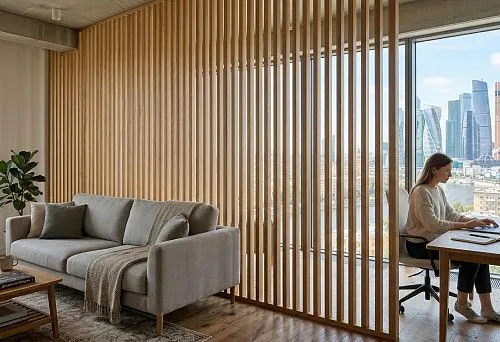
Architectural accent.Rafter panels— it's also a decorative element. The rhythm of vertical lines creates an expressive plane that becomes one of the main architectural accents of the interior.
Our factory also produces:






Where a slatted partition works best
-
Studio: separating the sleeping area and living area without losing the sense of volume
-
Kitchen-living room: a visual screen for the kitchen work zone
-
Hallway-living room: a warm 'entrance' to the home without a heavy door
-
Bedroom-dressing room: a delicate boundary without construction
-
Home office within an apartment: a workspace with psychological privacy
-
Open space office: structuring work groups without losing a unified space
In all these scenariospassage zoningwith battens — an organic response to the request 'there is a boundary, but the space remains unified.'
Get Consultation
What role does a casing play in such a passage
When talking about casings, the first thing that comes to mind is a door opening. A casing as a door frame. But in the context of interzonal passages without a door, the roleskirting boardbecomes fundamentally different — and much more interesting.
Casing as an architectural vertical
An opening between two zones is an open vertical element. It starts at the floor and ends at the ceiling (or at a horizontal lintel). And if the edges of this opening are not finished in any way — the wall looks 'torn': an uneven cut of plaster is visible, the wall corner loses clarity.
CasingsThey solve this problem. They create a vertical frame along the edges of the opening—clear, aligned, decoratively finished. This is not just 'closing the gap.' It is an architectural solution that turns a random opening into a meaningful architectural element.
Framing an opening with architraves: what changes
Imagine two options for a passage from the hallway to the living room.
Option 1: The slatted partition is installed, the slats are even and beautiful, but the edges of the opening are bare wall without finishing. The eye catches on uneven corners, uncovered ends, the transition from plaster to slats.
Option 2: On both vertical sides of the opening, architraves are installedDecorative lintels—of the same material or in a coordinated tone with the slats. The edges of the opening are clear, the verticals are emphasized, the boundary between the slatted structure and the clean wall is framed like a picture frame.
The difference is colossal. It is precisely the architrave that turns 'done' into 'finished.'
Wide and narrow architrave: how to choose
The width of the architrave affects the scale and character of the passage.
Narrow architrave (30–50 mm)—delicate, almost unnoticeable. Suitable for a modern minimalist interior, where the purity of lines without accents is important.
Medium architrave (50–80 mm) — universal. Works well in most styles, from Scandinavian to modern classic.
Wide architrave (80–120 mm and wider) — an architectural accent. Suitable for classic, neoclassical interiors with high ceilings, where a pronounced vertical belt is important. A wide architrave next to tall battens creates a powerful, expressive vertical system.
Detailed breakdown of selectionof MDF architraves by profile, width, and material — in a separate article on the website.
Why MDF skirting board is not a secondary detail here
A common mistake many make is to consider the skirting board a 'final touch' that appears last and no longer affects the overall impression. In the context of interzonal passages, this misconception is costly.
MDF Skirting Board — the lower architectural belt of the entire structure. It is precisely this that closes the gap between the floor and the wall/batten structure, forms a clean horizontal line, and unites the lower contour of the passage into a single line.
What happens without a skirting board in a passage between zones
Without a skirting board, the lower part of the passage looks unfinished: gaps near the floor are visible, uneven ends of the batten structure, the joint between the floor and wall lacks a clear line. This is especially noticeable when looking from one zone to another — the passage is open, the gaze 'slides' down and meets a messy bottom.