












































































Article Contents:
- St. Petersburg climate and interior: why material matters especially here
- Why you shouldn't choose slat panels based only on photos and price
- MDF base class
- Type of finish
- Geometric accuracy
- Load-bearing base characteristics
- How to properly check slat panels before purchase: checklist
- Checklist 1: Documentation
- Checklist 2: Physical parameters of the sample
- Checklist 3: Manufacturer
- Slat panels for residential interiors: which material for which rooms
- Living room and bedroom: no material restrictions
- Hallway: MR only, only 2K coating
- Kitchen: MR + sealing of all perimeters
- Children's room: E0 or E1, water-based coatings
- Old housing stock with wooden floors
- Stucco decor in St. Petersburg: what the market offers and how not to make a mistake
- Three categories of stucco materials
- How to distinguish polyurethane from polystyrene in a store
- Assortment of polyurethane stucco: what is needed for a St. Petersburg interior
- Ceiling Cornices and Plinths
- Decorative overlays and sockets
- Wall moldings
- How to choose molding decor based on ceiling height and apartment style in St. Petersburg
- Pre-revolutionary building: ceilings 3.2–4.0 m
- Stalin-era buildings: ceilings 2.9–3.3 m
- Typical buildings from the 60s–80s: ceilings 2.5–2.7 m
- Modern new buildings: ceilings 2.7–3.0 m
- Slatted wall panels in St. Petersburg: what to pay attention to when ordering
- Rule 1: Order samples before the batch
- Rule 2: Clarify the MDF class, coating type, and MDF board manufacturer
- Rule 3: Clarify the geometric tolerance
- Rule 4: Check the completeness of the system
- Where buyers make mistakes most often
- Mistake 1: Buying cheap rails and expensive molding
- Mistake 2: Not considering moisture resistance for the hallway
- Mistake 3: Choosing a cornice without considering ceiling height
- Mistake 4: Mounting rails before molding
- Mistake 5: Not requesting material documentation
- Mistake 6: Relying on 'a master who will buy everything themselves'
- Mistake 7: Not considering acclimatization
- Mistake 8: Buying 'with a reserve' without calculation
- Installation in St. Petersburg: what you need to know about local specifics
- Old housing stock: brick and wood
- New buildings: settlement cracks
- Humidity during the construction phase
- Comparison of purchase formats: showroom, online, direct manufacturer
- Style and proportions: quick reference for St. Petersburg apartments
- Budget calculation: approximate figures for the St. Petersburg market
- FAQ: popular questions about buying slatted panels and stucco decor in St. Petersburg
- About the Company STAVROS
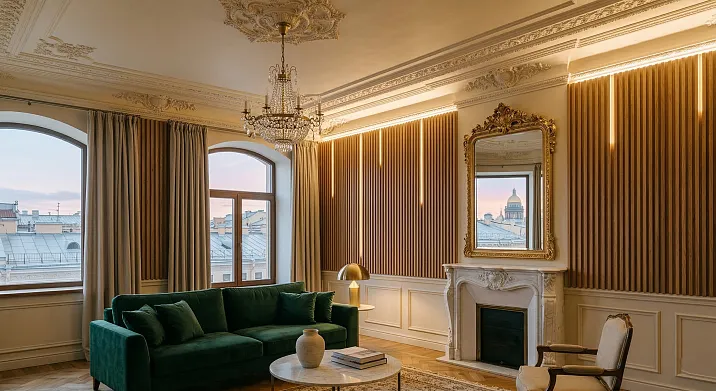
St. Petersburg is a city with a special attitude towards interiors. This is not an exaggeration or lyricism: the historical context is felt here literally — in the proportions of old housing stock ceilings, in window heights, in the very architectural memory of the walls. A St. Petersburg apartment often carries something that requires correspondence. And when it comes to finishing — slatted panels, stucco decor — this correspondence becomes not an aesthetic, but almost an ethical task.
But today's conversation is not only about historical housing stock. St. Petersburg's new buildings are tens of thousands of apartments per year, ceilings of 2.7–3.0 m, open layouts, demand for 'modern classic' and 'Scandinavian coziness with details'. And here, the right materials are also needed.
Buying paneling in St. Petersburg is a search query made by a specific person with a specific renovation project. And this person most often faces the same problem: there are many offers, but understanding which ones actually work is difficult. St. Petersburg decorative molding is the same story: from polystyrene baseboards to professional polyurethane systems, and the difference between them is the difference between 'we'll redo it in a year' and 'it lasts twenty years.'
This article is an honest conversation about what's important to know before buying. Without advertising clichés, with specific technical guidelines.


St. Petersburg climate and interiors: why the material matters especially here
Before discussing material choices, it's necessary to talk about the specific impact the St. Petersburg climate has on interior finishing. These aren't general statements—it's a real technical factor.
St. Petersburg is located in a humid subcontinental climate with maritime influence. The average annual relative air humidity is 78–82%. This is one of the highest rates among major Russian cities. During the transitional seasons (October–November, March–April), humidity in unventilated rooms regularly exceeds 85–90%.
What does this mean for finishing materials?
For MDF paneling: only MR (Moisture Resistant) class with all edges sealed. Standard MDF in St. Petersburg's humidity begins to delaminate at the edges during the very first transitional season cycle. This isn't theory—it's what craftsmen see all over the city: swollen corners of structures, bulging edges, deformed bottom planks.
For polyurethane decorative molding: moisture neutrality is the main advantage over plaster. In St. Petersburg apartments with wooden floors (old housing stock) and insufficient ventilation, plaster molding deteriorates within 5–7 years.polyurethane plasterwork in St. Petersburg— a choice dictated not only by price or installation convenience, but primarily by climatic reality.
For natural wood: kiln drying to 8–10% moisture content is a mandatory requirement for St. Petersburg. Solid wood with 14–16% moisture content in the St. Petersburg climate will start to 'work'—expand, warp, develop cracks—during the very first heating season when humidity drops sharply in heated rooms.
This is not a reason to avoid natural materials. It's a reason to choose them correctly and from the right manufacturers.




Why you shouldn't choose slatted panels based solely on photos and price
In St. Petersburg — as in any major city — the market for finishing materials is oversaturated. Construction hypermarkets, online marketplaces, small suppliers with Instagram accounts. Choosing slatted panels in St. Petersburg based on the principle of 'looks good in the photo + acceptable price' is not saving money, it's a lottery.
What's hidden behind a beautiful photo?
Our factory also produces:


MDF core class
Moisture-resistant MR with a green edge and standard E1 with a white edge look identical in photos. The difference becomes apparent after 1–2 seasons in St. Petersburg's humid conditions. A visual marker when purchasing: cut a corner sample — the edge of moisture-resistant MDF is green or greenish. A white edge is standard, not suitable for hallways, kitchens, or bathrooms.
Get Consultation
Type of finish
Single-component acrylic enamel (1K) and two-component polyurethane varnish (2K) are indistinguishable on display. Hardness of 1K coating: B–HB on the pencil scale. Hardness of 2K coating: H–2H. In a hallway with heavy traffic, the soft 1K coating gets scratched within just 3–6 months.
Test: try running a coin over the sample with slight pressure. A scratch from the coin on the coating means it's 1K or poor-quality varnish. No scratch — it's a 2K coating.
Geometric accuracy
Slatted panels are produced on CNC equipment or on a manual milling machine. The difference: accuracy of ±0.1–0.3 mm versus ±1.5–3.0 mm. During installation on a wall, a 2 mm difference in the width of one slat accumulates to a 20–30 mm error by the end of a 3 m long wall. The rhythm of the design 'shifts,' and the gaps become uneven.
Test: take 5–7 slats from different positions in the batch, stack them tightly together, and measure the total width. The deviation from the calculated value (width × number of slats) is the geometric tolerance.
Carrier base characteristics
In most systems, the battens are attached to a carrier base (substrate). Base material: MDF, HDF, metal profile, wooden beam. For St. Petersburg conditions: metal profile or moisture-resistant HDF. Using a wooden beam as a carrier base in an entrance hall with an entrance door carries a risk of warping and creating an environment for mold behind the structure.
How to properly check slatted panels before purchase: checklist
Before buying a slatted panel in St. Petersburg, use this practical checklist.
Checklist 1: Documentation
-
Declaration of conformity must be present. Without it, the material has not passed mandatory certification.
-
Formaldehyde emission class: E1 (≤8 mg/100 g) — for residential premises. E0 — for children's rooms. E2 — non-residential only.
-
Moisture resistance class for MR panels: indicated in the technical specifications or on the packaging.
Checklist 2: Physical parameters of the sample
-
End: green or greenish — MR. White — standard.
-
Coating: coin test. Hardness H and above is a good indicator.
-
Geometry: measure the width of 3–5 samples with a caliper. Deviation no more than ±0.3 mm.
-
Straightness: place a 2.4 m long slat on a flat surface. Deflection (sag) no more than 1–2 mm over the entire length.
-
End treatment: ends must be primed or coated with the same varnish as the face surface. An exposed MDF end is a swelling risk.
Checklist 3: Manufacturer
-
Does it have its own production or is it resale? A reseller does not control the quality of the original MDF and is not responsible for technical characteristics.
-
Is there chamber drying of solid wood for the wooden slats?
-
Is there a painting booth or is painting done 'in the field'?
Wooden slat panelsFrom a manufacturer with a full cycle — chamber drying, CNC milling, factory painting — this is a guarantee of a stable result. A slat panel painted with a brush in a garage is not the same thing.
Slat panels for residential interiors: which material for which rooms
In St. Petersburg, the variety of housing stock is enormous: 'Stalin-era' buildings with ceilings of 3.2–3.5 m, 'Khrushchev-era' buildings with 2.5 m, 'Brezhnev-era' buildings with 2.6–2.7 m, panel houses from the 90s with 2.5–2.7 m, and modern new builds with 2.7–3.0 m. Each type requires its own solutions.
Living room and bedroom: no restrictions on material
In dry residential areas with normal ventilation, all material classes work: standard MDF E1, MR E1, solid wood with coating. There are no humidity restrictions.
For the living room:Wall slat panels in interiorany format — from thin 35 mm slats in a minimalist interior to wide 80 mm ones in neoclassical.
For the bedroom: a special requirement is emission class E1 or E0 and a coating without a strong solvent odor. Water-dispersed acrylic coatings are preferable: they dry odorless and are safe for enclosed spaces.
Hallway: only MR, only 2K coating
The hallway with the entrance door is a high-humidity area in St. Petersburg conditions. Snow on shoes, rain on clothes, cold air from the stairwell — all this creates regular humidity fluctuations. Only MR class, only two-component coating, only sealing of ends and the bottom joint with neutral silicone.
slatted wall panels for interior finishinghallway — a detailed breakdown of materials, constructions, and application formats.
Kitchen: MR + sealing of the entire perimeter
The kitchen is the most demanding room. Slatted panels only in the dining area, away from the cooking surface. Not in the backsplash area. Material: MR E1, 2K polyurethane coating, gap between slats at least 12 mm with mandatory sealing of the structure sides.
Children's room: E0 or E1, water-dispersion coatings
Children's room — an area with special environmental requirements. Emission class E0 (≤3 mg/100 g) or E1. Coating: water-based acrylic or water-dispersion varnish without solvents. No solvent-based two-component polyurethane varnishes in children's rooms — only water-based systems.
Old housing stock with wooden floors
St. Petersburg houses built before the 1960s often have wooden or mixed floors. This affects the choice of fastening system: dowels into wooden beams require a different calculation than into concrete. Load-bearing system of the slatted structure: metal profile, attachment to walls (not to ceiling beams), stud spacing 400 mm.
St. Petersburg stucco decor: what the market offers and how not to make a mistake
St. Petersburg is a city with a historically rich tradition of stucco decor. Stucco in palaces and tenement houses of the 18th–19th centuries is part of the city's architectural DNA. This creates a special context: on average, St. Petersburg residents understand stucco decor better than residents of other Russian cities and have higher requirements for it.
What does the stucco decor market in St. Petersburg offer today?
Three categories of stucco materials
Polystyrene (foam): the cheapest option. Price for a 60 mm cornice — 80–150 rubles/meter. Characteristics: soft, breaks easily, yellows after 2–4 years under UV exposure, holds paint poorly, flammable (class G4). For residential premises — a temporary solution or for non-residential areas. How to distinguish from polyurethane by touch: polystyrene gives under finger pressure, polyurethane does not.
Plaster: classic material. Price for 80 mm cornice — 400–900 rubles/meter. Characteristics: heavy (1.5–2.5 kg/m), fragile, absorbs moisture, begins to deteriorate from the surface at humidity above 80%. In St. Petersburg old apartments with wooden floors — weight is a problem. In rooms with unstable humidity — risk of destruction.
Polyurethane: professional standard. Price for 80 mm cornice — 200–600 rubles/meter. Characteristics: lightweight (250–400 g/m), moisture-resistant, zero water absorption, mechanically durable, can be repainted, self-extinguishing (G1–G2). For St. Petersburg conditions — the only correct choice in most cases.
Sculptural decoration SPBPolyurethane — assortment of overlay elements, pilasters, rosettes, corner overlays for St. Petersburg interiors of any style and scale.
How to distinguish polyurethane from polystyrene in a store
This is an important practical skill because unscrupulous sellers often pass off polystyrene as polyurethane — with a similar appearance, the price differs by 2–3 times.
Test 1: Feel. Polyurethane is dense, does not crumple under finger pressure. Polystyrene is soft, crumples, crumbles under strong pressure.
Test 2: Bend. A small sample of polyurethane bends without breaking — elastically returns to shape. Polystyrene breaks when bent at 20–30°.
Test 3: Relief pattern. Polyurethane — clear, sharp relief, without 'melted' edges. Polystyrene — relief with rounded, imprecise edges.
Test 4: Weight. A linear meter of 80 mm cornice made of polyurethane — 280–380 g. Made of polystyrene — 120–180 g. With the same dimensions, polyurethane is 1.5–2 times heavier.
Assortment of polyurethane molding: what is needed for a St. Petersburg interior
A St. Petersburg apartment is a special request for stucco decoration. Proportions are important here: high ceilings of old buildings require cornices of 100–150 mm and large rosettes. Standard 2.7–3.0 m ceilings in new buildings require 70–90 mm. And in both cases — a complete system of elements, not just a separate cornice 'on the shelf'.
Ceiling cornices and moldings
A linear element installed along the perimeter of the ceiling.Polyurethane moldings in St. Petersburg— full range: from a smooth 40 mm profile (minimalism, Scandinavian style) to an ornamental 150 mm (neoclassical, St. Petersburg classic).
For typical St. Petersburg apartments:
-
Khrushchyovka / panel house, 2.5 m: cornice 45–55 mm, smooth
-
Brezhnevka / new building, 2.7 m: cornice 60–80 mm, profiled
-
Stalinka, 3.0 m: cornice 80–120 mm, classic ornamental
-
Pre-revolutionary building, 3.2–3.5 m: cornice 100–160 mm
Decorative overlays and rosettes
Sculptural decoration SPBin the form of overlay elements: rosettes (diameter 120–600 mm), medallions, corner overlays, keystones, archivolts, pilasters. Particularly relevant for St. Petersburg interiors:
Large-diameter rosettes: for ceilings 3.0–3.5 m — a 400–600 mm rosette creates a proportionate architectural accent. For ceilings 2.7 m — 250–350 mm.
Pilasters and capitals: for decorating doorways in the spirit of St. Petersburg architecture. Capital height — proportional to column diameter: 1/5 of the height. For a standard 900 mm wide opening — pilaster 150–200 mm wide.
Corner overlays: connect the cornice on internal and external corners — a more precise solution than a 45° joint.
Wall moldings
Horizontal profiles used to create a 'framing' system on walls. In St. Petersburg interiors — especially relevant: classic 'panel' wall division with moldings reproduces historical interior techniques.
Polyurethane moldings in St. Petersburg: profile strips 20–70 mm high, 2.0 m long. Used to create rectangular 'frames' on walls — above and below the slat construction.
How to choose stucco decor according to ceiling height and apartment style in St. Petersburg
St. Petersburg has fundamentally different types of housing with fundamentally different ceilings. Let's analyze the selection of stucco decor for each type.
Pre-revolutionary fund: ceilings 3.2–4.0 m
This is a special case. A historical apartment in a St. Petersburg tenement house often has preserved stucco decor. The task during renovation: either restore the existing one or organically complement it.
For addition and restoration:Polyurethane moldingswith relief in the classical spirit — acanthus ornament, volute scrolls, egg-shaped profile (ovolo). Cornice: 120–180 mm with a full classical profile.
Slatted panels in a historical interior: wooden slats made of oak or ash with UV varnish —Wooden slat panelsin dark walnut or warm oak tone. Structure height: from floor to the 'panel' line (1.4–1.7 m), with molding on top. This is a 'wainscot' panel, a historical technique of wooden cladding for the lower part of the wall.
Stalin-era building: ceilings 2.9–3.3 m
Stalin-era apartments — the most rewarding space for combining slatted panels and stucco. The height allows for a cornice 90–120 mm with ornament. Slats 55–70 mm from floor to cornice. Rosette 350–450 mm above the center of the room.
Style: neoclassical or Soviet Empire with modern details. Dark slats (walnut, anthracite) + white stucco + light ceiling — this is a St. Petersburg Stalin-era apartment at its best interpretation.
Typical buildings from the 60s–80s: ceilings 2.5–2.7 m
Here the main task is to visually 'raise' the ceiling. A thin smooth cornice 45–55 mm in the ceiling tone (white → white). Narrow slats 35–45 mm in a light tone. No horizontal moldings on the walls.
Modern new buildings: ceilings 2.7–3.0 m
The most versatile range. Cornice 65–90 mm, profiled. Battens 45–60 mm. Rosette 250–350 mm. Style: modern classic, Scandinavian with classic details, neoclassical.
Specifics of new buildings: shrinkage cracks in the first 2–3 years. Polyurethane cornice on adhesive + sealant in joints: when shrinkage cracks appear, the sealant joints act as a 'seam' — deformation is absorbed by the elastic sealant, not by a crack in the molding.
Batten wall panels in St. Petersburg: what to pay attention to when ordering
When ordering batten wall panels in St. Petersburg online or from a supplier — several practical rules that will protect you from disappointment.
Rule 1: Order samples before the batch
Any serious manufacturer or supplier provides samples. The sample must be from the same batch as planned for delivery — not a display stand that might have been hanging in the showroom for three years.
On the sample, check: tone, texture of the coating, hardness, cross-section geometry, quality of end processing.
Rule 2: Clarify the MDF class, coating type, and MDF board manufacturer
MDF battens made from domestic MR-MDF class E1 — good. MDF battens from an unknown source without documentation — risk. Request:
-
MDF board manufacturer (Kronospan, Egger, Pfleiderer, domestic DonPak, Pfleiderer)
-
Class: MR E1
-
Finish type: 1K or 2K, paint manufacturer
Rule 3: Specify geometry tolerance
Permissible tolerance for mounted slat systems: ±0.3 mm in slat width. If the seller cannot name this parameter, there is reason to assume production does not control geometry.
Rule 4: Check system completeness
A slat system is not just slats. It includes:
-
Support system (metal profile or proprietary battens)
-
Bottom skirting
-
Top molding
-
Corner profiles
-
Starting and finishing strips
If a supplier sells only slats without system elements—you will have to 'invent' finishing elements yourself, which often leads to an unreadable result.
slatted wall panels for interior finishing— complete system logic: from material to finishing details.
Where buyers make mistakes most often
A professional view of typical mistakes is not criticism but a warning. Because most of these mistakes cost not only money but also lost repair time.
Mistake 1: Buying cheap slats and expensive molding
Or vice versa. Systemic thinking in interior design is when all elements are in the same price and quality range. Cheap slats with an expensive polyurethane cornice—a mismatch that is visible. Quality slats with cheap polystyrene molding—the same thing.
Mistake 2: Not considering moisture resistance for the hallway
'It's not wet in the hallway'—an argument every seller hears. In a St. Petersburg hallway, it is wet: moisture from shoes, condensation on the cold external wall behind the structure, humid air from outside. Only MR—no exceptions.
Mistake 3: Choosing a cornice without considering ceiling height
A 120 mm cornice in a room with a 2.5 m ceiling is 4.8% of the room's height. A huge horizontal dark stripe (after painting) that visually lowers the ceiling. For a 2.5 m ceiling, the cornice should be no more than 55–60 mm.
Mistake 4: Installing battens before molding
A classic mistake. Molding is installed first: it needs access to the wall/ceiling joint. After installing the batten structure, this access is blocked—and the cornice is either not installed or installed with a visible gap.
Mistake 5: Not requesting material documentation
Without a declaration of conformity and data on emission class—you don't know what exactly will be in your apartment. Especially critical for children's rooms.
Mistake 6: Relying on 'the installer who will buy everything himself'
An installer of batten panels often buys what is easier or more profitable for them to purchase. Not what is best for your space. Controlling material selection is the client's responsibility.
Mistake 7: Not accounting for acclimatization
MDF battens and wooden panels brought from a cold warehouse to a warm room in winter require 24–48 hours of acclimatization. Installation without acclimatization risks deformation of the structure within a week.
Mistake 8: Buying 'with a surplus' without calculation
For slat constructions, material consumption is calculated precisely: wall area / (slat width + gap) × slat width = material consumption. Plus 5–8% for cutting and defects. Buying 'by eye' with a 30% margin is frozen money and a warehouse of who-knows-what.
Batten panels for ceilingsand for walls are calculated using the same principle, but with different correction factors for curved sections.
Installation in St. Petersburg: what you need to know about local specifics
Installation of slat constructions and stucco decor in St. Petersburg apartments has its own technical peculiarities.
Old building: brick and wood
In houses built before the 1960s, walls are made of brick or limestone (shell rock). The load-bearing capacity with dowel fastening depends on the condition of the brickwork. In houses with 'crumbling' brick, use chemical anchors (chemical dowels): they distribute the load over a larger area.
Wooden floors: the load-bearing system of the slat construction is attached to the walls, not to the floor. Stucco on the ceiling: only polyurethane — its weight is safe for wooden floors. Plaster — only after calculating the load-bearing capacity of the floor.
New buildings: settlement cracks
In the first 2–3 years after the house is commissioned — possible settlement. Stucco joints are sealed with elastic acrylic sealant (not a rigid compound). If settlement cracks appear, the elastic joint deforms without breaking.
Humidity at the construction stage
St. Petersburg winters mean construction with heating in humid air conditions. MDF battens are delivered only after 'wet' work is completed (plaster, screed completely dry). Substrate humidity during installation: no more than 8–12%.
Comparison of purchase formats: showroom, online, direct manufacturer
| Purchase format | Pros | Cons | When to choose |
|---|---|---|---|
| Construction hypermarket | Wide assortment, can be handled | No documentation, no system consultation, often polystyrene passed off as polyurethane | Basic materials, not for batten systems |
| Specialized showroom | Consultation, samples, visible system | High rent → high price | If visualization is important |
| Online marketplace | Low price | No samples, impossible to verify, many counterfeits | Only for familiar items |
| Direct manufacturer | Documents, samples, systematic approach, optimal price | No 'touch and feel' without a sample | Primary choice for serious projects |
The best format for purchasing slatted panels and stucco decor in St. Petersburg is direct from the manufacturer with sample ordering capability. This is the only way to obtain documentation, verify materials, and have quality guarantees for the entire batch.
Style and proportions: quick reference for St. Petersburg apartments
| Apartment type | Ceiling Height | Style | Slats | Crown Molding | Rosette |
|---|---|---|---|---|---|
| Pre-revolutionary housing stock | 3.2–4.0 m | Classic, empire | Oak/walnut, 60–80 mm | 120–180 mm ornamental | 450–600 mm |
| Stalin-era building | 2.9–3.3 m | Neoclassical | Any, 55–70 mm | 90–120 mm profile | 350–450 mm |
| Khrushchev-era building | 2.5 m | Minimalism, Scandinavian | White/wood, 35–45 mm | 45–55 mm smooth | None / 120 mm |
| Brezhnev-era building | 2.6–2.7 m | Modern | Neutral, 40–55 mm | 55–70 mm | 150–250 mm |
| New construction | 2.7–3.0 m | Any | 45–65 mm | 65–90 mm | 200–350 mm |
Budget calculation: approximate figures for the St. Petersburg market
| Element | Parameter | Material | Installation | Total |
|---|---|---|---|---|
| MDF MR slatted wall (living room) | 10–12 m² | 22,000–50,000 RUB | 14,000–24,000 RUB | 36,000–74,000 RUB |
| Slatted wall (solid oak) | 10–12 m² | 50,000–110,000 RUB | 16,000–28,000 RUB | 66,000–138,000 RUB |
| Polyurethane cornice (perimeter) | 14–18 m | 6,000–16,000 RUB | 5,000–10,000 RUB | 11,000–26,000 RUB |
| Wall frame moldings | 10–16 m | 3,500–9,000 rub. | 4,000–8,000 rub. | 7,500–17,000 rub. |
| Ceiling rosette | 1 pc. | 2,000–8,000 rub. | 1,000–2,500 rub. | 3,000–10,500 rub. |
| Slatted hallway furniture MR | 6–8 m² | 14,000–30,000 RUB | 10,000–18,000 RUB | 24,000–48,000 RUB |
FAQ: Popular Questions About Buying Slatted Panels and Stucco Decor in St. Petersburg
Is it possible to buy slatted panels in St. Petersburg with same-day delivery?
In showrooms and construction hypermarkets — yes, if the item is in stock. From manufacturers — delivery takes 1–5 days depending on availability. For large custom orders — 10–25 business days. Plan your purchase in advance.
Why is the St. Petersburg climate dangerous for slatted structures?
High average annual humidity (78–82%) and sharp temperature fluctuations in hallways with entrance doors. Only MR-class MDF with 2K coating and sealed edges.
Polyurethane stucco or plaster — which is better for a St. Petersburg apartment?
For most St. Petersburg apartments — polyurethane. For old buildings with historical plaster elements — restoration with plaster. For everything new — polyurethane: lightweight, moisture-resistant, safe for wooden floors.
Where to check the authenticity of MR-MDF class?
Ask to cut a corner sample. The end of MR class MDF is green or greenish. Request a declaration of conformity indicating the moisture resistance class.
How to choose a cornice for a Stalin-era building with a 3.0 m ceiling?
Cornice height: 80–120 mm, classic profile with ornament. Standard rule: cornice = 2.5–4% of room height. For 3.0 m — 75–120 mm.
Are there slatted wall panels with antibacterial coating in St. Petersburg?
Yes, some manufacturers offer coatings with biocide additives. Relevant for children's rooms and high-humidity areas.
Can IMoldings made of polyurethaneUse in a bathroom?
Yes, with quality ventilation and moisture-resistant paint (acrylic paint with moisture protection). Polyurethane is neutral to moisture — the limitation is only in the coating.
How to choose an installer for slatted panels in St. Petersburg?
Ask to show photos of completed projects with a view of the finishing details (baseboard, molding, joints). Good work is primarily about precise finishing elements, not just the installation of the slats.
About the company STAVROS
St. Petersburg knows how to appreciate quality. This city has been shaped by centuries of architecture that endures—and behind that word lies not beauty, but durability. Materials that serve. Details that hold their shape after twenty years.
STAVROS is a Russian manufacturer of architectural elements made from wood and polyurethane. Full production cycle at our own facility: chamber drying of solid wood to 8–10% moisture content, CNC milling with a tolerance of ±0.1 mm, application of two-component coatings in factory paint booths. Emission class E1, declaration of conformity, technical specifications for each series—documentation you receive with your order.
For St. Petersburg interiors, the STAVROS catalog includes:Wooden slat panelsmade of oak and ash with UV varnish;MDF slatted panelMR E1 class with 2K coating;slatted wall panels for interior finishing— a systematic approach to selection;Sculptural decoration SPB— overlays, rosettes, pilasters, corner elements;polyurethane plasterwork in St. Petersburg— a full range for St. Petersburg apartments;Polyurethane moldings in St. Petersburg— cornices, moldings, baseboards for any style;Batten panels for ceilings— for those who go beyond walls.Pogonazh iz massiva— skirting boards and moldings matching the color of slatted structures.
Material samples — upon request. Consultation on selection, calculation, and installation solutions for a specific St. Petersburg apartment — free of charge. STAVROS — because in St. Petersburg they know: true quality is not immediately visible, but after years.


