Article Contents:
- What is an Oak Slat Panel and How Does It Differ from Imitations
- Why Oak: Density, Hardness, Lifespan, and Material Character
- Types of Oak Slat Panels by Construction
- Rigid Oak Panels
- Flexible Oak Panels on Fabric Backing
- Panels Made from Semi-Round Oak Battens
- Oak Slat Profile: How Shape Changes the Panel's Character
- How to Finish an Oak Slat Panel
- Oil
- Wax
- Varnish
- Stain and Tinting Oils
- Popular Color Solutions for Oak Slat Panels
- Where Oak Slat Panels Look Best
- Living Room
- Bedroom
- Office
- Entry Hall
- TV Area
- Office, Meeting Room, Showroom
- Ceiling
- What Oak Panels Offer Besides Decoration
- Oak or MDF: When to Buy Solid Wood and When Not To
- What to Check Before Buying an Oak Slat Panel
- Common Mistakes When Choosing Oak Slat Panels
- Where to Buy Oak Slat Panels
- FAQ: Popular Questions About Oak Slat Panels
- About the Company STAVROS

There are things that cannot be convincingly faked. You can print a wood grain pattern on paper, you can apply a film with an imitation of the fiber, you can press veneer to fractions of a millimeter and call it a 'wooden surface.' But all of this is not oak.Oak Slat PanelSolid wood is a material with its own biography: a living grain pattern that cannot be replicated twice, a tactile surface you want to touch, and the ability to age as only genuine things do—with dignity and character.
But knowing that oak is better than film is just the beginning of the conversation. Before buying, you need to understand which slat profile to choose, which finish suits your interior, in which shade oak will reveal itself best, where it is unconditionally appropriate, and where it's better to opt for MDF. This is exactly what this article is about.


What is an Oak Slat Panel and How Does It Differ from Imitations
Let's start with a definition that needs no embellishment. An oak slat panel is a structure of parallel slats, milled from solid oak, mounted on a supporting substrate at a set spacing. Each slat is solid wood. Not a layer, not a coating, not pressed dust with a pattern. A full cross-section through the entire body of the tree.
Now about the difference from what is sold alongside and called 'oak-like.'
Veneered panel — this is MDF or particleboard faced with a thin slice of natural wood (veneer 0.5–1.5 mm thick). Visually, from a distance — similar. In hand — different: the veneer pattern is flat, without pore depth, without the living volume of the grain. Upon impact or scratch, the veneer peels, and underneath is a synthetic base.
Decorative film — an imitation of texture printed on a polymer base. This is the cheapest option and the furthest from reality. The pattern repeats with the pattern step — endlessly, like wallpaper. There is no living grain, no tactility, no depth.
Solid oak is something entirely different. Each slat carries a unique natural grain pattern that won't match any other board in the world. The pore is open—it's visible and can be felt with your fingertips. Under side lighting, the surface comes alive: shadows glide along the grain, changing with the light. It is precisely this living effect that people pay for when purchasing solid oak slatted panels.
There is another parameter that is often overlooked: noble aging. MDF accumulates scratches over time and cannot be restored—only repainted. The laminate yellows and peels. Oak is a different material: over the years, it darkens, develops a patina, and acquires a warm amber tone not found in fresh wood. It can be sanded and renewed—it will become newer but retain its age. This is a unique property of solid wood that all imitations lack.




Why oak: density, hardness, service life, and character of the material
Oak is one of the densest and most durable hardwood species traditionally used in European interiors. Its density is 700–750 kg/m³. This translates to specific practical implications, not just 'a durable material.'
High hardness. Oak is resistant to wear and mechanical impact. For wall panels, this is important in hallways, corridors, restaurant halls, and offices—places where furniture, people, and incidental contact create surface stress. Oak withstands what would leave marks on softer wood.
Durability. With proper finishing and normal operating conditions, oak slatted panels last for decades without losing their appearance or mechanical integrity. This is not an exaggeration—50–70-year-old oak floors and furniture today only reinforce this point.
Stability under humidity fluctuations. Oak is less susceptible to seasonal humidity changes than softwoods. When normal indoor conditions are maintained (relative humidity 45–65%), oak panels do not warp, crack, or lose their profile geometry.
Repairability. This is one of the main advantages of solid wood over any laminated material. An oak panel can be sanded multiple times—removing the surface layer, refreshing the texture, changing the finish tone. It is renewed, not rendered unusable.
Investment character. Oak slatted panels are not a consumable material or 'trendy decor for a few years.' It is a material choice with an ownership horizon of 20–30 years. It is more expensive than MDF at purchase and significantly more cost-effective in the long term.
Our factory also produces:


What types of oak slatted panels are available by construction
Get Consultation
Rigid oak panels
A classic and most common solution. Oak slats are fixed to a rigid MDF backing with precise factory spacing. The module has fixed dimensions and is installed as a single unit on a flat surface.
Rigid oak slatted panels are ideal for: main walls in living rooms, bedrooms, studies; accent walls behind sofas or desks; TV zones; furniture fronts; wardrobe walls; ceiling areas with frame mounting. This is the base—quick installation, precise geometry, predictable results.
A limitation to remember: the rigid construction does not wrap around curves. A radius wall, column, or arch requires a different construction.
Flexible oak panels on fabric backing
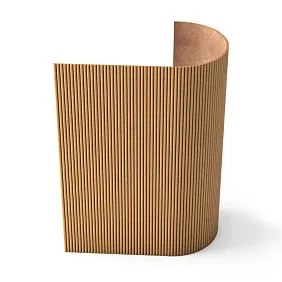
This is a solution for non-standard geometry. Slats are fixed to a fabric backing with gaps sufficient for bending without distorting the pattern. Flexible oak slatted panels wrap around a column, follow an arched vault, pass through a rounded corner—and the slat pattern continues seamlessly, without breaks or steps, like a continuous surface.
Where this is especially valuable: hotel lobbies with columns, restaurant halls with arches, office reception desks with rounded counters, apartments with non-standard layouts. Buying flexible oak slatted panels and applying them to a radius surface visually creates the effect of custom fabrication, though in fact it is a standard product.
Panels made from half-round oak battens
The third type—by profile, not by construction. A half-round batten creates a fundamentally different play of light and shadow: light glides smoothly over the convexity, without sharp shadows. A panel made from half-round oak battens is a soft, pliable surface with a warm, delicate relief. Compared to a rectangular profile, it feels significantly warmer and more alive.
Especially suitable for bedrooms, children's rooms, libraries, cozy living rooms—places where strictness is not needed, but an enveloping character of space is.
Oak slat profile: how shape changes the character of the panel
If the material is the 'what,' then the profile is the 'how it looks in your specific lighting.' And this question is fundamentally important when choosing, because the same oak species in the same shade with different batten profiles creates completely different surfaces.
Rectangular profile—the most architectural option. Clear vertical edges create sharp shadows in the gaps. With directed side lighting, the wall acquires a strict graphic pattern—precise, disciplined, with character. This is the profile for studies, offices, meeting rooms, living rooms with modern or neoclassical interiors. Natural oak with a rectangular profile and matte oil is one of the most 'mature' interior looks.
Half-round profile—the opposite in spirit. Shadows are soft, the pattern is pliable. An oak panel with a half-round batten in a bedroom or children's room creates an atmosphere that is hard to describe in words but easy to feel: warm, safe, alive. The delicate chiaroscuro of the half-round works especially well in combination with warm light—amber or neutral LED strips.
Trapezoidal profile—a complex and expressive option. The section widening towards the backing gives an interesting play of shadows: not as sharp as a rectangle, not as soft as a half-round. The trapezoid works in lofts, modern restaurant interiors, vibrant commercial spaces where more dynamism and tension in the surface is needed.
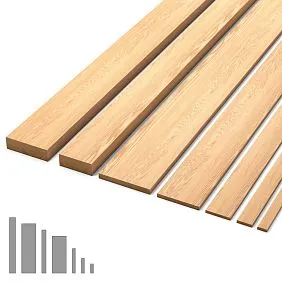
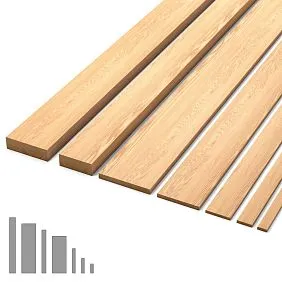
Slat width and spacing—two more parameters that change everything. Thin slats with small gaps create a rich, almost textile-like rhythm—the wall feels opulent and delicate. Wide slats with large gaps feel more airy and monumental. In small rooms, wide spacing overloads the wall: opt for a thin profile and moderate spacing.
How to finish oak slatted panels
This is perhaps the most important question for those choosing oak slatted wall panels. Because the finish is not just protection. It is the material's final voice: it is the finish that determines whether the oak will look alive or frozen.
Oil
Oil finish—the most natural of all. Oil penetrates the wood pores, not sealing them with a film but strengthening the fibers from within. The surface under oil is matte, tactile, 'breathing'—the hand feels the living structure of the wood. The open pore remains open.
Oak slatted panel with oil finish is the choice for interiors with a natural language: Scandinavian style, Japandi, organic minimalism, eco. Oil requires renewal every 1–2 years in residential spaces and every 0.5–1 year in commercial ones—but it is renewed locally, without dismantling. Wipe the damaged area with a new coat of oil—done.
Slatted oak panel with oil finish in natural tone — warm golden hue with visible grain. This is the most natural look, showcasing the beauty of the wood species to the fullest.
Wax
Wax works similarly to oil but creates a slightly more noticeable protective film on the surface. The waxed surface has a silky, warm feel. Suitable for areas with moderate use. Slatted oak panel with wax finish — a choice for bedrooms, studies, and home libraries. Wax is easy to renew and gives the surface a pleasant tactile character.
Varnish
Lacquer coating creates a transparent film on the surface — protective and durable. The lacquered surface is more sealed: the pores are either partially or completely covered. Tactility is reduced, but resistance to mechanical impact, moisture, and household stains is significantly higher.
Slatted oak panel with lacquer finish — the right choice for commercial spaces (restaurants, offices, showrooms, hotels) and high-traffic residential areas (hallways, children's rooms). Matte lacquer — a more natural effect. Semi-gloss — elegant, slightly expressive. Gloss — formal and ceremonial; rarely used in modern interiors.
Stain and tinting oils
This is a color tool. Stain changes the tone of the wood while keeping the grain pattern visible — unlike paint, which covers the texture. Tinting oil combines protection and tinting in one product.
Slatted oak panel with stain finish — a path to unconventional shades: wenge, tobacco, cognac, gray, anthracite, graphite. The grain is visible through the tinted layer — this is the key difference from paint. The result is colored oak with a living texture.
Popular color solutions for oak slatted panels
Color is a design decision that determines in which interior an oak panel will work organically and where it will stand out from the context.
Natural oak — warm golden tone under transparent oil or lacquer. The most versatile option: suitable for Scandinavian, organic, modern, and classic styles. Any neutral color scheme — white, beige, gray, cream tones — accepts natural oak organically.
Scandinavian gray — a cool ashy shade achieved with tinting oil containing gray pigment. The oak retains visible grain but acquires a Nordic, restrained character. Slatted oak panel in gray — a basic choice for Scandinavian and minimalist interiors, for spaces with a neutral light palette.
Wenge — deep dark brown with almost black veins. Slatted oak panel in wenge — a highly expressive, ceremonial look. Works well in a masculine study, restaurant, executive meeting room, or lobby. Requires good lighting: in a dark room, wenge 'absorbs' the space. With proper lighting — creates a rich, luxurious visual image.
Warm honey and tobacco tones — one of the most vibrant and cozy options. Tinting oil with warm pigment enhances the golden quality of the natural grain. For living rooms, bedrooms, home libraries — this is a look that makes you want to stay.
Whitewashed oak — a light, almost white tone with preserved grain pattern. Special compositions remove the wood's yellowness, leaving a cool milky shade. Appropriate in light Scandinavian interiors, in rooms with white or light gray walls.
How to choose the shade correctly: look not at the sample in isolation, but at its interaction with the floor tone, wall color, and lighting character. Warm oak in cool lighting and cool gray in warm lighting — both will look different than on the sample. Always request a physical sample and view it under the actual lighting conditions of your space.
Where oak slatted panels look best
Oak paneling is a material with character. It works where it has 'something to talk to' in the interior. Not everywhere. But where it works — it works flawlessly.
Living Room
Here, the oak slatted panel for the living room is the main architectural statement of the space. An accent wall behind the sofa made of natural oak with oil finish in a warm tone, with integrated LED lighting along the top perimeter — this is an image perceived as an expensive and well-thought-out interior, even if everything else is relatively modest.
Oak in the living room pairs well with: linen and wool textiles; furniture with metal details in black steel or brass; stone surfaces (tile, marble); neutral plastered walls.
Important condition: in a living room with an already warm wooden floor, oak on the wall requires tone coordination. Too similar a shade — monotony. Too contrasting — a disconnect. The best solution: shades from the same family but of different lightness.
Bedroom
Oak slatted panel for the bedroom — the wall behind the headboard as the main focal point of the space. A semi-circular profile in a warm oil tone creates an atmosphere of enveloping coziness. Hidden LED strip along the panel perimeter gives a soft halo — 'luxurious,' 'calm,' 'hotel-like.'
For the bedroom — only matte and satin finishes. Lacquer is possible here, but matte or ultra-matte finish is preferable. Gloss in the bedroom is a rare and bold decision.
Office
Oak paneling for the study — an environment for concentration and status. The wall behind the desk made of dark oak (wenge or tobacco) with a rectangular profile — a strict, collected look. Simultaneously, the textured surface diffuses sound, reducing echo, which is important for video calls and negotiations.
Oak in the study pairs well with leather elements (chair, folders), metal, and dark stone.
Entryway
Hallway — the first and last impression of the home. Oak slatted panel for the hallway in vertical orientation immediately sets the tone: 'people with taste live here.' Practically: the lower part of the wall with oak cladding is significantly more resistant to mechanical impact than any paint.
The choice of finish for the hallway is important: lacquer or hard oil — more resistant to scratches and moisture from outerwear.
TV area
Oak panel for the TV area in dark tones (wenge, anthracite, graphite with tinting) creates the right architectural context for the screen. A dark background eliminates the feeling of a 'stuck-on TV' and integrates the technology into the interior.
Combination: a niche for the TV in dark oak, side vertical slats in light natural oak — contrast of tones within the same wood species works convincingly.
Office, meeting room, showroom
Oak slat panel for the office is an argument in favor of the company. A conference room wall made of natural oak conveys: 'quality is valued here.' When purchasing panels for a conference room, an additional acoustic effect comes into play: the textured surface of solid wood disperses sound waves, reducing reverberation in rooms with hard floors.
Oak slat panel for a showroom creates an 'expensive' neutral background that advantageously showcases any product—from furniture to jewelry.
Ceiling
Oak ceiling panel is a bold and very effective technique. Horizontal slats on the ceiling create a sense of cozy, 'drawn-in' space—especially suitable for dining rooms, offices, conference rooms. Important: installing oak panels on the ceiling requires a reliable frame with load calculation—oak is denser than MDF.
What an oak panel offers besides decoration
Oak slat panel solves tasks that go beyond aesthetics—and that's a separate conversation.
Accent architectural surface. Oak creates a focal point in the interior: the eye is drawn to the living texture, the space gains focus. Without an accent wall, most interiors look incomplete.
Zoning without partitions.Oak slat panel for zoningdefines the boundary between zones—dining and living, work and living—exclusively through a change in finish. No loss of light, no feeling of confinement.
Tactility as a quality of the environment. The surface of natural wood is a physical sensation unavailable to any synthetic material. In a world where most surfaces are cold and smooth, tactile oak creates a sense of naturalness and homeliness.
Oak panel with lighting. Hidden LED strip in the gaps between slats or behind the top perimeter of the panel reveals the texture of natural fiber in soft light. In the morning—one surface. In the evening with the lighting on—a completely different one. This layering is unavailable to flat walls.
Partial acoustic effect. Textured solid wood surface disperses sound waves, reducing echo and reverberation. For rooms with high ceilings and hard floors—a noticeable improvement in acoustic comfort.
Long-term value of the interior. Investing in natural oak is an investment in environmental quality that works for decades. High-quality oak finish does not become outdated along with fashion trends.
Oak or MDF: when to buy solid wood, and when not to
An honest answer to this question is worth more than any advertisement.
Choose oak when:
-
The interior is built around natural materials: stone, linen, leather, metal.
-
You need a living texture that cannot be imitated.
-
Durability and repairability are important: after 15 years, oak can be refreshed by sanding, MDF can only be replaced.
-
Tactility is needed: a surface you want to touch.
-
The style requires natural expressiveness: Scandinavian, Japandi, organic, loft.
-
The object is commercial with requirements for durability and status.
Choose MDF for painting when:
-
You need an exact color according to RAL or NCS.
-
You need monochrome: a panel matching the wall color, so the texture is present but there's no color break.
-
The interior is based on geometry and graphics, not texture.
-
You need flexibility for future color change without dismantling.
-
The budget is limited: MDF is cheaper than oak while maintaining high aesthetics.
When oak is not the best choice, even if it's beautiful:
-
The interior already has many wooden textures: floor, furniture, doors. Oak on the wall will create overload if the shades are not carefully coordinated.
-
An exact 'corporate' color is needed. The wood tone will always affect the final finish — an exact color match will not be achieved.
-
Spaces with unstable temperature and humidity conditions: garage, unheated dacha, unglazed balcony — oak is uncomfortable there.
What to check before buying an oak slat panel
Before placing an order, go through this checklist. Each point affects the final result:
-
Construction: rigid for straight walls or flexible for curved surfaces?
-
Profile: rectangular, semicircular, or trapezoidal — based on the desired light and shadow effect?
-
Slat width and spacing: are they suitable for the scale of the room?
-
Finish: oil, wax, varnish, or stain — what matches the operating conditions and visual goal?
-
Shade: natural, gray, wenge, honey — check under the actual lighting conditions of your room.
-
Mounting orientation: vertical to increase height, horizontal to widen the wall?
-
Module dimensions: do they match the wall height?
-
Quantity calculation: measured the area, added a 10–15% reserve?
And most importantly: always request a physical sample. A photo on a monitor is not the material. A sample in your hands under your lighting is already an informed choice.
Typical mistakes when choosing an oak slat panel
There aren't many, but each one is costly — in the literal sense.
Choosing based only on a photo. The most common mistake. The natural grain pattern of oak is variable: different boards in the same batch differ in pattern and tonality. A sample is necessary.
Ignoring the finish. The same oak under matte oil and under varnish are different surfaces with different characters. You need to understand not only the shade but also the type of finish.
Incorrect profile for the context. A rectangular batten in a child's room creates sharp shadows in a delicate space. A semicircle in a strict executive office is too soft. The profile is chosen based on the room's purpose.
Too active relief in a small room. Large slats with wide spacing in a 10–12 sq.m. room overwhelm the space. In small rooms — a thin profile, moderate spacing.
Oak on oak without coordination. Oak slats on the wall + oak floor + oak furniture without tonal coordination — visual chaos. Either all wooden elements follow a unified tonal logic, or one of the elements is neutralized.
Ignoring side lighting. Oak without proper lighting loses half of its expressiveness. The grain only comes alive in light. Side tracks or hidden lighting are essential elements when working with oak panels.
Where to buy oak slat panels
The final part of the conversation — a specific address.Solid oak slat panels in the STAVROS catalog are ready-made solutions made from natural oak with a density of 700–750 kg/m³, featuring various profiles (rectangular, semicircular, trapezoidal), rigid construction on an MDF backing for flat surfaces, and flexible solutions on a fabric base for curved forms and non-standard architecture.
The assortment includes panels made from semicircular oak battens for delicate, soft light and shadow — a solution for bedrooms, children's rooms, and home libraries. In combination with solid wood millwork — oak and beech skirting boards, moldings, and cornices — STAVROS oak slat panels form a unified interior finishing system: walls, ceilings, furniture fronts, transition elements — all in one material language.
Solutions are available for both residential interiors (apartments, houses, apartments) and commercial projects (offices, restaurants, hotels, showrooms).
FAQ: popular questions about oak slat panels
Can oak slatted panels be painted like MDF?
Technically — yes, paint will adhere. But it makes no sense: you lose the main advantage of oak — its natural grain. Paint covers the wood fibers. For precise colors, use paintable MDF; oak is for staining, oil, or varnish that preserve the wood pattern.
How long will oak slatted panels last?
With proper coating and normal operating conditions — 20–40 years. Oil needs refreshing every 1–2 years, varnish — when wear appears, which may be every 5–10 years in a residential space.
Do oak panels need coating maintenance?
Yes. Oil coating — refresh every 1–2 years in residential spaces. Varnish — when visible wear appears, typically every 5–10 years. Wax — annually. This is not a drawback, but normal care for a natural material.
Is oak suitable for bathrooms?
For dry zones in bathrooms — yes, when using moisture-resistant coating (hard oil with water-repellent properties or varnish). For areas with direct water exposure — no: solid wood is not designed for systematic wetting.
Can oak panels be installed independently?
Rigid panels on a flat base — yes, with basic skills and precise marking. Ceiling installation and working with flexible panels on complex geometry — professional installation is recommended.
Oak or MDF slatted panels: what to choose for an office?
For commercial spaces with high traffic and durability requirements — oak with matte varnish. For offices with strict corporate color schemes (exact RAL color) — paintable MDF. Both tasks are solved correctly — the question is about priority.
How to match an oak shade to an existing floor?
Request samples of several tinting options, place them next to a sample of your flooring under your lighting. The goal is not to match the shade exactly, but to avoid conflict: either a difference in lightness (dark floor — light wall), or a unified tonal family (both warm or both cool).
About the company STAVROS
Behind every good material stands a manufacturer you can trust. This is not just a nice phrase — it's a real condition for a purchase that won't turn into disappointment.
STAVROS — a Russian manufacturer of solid wood and MDF products for interior finishing. The company produces slatted panels from natural oak and MDF, wooden moldings, cornices, and skirting boards — forming a complete range for a unified finishing system. Not a set of disparate products, but materials that work together.
STAVROS production standard — profile precision, uniform spacing, quality of edge and backing processing, honest answers about material and its properties. This is what makes the difference between a sample that looks good and a wall that looks flawless a year after installation.
STAVROS range includes: rigid oak slatted panels for flat surfaces, flexible fabric-backed panels for columns and arches, panels made of half-round battens for delicate relief, as well as paintable MDF panels for precise color solutions. The catalog covers residential and commercial projects of any scale.