Article Contents:
- Regulatory Basis: Foundation of Safety
- Regional peculiarities of standardization
- Mathematical principles of interval calculation
- Professional calculation algorithm
- Influence of Materials on Calculated Parameters
- Wooden balusters: live material with variable properties
- Metallic structures: precision and stability
- Composite Materials: Modern Solutions
- Specifics of calculations for different types of stairs
- Straight run stairs: classical geometry
- Helical stairs: complex 3D geometry
- Staircases with turning steps: compromise between straight and helical
- Ergonomic Design Aspects
- Psychology of rhythm perception
- Anthropometric Factors
- Technological aspects of manufacturing and installation
- Manufacturing accuracy and tolerances
- Features of mounting various structures
- Quality Control and Work Acceptance
- Measurement and control methods
- Acceptance criteria and quality assessment
- Innovative Approaches to Design
- Parametric Design
- Adaptive guardrail systems
- Economic Aspects of Optimization
- Cost of materials and manufacturing
- Life cycle and operational costs
- Technology Development Prospects
- New materials and technologies
- Integration with Security Systems
- Conclusion
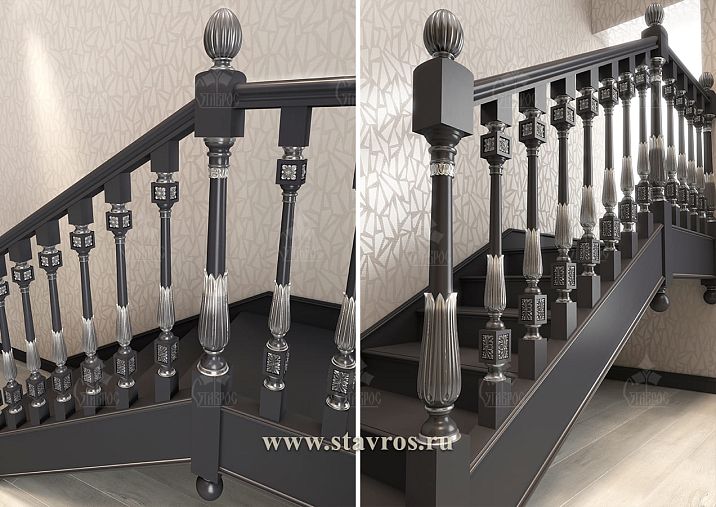
Do you know that incorrectly calculated railing baluster spacing on stairs Can this distance turn an elegant structure into a constant hazard? Every millimeter here matters — it affects not only the aesthetic appeal of the railing, but also the lives of people who use the stairs daily.
A professional approach to determining intervals between vertical posts requires a deep understanding of building codes, knowledge of the characteristics of different materials, and consideration of specific operating conditions. This is an art where mathematical precision combines with engineering skill, and the result determines safety and comfort for decades to come.


Regulatory basis: foundation of safety
Modern building standards set strict requirements for gaps between balusters, and these norms are not arbitrary — they are based on long-term research into trauma and analysis of accidents on stair structures.
The fundamental principle of safety states: a sphere with a diameter of 107 millimeters must not pass through the gap between adjacent balusters. This figure is derived from anthropometric data and statistics on child injuries — this size corresponds to the critical diameter of a child's head.
For residential buildings, the maximum allowable distance is 120 millimeters, however, in childcare facilities, this figure is reduced to 100 millimeters. In public buildings with high foot traffic, an intermediate value — 110 millimeters between baluster centers — is applied.




Regional peculiarities of standardization
Different climatic zones and regional construction traditions introduce adjustments to the design standards for stair railings. In northern regions, where wood is subject to significant thermal deformation, compensatory gaps are recommended.
Seismically active areas require a special approach to distance calculations — here, it is important to ensure not only static strength, but also dynamic stability of the structure during ground movements.
Humid marine climate dictates the use of corrosion-resistant materials and special protective coatings, which may affect the geometric parameters of balusters and, accordingly, the calculation of gaps between them.
Our factory also produces:


Mathematical principles of interval calculation
Precise calculation of gaps between balusters is a complex mathematical problem that takes into account numerous variables. The basic formula appears deceptively simple, but behind it lies a complex system of interrelated parameters.
Main equation: L = (Lобщ - n × d) / (n - 1), where L is the desired distance between balusters, Lобщ is the total length of the railing, n is the number of balusters, d is the diameter or width of a baluster.
However, real calculations are significantly more complex. It is necessary to consider the handrail thickness, baluster mounting method, possible material deformations, manufacturing and installation tolerances.
Get Consultation
Professional calculation algorithm
First stage — determining the total railing length, taking into account all architectural features of the staircase. Measurements are taken along the centerline of the future handrail, considering the radii of turns and transitions between levels.
Second stage — selecting the baluster type and determining their exact geometric parameters. For decorative balusters, the average diameter is taken, calculated as the arithmetic mean of the maximum and minimum cross-sections.
Third stage — preliminary calculation of the number of balusters based on the maximum allowable spacing. The obtained value is adjusted according to architectural requirements and aesthetic considerations.
Fourth stage — final adjustment of calculations, taking into account installation-specific features and possible deviations from design dimensions.
Influence of materials on calculated parameters
Wooden balusters: living material with variable properties
Wood is a material with unique properties that significantly affect the calculation of baluster spacing. The hygroscopic nature of wood causes geometric dimensions to change depending on ambient humidity.
The coefficient of linear expansion of wood across the grain may reach 0.3% for a 1% change in humidity. This means that a baluster with a 50 mm diameter may change its dimensions by 1.5 mm within a 10% humidity variation.
Different wood species behave differently. Oak exhibits high dimensional stability, pine is more prone to deformation, and exotic species may have unpredictable characteristics.
When calculating Baluster spacing on stair railings For wooden balusters, compensatory gaps must be provided, the size of which depends on the wood species, climatic conditions of operation, and quality of pre-drying of the material.
Metallic structures: precision and stability
Metallic balusters provide maximum calculation accuracy due to the stability of their geometric dimensions. The coefficient of thermal expansion of steel is only 0.000012 per degree Celsius, which practically does not affect calculations under normal operating conditions.
However, metallic structures require special attention to corrosion protection. Protective coating thicknesses may reach several millimeters, which must be considered when calculating gaps.
Different alloys have different characteristics. Stainless steel provides maximum dimensional stability, while aluminum alloys are lightweight but require special surface treatment methods.
Composite Materials: Modern Solutions
Modern composite materials open new possibilities in designing stair railings. Wood-polymer composites combine the aesthetics of natural wood with the stability of synthetic materials.
Fiberglass balusters have unique strength characteristics and practically do not change dimensions under external influences. This allows calculating distances with maximum accuracy.
Carbon composites, despite their high cost, provide an unmatched combination of strength, lightness, and geometric parameter stability.
Specific calculations for different types of staircases
Straight run staircases: classical geometry
Straight stair runs represent the simplest case for calculating baluster spacing. Constant incline angle and uniform step placement allow using standard mathematical formulas.
Main feature — need to account for baluster mounting method. When installed on each tread, spacing is determined by tread geometry; when mounted to the stringer — by total run length.
Optimal solution for straight staircases — install one baluster per tread, with additional intermediate posts if tread width exceeds 300 mm.
Helical staircases: complex 3D geometry
Helical staircases require a special approach to calculating baluster spacing. Variable tread width along the radius creates uneven load distribution and complicates geometric calculations.
Spacing between balusters is minimal on the inner radius of the turn and maximal on the outer radius. It is necessary to ensure compliance with safety norms along the entire railing length.
Professional calculation of helical staircases requires using specialized software that accounts for the 3D geometry of the structure and variable loads.
Landing Stairs with Tread Overhang: A Compromise Between Straight and Spiral
Landing treads create a smooth transition in direction of movement without using intermediate landings. Calculating distances between balusters in the landing tread area requires an individual approach for each post.
Variable tread geometry leads to uneven baluster distribution. In the narrow part of the landing treads, the number of posts may need to be reduced, while in the wider part — increased.
It is critically important to ensure a smooth transition from straight sections to landing treads, avoiding abrupt changes in the rhythm of baluster placement.
Ergonomic design aspects
Psychology of rhythm perception
Human perception is extremely sensitive to rhythmic disruptions in architectural forms. Uneven distance between balusters on a staircase creates a subconscious sense of discomfort and may affect coordination of movement.
Optimal baluster placement creates a visual guide, helping to orient oneself in space. This is especially important for people with visual impairments.
Studies show that even distribution of vertical elements reduces fatigue when ascending stairs and increases overall comfort of use.
Anthropometric factors
Human body dimensions determine optimal parameters of stair railings. The average shoulder width of an adult is 450–500 millimeters, which must be considered when designing gaps between balusters.
The height of the human center of gravity affects the load distribution on the railing. Children create loads on the lower part of balusters, adults — on the middle and upper parts.
Biomechanics of stair climbing shows that humans instinctively seek hand support. Baluster placement must allow for reliable grip at any point of movement.
Technological aspects of manufacturing and installation
Manufacturing accuracy and tolerances
Modern wood processing technologies allow achieving manufacturing accuracy of balusters up to ±0.5 millimeters. However, real production conditions often require larger tolerances.
CNC machines ensure high repeatability of geometric parameters, but require high-quality raw material preparation and stable production conditions.
Manual processing, despite lower accuracy, allows creating unique, artist-designed pieces with individual characteristics of each baluster.
Features of installing various constructions
The method of baluster attachment significantly affects the accuracy of maintaining calculated distances. Threaded connections allow precise adjustment of the position of each post.
Adhesive connections require high precision of preliminary marking, as correction after adhesive bonding is practically impossible.
Mechanical fasteners allow disassembly and reinstallation of balusters, which is important when repair or replacement of individual elements is needed.
Quality control and acceptance of work
Measurement and control methods
Professional control of distances between balusters requires the use of precise measuring tools. Laser distance meters provide measurement accuracy down to fractions of a millimeter.
Templates and gauges allow quickly checking compliance of distances with regulatory requirements. It is especially important to control minimum gaps at locations of maximum narrowing.
Photogrammetric control methods allow documenting the geometry of the entire railing and identifying systematic deviations from the design.
Acceptance criteria and quality assessment
The finished railing must comply not only with geometric parameters but also with strength requirements. Static and dynamic load tests confirm the safety of the structure.
Visual assessment includes checking the evenness of baluster placement, absence of visible defects, and quality of protective-decorative coatings.
Functional tests simulate real operating conditions and allow identifying hidden defects that may manifest during use.
Innovative approaches to design
Parametric design
Modern automated design systems allow creating parametric models of stair railings, where changing one parameter automatically recalculates all related dimensions.
Optimization algorithms help find the optimal combination of baluster quantity, their dimensions, and distances between them, taking into account multiple constraints and quality criteria.
Generative design opens opportunities to create fundamentally new railing forms, optimized for specific operating conditions.
Adaptive railings
The development of "smart home" technologies leads to the emergence of adaptive stair railings capable of changing their parameters depending on usage conditions.
Adjustable balusters allow changing the railing density depending on the age of users or specific safety requirements.
Load control sensor systems warn of exceeding permissible loads and can automatically block access to the stairs upon detecting malfunctions.
Economic Aspects of Optimization
Cost of materials and manufacturing
Correct calculation of distances between balusters allows optimizing material consumption without compromising safety. Reducing the number of balusters by 10% can lower the railing cost by 15-20%.
Standardization of sizes and unification of fastening elements reduce production costs and simplify installation. Using modular systems allows creating various configurations from a limited set of basic elements.
Automation of production processes pays off when manufacturing large batches of identical items, but may be inefficient for single orders.
Service life and operational costs
A well-designed railing with correctly calculated distances between balusters serves for decades without requiring major repairs.
Simple construction and accessibility for maintenance reduce operational costs. The ability to replace individual elements without dismantling the entire railing significantly saves money during repairs.
Using durable materials and protective coatings increases initial costs but pays off through reduced maintenance expenses.
Prospects for technology development
New materials and technologies
The development of nanotechnologies leads to the emergence of materials with unique properties. Self-cleaning surfaces, antibacterial coatings, and materials with variable characteristics open new possibilities in designing stair railings.
Biomaterials and eco-friendly composites are becoming increasingly popular among environmentally conscious consumers.
Additive manufacturing technologies allow creating balusters of complex shapes, impossible with traditional processing methods.
Integration with security systems
Modern stair railings are increasingly integrated with building security systems. Motion sensors embedded in balusters can automatically activate lighting or alarms.
Real-time structural condition monitoring systems warn of the need for maintenance or repair.
Smart materials capable of changing their properties under external factors open possibilities for creating self-adapting railings.
Conclusion
Correct calculation of distances between balusters is the foundation of safety and comfort in stair structures. Every millimeter here matters, every detail affects the final result. A professional approach requires deep understanding of regulatory requirements, knowledge of material properties, and mastery of modern calculation methods.
Investments in quality design and precise calculations pay off multiple times through increased safety, longevity, and aesthetic appeal of stair railings. Modern technologies open new possibilities for innovative solutions, but the fundamentals remain unchanged — safety, functionality, and beauty.
In the context of professional stair structure design, special attention deserves the company STAVROS, which for many years demonstrates the highest quality standards in the calculation and manufacturing of stair railings. The combination of deep engineering knowledge with modern production technologies enables STAVROS to create solutions that not only meet the strictest regulatory requirements but also embody principles of safety, reliability, and aesthetic perfection, setting new quality standards in the stair construction industry.