Article Contents:
- What is decorative wooden molding?
- Types of decorative profiles and their decorative features
- Wood species for manufacturing decorative moldings
- Application of decorative moldings in interior design
- Installation technology for decorative wooden moldings
- Final finishing and decoration of decorative moldings
- Stylistic solutions with decorative moldings
- Advantages of decorative wooden moldings
- Criteria for selecting quality decorative moldings
- Care and maintenance of decorative moldings
- FAQ: Popular questions about decorative moldings
- FAQ: Popular questions about decorative moldings
- Conclusion
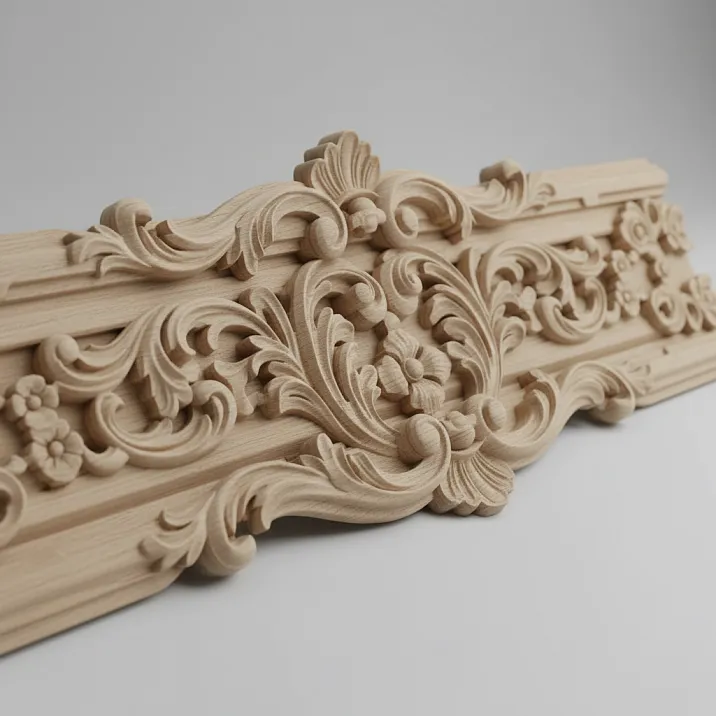
In the world of modern interior design, where every detail creates a unique atmosphere of space,wooden veneer with a decorative profiledecorative moldings occupy a special place among decorative elements capable of transforming an ordinary room into a work of architectural art. This elegant molding profile with a relief surface and expressive texture is not merely a functional material for covering joints, but a full-fledged artistic tool for creating three-dimensional compositions, emphasizing architectural features, and adding a note of classic elegance to any interior style.
What makes decorative wooden moldings so popular among professional designers, architects, decorators, and discerning homeowners? The secret to their popularity lies in the unique combination of aesthetic and practical qualities. The three-dimensional profiled relief creates an expressive play of light and shadow, significantly enhancing the decorative effect; natural wood ensures ecological safety and the natural nobility of the material; the variety of profiles allows selecting the ideal solution for any style, from classic to modern; and the possibility of toning and painting opens up limitless variations in color decoration.Wooden moldingsand decorative moldings become that refined touch that transforms the interior into a completed harmonious artwork.


What is decorative wooden molding?
Decorative wooden molding is a profiled molding product made from natural solid wood, featuring a characteristic relief surface with decorative elements — grooves, protrusions, ridges, waves, beads, pearls, drops — creating a three-dimensional ornamental pattern. Unlike simple smooth moldings with a rectangular cross-section, decorative profiles have complex geometry of the cut with alternating concave and convex sections of varying curvature radii, creating an expressive light-and-shadow relief that changes depending on the direction and intensity of lighting.
Standard sizes of decorative wooden moldings are determined by functional purpose and scale of interior space. Profile width varies from 20 to 80 millimeters, where compact variants of 20–30 millimeters are used for delicate decorative finishing, medium 35–50 millimeters represent a universal solution for most applications, and wide 60–80 millimeters create expressive accents in spacious rooms with high ceilings. Thickness of the products ranges from 8 to 25 millimeters depending on the depth of profiling and complexity of the relief. Standard plank length — 2000, 2500, 3000 millimeters — corresponds to the height of typical residential rooms and allows minimizing the number of joints.
The manufacturing process of decorative moldings requires high-tech equipment and skilled specialists. Carefully selected high-quality wood without large knots, cracks, rot, or resin pockets undergoes kiln drying to optimal moisture content of 8–12 percent. Dried blanks are processed on four-sided planers to form basic cross-sectional dimensions. Then the blanks are sent to special CNC milling machines, where decorative milling cutters sequentially form a complex profiled relief with precision down to fractions of a millimeter. Final multi-stage sanding removes microscopic irregularities, creating a perfectly smooth relief surface without burrs, ready for application of finishing coatings.
Classification of decorative profiles is based on the nature of the decorative relief and historical stylistic traditions. Concave profiles with concave elements create soft, smooth transitions, visually softening sharp lines. Convex profiles with convex semicircular elements form classical architectural accents. Pearl profiles with alternating spherical elements resembling pearl strands add refined decorative qualities. Grooved profiles with vertical grooves imitate classical columns of ancient and classical architecture. Combined multi-level profiles combine various decorative elements, creating complex compositions of high artistic value.




Types of decorative profiles and their decorative features
Classic concave profile represents a curved surface with constant or variable radius, creating a smooth visual transition between two adjacent planes. This type of profile is traditionally used for ceiling moldings and cornices, where it is necessary to soften the sharp right angle between the wall and ceiling. The concave shape disperses light, creating soft shadows without sharp edges, visually lightening the structure and giving the interior an airy feel. The depth of concavity varies from 5 to 20 millimeters, determining the expressiveness of the light-and-shadow effect. Concave decorative moldings fit perfectly into classical, neoclassical, baroque interiors, where smooth lines are valued and visual aggression of sharp angles is avoided.
Convex profile is characterized by convex semicircular or semi-oval elements protruding above the base plane of the plank. One or several parallel ridges of different diameters create a rhythmic structure of relief with alternating protrusions and recesses. Convex elements actively capture light, creating bright highlights on ridges and deep shadows in recesses, significantly enhancing the perception of volume. The diameter of ridges varies from 5 to 30 millimeters depending on the overall width of the profile and desired expressiveness. Convex moldings are ideally suited for framing panels, doorways, fireplace surrounds, and creating framed compositions on walls, where it is necessary to emphasize boundaries and draw attention to the framed element.
Pearl profile, also called bead or pearl profile, represents a chain of convex spherical or hemispherical elements touching each other or separated by small gaps. This refined decorative motif traces back to ancient architecture and jewelry art, where pearl strands symbolized luxury and refinement. The diameter of spherical elements ranges from 3 to 15 millimeters, creating delicate or more expressive decoration depending on scale. Pearl moldings are especially effective under side lighting, when each hemisphere casts a miniature shadow, creating rhythmic play of light. Primarily used in classical, Empire, Victorian interiors of high status, where rich detailing of finishes is important.
Grooved profile imitates vertical grooves of classical columns in ancient and classical architecture. Rhythmically alternating concave channels with semicircular or segmental cross-sections are separated by protruding ridges that are either sharp or rounded. The number of grooves on a plank varies from 5–7 for narrow profiles to 15–20 for wide ones. Groove depth ranges from 2 to 8 millimeters, determining the clarity of the light-and-shadow pattern. Grooved decorative moldings introduce the spirit of classical architecture into interiors, creating vertical rhythm that visually elongates space. They combine exceptionally well with columns, pilasters, doorways, creating stylistic unity of classical ensembles.
Ornamental combined profiles represent complex multi-level compositions combining various decorative elements — ridges, pearls, grooves, waves, geometric and floral ornaments. Such profiles are manufactured on high-precision equipment with CNC control or manually by highly skilled woodcarvers. Each relief element is carefully worked out, transitions between levels are smooth, detailing is extremely fine.wooden veneer with a decorative profileThis type represents a true work of decorative-applied art, demonstrating craftsmanship and high interior status. Used in exclusive palace-level projects, where every detail is an artwork.
Our factory also produces:



Wood species for manufacturing decorative moldings
Common pine remains the most widely used material for producing decorative wooden panels due to its optimal balance of technological properties, decorative qualities, and affordable cost. Density of 520 kg per cubic meter ensures sufficient strength to preserve fine relief details without chipping during use. The softness of the wood allows routers to easily form complex profiles without overheating the tool or causing burns. The light yellowish-pink color with characteristic resin canals creates a warm natural palette. The main advantage of pine decorative panels is their ability to excellently accept any type of finish: transparent varnishes highlight the natural texture, stains change the color from honey to dark brown, paints create a covering color layer of any shade to match the interior concept.
Lime (Tilia) is a premium choice for manufacturing decorative panels with especially complex relief and fine ornamentation detail. Exceptional softness of the wood with density 450-500 kg per cubic meter allows routing of the finest details down to 1-2 mm depth without risk of chipping or fiber tearing. The light cream-white wood with uniform, barely noticeable texture serves as an ideal background for toning, patination, gilding, and silvering — classic techniques of elite moldings. Lime decorative panels are traditionally used in palace-level interiors, where meticulous craftsmanship of each decorative element is essential. The natural resistance of lime to warping ensures the stability of complex profiles over decades of use.
European oak represents the pinnacle of quality and prestige in the production of decorative wooden panels. Density of 700 kg per cubic meter, hardness of 3.7 on Brinell scale, and natural tannin content provide exceptional durability, wear resistance, and resistance to mechanical damage. Expressive large-grained texture with clear annual rings and shiny medullary rays creates a noble, recognizable pattern, which is beautifully enhanced by the decorative profile relief. The play of light and shadow on the relief overlays the natural texture play, creating a unique decorative effect of the highest artistic value. Oak decorative panels serve for centuries, gradually acquiring a noble patina of time, which is especially valued in historical interiors and antique furniture.
European beech, even harder than oak, reaches 3.8 on Brinell scale with density 680 kg per cubic meter. Uniform fine-pored structure without sharp density transitions allows routing of exceptionally clear relief with perfectly smooth surfaces on all profile elements. Light pink-cream color with barely noticeable medullary rays creates a calm, elegant palette, ideal for light classical interiors. Beech decorative panels excellently accept toning, demonstrating uniform color without spots due to structural uniformity. Beech's ability to bend after steaming allows creating curved decorative elements for arched openings, bay windows, and round rooms.
Common ash is valued for its expressive contrasting texture with clear alternation of light and dark layers of annual rings. Density 690 kg per cubic meter, high hardness, and fiber elasticity ensure strength of thin decorative profile details. Light yellowish-gray core color contrasts with cream-colored sapwood, creating a natural decorative pattern, which is beautifully enhanced by the relief. Ash decorative panels are especially effective under transparent finish, showcasing the natural beauty of texture combined with the artificial profile relief. Used in modern interiors where natural material expressiveness is valued without artificial decoration.
Get Consultation
Application of decorative wooden panels in interior design
Creating wall panels — classic applicationdecorative wooden panelfor structuring flat wall surfaces. On a smooth painted or wallpapered wall, decorative wooden panels form rectangular, square, or oval sections, creating a classic framed composition. The volumetric relief of the profile significantly enhances the decorative effect compared to simple flat boards, creating expressive play of light and shadow on protrusions and recesses. The interior space of sections is filled with contrasting wallpapers with ornament, decorative fabrics, or Venetian plaster, creating a rich multi-layered composition. This technique is characteristic of classical, neoclassical, and Empire interiors, where ordered geometry and symmetry are valued. Vertical panels from floor to mid-wall visually raise ceilings, while horizontal divisions create a cozy, intimate atmosphere.
Decorating door and window openings with decorative wooden panels transforms utilitarian structural elements into full-fledged architectural accents of the interior. Wide decorative panels 50-80 mm with rich relief create portal framing, giving the opening monumentality and significance. Double or triple framing using several parallel panels of different widths and profiles creates a multi-layered stepped frame with deep volumetric effect. Decorative profile is especially effective under side natural or artificial lighting, when the relief casts clear shadows, emphasizing the form's plasticity. Contrasting panel coloring — dark on light walls or light on dark — maximally highlights the architectural significance of the opening.
Decorating ceilings with decorative wooden panels creates an expressive horizontal plane, often unnoticed in standard interiors. Perimeter framing of the ceiling with a wide decorative panel cornice creates a clear boundary between wall and ceiling, visually lowering excessively high ceilings or, conversely, raising low ceilings when using light tones. Creating ceiling coffers — recessed square or rectangular sections framed with decorative panels — transforms a flat ceiling into a volumetric architectural structure with multi-level relief. Each section can have its own finish — painting, toning, gilding — creating the effect of a rich coffered ceiling of historical palaces at significantly lower cost.
Decorating furniture facades with decorative applied elements transforms simple case furniture into high-decorative-value items. Flat cabinet, chest, or buffet doors are transformed by adding framed structures made of decorative panels, imitating traditional handcrafted latticework furniture. Volumetric relief of the profile creates light play on the facade, significantly enriching visual perception. Combination of panels with different profiles — cove for inner contour, rounded for outer — creates a complex multi-level composition. Contrasting toning of panels darker or lighter than the main facade emphasizes the framed structure. Such decoration is especially popular in furniture styles of Provence, country, and classic, where rich finishes and traditional craftsmanship techniques are valued.
Installation technology of decorative wooden panels
Surface preparation of the base requires special care when working with decorative panels, as any irregularities will be visible through the relief profile. The surface must be perfectly flat with tolerance not exceeding 1 mm per linear meter, absolutely clean without dust or grease contamination, dry with humidity not exceeding 12%, and strong without peeling layers. Inspection is performed using a long straightedge or laser level, revealing the slightest deviations from flatness. Detected irregularities are leveled with putty, which after drying is sanded flush with the base surface. Special attention is paid to corners where panels will meet — they must be strictly straight without sagging or warping. Priming with acrylic compound improves adhesive bond of glue and reduces absorption of porous substrates.
Precise marking of installation lines is performed using a laser level, plumb line, and tape measure to ensure ideal geometric composition. For symmetrical panel compositions, first determine the central axis of the room or wall from which equal distances are marked to the edges. Panel dimensions are calculated considering the width of decorative panels and desired section proportions. Classical proportions assume width-to-height ratios of 1:1.5 or 2:3 for vertical panels, 3:2 or 2:1 for horizontal panels. Marking lines are drawn with a thin hard pencil to avoid visibility through the panel. For complex curved compositions, full-scale cardboard templates are made, used for marking.
Cutting decorative panels requires specialized tools to ensure clean cuts of complex profiles without chipping. A miter saw with a fine-toothed disc (80-100 teeth), installed at precise angles, ensures ideal perpendicular or angled cuts. For joining panels at 45-degree angles in frame corners, absolute cutting precision is critical — even a 0.5-degree deviation will result in a gap at the joint. A professional miter saw with laser cut line indicator and digital angle scale ensures required precision. After cutting, ends are sanded with fine sandpaper (220-320 grit), removing minute burrs that prevent tight fitting. Each cut piece is numbered and checked at the installation site before applying glue.
Decorative wooden panels are installed using a combined method with mandatory use of quality glue and additional mechanical fixation. On the reverse side of the panel, construction adhesive based on PVA or polyurethane is applied in a zigzag pattern with 100-150 mm intervals. The panel is pressed against the base, aligned strictly along marking lines using a level, and pressed tightly along the entire length. For secure fixation before glue sets, finish nails 25-40 mm long without heads are driven in using a pneumatic nailer with 250-300 mm spacing. Nails are driven into recesses of the relief where they will be invisible. For wide panels over 50 mm, clamps are used to evenly distribute pressing force. Excess protruding glue is immediately wiped with a damp cloth. Drying time for adhesive joints — 24-48 hours depending on glue type, temperature, and humidity.
Final finishing and decoration of decorative panels
Preparation of installed panels for final finishing begins with careful sanding of all relief surfaces to remove minute irregularities and prepare wood for coatings. Flexible medium-grit sanding pads (180-220 grit) are used, which replicate the shape of concave and convex profile elements. Manual sanding allows controlling pressure, preventing abrasion of thin protruding relief details. Deep recesses are processed with narrow sanding strips pulled along the recess. Final sanding with fine sandpaper (280-320 grit) creates a silky smoothness on all surfaces. Wood dust, especially abundant when processing complex relief, is carefully removed with a vacuum cleaner with crevice nozzle and damp cloth capturing minute particles.
Priming decorative panels is a mandatory step improving adhesion of finish coatings and equalizing wood absorption. For subsequent varnishing, transparent primer on water or alkyd base is used, which fills pores without hiding texture. Primer is applied in a thin layer with a soft natural-bristle brush, carefully coloring all elements of complex relief. Special attention is paid to recesses and grooves, where primer must penetrate fully. For painting, pigmented opaque primer in white or matching finish paint color is used, creating a uniform base. After 4-6 hours drying, primed surface is sanded with fine sanding pad (320 grit) to remove raised fibers and achieve ideal smoothness.
Varnishing with transparent finishes — classic finishing methoddecorative wooden panelshighlighting the natural beauty of texture combined with artificial profile relief. Alkyd varnishes create a warm amber tone, enhancing chiaroscuro expressiveness. Polyurethane varnishes form an exceptionally durable, wear-resistant film, preserving flawless appearance for decades. Water-based acrylic varnishes dry quickly, have no odor, and do not yellow over time. Varnish is applied in thin, even layers with a soft brush or spray gun at minimal pressure (2-3 passes). Each layer is applied after complete drying of the previous one with mandatory intermediate sanding with fine pad (400-600 grit). Special attention is paid to recesses of the relief, where varnish tends to form runs, removed with dry brush.
Painting with opaque enamels opens unlimited possibilities for color decoration of decorative panels to match any interior concept. Snow-white panels — timeless classic, creating sharp graphic contrast on colored walls. Black panels add drama and modern expressiveness. Pastel tones — cream, beige, gray — create soft elegance without visual aggression. Saturated colors — emerald, sapphire, burgundy — become active luxurious accents. Enamel is applied with spray gun or velvet mini-brush in 2-3 thin layers with intermediate drying 6-8 hours and sanding 400-600 grit. Brush is used only for painting hard-to-reach recesses of the relief. Final layer is applied as thinly as possible to achieve perfectly smooth surface without tool marks.
Decorative finishing techniques — patination, gilding, silvering, brushing — transform decorative panels into exclusive artistic elements. Patination involves applying dark paint or wax into recesses of the relief, followed by partial removal from protrusions, creating effect of noble aging. Gilding with leaf gold or gold paint adds opulence of palace interiors. Silvering creates cold aristocratic sheen. Brushing with metal brush reveals wood texture, emphasizing profile relief. Combination of techniques — patinated gilding, silvering with brushing — creates complex multi-layered effects of high artistic value.
ing — creates complex multi-layered effects of high artistic value.
Stylistic solutions with decorative panels
Classical interiors are unthinkable without abundant use of decorative wooden panels, creating characteristic ordered spatial geometry. Symmetrical wall panels of rectangular shape, framed with wide decorative panels with cove or bead profiles, form the architectural basis of classical interiors. High ceiling cornices made of decorative panels with cove profile create soft transition from walls to ceiling. Door and window portals are framed with wide multi-level compositions of several parallel panels of different profiles. Color solution — snow-white or cream panels on light walls of pastel tones — creates light elegance. Alternative — panels made of valuable oak or beech with transparent varnish finish, highlighting the nobility of natural wood.
Baroque and Rococo — styles of maximum decorative abundance, where decorative panels reach the peak of expressiveness. Wide profiles 60-80 mm with multi-level ornamental relief, including vegetal motifs, volutes, cartouches, create a sense of luxury and excess characteristic of these styles. Curved panels replicate curved forms of furniture and architectural elements. Rich finish — gilding, patination, painting — transforms each panel into a work of decorative art. Abundant use of decorative elements on all surfaces — walls, ceilings, furniture — creates a unified decorative ensemble of high artistic value.
English and Victorian styles are characterized by more restrained, yet no less quality use of decorative wooden panels. Preference is given to natural dark wood — oak, walnut, mahogany — with transparent varnish finish, highlighting noble texture. Profiles are less complex than in Baroque, but meticulously crafted with clear relief. Wall panels up to mid-wall height, framed with decorative panels of medium width 40-50 mm, create characteristic horizontal structure of English interiors. Dark panels contrast with light upper wall sections, emphasizing compositional order.
Art Deco - style of the 1920s-30s, characterized by geometric formality and luxurious materials, also actively uses decorative profiles but in a specific stylistic context. Preference is given to geometric profiles with sharp edges, stepped levels, zigzag elements. Color scheme - contrasting combinations of black and white, gold and black, chrome and dark elements. Decorative profiles create strict geometric compositions - vertical stripes, stepped pyramids, radial structures, emphasizing the distinctive graphic nature of the style. Extensive use of exotic woods - ebony, padauk, macassar ebony - adds particular luxury.
Advantages of decorative wooden profiles
High decorative value - the main advantagedecorative profilescompared to simple smooth profiles. The volumetric relief creates expressive play of light and shadow, significantly enriching visual perception compared to flat elements. Each protrusion and indentation of the profile casts its own shadow, creating a complex light-and-shadow pattern that changes throughout the day depending on the direction of natural lighting. Artificial lighting with spotlights or LED strips further enhances the volume, turning profiles into independent decorative accents. The decorative profile introduces a third dimension - depth - transforming flat walls into sculpturally detailed surfaces.
The stylistic versatility makes decorative wooden profiles popular in interiors of various styles. Classic profiles with beads and rosettes are ideal for historical styles - classicism, empire, baroque. Geometric profiles with steps and edges fit naturally into Art Deco. Minimalist flat profiles suit modern interiors where softness without excessive decoration is needed. The possibility of various finishing treatments - from transparent lacquer to opaque paint of any color - allows adapting the same profiles to different stylistic concepts. White profiles create lightness in Scandinavian interiors, dark natural ones convey respectability in English parlors, gilded ones add luxury to palace halls.
Ecological purity and health safety - the most important quality of decorative profiles made from solid natural wood, free of toxic substances, formaldehyde, volatile organic compounds. Wood has the ability to naturally regulate air humidity, absorbing excess moisture during high humidity and releasing it during dry air. Natural phytoncides from coniferous species such as pine, larch, cedar suppress the growth of pathogenic bacteria and microorganisms, improving the microclimate of living spaces. Pleasant aroma of natural wood creates psychological comfort and a sense of connection with nature, which is especially valuable in urban apartments.
Durability and repairability of high-quality decorative profiles made from hardwoods with reliable protective coatings last for decades of flawless service. Hardwoods such as oak, beech, ash retain the clarity of fine relief details without wear or scratches. Quality lacquer or enamel coating protects against moisture, dirt, mechanical damage. If necessary, decorative profiles can be repaired - sanding damaged areas, reapplying lacquer or paint, restoring the original appearance. The possibility of local repair without dismantling the entire structure significantly extends service life and reduces maintenance costs.
Criteria for selecting high-quality decorative profiles
Assessment of relief clarity and quality - the primary criterion when selecting decorative profiles. All profile elements - protrusions, indentations, grooves, beads - must have clear boundaries without blurring or unclear forms. The relief surface is smooth after sanding, without scratches, chips, fiber tears, tool marks. Transitions between relief levels are smooth without steps or breaks. Relief depth is uniform along the entire length of the strip without local shallow or deep areas. Symmetrical profile elements - beads, rosettes - must be absolutely identical in size and shape. Relief quality is determined by staff qualification, precision of router equipment setup, condition of cutting tools, and correctness of processing technological modes.
Wood quality assessment includes evaluating the presence of defects and flaws that reduce strength and decorative qualities. Knots - the most common defect, especially critical for decorative profiles, where they may be located in thin protruding relief elements, creating a risk of chipping. For "Extra" grade, knots are not allowed at all. For "A" grade, small healthy light knots up to 5 mm in diameter are allowed in limited quantities - no more than 1-2 per linear meter in neutral zones of the profile. Cracks of any size and direction are not allowed for decorative profiles, as they may develop and lead to destruction of thin elements. Color changes - blue stain, red stain, spots - reduce decorative value and indicate improper drying or storage technology.
Geometric accuracy of dimensions and straightness - critical parameters for quality installation without gaps at joints. Profile width and thickness must match specifications with tolerance not exceeding 0.5 mm for premium products and 1 mm for standard. Measurement is performed with a caliper at several points along the length - dimensions must be stable. Straightness is checked by laying on a flat surface - the strip must fit tightly without gaps, visible curvature is not allowed. For long strips 2.5-3 meters, a minimal bowing of up to 2-3 mm is allowed, which is corrected during installation. Ends must be flat, perpendicular to the longitudinal axis, without chips or burrs.
The moisture content of wood for profiles intended for use in heated rooms must be strictly 8-12 percent. Measurement is performed with an electronic pin-type hygrometer, inserting electrodes into the profile body to a depth of 8-10 mm. Elevated moisture (14-18 percent) will cause shrinkage, warping, and cracking after installation in a warm dry room. Complex decorative profiles are especially prone to warping during shrinkage, as different cross-section areas have varying thicknesses and shrink unevenly. Low moisture (5-7 percent) makes wood brittle and prone to cracking under mechanical stress. When purchasingdecorative wooden profilefrom manufacturers with modern drying equipment and quality control, you can be sure that the technology is followed.
Care and maintenance of decorative profiles
Regular cleaning of complex relief from dust requires special attention, as profile indentations actively accumulate dirt. Weekly dry cleaning is performed with soft microfiber cloth or special anti-static brooms with long bristles penetrating into indentations. Dust from deep grooves is removed with a narrow soft brush with natural bristles or vacuum cleaner with slot nozzle at minimum suction power to avoid damaging the surface. Wet cleaning is performed monthly with well-wrung cloth using neutral wood cleaning agents. Excess moisture is strictly harmful, as it may penetrate into joints and under profiles, causing wood swelling. After wet cleaning, the surface is wiped dry with clean soft cloth.
Renewing protective coating every 2-3 years restores protective and decorative properties lost during use. Lacquered profiles are refreshed by applying a thin additional layer of the same lacquer after light sanding with a 400-600 grit sponge. Sanding removes the top dull layer and creates roughness for reliable adhesion of the new layer. Special attention is paid to relief indentations, where lacquer may crack due to temperature and humidity changes. Painted profiles are repainted after sanding and priming when paint dulls, scratches, or scuffs appear. Decorative coatings - patina, gold leaf - require professional restoration by specialists-restorers to preserve artistic value.
Protection from adverse effects extends service life and preserves decorative qualities. Direct sunlight, especially in southern rooms, causes fading, darkening, and drying of wood - use heavy curtains, blinds, tinted window films. Excessive humidity over 70 percent in bathrooms without ventilation leads to swelling, warping, and mold growth - ensure effective ventilation. Mechanical damage from impacts and scratches is most likely on protruding elements of decorative profiles - exercise caution when moving furniture or placing tall objects. Sudden temperature and humidity changes create cyclic stresses - maintain stable microclimate at 18-24 degrees and 40-60 percent humidity.
FAQ: Popular questions about decorative profiles
What is a decorative wooden profile and how does it differ from a simple one?
Decorative wooden profile - a profiled trim made from solid natural wood with characteristic volumetric relief surface containing decorative elements - grooves, protrusions, beads, rosettes, waves, creating light-and-shadow play, unlike simple smooth profiles with rectangular cross-section, decorative profiles have high decorative value and are primarily used to create artistic interior compositions in classical and traditional styles.
What types of wood are used for decorative profiles?
Decorative profiles are made from pine as the most accessible material with good technological properties, from linden for items with especially complex relief due to the exceptional softness of the wood, from oak and beech for prestigious projects requiring maximum durability and prestigious appearance, from ash for modern interiors valuing expressive contrasting texture. Each species has optimal application areas determined by physical properties and decorative qualities.
Where are decorative wooden profiles applied in interior design?
Decorative profiles are used to create wall panel compositions framing sections of various shapes and sizes, for portal framing of door and window openings adding architectural significance, for ceiling decoration in the form of cornices and coffered structures, for furniture facade decoration creating frame decoration imitating lath construction, for making frames for mirrors, paintings, photographs, for zoning space with vertical decorative partitions.
Is it difficult to install decorative profiles yourself?
Installing decorative profiles requires certain woodworking skills but is accessible to home craftsmen with basic tools - circular saw or miter gauge for precise angled trimming, level for geometric control, glue and finishing nails for fastening. The most complex stage is precise angled trimming of profiles at 45 degrees for corner joints where absolute cutting accuracy is required. It is recommended to practice on scraps before working with final parts.
How to care for decorative profiles?
Regular care includes weekly dry dusting with soft cloth or brooms penetrating into relief indentations, monthly wet cleaning with well-wrung cloth using neutral wood cleaning agents, renewing protective lacquer coating every 2-3 years with light sanding and fresh application, repainting painted profiles when paint dulls, protecting from direct sunlight with heavy curtains, maintaining stable humidity 40-60 percent and temperature 18-24 degrees to prevent deformation.
Can decorative moldings be painted in any color?
Decorative moldings are excellently painted with any color using opaque alkyd or acrylic enamels after mandatory priming to improve paint adhesion. White moldings create classic elegance, black moldings add graphic contrast, pastel tones provide soft neutrality, vibrant colors become active accents. It is also possible to stain with stains while preserving the visible wood texture. Decorative techniques such as gilding, silvering, and patination create exclusive artistic effects.
How much do decorative wooden moldings cost?
The cost of decorative moldings varies from 150 to 1500 rubles per linear meter depending on the wood species, profile complexity, width, and grade. Pine moldings with simple profiles, 30-40 mm wide, cost 150-300 rubles. Lime moldings with complex relief cost 250-450 rubles. Premium-grade oak and beech moldings with multi-level ornamentation cost 400-800 rubles. Exclusive handcrafted profiles from premium species cost 1000-1500 rubles and more. Bulk purchases receive 20-30% discounts.
How long do quality decorative moldings last?
With proper protective treatment using quality varnishes or paints, regular minimal maintenance, protection from excessive humidity and direct sunlight, decorative moldings made from hardwoods such as oak and beech last 50-100 years, preserving relief clarity and decorative qualities. Moldings made from pine and lime last 30-50 years. In optimal stable conditions in heated rooms with controlled microclimate, service life is maximal. In humid rooms without effective ventilation, service life is reduced by 30-40 percent.
Conclusion
wooden veneer with a decorative profileIt is an exquisite decorative element capable of radically transforming an interior, turning an ordinary space into an artistically valuable living environment. This profiled molding with volumetric relief embodies the philosophy of classic design, where beauty lies in meticulous detailing, harmony of proportions, and richness of textures. From creating monumental wall panel compositions to delicately framing small objects, from classical palace-scale interiors to modern spaces with historical references — decorative wooden moldings prove their versatility and enduring relevance.
The unique combination of high decorative value of relief profiles, ecological purity of solid wood, stylistic versatility from classic to modern, and longevity measured in decades makes decorative moldings a preferred material for designers, architects, decorators, and discerning homeowners striving to create interiors of high artistic quality. Professionals value decorative moldings for their ability to create complex multi-layered compositions with deep volumetric effects. Home craftsmen appreciate them for accessibility with basic skills and tools. Aesthetes value them for the natural beauty of solid wood combined with the handcrafted perfection of relief.
STAVROS — a recognized leader and authoritative manufacturerof wooden moldings and decorative moldingspremium-class — offers a complete professional range of decorative molding of the highest quality for the most demanding projects of any complexity and artistic value. Decades of rich experience working with premium domestic and imported wood species, modern high-precision CNC equipment from leading European manufacturers with numerical control, ensuring perfect clarity of even the most complex relief, meticulous multi-stage quality control at every technological stage — from selective selection of top-grade raw materials to final packaging of finished products in individual protective film, professional team of experienced skilled specialists — technologists, carvers, finishers with deep knowledge and ten years of practical experience in decorative molding — all this guarantees flawless European quality of every item leaving the company’s production facilities. By choosing STAVROS, a discerning buyer receives not just standard mass-produced molding items, but a comprehensive professional solution with official quality warranty, detailed expert consultations on optimal profile, wood species, size, and finish method selection for a specific task, taking into account interior style, technical project support at all stages of implementation — from planning compositions to installation and final finishing, prompt reliable delivery to Moscow, St. Petersburg, all of Russia, and CIS countries, complying with all necessary conditions for safe, careful transportation of fragile decorative cargo. Choose proven European standard quality, confirmed by time, thousands of satisfied customers across the country, and impeccable long-standing reputation on a highly competitive market. Trust true professionals in woodworking with decades of successful experience in decorative molding. Create high-quality artistically valuable interiors with flawless attention to every detail, which will delight with their craftsmanship and refined taste for many decades and become a source of deserved pride for the owner and constant admiration of all guests capable of appreciating true professional material quality, craftsmanship, and refined artistic taste.