












































































Article Contents:
- Frame as an art object: from framing to artwork
- Sculptural frames: volumetric expressiveness
- Asymmetric avant-garde frames: rejection of the rectangle
- Multi-layered frames: depth and perspective
- Minimalist frames: purity of line
- Hand-painted decoration: individuality and artistic value
- Traditional techniques: gilding and patination
- Decorative painting: ornaments and narratives
- Ombre and gradients: color transitions
- Crackle: Effect of Antique Cracks
- Textured finish: tactile expressiveness
- Carving: from classical ornaments to avant-garde patterns
- Brushing: Revealing Texture
- Firing and Show-Sugi-Ban technique: fiery patina
- Texturing and embossing: patterns on the surface
- Materials: solid wood and alternatives
- Solid wood: premium organic quality
- Polyurethane: sculptural decorative quality
- MDF and plywood: practical alternatives
- Metal: industrial graphic quality
- Sizes and formats: from miniatures to monumental
- Standard formats
- Non-standard formats
- Frames for mirrors: from compact to floor-standing
- Stylistic solutions: frames in different interiors
- Classic: gilded carved
- Neoclassical: White Minimalist
- Scandinavian: light wood, minimalism
- Loft: metal, dark wood
- Boho and eclecticism: painting, combinations
- Practical aspects
- Choosing a frame for the artwork
- Passe-partout: additional framing
- Mounting and installation
- Maintenance
- Frequently asked questions
- Conclusion: framing worthy of art
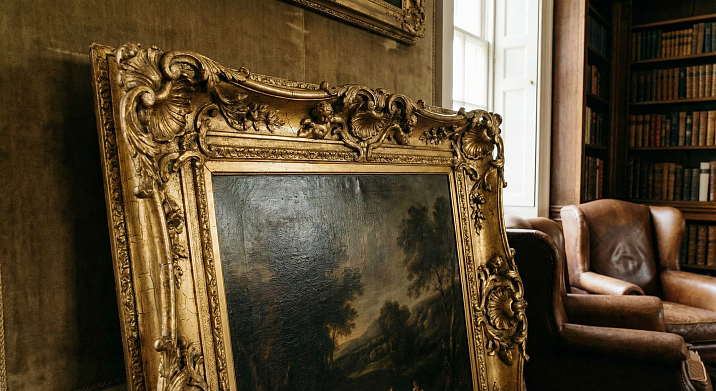
Artwork — painting, photograph, mirror — requires worthy framing that does not merely limit the image but engages in dialogue with it, creates context, and enhances emotional impact. In 2026, the frame ceases to be a neutral border, modestly receding into the background. It becomes an independent art object, drawing attention through textured finishes, hand-painted decoration, sculptural elements, and original design. The frame for a painting transforms into an artwork that frames another artwork, creating a multi-layered artistic object. The frame for a mirror transforms into a decorative sculpture, where the reflective surface is merely a central element of a complex composition.
Hand-painted decoration endows the frame with individuality, uniqueness, and artistic value — each frame becomes a one-of-a-kind piece, signed by the artist. Textured finishes — carving, brushing, patination, gilding, inlay — create tactile complexity, play of light and shadow, visual depth. Wooden frames retain premium material status — organic warmth, natural texture, ecological purity, and ability to undergo detailed processing make solid wood indispensable for original, collectible frames. Wood can be carved, shaped, bent, painted, gilded, creating endless possibilities for artistic expression.


Frame as an art object: from framing to artwork
Traditionally, the frame served as framing, highlighting the artwork while remaining neutral. The modern approach considers the frame as part of the artwork, sometimes equal in importance, sometimes dominant, creating artistic value independently of the content.




Sculptural frames: three-dimensional expressiveness
Sculptural frames go beyond flat molding, creating three-dimensional expressiveness. Carved elements — leaves, flowers, figures, ornaments — protrude 20–50 mm, creating relief and play of light and shadow. A frame for a painting transforms into a sculptural frame, where each corner and side becomes a miniature carving masterpiece.
Sculptural frames are crafted from solid hardwoods (oak, walnut, linden for carving), where carving is done manually — for unique, exclusive pieces, or on CNC machines using 3D models — for precision and repeatability. Carving depth of 10–30 mm creates expressive volume visible from a distance. Carving can be symmetrical — classical ornaments repeated on all sides, or asymmetrical — artist-designed compositions where each side is unique.
Sculptural frames suit classical, baroque, eclectic interiors where decorative complexity is valued. They transform even simple reproductions into significant objects, adding weight and value. A wooden frame with deep carving becomes a family heirloom passed down through generations.
The company STAVROS offersSolid wood frameswith carved elements, including classical baroque, neoclassical, and original sculptural forms.
Our factory also produces:


Asymmetrical avant-garde frames: rejection of the rectangle
Asymmetrical frames reject the traditional rectangle in favor of arbitrary forms: organic curves creating smooth lines reminiscent of natural contours, geometric broken forms — angular, dynamic, variable width — one side wide, another narrow, creating visual imbalance, fragmented — the frame consists of separate elements that do not form a closed contour.
Asymmetrical frames for paintings create modernity, avant-gardism, artistic boldness. They suit contemporary art — abstractions, photography, graphics — where the frame itself becomes part of the artistic statement. Asymmetry can emphasize the composition of the artwork, guide the viewer’s gaze, and create tension.
Manufacturing asymmetrical frames requires individual design, precise milling, and non-standard joints. Material — wood (for organic forms), metal (for geometric forms), or combinations. Asymmetrical frames are a choice for galleries, collectors of contemporary art, and avant-garde interiors.
Get Consultation
Multi-layered frames: depth and perspective
Multi-layered frames consist of several frames nested within each other, creating depth, perspective, and visual complexity. The outer frame — wide (80–150 mm) — creates the main volume, the middle frame — contrasting in color or texture (30–50 mm), the inner frame (fillet) — narrow (10–20 mm), directly adjacent to the image.
Multi-layering creates a window or tunnel effect leading into the image, adding depth. Contrast between layers — gold outer, black middle, white inner — creates visual play, emphasizing the artwork. Multi-layered frames suit classical paintings where traditional framing is valued, museum aesthetics.
Multi-layered frames for mirrors create decorative complexity, transforming a simple mirror into a luxurious object. Layers can be made of different materials — wood, metal, glass — creating textural contrast.
Minimalist frames: purity of line
Minimalist frames reject decoration in favor of line purity, geometric precision, monochromatic color. Profile is narrow (20–40 mm), rectangular or square cross-section without moldings or relief. Color is monochromatic — white, black, gray, or light-toned natural wood. Surface is smooth — matte enamel, lacquer, oil.
Minimalist frames suit contemporary art, photography, graphics, where the frame should not compete with the image. They create a clear boundary without distracting attention. A narrow frame in natural wood tone suits Scandinavian interiors, white — for minimalism, black — for contrasting solutions.
Minimalist frames are cheaper than sculptural ones, easier to manufacture, and versatile. They are a choice for modern apartments, offices, and contemporary art galleries.
Hand-painted frames: individuality and artistic quality
Hand-painted frames transform the frame into a unique artwork, where the artist creates individual decoration matching the image, interior, and client’s taste.
Traditional techniques: gilding and patination
Gilding — applying gold leaf (thin gold sheets 0.0001 mm thick) to the frame surface — creates luxury, brilliance, and reference to classical museum frames. Gilding can be full — entire frame covered in gold, or accent — only carved elements and protrusions gilded. Gold can be polished — mirror-like sheen, or matte — soft glow.
Patination — artificial aging, creating an effect of time and vintage. Patina is applied to recesses of carving, creating dark accents that emphasize relief. Patina can be green (copper oxide), black (soot, wax), brown (bitumen), or gold-colored (metallic powder). Patination creates an antique look, nobility, and historic character.
Gilding and patination — traditional techniques requiring skill and patience. A gilded frame for a painting suits classical paintings, portraits, religious art. A gilded frame for a mirror transforms it into a luxurious decorative object, a focal point in the interior.
Decorative painting: ornaments and scenes
Decorative painting creates individual frame decoration: botanical ornaments — vines, leaves, flowers wrapping around the frame, geometric patterns — meanders, zigzags, repeating motifs, narrative compositions — miniature scenes, figures, landscapes on the frame surface, abstract painting — color transitions, splashes, brushstrokes.
Painting is done with acrylics on primed wooden surfaces, covered with protective lacquer. The artist can adapt the painting to the image: for a seascape — waves on the frame, for a floral still life — botanical motifs, for a portrait — period ornaments. Painting creates uniqueness, personalization, and artistic value.
Painted frames suit eclectic, boho, maximalist interiors where decorative quality and individuality are valued. These are one-of-a-kind items, where cost is determined by the complexity of the artist’s work.
Ombre and gradients: color transitions
Ombre technique creates a smooth transition from one color to another on the frame's surface. For example, from dark blue at the outer edge to light blue at the inner edge, from gold to white, from black to gray. The gradient can be horizontal, vertical, or radial (from center to edges).
Ombre creates visual depth, dynamism, and modernity. The color transition can support the image's palette, creating a connection between the frame and its content. Ombre frames suit modern painting, photography, and abstraction.
The technique requires an airbrush or brush for smooth transitions, several layers of paint, and a varnish finish. A wooden frame with ombre becomes a standalone color accent that contributes to the overall aesthetic.
Crackle: Effect of Antique Cracks
Crackle — a technique of creating a network of fine cracks on the surface, mimicking the natural cracking of old paint. A special lacquer is applied between paint layers, which forms cracks as it dries. A contrasting pigment (gold powder, dark paint) is rubbed into the cracks, emphasizing the pattern.
Crackle creates an antique look, vintage feel, and sense of history. The frame appears as if inherited from a grandmother, bearing the patina of time. Crackle frames suit classical paintings, reproductions of old masters, and vintage photographs.
Crackle frames for mirrors create vintage luxury, shabby chic aesthetics, suitable for Provence, French, and romantic interiors.
Textural treatment: tactile expressiveness
Textural treatment creates tactile expressiveness, inviting touch, play of light on uneven surfaces, and visual complexity.
Carving: from classical ornaments to avant-garde patterns
Carving — the oldest technique of wood surface treatment, creating relief, volume, and decorative effect. Carving can be: relief — the pattern protrudes above the background (5–20 mm), pierced (openwork) — the pattern is cut through, creating openings, contour — the pattern is cut along the outline, creating lines, three-dimensional — three-dimensional elements (figures, rosettes).
Classical ornaments — acanthus, grapevine, rocaille (baroque scrolls), meanders (geometric ribbons) — suitable for classical, neoclassical, and baroque interiors. Avant-garde patterns — abstract compositions, biomorphic structures, fractal patterns — for modern, art interiors.
Carving on a wooden frame creates play of light and shadow — protrusions are light, recesses are dark — visual dynamism. A carved frame for a painting transforms a simple artwork into a museum exhibit. A carved frame for a mirror becomes a decorative sculpture.
The company STAVROS offersSolid wood frameswith classical and modern ornaments, crafted by master carvers.
Brushing: revealing texture
Brushing — processing wood with metal brushes that remove soft fibers, leaving hard ones, creating a relief texture that highlights growth rings. Brushed surfaces are tactile, with a pronounced relief of 1–3 mm, creating natural texture.
After brushing, the frame is stained — dark paint is rubbed into recesses, while light paint remains on protrusions — creating a contrasting texture. Or it is patinated with gold or silver powder in recesses. Brushed wooden frames suit rustic, country, Provence, and loft interiors, where natural organic quality is valued.
Brushing highlights the nobility of wood, its natural beauty, transforming a simple frame into a textured object. A brushed frame for a mirror creates a country chic, vintage feel, and tactile invitation.
Pyrography and Shou Sugi Ban technique: fire patina
Pyrography of wood (Japanese Shou Sugi Ban technique) creates a dark, almost black surface with deep cracks and velvety texture. The surface is scorched with a blowtorch, then brushed to remove soot, revealing the texture. Burned wood is coated with oil, creating a deep matte finish.
Burned frames create drama, expression, and connection with natural elements. They suit modern art, black-and-white photography, and graphics. A burned frame for a painting transforms the image into an object with character and strength. A burned frame for a mirror creates an industrial chic, masculine feel.
Shou Sugi Ban technique also creates protection for wood against moisture, pests, and fire — the burned layer becomes a barrier. It is an eco-friendly, long-lasting treatment.
Texturing and embossing: patterns on the surface
Texturing creates relief patterns on the frame's surface using methods: stamping — a metal stamp with a pattern is pressed into softened wood (heated or steamed), CNC milling — a machine creates a fine repeating relief (waves, diamonds, lines), embossing — a hot tool burns the pattern, creating dark lines.
Textured frames create tactile complexity, fine texture that is readable up close, adding detail. Patterns can be geometric — repeating forms, organic — mimicking natural textures (bark, stone), abstract — artist-created compositions.
Textured wooden frames suit eclectic, maximalist interiors, where detail and layering are valued.
Materials: solid wood and alternatives
Solid wood: premium organic quality
Solid wood — the standard for quality frames, creating organic warmth, natural texture, durability, and suitability for detailed processing. Species: oak — hard, strong, with pronounced texture, suitable for carving and brushing, walnut — noble dark, luxurious, for premium frames, linden — soft, ideal for delicate carving, classical frames, ash — light, with expressive texture, modern, beech — uniform, dense, for smooth frames.
Solid wood allows any processing: carving, turning, bending, brushing, painting, gilding. It is eco-friendly, creates a healthy microclimate, tactilely pleasant, and long-lasting (50–100 years with proper care). A solid wood frame is an investment, a family heirloom, passed down through generations.
The drawback — higher cost compared to polyurethane, plastic, requires quality drying (humidity 8–12%), maintenance (protection from moisture, mechanical damage). Company STAVROS offersSolid wood framesvarious species, sizes, styles.
Polyurethane: Molded decorative
Polyurethane frames imitate carving, creating classic profiled shapes at a lighter weight and lower cost. Polyurethane is molded in molds, producing intricate ornaments impossible or expensive to carve. The surface is smooth and uniform, painted with enamel, gilded, or patinated.
Polyurethane frames are suitable for classical and neoclassical interiors where ornamental detailing is needed within a limited budget. They are lightweight, moisture-resistant, and do not deform. The downside is their artificial appearance and lack of natural wood texture and tactile warmth.
MDF and plywood: practical alternatives
MDF and plywood are practical materials for frames. MDF can be veneered (imitating solid wood), covered with film, or primed for painting. Plywood is lightweight with distinct layers creating graphic effects. MDF/plywood are more stable than solid wood, cheaper, and allow painting in any color.
MDF frames are suitable for minimalist, modern interiors where color matters more than texture. Plywood frames are for loft, industrial, and eco-interiors, where layered structure is valued.
Metal: industrial graphic design
Metallic frames — steel, aluminum, brass — create industrial graphic design and modernity. The profile is thin (10-20 mm), creating a minimalist frame. Finish — powder coating (black, white), anodizing, patination (brass, copper).
Metallic frames are suitable for contemporary art, photography, minimalist interiors. They are strong, durable, and require little maintenance. The thin metallic profile creates the impression that the image floats in the air.
Sizes and formats: from miniature to monumental
Standard formats
Standard frame sizes correspond to common picture and photograph formats: 20x30 cm — for small photos, reproductions, 30x40 cm, 40x50 cm — for medium-sized paintings, posters, 50x70 cm, 60x80 cm — for large canvases, posters, 70x100 cm and larger — for monumental paintings.
Square formats: 30x30 cm, 40x40 cm, 50x50 cm, 60x60 cm — for contemporary painting, photography, abstraction.
Non-standard Formats
Non-standard sizes are custom-made for specific artworks: panoramic — narrow horizontal (100x30 cm, 150x40 cm), vertical elongated — for icons, narrow compositions, round, oval — for portraits, mirrors, arbitrary — for artworks of non-standard shapes.
Non-standard frames require custom manufacturing, precise measurements, and professional molding craftsmanship.
Frames for mirrors: from compact to floor-standing
Mirror frames vary in size: compact wall-mounted — 40x60 cm, 50x70 cm, for bathrooms, hallways, medium decorative — 60x80 cm, 70x100 cm, focal points in interiors, large floor-standing — 80x180 cm, 100x200 cm, full-length mirrors, monumental — 150x250 cm and larger, for mansions, commercial spaces.
Large mirror frames require a sturdy construction, secure wall mounting, and high-quality mirror glass (4-6 mm thick).
Stylistic solutions: frames in different interiors
Classical: gilded carved
Classical interiors require wide (80-150 mm) carved frames with gilding and patina. Ornaments — acanthus, rocaille, meanders. Color — gold, silver, natural wood. Classical frames create grandeur, museum aesthetics, luxury.
Neoclassical: White minimalist
Neoclassical interiors use white-painted frames 60-80 mm wide, simplified profile with light moldings. Surface is smooth and matte. Neoclassical frames create elegance, freshness, contrast with colorful walls.
Scandinavian: light wood, minimalism
Scandinavian frames made of light wood (oak, birch) or white, narrow (30-50 mm), simple profile. Finish — matte oil. Scandinavian frames create lightness, subtlety, connection with nature.
Loft: metal, dark wood
Loft frames made of black metal, dark wood (wenge, charred), with industrial elements. Profile is simple or brutalist. Loft frames create graphic design, modernity, contrast with concrete, brick.
Boho and eclectic: painting, combinations
Boho frames with hand-painted finishes, patinas, material combinations (wood+metal+textile). Colors are bright, patterns are ethnic and botanical. Eclectic frames create individuality, visual richness, artistic flair.
Practical aspects
Choosing a frame for the artwork
Classical painting: wide gilded carved frames, creating museum aesthetics.
Contemporary painting, abstraction: minimalist narrow frames, not competing with the image.
Photography: simple wooden or metallic frames, accentuating the image.
Graphics, posters: passe-partout + narrow frame, creating space around the image.
Mirrors: decorative carved, sculptural frames, transforming the mirror into an art object.
Passe-partout: additional framing
Passe-partout — a colored cardboard frame between the image and the frame — creates additional framing, space, protection. Passe-partout width 5–10 cm, color white, cream, gray, or contrasting. Suitable for watercolors, graphics, photographs, small paintings.
Mounting and Installation
Wall frames: mounted on hinges, hooks, or string (for heavy ones). Two mounting points for security.
Floor mirrors: mounted on a stand, leaning against the wall with a secure attachment.
Group compositions: several frames hung together — gallery wall — requiring thoughtful arrangement.
Maintenance
Wooden frames: wipe with soft cloth, avoid moisture, touch up scratches.
Gilded frames: wipe with dry cloth, do not use abrasives, polish with special agents.
Painted frames: wipe with damp cloth, touch up chips with matching paint.
Frequently Asked Questions
What frame width is optimal?
For small paintings (up to 40x50 cm) — 40–60 mm, for medium (50x70 cm) — 60–80 mm, for large (70x100 cm and larger) — 80–150 mm.
Wood or polyurethane — which to choose?
Wood — for premium, natural, tactile qualities, and detailed processing. Polyurethane — for budget, molded decorative qualities, and moisture resistance.
Is passe-partout needed?
For watercolors, graphics, photographs — recommended, creates space. For oil paintings — not necessary, paintings often come without passe-partout.
How to choose frame color?
Classic approach — color from the painting’s palette. Contrasting — opposite color. Neutral — white, black, gray, natural wood.
How much do wooden frames cost?
Simple pine frames — from 1500–3000 rubles, oak — from 3000–6000 rubles, carved — from 8000–20000 rubles, gilded — from 15000–50000 rubles and more depending on size.
Where to buy quality frames?
From specialized manufacturers like STAVROS, offering solid wood frames with various finishes, or from molding workshops with custom manufacturing.
Conclusion: framing worthy of art
Frame for paintings and mirrors in 2026 — it is not utilitarian framing, but an independent work of art entering dialogue with the image, creating context, enhancing emotional impact. Sculptural carved frames transform a simple reproduction into a museum exhibit, hand-painted finishes add uniqueness, textured finishes create tactile complexity. The frame ceases to be secondary — it becomes an equal part of the artistic object, sometimes dominant.
Hand-painted finishes — gilding, patination, decorative ornaments, ombre, craquelure — create individuality, artistic value, uniqueness. Textured finishes — carving, brushing, firing, texturing — create tactile expressiveness, play of light, visual depth. Wooden frames retain premium material status — organic warmth, natural texture, ability for detailed processing make solid wood indispensable for collector and artist frames.
The frame is a bridge between art and space, transition from wall to image, context defining perception. It can accentuate, emphasize, create contrast, or conversely — dissolve, leaving the image as the sole focus. Choosing a frame is a curatorial act requiring taste, understanding of art, interior design, and harmony.
STAVROS — manufacturer of solid wood products, offering a wide range offrame for paintings and mirrorsfrom classic carved gilded to modern minimalist, in oak, beech, walnut, various sizes and formats. Here you can find ready-made solutions and order frames to custom sizes, sketches, with artist finishes.
STAVROS works only with high-quality dry wood with moisture content of 8–12%, collaborates with master carvers, uses modern equipment, guarantees precision manufacturing and clean processing. Each frame undergoes quality control and is coated with eco-friendly finishes — oil, wax, varnish, enamel, gilding. The assortment also includesother solid wood itemsbaseboards, casings, moldings, decorative elements — for creating a cohesive interior composition.
When consulting with professionals with years of experience in working with wood, you receive consultations on selecting size, style, species, finish, recommendations for pairing with artwork, interior design, the option to order non-standard sizes, custom solutions, and quality guarantees. STAVROS frames are an investment in beauty, creating interiors where art is framed appropriately.
The frame is the final touch that transforms an image into a work of art, a mirror into a decorative object, and space into a gallery. It is an element that enhances perception, creates completeness, and adds value. Create interiors where every artwork is framed with care, every frame is thoughtfully designed, and every detail contributes to harmony — interiors where art lives in worthy framing, and framing itself becomes art.


