Article Contents:
- Digital Transformation of the Oldest Craft
- Laser Technologies: The Precision of a Surgeon in the Hands of a Woodworker
- Symbiosis of Nature and Science: How to Choose Wood in the 21st Century
- Genetic Passport of Each Log
- Thermal Modification: Enhancing Nature
- The Art of Connections: When Fasteners Become Philosophy
- Traditional Methods in Modern Interpretation
- Ecological Challenges: Responsible Production
- New-generation adhesive technologies
- Certification and Origin Control
- Energy Efficiency and Renewable Sources
- Design and Functionality: When Beauty Meets Intelligence
- Multifunctionality as Art
- Parametric Design
- Finishing and Protection: When Surface Matters More Than Substance
- Nanotechnology in Wood Processing
- UV-Cured Coatings
- Stress Tests and Durability Testing
- Quality Control: Perfection in Every Detail
- Multi-level inspection system
- Virtual Try-On and Augmented Reality
- Personalization and individual approach
- Mass Customization
- Global Trends and Local Solutions
- Scandinavian Design Philosophy
- Japanese Minimalism and Attention to Detail
- Innovative Materials and Hybrid Technologies
- Innovative Materials and Hybrid Technologies
- Wood-Based Composites
- Wood-Based Composites
- Automation and robotization of production
- Robotic Woodworkers
- Artificial Intelligence Systems
- Furniture of the Future: When Wood Becomes Smart
- Integration of Electronics
- IoT and Connected Furniture
- Economic aspects and market trends
- Investment attractiveness
- Premium Segment and Exclusivity
- Conclusion: The Future Lies in the Synthesis of Tradition and Innovation
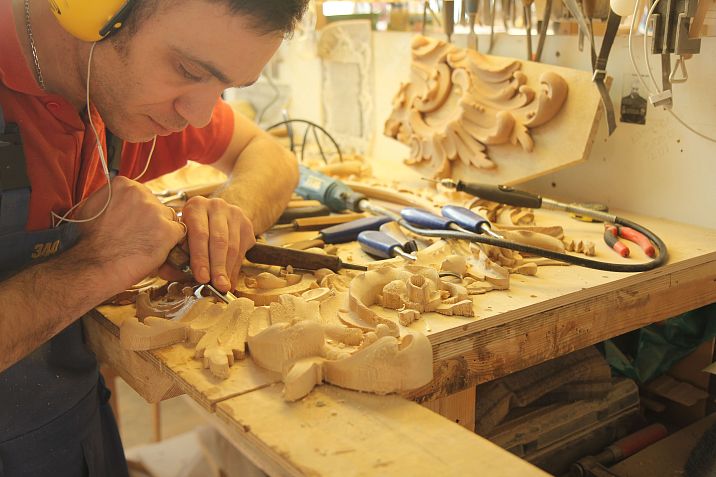
When a craftsman takes a piece of raw wood into his hands, he holds a fragment of eternity. Each growth ring tells the story of decades, and every fiber bend preserves the memory of winds and rains. It is precisely this attitude toward material that underpins modern production of solid wood philosophy, which transforms ancient craftsmanship into high-tech art.


New Era of Woodworking: Where Tradition Meets Innovation
Do you think modern solid wood furniture production is just an updated version of old carpentry methods? Those who consider woodworking an outdated craft are far from the truth! Today’s workshops resemble scientific laboratories, where precision is measured in microns and quality is controlled by laser systems.




Digital Transformation of the Oldest Craft
Imagine: a CNC machine creates an item designed in 3D software, from material prepared using technology that even accounts for the humidity of the air on the day of preparation. This is not science fiction — it is the reality of modern wooden furniture production.
Computer modeling allows visualizing every detail of the future product even before the first cut. Engineers analyze stresses in the structure, calculate optimal fiber orientation, predict material behavior under various climatic conditions. This approach guarantees not only flawless quality, but also the longevity of each item.
Our factory also produces:


Laser Technologies: Surgical Precision in the Hands of a Carpenter
Laser cutting has brought a true revolution to wood processing. A beam of light, focused to the thickness of a human hair, cuts wood with precision unattainable even by the most experienced craftsman. The edges produced are so smooth that they often require no additional finishing.
Laser engraving opens up limitless possibilities for decoration. Complex ornaments, portraits, logos — all of this can be applied to a wooden surface with photographic precision. The depth and intensity of engraving are controlled by software, enabling the creation of three-dimensional images and textures.
Get Consultation
Symbiosis of Nature and Science: How to Choose Wood in the 21st Century
Genetic Passport of Each Log
Modern technologies allow not only determining the species and age of wood, but also the conditions in which it grew. Spectral analysis reveals resin, tannin, and moisture content. X-ray scanning detects internal defects invisible to the naked eye. Each log receives a unique 'genetic passport' that determines its future fate.
Oak grown in northern latitudes has a denser structure and higher resistance to temperature fluctuations. Southern wood of the same species will be softer but with a richer color palette. Manufacturers take these nuances into account when planning products.
Thermal Modification: Enhancing Nature
One of the most promising directions in wood processing is thermal modification. Wood is heated in special chambers to 160-230°C in a steam environment. This process alters the molecular structure of cellulose and lignin.
Thermally treated wood acquires unique properties: increased resistance to moisture, fungi, and insects, dimensional stability, and a noble dark tone. At the same time, the material remains fully ecological — no chemical additives are used.
The Art of Joints: When Fastening Becomes Philosophy
Traditional Methods in Modern Interpretation
Dovetail, birdsmouth, and scarf joints — these terms may seem archaic in the age of screws and glue. However, it is precisely traditional carpentry joints that provide maximum strength and longevity for solid wood furniture.
Modern Production from Natural Wood uses CNC routers to create perfectly matched joints. The processing accuracy reaches tenths of a millimeter, ensuring tight fitting of parts without gaps.
Adhesive Technologies of the New Generation
Modern woodworking adhesives differ fundamentally from those of previous years. Polyurethane adhesives provide water resistance, epoxy adhesives offer exceptional strength, casein adhesives ensure ecological safety. The choice of adhesive depends on the purpose of the item and its operating conditions.
An adhesive joint can be stronger than the wood itself. When properly executed, failure occurs along the wood fibers, not along the glue line. This allows creating structures that retain their original rigidity for decades.
Ecological Challenges: Responsible Production
Certification and Origin Control
Environmental responsibility has become an indispensable part of modern wood processing. The FSC (Forest Stewardship Council) certification system guarantees that wood is sourced from sustainably managed forests. Each log has a traceable chain from its place of origin to the finished product.
Producers are implementing zero-waste production systems. Sawdust is used to manufacture pellets, shavings for particleboard production, and small offcuts for souvenirs. This approach minimizes environmental impact and increases economic efficiency.
Energy efficiency and renewable sources
Modern wood processing enterprises actively adopt energy-saving technologies. Solar panels power drying chambers, and heat recovery systems use exhaust air to heat rooms.
Biomass from production waste serves as fuel for boilers. Such a system is almost entirely closed: wood provides heat for processing wood. The carbon footprint of such enterprises approaches zero.
Design and functionality: when beauty meets intelligence
Parametric design
Modern furniture production uses parametric design — a method in which changing one parameter automatically adjusts the entire structure. Want a table 20 centimeters wider? The system automatically recalculates leg sizes, tabletop thickness, and number of fasteners.
This approach allows creating personalized furniture without significant cost increase. Each item is adapted to the specific needs of the customer while maintaining optimal technical characteristics.
Multifunctionality as an art
Modern solid wood furniture is not just beautiful interior items, but complex functional systems. A transformable table can change height and configuration, a chest can hide a workspace, and a bed can integrate storage systems.
Engineers develop mechanisms capable of enduring thousands of transformation cycles without losing functionality. Ball bearings, gas lifts, and auto-return systems — all hidden within noble solid wood.
Finishing and protection: when surface matters more than substance
Nanotechnology in wood processing
Nanocoatings have revolutionized the protection of wooden surfaces. Molecules of the protective composition penetrate into the wood structure up to 100 microns deep, creating an invisible barrier against moisture, dirt, and mechanical damage.
Hydrophobic coatings cause water to bead and roll off the surface, like on a lotus leaf. Antibacterial additives prevent microbial growth. Meanwhile, the wood retains its ability to "breathe" and its tactile properties.
UV-curable coatings
UV curing allows obtaining an exceptionally strong and durable coating in seconds. Liquid lacquer instantly polymerizes under UV light, forming a hard glossy film.
Such coatings withstand intensive use, are resistant to scratches, stains, and chemical exposure. The depth of gloss and matte finish are controlled by the lacquer composition and exposure parameters.
Quality control: perfection in every detail
Multi-level Inspection System
Modern solid wood furniture production implies quality control at every stage. Incoming wood inspection includes determining moisture content, density, and presence of defects. Intermediate control checks the geometry of parts and surface finish quality. Final control involves tests for strength, durability, and compliance with standards.
Automated control systems use laser measuring devices, digital cameras, and weight sensors. Artificial intelligence analyzes surface images, identifying micro-defects invisible to the human eye.
Stress tests and durability tests
Before reaching the customer, each furniture model undergoes comprehensive tests. Tables are loaded with weights exceeding operational limits multiple times. Chairs are repeatedly seated and lifted tens of thousands of times. Drawers are repeatedly pulled and pushed until the guides wear out.
Climate chambers simulate extreme conditions: from Arctic cold to tropical heat, from desert dryness to tropical humidity. Only after successfully passing all tests does the product receive a quality certificate.
Personalization and Individual Approach
Mass customization
Modern technologies allow combining the advantages of mass production with individualized approaches. Modular systems enable creating unique configurations from standard elements. Digital technologies ensure flexibility in the production process.
The customer can choose the wood species, finish type, hardware, dimensions, and additional options. The system automatically calculates cost and production time. Production adapts to each order without significant time and resource expenditure.
Virtual try-on and augmented reality
Augmented reality technologies allow "trying on" furniture in an interior even before manufacturing. A special application creates an accurate 3D model of the room and places virtual furniture within it. You can assess proportions, color combinations, and layout functionality.
This approach minimizes the risk of errors and dissatisfaction with the result. The buyer sees the final outcome and can make adjustments during the design phase.
Global trends and local solutions
Scandinavian design philosophy
The Scandinavian approach to furniture design is based on principles of functionality, minimalism, and eco-friendliness. Light wood species, simple forms, natural finishes — these elements create an atmosphere of comfort and tranquility.
Producing furniture from natural wood in the Scandinavian style requires special attention to details. Every line must be justified functionally, and every surface must be carefully processed. The philosophy 'less is more' is evident throughout: from material selection to packaging of finished products.
Japanese minimalism and attention to detail
Japanese woodworking tradition is based on deep respect for the material and pursuit of perfection. Each piece is created as a work of art, capable of serving for centuries. Joints without a single nail, surfaces polished to a mirror finish — these are the standards of Japanese craftsmanship.
Modern Production from Natural Wood Adopts the best traditions of Eastern masters, adapting them to European tastes and needs. The result is furniture combining Eastern philosophy with Western practicality.
Innovative materials and hybrid technologies
Stabilized wood
Wood stabilized with polymer resins fundamentally changes the material's properties. Vacuum-impregnated wood acquires the hardness of stone while retaining the texture and warmth of natural material. Such wood is resistant to moisture, does not crack, and does not deform.
Stabilized wood opens new possibilities for designers. It is possible to create thin, complex-shaped elements that cannot be made from ordinary solid wood. Colored impregnations allow achieving unusual decorative effects.
Wood-based composites
Modern composite materials combine the beauty of natural wood with improved technical properties. Wood-polymer composites do not rot, do not absorb moisture, and require no special maintenance.
The technology allows obtaining material with specified properties: increased strength, fire resistance, and biostability. At the same time, the composite may visually be indistinguishable from natural wood.
Automation and robotization of production
Carpentry robots
Industrial robots are gradually being introduced into woodworking production. Robotic systems perform sanding, painting, and assembly operations with precision and consistency unattainable by humans. At the same time, each robot can be quickly reconfigured for a new task.
Collaborative robots (cobots) work alongside humans, performing routine operations and freeing craftsmen for creative work. This approach combines the advantages of automation with the flexibility of manual labor.
Artificial intelligence systems
AI systems analyze wood quality, optimize cutting patterns, and plan production processes. Machine learning allows systems to improve by analyzing accumulated experience.
Predictive analytics forecasts potential problems before they occur. The system can warn about the need to replace tools, perform preventive equipment maintenance, or adjust technological parameters.
Furniture of the future: when wood becomes smart
Integration of electronics
Modern furniture made of natural wood may include electronic components: wireless charging devices, USB ports, lighting systems, motion sensors. All of this is integrated into the wooden structure in such a way that it does not compromise its aesthetics.
Smart furniture can adapt to user needs: adjust table height according to the time of day, change lighting according to activity, track health parameters.
IoT and connected furniture
The Internet of Things (IoT) transforms ordinary furniture into smart home elements. A table can synchronize with a calendar, reminding you of important meetings. A bed can analyze sleep quality and transmit data to a mobile app.
Such technologies do not replace the traditional merits of solid wood furniture, but complement them with modern functionality. The result is items combining centuries-old traditions with innovative capabilities.
Economic aspects and market trends
Investment Appeal
Quality solid wood furniture is not only interior decor, but also long-term investments. Unlike furniture made from composite materials, wooden items do not lose value over time, and often even increase in value.
Antique furniture made of natural wood reaches astronomical prices at auctions. Modern pieces from renowned manufacturers also demonstrate steady price growth. This makes purchasing quality wooden furniture a financially sound decision.
Premium segment and exclusivity
The market for premium solid wood furniture demonstrates steady growth even during periods of economic instability. Discerning buyers are willing to pay for quality, exclusivity, and status.
Limited editions, handmade pieces, use of rare wood species — these factors shape the premium segment of the market. Manufacturers compete not on price, but on the uniqueness of their offerings.
Conclusion: the future lies in the synthesis of tradition and innovation
Modern Production from Natural Wood It lies at the intersection of ancient traditions and cutting-edge technologies. The craftsmanship of woodworkers from past centuries is complemented by robotic precision, while the wisdom of generations is enhanced by artificial intelligence capabilities.
The future of this industry is envisioned as a harmonious blend of humanity's greatest achievements: respect for nature and pursuit of perfection, technological progress and preservation of cultural values. Each piece becomes a bridge between past and future, between nature and technology.
Those who choose Furniture made of natural woodinvest not only in interior items, but in a philosophy of life based on respect for nature, pursuit of quality, and understanding of true values. In a world of fleeting trends and disposable goods, wooden furniture remains a symbol of constancy, reliability, and connection to roots.
Modern manufacturers understand this responsibility. They create not just furniture, but artworks capable of serving generations. Each piece embodies a fragment of the master’s soul, the wisdom of traditions, the strength of nature, and the precision of modern technologies.
STAVROS Company embodies this philosophy in every project. The combination of long-standing experience with innovative approaches, the use of premium materials with advanced technologies enables the creation of furniture that will be a pride of any interior. In STAVROS workshops, ancient woodworking traditions breathe new life, while modern technologies serve to preserve and develop the craft proven over centuries.
Choosing STAVROS means choosing not just a furniture manufacturer, but a partner in creating a space that will delight you and your children for many years. Every product from the company is an investment in beauty, quality, and the future, where traditions and innovations create perfect harmony.