Article Contents:
- Evolution of Decorative Planks: From Function to Art
- Philosophy of Modern Application
- Variety of Profiles: Classification and Features
- Functional Profiles: Beauty with Purpose
- Material Science: Choosing Wood Species as an Art
- Exotic Species: Luxury in Details
- Technological aspects of production
- Innovative Processing Methods
- Design Solutions: From Classic to Avant-Garde
- Technology of Manufacturing and Quality Control
- Application in various interior zones
- Non-Standard Solutions
- Installation and Mounting: Technical Aspects
- Compensation for thermal deformations
- Lighting and Acoustics: Functional Aesthetics
- Smart Technologies in Wooden Decoration
- Operation and maintenance
- Prevention and restoration
- Economic Aspects and Pricing
- Hidden Costs and Cost Optimization
- Ecological aspects and sustainable development
- Recycling and reuse
- Regional application specifics
- Architectural traditions and cultural specifics
- The Future of Profiled Planks: Trends and Innovations
- Integration with IoT and Smart Technologies
- Custom solutions and customization
- Designer Collections and Collaborative Design
- Frequently Asked Questions
- Conclusion

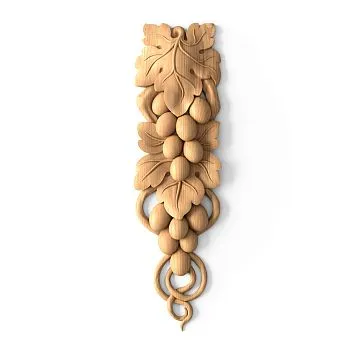
When was the last time you thought about what exactly turns an ordinary room into a piece of designer art? Perhaps the secret lies not in expensive materials or complex constructions, but in details that are often overlooked.Beech strip profilesThey represent exactly such a case – elements capable of radically transforming space, creating a unique atmosphere of warmth, coziness, and elegance.
In the modern world of interior design, there is an amazing trend: a return to natural materials and organic textures. Among many solutions, wooden planks of various profiles have captured the hearts of both professional designers and ordinary people striving to create a special atmosphere in their homes. But what makes these seemingly simple elements so popular?
The answer lies in the unique ability of wooden planks to create visual dynamics in space. Each profile has its own character: some create soft shadows and smooth transitions, others form clear geometric lines, while others play with light, creating unique optical effects. This multifaceted nature opens up boundless opportunities for creative self-expression.


Evolution of Decorative Planks: From Function to Art
The history of using wooden planks in construction and decoration spans thousands of years. Initially, they performed exclusively functional tasks – reinforcing structures, creating frames, serving as a base for other materials. However, over time, craftsmen noticed their aesthetic potential and began using planks as a standalone decorative element.
A revolutionary shift occurred in the mid-20th century, when Scandinavian designers introduced the world to the beauty of minimalism accentuated by natural materials. Wooden planks became a symbol of this design philosophy – simple, functional, yet incredibly expressive. Their use spread worldwide, adapting to various cultures and styles.
Modern production technologies have brought the art of creating profiled planks to a fundamentally new level. If previously craftsmen were limited by the capabilities of hand tools, today CNC machines allow creating profiles of any complexity with mathematical precision. This has opened the door to experimenting with shapes, sizes, and textures.




Philosophy of Modern Application
Why are profiled wooden planks experiencing such a surge in popularity now? The answer lies in our changing relationship to living space. After decades of dominance by artificial materials and cold high-tech, people have felt the need for warmth and natural harmony.
Wooden planks satisfy this need on a deep, almost subconscious level. Their texture reminds us of forests and nature, their aroma creates a sense of freshness, their tactile qualities soothe the nervous system. At the same time, modern profiles allow us not to compromise on the technological and functional aspects of interior design.
Wooden planksThey have become a bridge between tradition and innovation, between nature and civilization. They allow us to create spaces that are simultaneously modern and timeless, technologically advanced and cozy.
Our factory also produces:


Variety of Profiles: Classification and Features
The world of profiled wooden planks is astonishing in its diversity. Each profile shape has its own purpose, character, and optimal application area. Understanding these differences is critically important to achieving the desired aesthetic and functional result.
Rectangular profiles represent the classic of the genre. Their strict geometry emphasizes the architectural logic of space, creating a sense of order and stability. The ratio of width to height determines the visual effect: narrow, tall planks visually increase ceiling height, while wide, low ones expand the space.
Rounded profiles bring softness and coziness to interiors. The radius of rounding can vary from barely noticeable to a clearly defined semicircle. Such planks are ideal for creating relaxation zones, children's rooms, bedrooms – anywhere where psychological comfort is important.
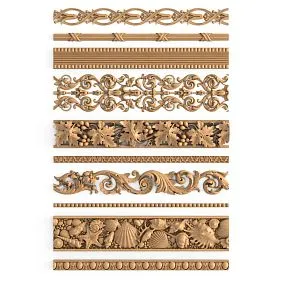
Complex composite profiles combine several geometric forms into one element. They may include protrusions, recesses, bevels, creating a rich interplay of light and shadow. Such profiles require careful application, as they can easily overload space with details.
Get Consultation
Functional profiles: beauty with purpose
Modern designers increasingly use profiles that combine aesthetic and practical functions. For example, rails with built-in channels for wiring allow hiding utilities without disrupting the overall interior concept. This is especially relevant in the era of smart homes, where the number of wires and cables continues to grow.
Acoustic profiles have a special shape, optimized for absorbing or dispersing sound. They are indispensable in home theaters, music studios, and open offices. At the same time, their aesthetic qualities do not fall short of decorative analogs.
Wood science: choosing species as an art
Choosing wood species for profiled rails is not only a technical solution but also a creative act that defines the character of the future interior. Each species has a unique set of characteristics: color, texture, density, aroma, acoustic properties.
Oak rails embody strength and nobility. Their dense structure ensures exceptional durability, while their rich color palette—from light gold to dark brown—allows selecting a shade to match any interior. The distinctly visible oak texture creates a unique play of light on profiled surfaces.
Beech profiles attract with their uniformity and warm pinkish tone. Beech is easy to work with, allowing the creation of profiles with delicate details. This species is ideal for Scandinavian-style or modern minimalist interiors.
Pine rails offer an economical solution without compromising quality. Their natural resinous nature provides moisture resistance, which is especially valuable in humid areas. Pine’s light color visually expands space and creates a sense of freshness.
For exclusive projects, rare and exotic wood species are used. Wenge, with its dark, almost black color and contrasting grain, creates an atmosphere of luxury and refinement. Teak, due to its high oil content, has natural water resistance and requires no additional treatment.
Exotic Woods: Luxury in Detail
American walnut combines noble brown color with purple hues and refined texture. This species is considered one of the most beautiful for making furniture and decorative elements.
Made from walnut become true works of art.Trimming ItemsZebrawood got its name due to its distinctive striped pattern resembling zebra skin. This African species creates a striking accent in interiors and requires careful application to avoid overloading the space.
Creating high-quality profiled rails is a complex technological process requiring deep knowledge of wood properties and modern high-precision equipment. Each production stage affects the final product quality and requires strict control.
Technological aspects of production
Raw material preparation begins with careful selection of boards. Each blank undergoes visual inspection for defects: knots, cracks, resin pockets, rot. Automated sorting systems use X-ray radiation to detect hidden defects.
Wood drying is a critically important stage determining the stability of finished products. Modern drying complexes operate on programmable modes, taking into account the characteristics of each species. The final moisture content for interior rails should be 8±2%.
Profiling is performed on high-precision CNC machines capable of reproducing complex shapes with a tolerance of ±0.1 mm. The quality of cutting tools directly affects surface smoothness. Diamond cutters provide mirror-like smoothness without additional finishing.
Laser technology opens new possibilities for surface decoration of rails. A laser beam can create microtextures mimicking various materials, apply complex ornaments, and form tactile effects. Laser processing accuracy is measured in microns.
Innovative Processing Methods
Thermo-treatment of wood fundamentally changes its properties. The process occurs in a steam environment at 180–230°C without oxygen access. As a result, the wood gains enhanced dimensional stability, improved moisture resistance, and a noble dark tone.
Impregnation with special compounds imparts new properties to wood. Fire-retardant treatments reduce flammability, antiseptics prevent biological damage, hydrophobic compounds repel moisture. At the same time, the natural beauty of wood is fully preserved.
Open up boundless possibilities for design creativity. Their versatility allows successful integration into any interior style, from strict classicism to the boldest avant-garde solutions.
Design solutions: from classic to avant-garde
Beech strip profilesIn classic interiors, wooden rails emphasize traditional proportions and create a sense of solidity. Dark wood species combined with complex profiles form an atmosphere of aristocratic mansion. Golden hues of oak or walnut harmonize with antique furniture and create a sense of tradition continuity.
Modern minimalism uses rails as a means of structuring space. Simple geometric forms, light wood species, clean lines create a sense of order and calm. At the same time, the natural wood texture prevents the interior from becoming cold and impersonal.
Scandinavian style found the perfect ally in wooden rails. Light wood, simple forms, functionality of each element—all this perfectly aligns with the philosophy of hygge.
In Scandinavian interiors, rails often have increased height, emphasizing horizontal lines of space.Wooden baseboardModern designers are not afraid to experiment with the shape and size of rails, creating unexpected visual effects. Rails of different widths, arranged with varying spacing, create a dynamic rhythm. Combining vertical and horizontal elements forms complex geometric compositions.
Avant-Garde Directions
Color solutions go far beyond natural wood tones. Stained, painted, or patinated rails allow creating bold accents or, conversely, integrating into monochromatic interiors. Gradient color transitions along walls look especially striking.
Integration with modern technologies transforms rails into functional smart-home elements. Built-in LED lighting creates dramatic architectural illumination, motion sensors automatically turn on lighting, wireless charging turns walls into convenient gadget stations.
The living room is the face of the home, and wooden rails here play the role of the main decorative accent. The TV zone, framed by profiled rails, becomes the compositional center of the room. Vertical elements visually increase ceiling height, horizontal elements expand space.
Application in various interior zones
The bedroom requires a special approach to using wooden rails. Here, psychological comfort and creating a relaxing atmosphere are crucial. A headboard made of profiled rails is not only beautiful but also functional—it provides additional sound insulation.
The bedroom requires a special approach to using wooden rails. Here, psychological comfort and creating a relaxing atmosphere are crucial. A headboard made of profiled rails is not only beautiful but also functional—it provides additional sound insulation.
The kitchen and dining area use planks to zone the space.Furniture corniceThey can separate the kitchen from the living room in studio apartments, creating a visual boundary without losing the sense of openness. Moisture-resistant wood species or special treatments ensure longevity in high-humidity conditions.
Non-standard solutions
The bathroom is an unexpected but very effective sphere for using wooden planks. Modern moisture protection technologies allow using wood even in the most extreme conditions. Thermowood or exotic species with natural water resistance create a unique spa atmosphere.
Children's rooms open up creative space with profiled planks. Bright colors, unusual shapes, interactive elements turn walls into play areas. At the same time, the natural material ensures safety for the child's health.
Halls and corridors are traditionally considered auxiliary spaces, but wooden planks can turn them into full-fledged elements of design concept. Vertical planks visually increase ceiling height in narrow corridors, while built-in lighting creates a floating wall effect.
Installation and mounting: technical aspects
Quality installation of profiled planks requires understanding the specifics of working with wood and proper selection of fastening elements. Wood is a living material that reacts to changes in temperature and humidity, and these characteristics must be considered when designing the fastening system.
Surface preparation includes wall leveling, filling irregularities, and priming. A laser level ensures precise marking, which is critically important for creating straight lines. Even minor deviations become noticeable on long sections.
Hidden fastening systems provide a clean appearance without visible fasteners. Clamps, hidden grooves, and magnetic systems allow securely fixing planks while retaining the possibility of disassembly. This is especially important for modular housing or commercial spaces.
Compensation for thermal deformations
Wood expands and contracts with changes in humidity and temperature. For long profiled planks, compensatory gaps must be provided every 2-3 meters. Flexible sealants conceal these gaps, ensuring visual surface continuity.
Floating installation allows planks to deform freely without internal stresses. Special fasteners fix planks at only one point, allowing them to move along their length.
CasingsAnd finishing elements conceal the junctions between planks and other surfaces, ensuring a neat appearance of the structure even with temperature joints.
Lighting and acoustics: functional aesthetics
Integrating lighting into the structure of profiled planks opens new possibilities for creating a unique atmosphere in interior spaces. LED strips embedded in special grooves of the planks create soft diffused lighting without visible light sources. This effect is especially impressive at night.
Directional lighting highlights the wood texture, creating a dramatic interplay of light and shadow. Adjustable color temperature allows adapting lighting to different situations — from warm cozy light for relaxation to cool invigorating light for work.
Acoustic properties of wooden planks are used to improve the sound environment in rooms. Specifically designed profiles absorb or scatter sound waves, reducing noise levels and improving speech clarity. This is especially relevant for open-plan offices, restaurants, and public spaces.
Smart technologies in wooden decor
Modern wooden planks can be integrated with smart home systems. Built-in motion sensors automatically turn on lighting when a person approaches. Temperature and humidity sensors transmit data to the climate control system.
Wireless charging devices integrated into planks turn walls into functional zones for charging mobile devices. Hidden USB ports provide convenient gadget usage without disrupting interior aesthetics.
Voice assistants can be discreetly integrated into plank structures, enabling control of lighting, music, and climate without visible technical elements. This creates a magical space that responds to voice commands.
Operation and Maintenance
Proper maintenance of profiled wooden planks ensures preservation of their aesthetic and functional qualities for decades. Basic principles of wood care have been known for centuries, but modern coatings and processing technologies have introduced adjustments.
Air humidity control is a key factor in the longevity of wooden interior elements. The optimal range is 40-60% at a temperature of 18-24°C. Sharp fluctuations in these parameters may lead to deformation of planks, especially long ones.
Regular cleaning with a soft slightly damp cloth removes dust and surface dirt. Use of aggressive cleaning agents is not allowed, as they may damage the protective coating of the wood.
Prevention and restoration
Preventive inspections twice a year allow identifying initial signs of problems and taking timely measures. Special attention should be paid to connection points, fastening points, and areas with high humidity.
Minor damage — scratches, dents, scuffs — can be easily repaired with local repairs. Wax pencils, wood putty, and retouching compounds allow quickly restoring damaged areas without dismantling the entire structure.
Renewing protective coating is recommended every 5-7 years depending on usage intensity. Modern coatings are applied in thin layers and dry quickly, minimally disrupting the usual rhythm of life in the room.
Economic aspects and pricing
The cost of profiled wooden planks is determined by many factors, and understanding pricing mechanisms helps make informed decisions when planning project budgets. Wood species is the primary pricing factor — the difference between pine and exotic species can reach a 10-fold variation.
Profile complexity directly affects production cost. Simple rectangular planks are manufactured 5-10 times faster than complex shaped profiles. Custom profiles require special tooling, significantly increasing the cost of small batches.
Order volume is critically important for pricing. Small batches up to 100 linear meters may cost 2-3 times more than large orders. This is due to the need to retool equipment and adjust the technological process for each batch.
Hidden costs and cost optimization
Transportation of long planks requires special transport and can constitute a significant portion of total costs, especially for remote regions. The possibility of obtaining standard lengths in multiples of 2 or 3 meters significantly reduces logistics costs.
Installation work requires highly skilled personnel and specialized tools. The cost of professional installation may amount to 50-100% of the material cost. However, cutting corners on installation quality inevitably leads to problems in the future.
On-site finishing of beams costs more than factory processing, but ensures better adaptation to specific operating conditions. The choice between factory and on-site coating depends on project specifics and quality requirements.
Ecological aspects and sustainable development
Modern approaches to using wooden beams are inseparably linked with principles of sustainable development and responsible consumption of natural resources. FSC certification guarantees that the wood originates from properly managed forests, where a balance is maintained between harvesting and reforestation.
The carbon footprint of wooden products is significantly lower than that of synthetic analogs. Wood absorbs carbon dioxide from the atmosphere during tree growth and continues to store it in products throughout their service life. With proper disposal, wood can be recycled or used as biomass fuel.
Local production reduces transportation costs and supports regional economies. Using local wood species reduces dependence on imports and adapts products to the climatic conditions of a specific region.
Recycling and reuse
Modern technologies allow efficient recycling of waste from wooden beam production. Sawdust is used to produce fuel briquettes, wood shavings for particleboard, short offcuts for mosaic panels and souvenirs.
Demolished beams can find a new life in new projects. Vintage wood with the patina of time is highly valued by designers and may cost more than new products. This encourages careful material handling and stimulates the development of a secondary-use market.
The biodegradability of wood ensures environmentally friendly disposal of products at the end of their service life. Unlike plastic analogs, wooden beams do not pollute the environment and can be safely composted.
Regional application specifics
Climate conditions in different regions impose specific requirements on profiled wooden beams. In continental climates with large daily and seasonal temperature fluctuations, dimensional stability of products is critically important. Pre-acclimatizing beams for 2-3 weeks before installation reduces the risk of deformation.
Marine climates with high humidity and salt content in the air require additional protection for wooden elements. Special moisture-resistant coatings, stainless steel fasteners, and enhanced ventilation become mandatory conditions for the longevity of structures.
Northern regions with extremely low temperatures impose special requirements for wood and fastener frost resistance. Local species, adapted to harsh conditions, show better performance than exotic wood.
Architectural traditions and cultural characteristics
Regional architectural traditions influence the popularity of various types of profiled beams. In Russian wooden architecture, massive elements with rich carving traditionally dominate. Modern interpretations adapt these motifs to today's requirements.
Scandinavian traditions of minimalism and functionality are reflected in simple geometric profiles in light tones. Japanese wabi-sabi aesthetics value the natural imperfections of wood and minimal surface treatment.
American country style uses beams to create the atmosphere of a farmhouse with modern amenities. Weathered wood, natural finishes, and clearly functional elements form a recognizable aesthetic.
The future of profiled beams: trends and innovations
Digitalization of design processes opens new opportunities for creating and applying profiled beams. Parametric modeling allows automatically generating optimal profiles for specific tasks. Augmented reality helps visualize results even before installation begins.
3D printing with wooden composites is in an active development stage. Although this technology currently cannot compete with traditional processing in speed and cost, it opens fundamentally new possibilities for creating profiles of previously impossible complexity.
Artificial intelligence is beginning to be used to optimize material cutting, production planning, and forecasting demand for various profiles. Machine learning helps identify hidden patterns in consumer preferences.
Integration with IoT and smart technologies
The Internet of Things is penetrating even traditional materials like wood. Embedded sensors can monitor wood moisture, temperature, and lighting, transmitting data to smart home systems. This allows optimizing the microclimate for maximum material longevity.
Biometric systems integrated into wooden beams can recognize household residents and automatically adjust lighting, temperature, and music to individual preferences. Tactile sensors respond to touch, transforming walls into control interfaces.
Self-healing coatings activated by heat or ultraviolet light can repair minor surface damage on beams without human intervention. This technology is in development but already shows promising results in laboratory conditions.
Custom solutions and customization
Mass production is increasingly giving way to customized solutions tailored to specific customer needs. Modern CNC machines allow producing unique profiles in small batches without significant cost increases. The minimum order for a custom profile is usually 50-100 linear meters.
Co-design with the client ensures full alignment of products with the designer's vision and functional requirements. 3D modeling allows seeing the result before production begins, making necessary adjustments, and optimizing the profile shape.
Personalization may include engraving logos, commemorative inscriptions, decorative elements. Laser technology ensures high precision and detail in images. Such elements become unique pieces reflecting the owner's individuality.
Designer collections and collaborative partnerships
Collaboration between manufacturers and renowned designers and architects leads to the creation of exclusive collections of profiled beams. Designer profiles become a designer's signature and enjoy increased demand among connoisseurs of exclusivity.
Limited editions for special projects use rare wood species, innovative processing technologies, and unique coatings. Such items often become collectibles and may significantly increase in value over time.
Educational programs for designers include studying wood processing capabilities, properties of different species, installation and usage specifics. This improves project quality and reduces errors during implementation.
Frequently asked questions
Profiled wooden planks have richer aesthetic possibilities due to their complex cross-sectional geometry. They create play of light and shadow, add visual depth to surfaces, can conceal utilities or serve additional functions. Moreover, profiling often increases the stiffness of the product while using the same amount of material.
Choosing a profile depends on the interior style, room size, and functional requirements. For classic interiors, complex profiles with traditional elements are suitable; for modern interiors, simple geometric shapes are preferred. In small rooms, thinner profiles are better, while larger rooms benefit from more substantial profiles. Lighting is also important—some profiles look better under directional lighting.
How to choose the right profile for a specific interior?
The cost of manufacturing custom profiles depends on the complexity of the shape, wood species, and order volume. Typically, it is 1.5–3 times higher than standard products. The minimum order is 50–100 linear meters. Production time for custom profiles is 2–4 weeks depending on tool complexity.
Yes, but under certain conditions. It is necessary to choose moisture-resistant wood species (teak, larch, thermowood), ensure quality moisture protection, and provide good ventilation. Modern technologies allow using wood even in bathrooms and saunas.
Yes, but under certain conditions. It is necessary to choose moisture-resistant wood species (teak, larch, thermowood), ensure high-quality moisture protection, and provide good ventilation. Modern technologies allow using wood even in bathrooms and saunas.
What is the cost of manufacturing planks according to an individual project?
Durability is ensured by proper selection of wood species, quality drying of the material, professional installation taking into account thermal deformations, regular maintenance of finishes. It is important to maintain a stable microclimate in the room and protect the planks from direct moisture exposure.
How to ensure the longevity of wooden planks?
Longevity is ensured by proper selection of wood species, quality drying of the material, professional installation taking into account thermal deformation, and regular maintenance of finishes. It is important to maintain a stable microclimate in the room and protect the planks from direct moisture exposure.
Can you install profiled planks yourself?
Simple profiles can be installed yourself if you have basic woodworking skills and appropriate tools. Complex structures, especially those with integrated lighting or in rooms with complex geometry, are better left to professionals. Incorrect installation may lead to deformation of the planks and loss of warranty.
Main trends include integration with smart technologies, use of eco-friendly materials and coatings, development of custom solutions, application of digital design technologies. Demand is growing for multifunctional profiles combining decorative and practical functions.
What trends characterize the market for profiled planks?
How do profiled planks affect room acoustics?
Wooden planks represent a wonderful combination of traditional craftsmanship and modern high technologies. These decorative elements can dramatically transform any space, endowing it with character, warmth, and uniqueness unattainable with artificial materials.
Conclusion
Beech strip profilesThey represent a wonderful combination of traditional craftsmanship and modern high technologies. These decorative elements can dramatically transform any space, endowing it with character, warmth, and uniqueness unattainable with artificial materials.
The versatility of wooden planks allows their use in various interior styles—from strict classicism to bold avant-garde. They look equally naturally in urban apartments and country houses, in office centers and cozy cafes. The secret of their adaptability lies in the natural beauty of wood and the limitless possibilities of profiling.
Modern manufacturing technologies open unprecedented opportunities for designers and architects. Complex profiles, micron-level precision, integration with smart home systems—all this makes wooden planks not just decorative elements, but full-fledged components of a modern high-tech interior.
The ecological advantages of natural wood are becoming increasingly important in the context of growing attention to environmental issues. Wooden planks are not only beautiful and functional, but also contribute to creating a healthy microclimate in the room, absorb carbon dioxide, and support sustainable forestry.
The future of profiled wooden planks is linked to further development of wood processing technologies, integration with digital control systems, and creation of new functional coatings. However, no matter how innovative the technologies become, the main value of these products remains unchanged—their ability to bring a piece of living nature into our homes.
Investments in quality profiled wooden planks pay off not only in aesthetic pleasure and increased property value, but also in daily comfort from being in a harmonious space. Properly selected and professionally installed planks will delight owners for decades, confirming the wisdom of choosing natural materials.
The company STAVROS holds leading positions in the Russian market for manufacturing high-quality profiled wooden planks. Our long experience in woodworking, modern production equipment, and deep understanding of customer needs allow us to create world-class quality products.
The production philosophy of STAVROS is based on principles of sustainable development and responsible attitude towards natural resources. We work only with certified wood suppliers, use eco-friendly coatings, and implement zero-waste production technologies.
The technical equipment of STAVROS includes modern CNC machines from leading European manufacturers, automated drying and processing lines, high-precision measuring systems. This allows us to guarantee consistent quality and compliance with the strictest technical requirements.
STAVROS service goes far beyond simple product manufacturing. Our specialists are ready to assist in selecting optimal solutions, developing custom profiles, and consulting on installation and operation issues. We accompany each project from idea to full implementation.
Profiled wooden planks: a revolution in modern interior design | Company STAVROS