












































































Article Contents:
- Philosophy of Reliable Connection: Understanding Forces and Stresses
- Material science aspects of connections
- Revolutionary Techniques of Hidden Fastening
- Innovative System of Locking Connections
- Preparation Operations: Foundation of Quality Installation
- Precision Marking: The Art of Accuracy
- Technology of Installation on Threaded Connections
- Chemical Anchoring: Technology of the Future
- Using Handrail Support Systems: Simplifying Installation
- Technology of Installing Handrail Support Systems
- Features of mounting to various bases
- Installation on Wooden Steps
- Fastening to Concrete Bases
- Quality Control and Testing of Joints
- Dynamic Testing
- Final Finishing and Protection of Joints
- Antiseptic Treatment
- Innovative Solutions and Prospective Technologies
- Smart Monitoring Systems
- Economic Aspects and Lifecycle
- Cost of Ownership Analysis
- Conclusion: Mastery as Philosophy
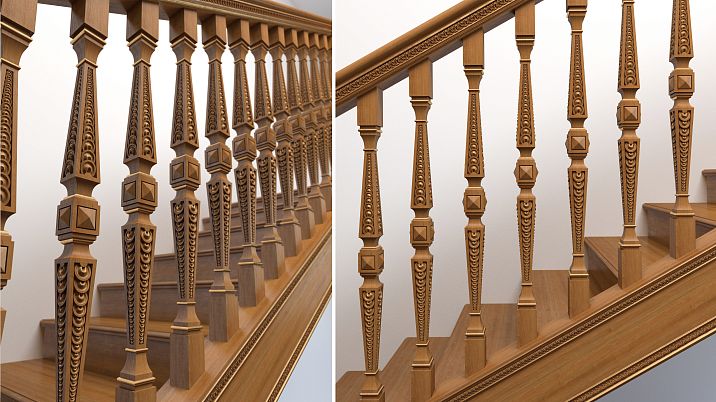
Perfect connection of handrails to balusters is an art requiring deep knowledge of structural features and mastery of professional techniques. Every day, millions of people entrust their safety to stair railings, and the quality of fastening becomes a matter of life and death. Can one afford to be careless in such a responsible endeavor?
Modern installation technologies allow creating connections stronger than the wood itself. However, the path to perfection lies through understanding the physics of loads, chemistry of materials, and psychology of spatial perception. Every movement of the master must be precisely executed, and each fastening element must be thought out down to the smallest details.


Philosophy of Reliable Connection: Understanding Forces and Stresses
Stair railing is not merely a decorative element, but a complex engineering system operating under constant dynamic loads. When a person ascends the stairs, they unconsciously generate lateral forces exceeding their own weight several times over. These forces are transmitted from the handrail to the balusters, and then to the base structure.
Understanding the vectors of force application allows correctly designing connection joints. Horizontal loads tend to overturn the balusters, vertical loads compress them, and torsional moments rotate them around an axis. Quality fastening must resist all these effects simultaneously, preserving the geometry of the structure for decades.




Material aspects of connections
Wood is a living material that continues to 'breathe' even after processing. Air humidity, temperature fluctuations, mechanical loads — all this affects the dimensions and shape of wooden elements. A skilled craftsman takes these characteristics into account when choosing a fastening method.
Different wood species require individual approaches. Oak and beech have high density and strength, but are prone to cracking with improper drilling. Pine and spruce are more workable but less reliable under heavy loads. Exotic species — teak, merbau, iroko — combine beauty with exceptional durability, but require special processing technologies.
Our factory also produces:


Revolutionary Techniques of Hidden Fastening
Modern methods allow creating connections where fastening elements are completely hidden from view. This not only improves the aesthetics of the structure but also protects metal parts from corrosion and wood from damage during operation.
Internal bolt technology involves using threaded rods with a diameter of 10-12 millimeters, fully embedded into the wood. A blind hole 80-100 millimeters deep is drilled into the baluster end, into which a bolt is installed using epoxy adhesive. The protruding part, 40-50 millimeters long, enters the corresponding hole in the handrail.
Get Consultation
Innovative System of Locking Connections
Locking connections of the "swallowtail" type provide exceptional strength and allow creating disassemblable structures. A trapezoidal protrusion is milled on the baluster end, and a corresponding groove is cut into the handrail. During assembly, the elements engage at an angle, after which the handrail is rotated into the working position.
This technology requires high manufacturing precision — tolerances must not exceed 0.1 millimeters. Yet the result exceeds all expectations: the connection becomes absolutely rigid, requires no additional fasteners, and can withstand loads many times exceeding normative values.
Preparation operations: foundation of quality installation
The quality of fastening is 80% determined by the correctness of preparatory operations. Start with careful checking of the geometry of all elements. Balusters must have strictly parallel ends, perpendicular to the longitudinal axis. Even a one-degree deviation will lead to uneven load distribution and premature failure of the connection.
Wood moisture is a critically important parameter. For indoor staircases, it should not exceed 10-12%. Using inadequately dried material will inevitably lead to weakening of connections within several months of operation. Moisture control is performed using electronic moisture meters at multiple points on each element.
Precision Marking: The Art of Accuracy
Marking fastening locations requires jewel-like precision. Modern laser levels allow creating reference lines with error less than one millimeter over the entire length of the stair run. Each baluster is marked individually, taking into account the actual geometry of the steps.
Special attention is paid to marking the centers of fastening holes. A deviation of even 2-3 millimeters may cause the entire structure to become misaligned. Special guides and templates are used, ensuring dimensional repeatability with the precision of a clockwork mechanism.
Threaded connections
Threaded connections provide maximum fastening reliability and allow for adjustment during operation. For wooden structures, special plumbing bolts with two types of threads are used: metric for the nut and self-tapping for wood.
A hole is drilled in the baluster end with a diameter 1 millimeter smaller than the threaded part of the bolt. The drilling depth is 60-80 millimeters depending on the baluster size. The bolt is screwed in using polyurethane adhesive, which provides additional fixation and moisture protection.
Chemical anchors are two-component compositions that polymerize directly in the hole, creating a monolithic connection with the wood. The strength of such fastening can exceed the strength of the material itself by several times.
Chemical anchoring: the technology of the future
The technology involves drilling holes of increased diameter — 14-16 millimeters for bolts with a diameter of 10-12 millimeters. The chemical composition is inserted into the hole, and then the bolt is installed. Full polymerization occurs over 24-48 hours, after which the connection is ready for full load.
The technology involves drilling enlarged holes—14–16 mm—for bolts with a diameter of 10–12 mm. A chemical compound is inserted into the hole, followed by installation of the bolt. Full polymerization occurs over 24–48 hours, after which the connection is ready to bear full load.
Use of handrail support systems: simplification of installation
A support rail is an intermediate element that significantly simplifies installation and increases the rigidity of the entire structure. A 30×50 mm cross-section rail is mounted to the upper ends of the balusters and serves as a base for installing the decorative handrail.
Technology for installing support systems
Installation technology for handrail systems
Installation begins with precisely trimming all balusters to height. The upper ends must lie in a single plane, taking into account the staircase’s incline. A laser level or taut string is used for control.
The support rail is marked according to the baluster placement. Guide holes with a diameter of 3-4 mm are drilled in the rail to prevent cracking. Fastening is done with 60-70 mm long self-tapping screws, screwed in from below at an angle of 30-40 degrees.
Mounting balusters to wooden treads requires consideration of wood grain direction and possible deformations. The optimal method is through-bolting with 8-10 mm diameter bolts, with wide washers installed on the tread’s reverse side.
Features of mounting to different bases
Installation on wooden treads
Mounting balusters to wooden treads requires consideration of wood grain direction and possible deformations. Optimal mounting is through bolts with a diameter of 8–10 mm, with wide washers installed on the reverse side of the tread.
The bolt passes through the entire tread thickness and enters the baluster end to a depth of 40-50 mm. The bolt head is embedded 3-4 mm into the baluster wood and covered with a wooden plug. The nut with a 30-40 mm diameter washer distributes load over a large area, preventing wood compression.
Mounting to concrete bases
Installation on concrete foundations is performed using chemical or mechanical anchors. Holes with a diameter of 12-14 mm are drilled into the concrete to a depth of 80-100 mm. A special vacuum cleaner or compressed air blowing is used to remove concrete dust.
Chemical anchors provide more even load distribution and better corrosion protection. The two-component composition is injected into the hole using a special gun, and then the threaded bolt is installed. Polymerization time is 2-4 hours depending on temperature.
Quality Control and Joint Testing
After completion of installation, a comprehensive quality check of all connections is mandatory. Each baluster is checked for play by applying lateral forces. The allowable deviation from verticality must not exceed 1 mm per meter of height.
Dynamic tests
In addition to static loads, the structure undergoes dynamic tests. Sudden loading on the handrail with a force of 80-100 kg is simulated. Tests are conducted at several points with an interval of 1-2 meters.
Special attention is given to checking connections in corner zones and areas where the structure meets walls. Here, stress concentration is maximum, and any installation defects become apparent first.
After completion of mechanical installation, all connections undergo final finishing. Installation points of fastening elements are carefully sanded and leveled. Wooden plugs covering bolt heads are made from the same wood species, with grain direction preserved.
Final Treatment and Protection of Joints
After completion of mechanical assembly, all connections undergo final finishing. Areas where fasteners are installed are carefully sanded and leveled. Wooden plugs covering bolt heads are made from the same wood species, with grain direction preserved.
Special attention is given to protecting end surfaces, where wood is most vulnerable to moisture. Special end sealants based on wax or polyurethane are applied, penetrating wood pores and creating a reliable barrier.
Antiseptic treatment
Innovative solutions and prospective technologies
Metal fastening elements are coated with anti-corrosion compounds. For concealed connections, zinc coatings of at least 12 microns thickness or austenitic stainless steel are used.
Advances in materials science open new possibilities for creating ultra-strong and long-lasting connections. Carbon fibers integrated into wood increase its strength several times. Nanostuctured adhesives provide adhesion exceeding the material’s cohesion.
3D printing technologies allow creating fastening elements with complex geometry, optimized for specific operating conditions. Bimetallic connectors combine steel strength with corrosion resistance of titanium or aluminum.
A promising direction is integrating monitoring systems into staircase structures. Strain and vibration sensors embedded in connection nodes allow real-time monitoring and predicting the need for maintenance.
Smart Monitoring Systems
An emerging direction is integrating monitoring systems into stair structures. Sensors for deformation and vibration, embedded in connection nodes, allow real-time tracking of changes and forecasting the need for maintenance.
Wireless data transmission systems provide continuous control without compromising the structure’s aesthetics. Artificial intelligence analyzes loading patterns and optimizes operating modes to maximize service life.
Proper attachment of handrails to balusters is an investment in the long-term operation of the structure. High-quality materials and professional installation pay off through minimal maintenance and repair costs throughout the entire service life of the structure.
Savings on fasteners may lead to catastrophic consequences. The cost of emergency repairs is dozens of times higher than the cost of quality initial installation. Moreover, reliable stair railings increase property value and create a positive impression of construction quality.
When planning the budget, it is necessary to consider the total cost of ownership, including initial costs, operating expenses, and disposal costs. Quality connections practically require no maintenance for 20-30 years, significantly reducing overall costs.
Analysis of ownership cost
Conclusion: craftsmanship as a philosophy
Using standardized elements simplifies logistics and reduces the likelihood of errors. Standardizing fastener dimensions allows creating warehouse stock and ensures quick replacement when needed.
— it is not just a set of technical techniques, but a philosophy of responsibility toward people who will use the stairs. Every connection must be executed as if it depends on the lives of the most precious people.
Art How to attach railings to balusters The path to mastery lies through continuous learning and experimentation. Each project is an opportunity to discover something new, refine the technology, find a more elegant solution. This is the beauty of the profession — in the endless pursuit of the ideal, which always remains on the horizon, beckoning and unattainable.
Modern technologies open boundless opportunities for creativity, but the foundation remains fundamental principles: understanding the material, respecting traditions, and striving for perfection. Only the combination of deep knowledge with practical experience allows creating masterpieces that will serve generations.
The path to mastery lies through continuous learning and experimentation. Each project is an opportunity to discover something new, refine the technology, find a more elegant solution. This is the beauty of the profession—endless striving toward an ideal that remains always on the horizon, beckoning and unattainable.
For decades, the company STAVROS has remained a benchmark of quality in the field of stair construction. Our masters are proficient in all modern fastening technologies and continuously refine their skills. Choosing STAVROS means investing in safety, beauty, and longevity, receiving a guarantee that your staircase will serve faithfully for many years, delighting the eye and ensuring absolute safety for every step.





