Article Contents:
- Anatomy of Stair Railing: Understanding Structural Features
- Wood Joining Material Science
- Joining Technologies: From Classic to Innovative
- Connection with Metal Bolts: The Standard of Reliability
- Dowel Connections: Traditional Elegance
- Screws: Balance of Speed and Reliability
- Preparation Operations: Foundation of Quality Installation
- Marking and Positioning Elements
- End Surface Treatment
- Assembly Technology: Step-by-Step Guide
- Preparation of Fastening Elements
- Construction Assembly Process
- Final Connection Finishing
- Features of Mounting on Different Types of Stairs
- Stairs on Stringers: Direct Mounting to Treads
- Stairs on Rails: Using Baluster Supports
- Innovative Solutions in Mounting
- Hidden Fastening Systems
- Combined Mounting Methods
- Quality Control and Testing
- Connection Strength Testing
- Long-Term Testing
- Typical Errors and Ways to Prevent Them
- Violations of Drilling Technology
- Incorrect Selection of Fastening Elements
- Modern Trends in Stair Railing Design
- Minimalism and Hidden Connections
- Combining materials
- Maintenance and Repair of Stair Railing
- Preventive Measures
- Repair and Restoration
- Economic Aspects of Quality Installation
- Price-to-Quality Ratio
- Long-Term Economic Efficiency
- Conclusion
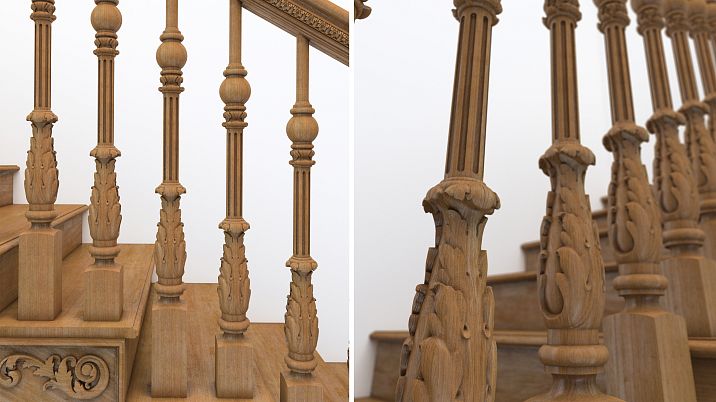
A wooden staircase is not just a functional interior element, it is a work of art that requires flawless execution of every detail. The mounting of balusters to handrails occupies a special place in this symphony of wood, a process that determines not only the aesthetics of the structure but also its durability and operational safety.
When creating a stair railing, many craftsmen face a dilemma: how to achieve the ideal balance between connection strength and visual elegance? The answer lies in a deep understanding of technological processes, proper selection of fastening elements, and mastery of carpentry techniques.


Anatomy of Stair Railing: Understanding Structural Features
Before diving into the intricacies of installation, it is necessary to understand the role of each element in the overall architecture of the stair structure. Balusters serve a dual function: they ensure safe movement and create visual completeness of the composition. Handrails, in turn, serve as support for the hand and as a connecting element between individual vertical posts.
Quality mounting of balusters to handrails begins with understanding the loads the structure will experience. Horizontal forces arising from support on the handrail, vertical loads from the weight of the railing itself, dynamic impacts during intensive stair use — all of this must be considered when selecting the method of connecting elements.




Wood Joining Material Science
Wood is a living material that continues to 'breathe' even after processing and installation. Seasonal fluctuations in humidity cause changes in the geometric dimensions of parts, creating additional stresses at connection joints. That is why a professional approach to mounting balusters implies using technologies that compensate for these natural processes.
Different wood species behave differently under changing operating conditions. Oak, beech, ash — hardwoods — have high strength but require pre-drilling for installing fasteners. Coniferous species — pine, spruce, larch — are more workable but require special attention to prevent cracking.
Our factory also produces:


Joining Technologies: From Classic to Innovative
Get Consultation
Connection with Metal Bolts: The Standard of Reliability
Threaded bolts with a diameter of 6-8 millimeters represent the most technologically advanced solution for creating a strong connection between balusters and handrails. This method ensures exceptional reliability of the connection and allows for disassembly of the structure without damaging the wooden elements.
The installation process begins with precise marking of the axial lines on the balusters. Drilling is performed strictly perpendicular to the end surface, using guiding fixtures to ensure hole alignment. The drilling depth in the baluster should be 50-70 millimeters, ensuring sufficient contact area between the thread and the wood.
Special attention is paid to preparing the mounting holes in the handrail. Holes are marked using templates or laser levels to ensure perfect parallelism of all connections. The hole diameter must exactly match the outer diameter of the bolts — this eliminates play and ensures a tight fit.
Dowel Connections: Traditional Elegance
Wooden dowels with a diameter of 8-12 millimeters represent a classic solution valued for its ecological and aesthetic qualities. This method of mounting balusters to handrails is especially popular when creating stairs in a traditional style, where material harmony is important.
Manufacturing dowels requires special skill. The wood for them must be absolutely dry, with moisture not exceeding 8-10 percent. The fibers of the dowel must be aligned along its axis — this ensures maximum shear strength. The dowel length is calculated so that it extends 30-40 millimeters into the baluster and 20-25 millimeters into the handrail.
Adhesive bonding plays a key role in ensuring the longevity of dowel connections. Modern polyurethane adhesives provide waterproof connections that do not degrade under changes in wood moisture. Adhesive is applied both to the dowel surface and to the hole walls, creating maximum bonding area.
Screws: balance of speed and reliability
Modern construction screws with concealed heads, 6-8 mm in diameter, allow creating a strong connection with minimal labor. This method is especially effective when working with soft wood species, where screws easily enter the material without pre-drilling.
The key point is selecting the correct screw length. For secure attachment of balusters to handrails, the screw must pass through the entire handrail thickness and penetrate the baluster to a depth of at least 25-30 mm. It is important to avoid the screw tip protruding to the opposite side of the baluster, which may cause wood cracking.
Preparation operations: foundation of quality installation
Marking and positioning elements
Accuracy of marking determines the quality of the entire structure. The process begins with installing the end balusters — support posts that define the geometry of the entire railing. Between them, a control string is stretched, along which the positions of intermediate balusters are verified.
The distance between balusters is regulated by building codes and should not exceed 150 mm in clear span. This ensures the safety of ladder use, especially in homes with small children. Uniform spacing between balusters creates visual harmony and emphasizes craftsmanship.
End surface treatment
The quality of end surface treatment of balusters directly affects the strength of the connection. The end surface must be perfectly flat, without chips or scratches. To achieve this result, use end-cutting saws with fine-toothed discs or hand planes with sharp blades.
Special attention is paid to the bevel angle of balusters when installing them on inclined sections of stairs. The angle must precisely match the slope angle of the stair treads, ensuring vertical positioning of balusters after installation. The angle is checked using protractors or special templates.
Assembly technology: step-by-step guide
Preparation of fastening elements
Metal studs are treated with anti-corrosion compounds before installation, preventing rust and dark stains on wood. The threaded part of the stud, which will be embedded in the wood, may be additionally treated with sealant to improve adhesion with glue.
When using wooden dowels, their surface is lightly sanded with sandpaper to create roughness, improving adhesive bond. The moisture content of dowels is controlled with a moisture meter — it should not exceed the moisture content of the main wood by more than 2-3 percent.
Assembly process of the structure
Assembly begins with installing end support posts, which define the geometry of the entire railing. These elements are secured to the stair structure's load-bearing components using strong bolted connections or lag bolts, ensuring maximum rigidity.
Intermediate balusters are installed step by step, with verticality control for each element. Balusters are attached to handrails after final fixation of their lower part to treads or stringers. This allows precise positioning of each baluster and ensures ideal railing geometry.
Final connection treatment
After completion of installation, all connections are carefully checked for absence of play and secure fixation. Locations of fastening elements are masked with wooden plugs made from the same wood species as the main structure, if necessary.
Connections are sanded with fine-grit sandpaper (220-320 grit), ensuring smooth surface and preparing it for application of protective-decorative coatings.
Features of fastening on different types of staircases
Staircases on stringers: direct fastening to treads
Stringer staircases offer the greatest opportunities for attaching balusters to handrails due to open access to the lower part of treads. Balusters can be directly attached to treads using through-bolted connections, ensuring maximum structural reliability.
A feature of such fastening is the possibility of concealed installation — fastening elements are located on the underside of treads and do not affect the staircase's aesthetics. To access fastening locations in treads, holes are drilled, which are later sealed with decorative plugs after installation.
Staircases on stringers: use of baluster supports
Stringer staircases require a special approach to baluster fastening. The inclined surface of the stringer does not allow direct installation of balusters — intermediate elements — baluster supports — are required.
A baluster support is a wooden plank attached to the stringer and serves as a base for installing balusters. Its cross-section is typically 40×60 or 50×70 mm, ensuring sufficient structural rigidity. Slots are milled into the upper part of the baluster support for installing balusters, and the lower part is profiled to match the stringer's shape.
Innovative solutions in fastening
Modern technologies offer innovative solutions for attaching balusters to handrails, providing ideal aesthetics with maximum reliability. Concealed fastening systems allow creating an impression of monolithic construction, where connections are practically invisible.
One such solution is special metal inserts installed in the ends of balusters and handrails. These elements provide strong threaded connections, completely hidden within the wood. Installation of such systems requires high precision machining, but the result exceeds all expectations.
One such solution are special metal inserts installed at the ends of balusters and handrails. These elements provide a strong threaded connection, fully concealed within the wood. Installation of such systems requires high precision machining, but the result exceeds all expectations.
Combined fastening methods
Professional craftsmen often use a combination of different fastening methods to achieve optimal results. For example, the main connection may be performed using metal studs, while additional fixation is provided by adhesive bonding. This approach allows compensating for the shortcomings of each method and achieving maximum structural reliability.
Another example of a combined approach is using dowels for precise positioning of elements and screws for final fixation. Dowels ensure perfect alignment of the axes of connected parts, while screws provide the necessary clamping force.
Quality control and testing
Checking connection strength
After completion of installation, it is mandatory to check the strength of all connections. Each baluster is subjected to load testing — a horizontal force of 100-150 kg is applied. Absence of deformation or play indicates quality workmanship.
Special attention is paid to checking connections at locations of maximum load — at the beginning and end of stair treads, at turns and landings. These nodes experience increased loads and require especially careful inspection.
Long-term testing
Quality fastening of balusters to handrails must retain its properties throughout the entire service life of the staircase. To evaluate long-term reliability, cyclic tests simulating multi-year structural operation are conducted.
These tests include repeated application of loads of varying magnitudes and directions, as well as temperature-humidity cycles simulating seasonal changes in operating conditions. Results of these tests allow predicting structural behavior and, if necessary, adjusting the installation technology.
Typical errors and ways to prevent them
Violations of drilling technology
One of the most common errors is inaccurate drilling of holes for fastening elements. Deviation from perpendicularity, misalignment of holes in connected parts, incorrect diameter — all of this leads to weakened connections and premature failure of the structure.
To prevent such errors, use special guiding fixtures — guides, which ensure drilling accuracy. When working with hand tools, special attention is paid to controlling the perpendicularity of the drill relative to the work surface.
Incorrect selection of fastening elements
Using fastening elements of inappropriate size or material may lead to connection failure. Too thin studs cannot withstand operational loads, while overly thick ones may cause wood cracking.
Material of fastening elements must match operating conditions. In high-humidity rooms, use stainless steel or galvanized elements. For outdoor staircases, fastening elements with enhanced anti-corrosion coatings are required.
Modern trends in staircase railing design
Minimalism and concealed connections
Modern interior design trends lean toward minimalism and clean lines. This imposes special requirements on baluster-to-handrail fastening — connections must be as inconspicuous as possible, not disrupting the overall aesthetic of the structure.
Achieving such results requires using special technologies and fastening elements. Concealed connections, embedded fastenings, use of magnetic systems — all of these allow creating an impression of monolithic construction while retaining the possibility of disassembly for maintenance or repair.
Combining materials
Modern staircase railings often combine different materials — wood, metal, glass, stone. Such combinations create unique design solutions, but require a special approach to fastening elements.
Connecting dissimilar materials has its own characteristics, related to different coefficients of thermal expansion, varying strength and elasticity. Special fastening systems are developed for such connections, compensating for these differences and ensuring long-term structural reliability.
Maintenance and repair of staircase railings
Preventive measures
Properly executed baluster-to-handrail fastening requires minimal maintenance, but complete elimination is impossible. Regular preventive inspections allow identifying potential problems at an early stage and preventing serious damage.
Inspection includes checking strength of all connections, identifying wood cracks, monitoring condition of fastening elements. Special attention is paid to areas of maximum load — beginning and end of treads, turning sections.
Repair and restoration
Upon detecting weakened connections, immediate measures must be taken to restore them. Depending on the nature of damage, various repair methods may be applied — from simple tightening of fastening elements to complete replacement of damaged parts.
Modern technologies allow restoring even severely damaged connections using special adhesives and reinforcing elements. Such repair may be practically invisible and ensure long-term structural reliability.
Economic aspects of quality installation
Price-to-quality ratio
Quality fastening of balusters to handrails requires certain financial investments, but these costs are fully offset by long-term reliability and safety of the structure. Saving on fastening elements or violating installation technology may lead to much higher costs in the future.
Costs of different fastening methods vary significantly. Dowel connections are the most economical, but require high skill from the installer. Metal fastening systems are more expensive but provide guaranteed reliability and ease of installation.
Long-term economic efficiency
Properly executed baluster fastening serves for decades without requiring repair or replacement. This ensures high economic efficiency of initial investments and minimal operational costs.
Moreover, a quality staircase with reliable railings increases property value and creates a positive impression of the house as a whole. This is especially important when selling or renting out real estate.
Conclusion
The skill of fastening balusters to handrails represents a synthesis of traditional carpentry techniques and modern technological solutions. Each method has its advantages and areas of application, and the choice of the optimal variant depends on multiple factors — from the type of staircase to the aesthetic preferences of the client.
Regardless of the chosen method, key factors for success are the accuracy of all operations, use of high-quality materials and fasteners, and adherence to technical requirements. Only such an approach guarantees the creation of a stair railing that will serve for many years, ensuring safety and delighting the eye with its beauty.
Modern technologies open up new possibilities for creating unique design solutions, but the foundations of craftsmanship remain unchanged. Deep understanding of wood properties, mastery of traditional joinery techniques, attention to detail — these are what distinguish a true master from a mere executor.
For more detailed information about stair railing installation technologies, we recommend reviewing professional methods of attaching balusters to handrails, where time-tested solutions for creating reliable and beautiful stair constructions are presented.
For many years, the company STAVROS has specialized in creating exclusive wooden staircases that combine traditional craftsmanship with modern technologies. Our specialists possess deep knowledge in woodworking and are ready to share their experience with those who strive for perfection in every detail.