Article Contents:
- Anatomy of stair railing: understanding the basics
- Preparation stage: foundation for successful installation
- Master's tool arsenal
- Calculation and marking: mathematics of beauty
- Fastening technologies: choosing the optimal solution
- Fastening with threaded studs: reliability proven over time
- Screw fastening at an angle: speed and simplicity
- “Swallowtail” system: traditions of carpentry craftsmanship
- Fastening to sub-baluster board: modular approach
- Installing handrails: final touch
- Connection with sub-rail supports: classic approach
- Hidden fastening: elegance without compromise
- Working with different materials: key features
- Wooden balusters: warmth of natural material
- Metal constructions: strength and durability
- Stone balusters: monumentality and respectability
- Quality control and final finishing
- Checking geometry and strength
- Final Finishing and Protection
- Common mistakes and ways to avoid them
- Inaccurate marking
- Insufficient fastening depth
- Use of low-quality fasteners
- Ignoring thermal deformations
- Modern Trends in Stair Railing Design
- Minimalism and clean lines
- Combining materials
- Integration of Lighting
- Use of composite materials
- Economic Aspects of the Project
- Budget Planning
- Price-to-quality ratio
- Long-Term Savings
- Safety techniques during installation
- Work area preparation
- Use of protective equipment
- Working at height
- Maintenance and care of stair railings
- Regular Cleaning
- Periodic coating renewal
- Fastener connection inspection
- Innovative solutions in stair railings
- Smart lighting systems
- Modular constructions
- Eco-Friendly Materials
- Regional Characteristics and Climatic Factors
- Humid climate
- Sharp temperature fluctuations
- Marine climate
- Psychological aspects of stair railing design
- Visual lightness
- Tactile sensations
- Color palette
- Integration with "smart home" systems
- Sensory handrails
- Adaptive lighting
- Alert system
- Restoration and modernization of existing railings
- Condition assessment
- Partial replacement of elements
- Structural Reinforcement
- Conclusion
A staircase without elegant balusters and reliable handrails resembles an unfinished symphony — technically functional, yet lacking soul and safety. Every homeowner facing the need to furnish a stairwell will eventually ask: how to transform a simple structure into an architectural masterpiece that becomes the pride of the home?
How to install balusters and handrails — is an art requiring not only technical skills but also an understanding of aesthetic principles. Proper installation transforms an ordinary staircase into an elegant structure that serves for decades, delighting the eye and ensuring the safety of all family members.


Anatomy of a stair railing: understanding the basics
Before delving into the intricacies of installation, it is necessary to understand the structure of the stair railing. Balusters are vertical support elements that not only support handrails but also create a visual rhythm throughout the entire structure. Handrails, in turn, serve a dual function — providing support when ascending and descending, and completing the railing's composition.
Modern balusters are made from various materials: classic wood, strong metal, refined stone, or practical composite. Each material dictates its own installation specifics and requires a specific approach to mounting.
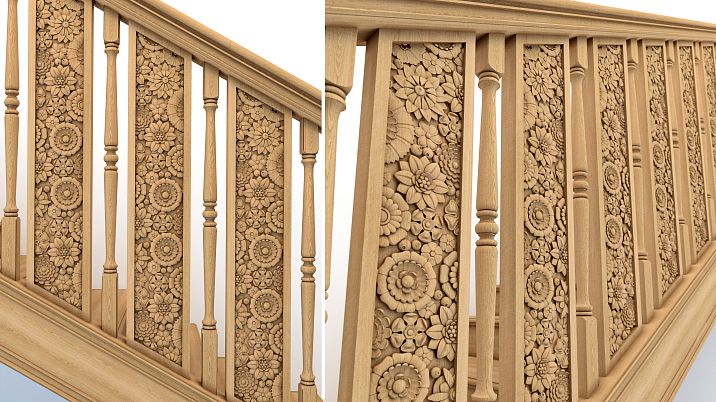
Wooden balusters remain the most popular choice due to their versatility and ability to create unique carved elements. They harmonize beautifully with any interior style — from classic to modern minimalism.
Metallic structures are distinguished by increased strength and durability. Wrought iron balusters can become true works of art, while simple steel posts fit perfectly into loft or high-tech interiors.
Stone elements impart monumentality and dignity to the staircase. Marble or granite balusters require a special approach to installation due to their significant weight.




Preparation stage: foundation for successful installation
Quality installation of balusters begins long before the first hammer strike. Careful preparation is the guarantee of the longevity and safety of the entire structure. The first step is a detailed analysis of the existing staircase and determining the optimal mounting method.
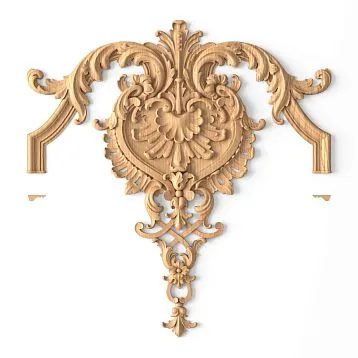
Our factory also produces:


Toolset of the craftsman
Professional installation requires appropriate tools. The master's toolkit must include:
- Measuring tools: laser level, tape measure, square, plumb bob
- Cutting tools: circular saw, jigsaw, chisels of various sizes
- Drilling equipment: drill with drill bit set, drill bits for deep drilling
- Fastening elements: screws, bolts, anchors, construction glue
- Auxiliary tools: clamps, hammer, socket wrenches
Tool quality directly affects the accuracy of work and the final result. Cutting costs on tools often results in additional time and material expenses.
Get Consultation
Calculation and marking: mathematics of beauty
Correct placement of balusters determines not only the safety of the structure, but also its aesthetic appeal. According to building codes, the distance between adjacent balusters should not exceed 15 centimeters — this ensures that a small child cannot fit their head between the posts.
Marking begins with installing the outer support posts. The first post is placed on the lower step or in front of it, the second — on the upper platform. A control string is stretched between them, serving as a reference for aligning intermediate balusters.
When marking, it is important to consider the architectural features of the staircase. On curved sections, the distance between balusters may vary slightly to maintain visual harmony.
Fastening technologies: choosing the optimal solution
Modern practice offers several proven methods of fastening balusters, each with its own advantages and areas of application.
Fastening with threaded bolts: reliability proven over time
The method of fastening with metal bolts is considered the most technologically advanced and reliable. The process begins with drilling a central hole in the lower part of the baluster. The depth of the hole should be at least half the height of the post's base.
The bolt is screwed into the baluster so that it protrudes 5-7 centimeters. For additional fixation, a special wood glue is used, which ensures a monolithic connection.
Points for installing balusters are marked on the step or floor. Holes with a diameter of 5 millimeters are drilled at these points. The depth of the holes should match the length of the protruding part of the bolt.
Installation is performed by screwing the baluster into the prepared hole. The process requires care — misalignment at this stage may lead to distortion of the entire railing's geometry.
Screws at an angle: speed and simplicity
For those who prefer simpler solutions, the method of fastening with angled screws is suitable. A guiding hole is drilled in the center of the baluster's end, into which a 80-90 millimeter screw is screwed at an angle of 30-40 degrees.
The baluster is placed in position and screwed into the base using rotational movements. To securely fix one post, four screws are required, arranged in a cross pattern.
This method is distinguished by the speed of installation, but it is less reliable than bolt fastening. When using soft wood, pre-drilling may not be necessary; however, for hardwoods, it is mandatory to prevent material cracking.
“Lap joint” system: traditions of carpentry craftsmanship
The “lap joint” type of tongue-and-groove connection represents the pinnacle of carpentry art. A trapezoidal tenon is formed on the lower part of the baluster, which fits into the corresponding groove on the step or stringer.
Preparing such a connection requires high skill and special tools — a router or set of chisels. The manufacturing accuracy must be perfect, as even minor deviations will weaken the connection.
The advantages of this method are obvious — the connection is exceptionally strong and durable, and the load is evenly distributed over the entire contact area. However, the complexity of manufacturing makes this method accessible only to experienced craftsmen.
Fastening to a baluster board: modular approach
Using a baluster board allows pre-assembling the railing section in the workshop and then installing it on the staircase as a whole. This approach significantly simplifies installation and reduces the likelihood of errors.
Balusters are attached to a special board using screws, dowels, or glue. The prepared section is then installed on the stringer or step and secured with screws or anchors.
There are three main types of baluster boards:
- L-shaped — provides maximum rigidity, holding the baluster from three sides
- Equal width with the rail — easier to manufacture, but less stable
- Set-in — inserted into the rail grooves, providing increased strength
Railing Installation: Final Touch
Installing handrails requires no less attention to detail than installing balusters. The quality of baluster connection to the rail determines not only the appearance of the structure, but also its functionality.
Connection with rail supports: classic approach
The traditional method involves using a middle board — a rail support. A rough board of small width is attached to the upper ends of the balusters, serving as a base for the decorative handrail.
The rail support is secured with screws or dowels. Since the fastening remains hidden, any suitable elements can be used without regard to aesthetics.
The decorative handrail is made with a groove corresponding to the size of the rail support. Installation is performed by simply placing the handrail onto the base and securing it with glue or hidden screws.
Hidden mounting: elegance without compromise
The hidden mounting method ensures a flawless appearance but requires high precision. Screws or nails are screwed into the upper part of each baluster, protruding 3-4 centimeters.
Holes are marked and drilled at a 45-degree angle in the handrail. Accuracy of marking is critically important — even a small deviation will cause the entire structure to be misaligned.
Assembly is performed by placing the handrail onto the fasteners and securing it with glue. For a tight fit, the handrail is gently tapped with a hammer through a wooden pad.
Features of Working with Different Materials
Each baluster material requires a specific approach to installation and use of appropriate fasteners.
Wooden balusters: warmth of natural material
Wood remains the most popular material for making balusters due to its workability and aesthetic qualities. When working with wooden elements, it is important to consider the wood species — soft coniferous woods allow screws to be driven in without pre-drilling, while hard deciduous woods require pre-drilled holes.
For connecting wooden elements together, it is optimal to use threaded fasteners — screws, bolts, or bolts. Additional strength is provided by using carpentry glue, which creates a monolithic connection.
When installing wooden balusters, it is necessary to provide for the possibility of seasonal changes in material dimensions. Wood expands and contracts depending on air humidity, so joints must allow for slight movement.
Metal structures: strength and longevity
Metal balusters require the use of appropriate fasteners — anchors, bolts, or welded connections. When installing steel elements onto a wooden base, special adapters are used, ensuring a reliable connection between dissimilar materials.
Special attention should be paid to protecting metal from corrosion. All fasteners must be galvanized or made of stainless steel. Welded areas require additional treatment with anti-corrosion compounds.
Stone balusters: monumentality and respectability
Installing stone balusters is the most complex task, requiring special skills and tools. The significant weight of the elements dictates the need to create a strong foundation capable of supporting the load.
Stone balusters are mounted using special sleeves — metal elements that are fixed into the base and serve as support for the stone post. The connection is sealed with special compounds that prevent moisture ingress.
Quality control and finishing
The final installation stage includes careful inspection of all connections and final surface finishing.
Checking geometry and strength
After completing the installation, it is necessary to check the verticality of all balusters using a level. Deviations exceeding 2 millimeters per meter of height are not permitted and require correction.
Connections are checked by gently rocking each baluster. Any movement indicates insufficient fixation and requires strengthening the fastening.
Handrails must be placed strictly horizontally or follow the slope of the stairs. The height of the railing is checked at several points — it must be at least 90 centimeters.
Final finishing and protection
Wooden elements require protective treatment — application of primer, stain, varnish, or paint. The choice of finish depends on the conditions of use and design intent.
Metal parts are coated with anti-corrosion compounds and decorative finishes. Special attention is paid to welded joints and threaded connections.
Stone surfaces can be treated with special impregnations that increase resistance to dirt and simplify maintenance.
Common mistakes and ways to avoid them
Analyzing typical errors during baluster installation will help avoid problems and ensure a high-quality result.
Inaccurate marking is the most common cause of installation problems. Using poor measuring tools or carelessness when transferring dimensions leads to misalignment and geometric distortion.
To prevent errors, use a laser level and conduct control measurements at each stage of work.
Insufficient fastener embedment depth
Savings on fastener embedment depth result in reduced connection strength. The minimum embedment depth must be at least 50 millimeters for wooden bases and 30 millimeters for concrete bases.
Savings in the embedment depth of fasteners result in reduced connection strength. The minimum embedment depth must be at least 50 millimeters for wooden bases and 30 millimeters for concrete bases.
Use of low-quality fasteners
Using cheap black metal fasteners leads to rapid corrosion and weakening of connections. All fasteners must be made of stainless steel or have a quality anti-corrosion coating.
Ignoring thermal deformations
Different materials have different coefficients of thermal expansion. When connecting wood to metal, compensating gaps must be provided to prevent connection failure due to temperature changes.
Modern trends in staircase railing design
Advancements in technology and changing aesthetic preferences influence approaches to designing and installing stair railings.
Minimalism and clean lines
Modern design trends favor simplicity and functionality. Balusters adopt minimalist forms, and the number of decorative elements is minimized. Glass railings are gaining popularity, creating a sense of lightness and spaciousness.
Combining materials
Combining different materials allows creating unique compositions. Wooden handrails on metal balusters, stone bases with wooden posts — possibilities are limited only by the designer’s imagination.
Integration of lighting
Built-in lighting transforms the stair railing into an element of interior lighting. LED strips embedded in handrails or baluster bases create dramatic light and shadow effects.
Use of composite materials
Modern composites combine the advantages of various materials — metal strength, wood workability, plastic durability. Composite balusters require minimal maintenance and retain their original appearance for decades.
Economic aspects of the project
The cost of installing balusters and railings depends on multiple factors — material used, construction complexity, fastening method, and need for additional work.
Budget planning
Proper budget planning begins with defining priorities. Saving on fastener materials is unacceptable — this is a safety issue. At the same time, a reasonable choice of baluster material can significantly reduce costs without compromising quality.
Simple-form wooden balusters will cost significantly less than hand-carved elements. Metal structures made of ordinary steel are cheaper than stainless steel ones, but require regular maintenance.
Price-to-quality ratio
The optimal price-to-quality ratio is achieved by using proven materials and technologies. Innovative solutions may prove unnecessarily expensive, while traditional methods provide predictable results at reasonable costs.
When the craftsman decides to install balusters and railingsit is important to consider not only initial costs but also long-term maintenance expenses.
Long-term savings
Investments in quality materials and professional installation pay off in the long run. Properly installed balusters serve for decades without requiring repair or replacement.
Safety techniques during installation
Working with stair structures requires strict adherence to safety rules.
Workplace Preparation
The work area must be well-lit and free of foreign objects. All tools should be placed in easily accessible locations, eliminating the need to stretch or bend uncomfortably.
Use of protective equipment
Protective eyewear is mandatory when drilling or cutting materials. Working with power tools requires using dielectric gloves and rubber-soled footwear.
Working at height
When working on a ladder, safety systems must be used. Portable ladders must be securely anchored, and their installation angle must comply with safety requirements.
Maintenance and care of stair railings
Proper care extends the lifespan of balusters and railings, preserving their original appearance.
Regular cleaning
Wooden surfaces are cleaned with a soft cloth using special wood-based solutions. Abrasive agents are prohibited — they damage protective coatings.
Metal elements are wiped with a damp cloth and then dried. If corrosion marks appear, immediate treatment with anti-corrosion compounds is required.
Periodic renewal of finishes
Protective coatings on wooden elements require periodic renewal. Frequency depends on operating conditions — in high-humidity areas, treatment is performed more frequently.
Fastening joint inspection
Once a year, the strength of all connections must be checked. Loose elements are tightened, worn fasteners are replaced.
Innovative solutions in stair railings
Modern technologies open up new possibilities for creating unique and functional stair structures.
Smart lighting systems
Integration of motion sensors and LED lighting transforms the stair railing into an intelligent system. Automatic lighting activation upon human approach enhances safety and creates comfortable usage conditions.
Modular constructions
The modular approach allows creating railings of any configuration using standard elements. This simplifies installation, reduces cost, and ensures the possibility of quick replacement of individual components.
Eco-friendly materials
Growing environmental awareness stimulates the use of renewable and recycled materials. Fiber-based composites combine eco-friendliness with high performance characteristics.
Adaptation to Russian climate
Regional climate conditions significantly influence the choice of materials and installation technologies for stair railings.
Humid climate
In high-humidity regions, special attention is paid to protecting wooden elements from rot and mold. Treatment with antiseptic compounds and use of moisture-resistant coatings are mandatory.
Sharp temperature fluctuations
In conditions of significant temperature fluctuations, compensatory gaps must be provided and materials with similar expansion coefficients should be used.
Marine climate
Proximity to the sea requires special protection of metal elements against corrosion. Preference is given to stainless steel or aluminum alloys with protective coatings.
Psychological aspects of stair railing design
Stair railing design affects not only safety but also the psychological perception of space.
Visual lightness
Transparent or openwork railings create a sense of spaciousness and do not clutter the interior. This is especially important in small rooms, where each element affects the perception of volume.
Tactile sensations
The quality of handrail finishing affects the comfort of stair use. A smooth, pleasant-to-touch surface creates positive emotions and increases safety through reliable grip.
Color palette
The railing color should harmonize with the overall interior, but also provide sufficient contrast for safe use by people with limited vision.
Integration with "smart home" systems
Modern stair railings can become part of a comprehensive home automation system.
Sensory handrails
Sensors embedded in handrails can monitor users' health status — pulse, body temperature, stress level. This information is transmitted to the central monitoring system.
Adaptive lighting
The system can automatically adjust the brightness and color temperature of the lighting based on the time of day, weather conditions, and individual user preferences.
Alarm system
Integration with the security system allows using the stair railing as an access control and unauthorized intrusion alert element.
Restoration and modernization of existing railings
Complete replacement of the stair railing is not always necessary — often, skilled restoration or modernization is sufficient.
Condition assessment
The first step of restoration is a thorough assessment of the existing elements. The degree of wear, presence of damage, and compliance with modern safety requirements are determined.
Partial replacement of elements
Often, it is sufficient to replace the most worn components while preserving the main structure. This significantly reduces costs while maintaining the historical value of the railing.
Structural reinforcement
Old railings may not meet modern load standards. Reinforcement is achieved by adding additional fastening elements or installing intermediate supports.
Conclusion
The skill of installing balusters and handrails comes with experience, but understanding the basic principles is accessible to everyone. A well-executed job transforms the staircase into an architectural feature of the interior, creating an atmosphere of comfort and safety.
Modern technologies and materials open up boundless opportunities for creativity, allowing the realization of the most daring design concepts. The key is not to forget about functionality and safety, as the stair railing must serve not only as decoration but also as reliable protection.
The correct approach to solving the question of How to install balusters and handrailsensures the longevity and beauty of the structure. Investments in quality materials and professional installation pay off through years of flawless service.
Correctly installed balusters and handrails become family heirlooms passed down from generation to generation. Every time family members ascend the stairs, they will feel pride in the quality workmanship.
For more than two decades, the company STAVROS has specialized in creating exclusive staircase structures, combining traditional craftsmanship with modern technologies. Our specialists are ready to realize any architectural concepts, ensuring impeccable quality and long-lasting results.