Article Contents:
- Evolution of Furniture Handles: From Function to Art
- From Antiquity to Today: A Journey Through Eras
- Materials and Technologies: From Bronze to Composites
- Furniture Handle Typology: Form Follows Function
- Constructive Solutions: From Brackets to Buttons
- Bio-tech: Organic forms of the future
- Functional Aspects of Choosing Furniture Handles
- Ergonomics and Ease of Use
- Technical Specifications and Installation
- Aesthetic Aspects of Choosing Furniture Handles
- Color Solutions and Finishing
- Matching Decorative Elements with Furniture and Interior Style
- Where to Buy Furniture Handles: Market Overview and Recommendations
- Specialized Stores and Online Platforms
- Criteria for Choosing a Seller and Manufacturer
- How to Match Handles to Furniture and Interior Style
- How to Avoid Mistakes in Selection: Step-by-Step Guide
- Installation and Maintenance: Secrets of Longevity
- Transforming Interiors with Furniture Handles: Success Stories
- Real Examples of Furniture Transformation
- Designers' Tips: How to Create a Wow Effect
- Modern Trends in Furniture Hardware Design
- Modern Trends: What's in Style Today
- Technological Innovations and Functional Solutions
- Conclusion: Small Details with Big Impact

Have you ever considered what role small details play in creating a cohesive interior design? Imagine an elegant cabinet with exquisite finish, perfect geometry, and... cheap plastic handles that literally scream their inappropriateness. Or, conversely, imagine a simple chest of drawers that suddenly transforms thanks to elegant handcrafted metal handles. It’s precisely these 'small details' that often become the decisive touch, turning ordinary furniture into a work of art.
Furniture hardware is like jewelry for your interior. And among all the variety of hardware, handles hold a special place. They not only perform a practical function, allowing you to open and close drawers and doors, but they are also a crucial decorative element capable of completely changing the perception of furniture.
In this article, we will dive into the fascinating world of furniture handles, reveal the secrets of their selection, and tell you, where to buy furniture handles, which will become the perfect finishing touch for your interior.


Evolution of Furniture Handles: From Function to Art
The history of furniture handles spans more than one century, and during this time they have undergone an amazing transformation—from purely utilitarian elements to true works of decorative-applied art.




From Antiquity to Today: A Journey Through Eras
The first prototypes of furniture handles appeared even in Ancient Egypt and were simple protrusions or indentations in wooden chests and boxes. In ancient Greece and Rome, metal rings and brackets were already used, attached to cabinet doors and drawers.
The Middle Ages brought variety in forms: forged iron handles adorned massive oak chests and cabinets. The Renaissance added elegance and ornamentation—bronze and brass handles with floral motifs and mythological scenes appeared.
Baroque and Rococo turned furniture handles into true works of art—elaborate forms, gilding, inlays with precious stones. Classicism returned strictness and symmetry, but retained refined execution.
The Industrial Revolution of the 19th century made furniture handles accessible to broad segments of the population. Cast iron, and later brass, mass-produced handles appeared, yet often copied historical styles.
The 20th century brought a revolution in furniture hardware design. Bauhaus and functionalism proclaimed the principle 'form follows function,' leading to minimalist, geometrically pure forms. In the latter half of the century, designers began experimenting with new materials—plastic, aluminum, stainless steel.
Today we observe astonishing diversity in styles and materials—from high-tech minimalist solutions to skillful replicas of historical samples. Modern technologies allow creating handles of any shape and finish, and designers continually seek new ways to express themselves through this seemingly humble furniture element.
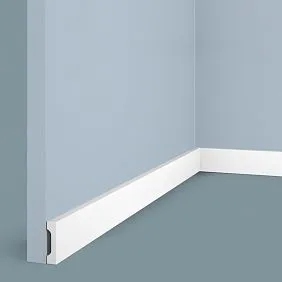
Our factory also produces:





Materials and Technologies: from Bronze to Composites
The evolution of materials for furniture handles reflects the general development of technologies and changing aesthetic preferences.
Metal handles are traditionally considered the most durable and prestigious. Among metals, the following hold special significance:
- Brass—a copper-zinc alloy with a warm golden hue and high corrosion resistance. Brass handles can have various finishes—from polished sheen to aged patina.
- Bronze—an alloy of copper with tin and other elements, distinguished by exceptional strength and noble appearance. Bronze handles are often used in classical and antique styles.
- Stainless steel—a modern material with high strength, corrosion resistance, and hygiene. Steel handles fit perfectly into contemporary minimalist interiors.
- Aluminum—a lightweight metal that can have various surface treatments—from matte to mirror-polished. Aluminum handles are popular in modern design due to their lightness and technological appearance.
- Zinc alloys—an affordable material enabling the creation of complex shapes via die-casting. Such handles usually have protective-decorative coatings—chroming, nickel plating, or painting.
Non-metallic materials are also widely used in furniture handle production:
- Wood—a natural material that harmonizes beautifully with wooden furniture, creating a cohesive look. Wooden handles can be made from various species—from light beech to dark wenge.
- Glass and crystal—materials that impart special elegance and lightness to furniture. Glass handles can be transparent or colored, smooth or textured.
- Ceramic and porcelain—traditional materials for handles in Provence, country, and shabby chic styles. Ceramic handles are often decorated with painting or relief ornamentation.
- Plastic and composites—modern materials enabling the creation of handles in any shape and color. High-quality polymers can imitate more expensive materials or, conversely, emphasize their technological nature.
- Leather and textile—unusual materials used to create soft pull handles or as decorative elements on metal or wooden bases.
Modern surface processing technologies allow creating various effects on handles—from glossy sheen to aged patina, from smooth polishing to textured relief. Many manufacturers use material combinations, creating unique designer solutions.
Get Consultation
Furniture Handle Typology: Form Follows Function
The variety of forms and constructions of furniture handles is astonishing. Each type has its functional features and aesthetic qualities that should be considered when choosing.
Construction Solutions: from Hooks to Buttons
Hooks and loops—a classic handle type, consisting of a curved element secured to furniture surfaces with two fasteners. Hooks provide secure grip and are convenient to use. They can have various shapes—from strict rectangular to curved in Baroque style.
Buttons and knobs—compact handles secured to furniture with a single screw. They occupy minimal space and are ideal for small drawers or when preserving the clean lines of furniture facades is required. Buttons can be flat or convex, simple or decorative.
Recessed handles—embedded handles that do not protrude beyond the facade surface. They are recessed indentations shaped like bowls or cups, designed to be grasped with fingers. Such handles are ideal for furniture in passageways, where protruding elements may obstruct movement.
Profile handles—long horizontal or vertical elements mounted along the edge of a door or drawer. They provide comfortable grip along the entire length and are often used in modern furniture with smooth facades lacking visible handles.
Furniture rails—bars mounted at a certain distance from the facade surface. They provide comfortable grip with the entire palm and are often used on kitchen furniture, where hands may be wet or dirty.
Ring handles—a classic variant shaped like a ring suspended from a decorative rose. Such handles are characteristic of antique and classical furniture, but modern designers often reinterpret this form in a new context.
Drop-shaped handles—elegant handles resembling a drop or pear shape. They usually have a single mounting point and create an effect of lightness and refinement.
Bow-shaped handles - decorative handles with complex shapes resembling bows or flowers. They are often used in furniture of Provence, shabby chic, and rococo styles.
Stylistic Directions: From Classic to Avant-Garde
Choosing furniture handles should correspond to the overall interior concept and the design of the furniture itself. Let's consider the main stylistic directions:
Classic style is characterized by symmetrical forms, plant motifs, and the use of traditional materials - brass, bronze, wood. Classic handles often feature intricate relief decoration, patina, and gilding.
Baroque and Rococo are styles distinguished by opulence, curved lines, and abundant decoration. Handles in these styles often have the shape of scrolls, shells, floral compositions, and are complemented by decorative rosettes.
Empire and Neoclassicism return to classical motifs - laurel wreaths, meanders, columns. Handles in these styles are characterized by strict lines and symmetry, yet retain rich decoration.
Modern (Art Nouveau) introduces flowing, organic lines inspired by natural forms - plant stems, waves, insects. Handles in the modern style are often asymmetrical and have complex organic shapes.
Art Deco combines geometric clarity with luxurious materials. Handles in this style may have stepped forms, zigzag lines, and contrasting color combinations.
Minimalism rejects decoration in favor of line purity and functionality. Minimalist handles have simple geometric shapes, often made of metal with matte or polished surfaces.
High-tech emphasizes technology and innovation. Handles in this style are often made of stainless steel, aluminum, high-tech composites, and have an industrial appearance.
Scandinavian style combines functionality with natural aesthetics. Handles in the Scandinavian style are usually simple in shape, made of light wood, leather, or matte metal.
Provence and country styles lean toward rustic simplicity and coziness. Handles in these styles often imitate antiquity - with wear, patina, and simple forms. Ceramic handles with painted or relief ornamentation are popular.
Loft plays on industrial aesthetics. Handles in the loft style may be made of rough metal, resemble pipes, bolts, or industrial parts.
Eclecticism and fusion allow bold combinations of different styles and eras. Here, the most unexpected solutions are possible - from vintage handles on modern furniture to avant-garde designer models in classic interiors.
Functional aspects of choosing furniture handles
Although the aesthetic component is important, it should not be forgotten that furniture handles are primarily a functional element that must ensure the convenience of using furniture.
Ergonomics and ease of use
The shape and size of the handle should correspond to the type of furniture and its usage. For frequently used drawers and doors, it is better to choose handles that provide a secure grip - hooks, rails, profiled handles. For decorative elements or rarely opened compartments, more elegant but less functional options - buttons, drops, complex decorative handles - can be used.
The placement of handles also affects usability. For tall cabinets, handles are better placed at shoulder or waist level. For lower drawers, horizontal placement of hook handles is more convenient. For upper kitchen cabinets, handles located at the bottom of the door are optimal.
The weight and inertia of the door or drawer should be considered when choosing a handle. Heavy facades require strong, reliable handles with good grip. Light drawers can use more elegant models.
Safety is especially important in children's rooms and areas with small children. Avoid handles with sharp edges or small parts that may break off. Smooth, rounded shapes without protruding elements are preferred.
Special user needs should also be considered. For people with limited hand mobility, it is better to choose large handles with a comfortable grip. For elderly people, reliability and the absence of need to exert significant effort are important.
Technical specifications and installation
Center-to-center distance - the most important technical parameter, determining the distance between the centers of mounting holes for hook handles. Standard sizes are 96, 128, 160, 192, 224, 256 mm, but other options exist. When replacing handles, it is important to choose models with the same center-to-center distance or to account for the old holes.
The mounting method may vary depending on the type of handle and the material of the furniture. Most handles are mounted using screws that pass through the facade and are screwed into the base of the handle. Some models have special mounting plates or adhesive mounting.
Compatibility with facade material is an important aspect. Special handles with silicone gaskets are required for glass doors. For thin MDF facades, handles with short mounting hardware or special bushings are needed. Solid wooden facades allow the use of almost any type of handle.
Adjustment and fitting may sometimes be required for ideal installation. Some handle models allow adjustment of position relative to the facade, which is especially important for drawers, where precise alignment is required.
Kit contents may vary among manufacturers. Some handles come with mounting hardware of different lengths for different facade thicknesses, while others require separate purchase of suitable screws.
Aesthetic aspects of choosing furniture handles
Furniture handles are not just a functional element, but also an important design detail capable of radically changing the perception of furniture and the entire interior.
Color solutions and finishing
Color harmony with the overall interior palette is an important aspect of choosing handles. They can either blend with the furniture color, creating a unified look, or contrast, becoming a bright accent. For example, light metallic or ceramic handles look striking on dark facades, while dark bronze or matte black metal handles stand out beautifully on light furniture.
The texture and surface finish of handles also play an important role in creating a certain impression:
- A glossy polished surface reflects light, creating a sense of luxury and festivity, but fingerprints are visible on it.
- A matte surface appears more restrained, does not glare, and is practical to maintain.
- A brushed (brushed) surface has directional micro-grooves, creating an interesting play of light.
- A satin surface has a slight silk-like sheen and is pleasant to the touch.
- A patinated surface imitates the natural aging of metal, creating a sense of vintage.
- A textured surface can imitate various materials or have a decorative relief.
Finishes and coatings of metal handles are diverse and affect both appearance and durability:
- Chroming creates a bright silver sheen and high corrosion resistance.
- Nickel plating gives a warmer silver tone with a slight yellow tint.
- Brass and bronze plating give a golden or reddish hue.
- Copper coating creates a characteristic reddish color, which may develop a patina over time.
- Blackening and bluing give metal a deep black color with a slight sheen.
- Powder coating allows you to achieve any color and texture, from glossy to textured.
- Anodizing aluminum creates a durable oxide coating in various colors.
Combinations of materials and colors allow creating unique designer solutions. Popular combinations include metal and glass, metal and wood, metal and ceramic. Two-tone handles can serve as a connecting element between different color zones in the interior.
Matching the style of furniture and interior
Harmony with furniture design is a key principle in choosing handles. They should match the style, era, and character of the furniture. For classic furniture with carved facades, decorative handles are suitable; for modern minimalist furniture, simple geometric shapes are appropriate.
Unity of style within a single room creates a sense of completeness and thoughtful interior design. This does not mean all handles must be identical, but they should be stylistically coordinated. For example, you can use handles from the same collection but of different sizes and configurations for different furniture elements.
Accents and dominants can be created using unusual, bright handles against more neutral furniture. This technique allows you to enliven the interior and introduce individuality. For example, vintage handles on a modern chest of drawers or bright colored handles on neutral kitchen facades.
Scale and proportions are also important when choosing handles. Large, heavy furniture requires handles of corresponding size; small items will harmonize with small, elegant handles. Violating proportions may create a comic or, conversely, dramatic effect, if this is a deliberate design decision.
Where to buy handles for furniture: market overview and recommendations
Choosing where to buy furniture handles depends on your preferences, budget, requirements for quality and uniqueness. Let's consider the main options with their advantages and disadvantages.
Specialized stores and online platforms
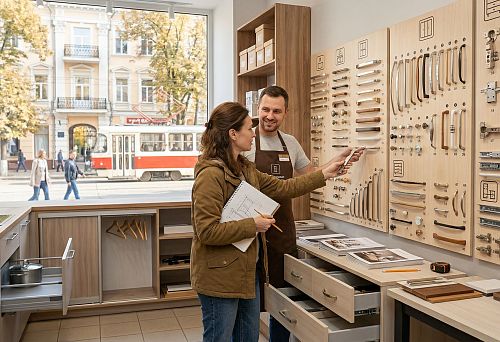
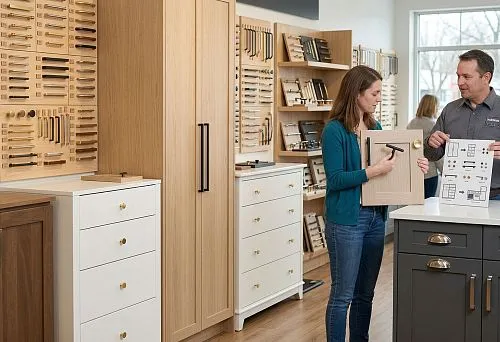
Specialized furniture hardware stores offer a wide variety of handles in different styles, materials, and price categories. Here you can see the product in person, assess its quality, and receive expert advice. Such stores usually have catalogs with full assortments and can order the required model if it is not in stock.
Hardware hypermarkets also offer furniture hardware, although the assortment here is usually more limited and oriented toward mass demand. The advantage of such stores is accessibility and the ability to purchase all necessary materials for repair or updating furniture at once.
Online stores offer a vast selection of furniture handles from manufacturers around the world. You can find both mass-market models and exclusive designer solutions. Advantages of online shopping include ease of selection, ability to compare prices, and home delivery. Disadvantages include inability to physically assess product quality and risk of the actual item not matching photos.
Particular attention should be paid to the online store Stavroswhich specializes in high-quality furniture hardware, including metal handles of various styles and designs. Here you will find both classic models and modern designer solutions that will help transform your furniture and overall interior.
Furniture showrooms often offer hardware as an addition to their main assortment. Here you can find handles that perfectly match specific furniture models, but the selection is usually limited to collections from a particular manufacturer.
Antique shops and flea markets are places to search for unique vintage handles with history. Here you can find true treasures — handmade handles, antique models, rare specimens from past eras. Such finds can become a distinctive feature of your interior, but require time to search and often need restoration.
Seller and manufacturer selection criteria
When choosing Places to buy furniture handles, pay attention to the following aspects:
Seller reputation - review customer feedback, company history, complaint records and resolution methods. A reliable seller values their reputation and strives for long-term customer relationships.
Product quality - pay attention to the manufacturer, country of origin, presence of quality certificates. Well-known brands usually guarantee a certain level of quality, but even among lesser-known manufacturers, you can find worthy options.
Assortment - a wide selection allows you to find exactly what you need. A good store offers variety in styles, materials, and price categories.
Product availability - confirm whether the selected model is in stock or if you will need to wait for delivery. Some rare or exclusive models may be ordered with a long lead time.
Delivery terms - cost, delivery time, geographic coverage, tracking capability. For fragile or expensive handles, reliable packaging protecting against damage during transport is essential.
Warranties and returns - review the store's policy regarding defective items, exchange or return options, if handles don't fit or meet expectations.
Additional services - some stores offer services such as selecting hardware to match your interior, designer consultations, and handle installation on furniture.
Pricing policy - compare prices for identical or similar models across different stores. Extremely low prices may indicate counterfeits or low quality, while unreasonably high prices may indicate middleman markups.
Practical tips for choosing and installing furniture handles
Choosing and installing furniture handles - a process requiring attention to detail and understanding of basic principles. Here are several practical recommendations to help you make the right choice and achieve an ideal result.
How to avoid mistakes in selection: step-by-step guide
Step 1: Determine the style and character of your furniture and overall interior.
Take photos of the room and furniture for which you are selecting handles. This will help you avoid relying solely on memory when making selections and consulting with sellers.
Step 2: Measure existing holes or determine the optimal placement for new handles.
When replacing existing handles, it's important to know the center-to-center distance - the distance between mounting hole centers. For new furniture, determine where handles will look most harmonious and ensure ease of use.
Step 3: Determine the required number of handles with a reserve.
It's better to purchase a few extra handles in case of damage during installation or for future replacement. This is especially important for limited-edition or unique models that may be discontinued.
Step 4: Choose materials and finishes suitable for the usage conditions.
For kitchens and bathrooms, prefer materials resistant to moisture and frequent use. For children's rooms, choose safe options without sharp edges or small parts. For bedrooms, you can opt for more decorative and elegant models.
Step 5: Consider several design options and compare them.
Don't settle for the first appealing option. Collect several alternatives, compare them by appearance, functionality, and price. Some stores offer samples or visualization options to see handles on your furniture.
Step 6: Check the quality of the selected handles.
Inspect handles for defects - unevenness, scratches, uneven coating. Check the secure attachment of decorative elements. Assess weight and durability - quality metal handles usually have noticeable weight.
Step 7: Confirm the package contents and availability of necessary mounting hardware.
Ensure the package includes all necessary screws of the correct length for your furniture. If the door panels have non-standard thickness, you may need to purchase additional mounting hardware.
Installation and care: secrets of longevity
Preparation for installation:
- Gather necessary tools: screwdriver or drill, ruler, pencil, drill bit of appropriate diameter, template for marking holes.
- Clean the furniture surface of dust and dirt.
- If you are replacing old handles and the new ones have a different center-to-center distance, prepare materials to fill the old holes - wood putty, paint, or stain matching the furniture color.
Drill hole marking:
- For precise marking, use a template - you can make one yourself from cardboard or purchase a ready-made one from a furniture hardware store.
- Mark the holes on the front side of the facade to avoid chipping during drilling.
- For symmetrical placement of handles on multiple identical facades, use the same distance from the edges.
Drilling holes:
- Choose a drill bit diameter matching the diameter of the mounting screws.
- To prevent chipping at the drill exit, place a wooden block under the facade.
- Drill at low speeds, especially if the facade material is MDF or particleboard.
- After drilling, remove burrs and dust.
Installing handles:
- Insert mounting screws from the front side of the facade.
- Screw the handle onto the screws, but do not tighten fully.
- Check the handle position, adjust if necessary.
- Tighten the screws, but do not over-tighten, to avoid damaging the facade or the threads in the handle.
Care for furniture handles:
- Regularly clean handles of dust and dirt with a soft cloth.
- For metal handles, use specialized cleaners appropriate for the type of metal and finish.
- Avoid abrasive cleaning agents that may damage the finish.
- Periodically check the tightness of the mounting and tighten screws as needed.
- To protect polished surfaces from fingerprints, use special polishes or wax.
Transforming interiors with furniture handles: success stories
Replacing furniture handles is one of the simplest and most affordable ways to refresh an interior without major renovation or buying new furniture. Let’s consider several real examples demonstrating how this small element can dramatically change the perception of space.
Real examples of furniture transformation
Story 1: New life for a vintage chest of drawers
An old oak chest with faded finish and lost original handles seemed hopelessly outdated. The owner decided not to discard the quality furniture but to give it a new life. After light wood restoration, the chest was adorned with elegant Art Deco-style bronze handles found in an antique shop. The contrast between the chest’s classic form and the geometric handles created an unexpected and stylish effect. Now this piece of furniture has become the focal point of the living room, drawing attention and impressing guests.
Story 2: Transforming a standard kitchen
Owners of a standard IKEA kitchen wanted to give it personality without resorting to expensive replacement of the entire set. The solution was replacing standard plastic handles with elegant, elongated matte stainless steel handles. This simple step visually 'stretched' the facades, giving the kitchen a more upscale and modern look. By adding a new backsplash and countertop, the owners achieved almost a brand-new kitchen for one-third the cost of a full set replacement.
Story 3: A child’s room with character
Parents wanted to create a room for their teenage daughter that reflected her individuality and interests. The white furniture from the children’s collection looked too childish. The solution was replacing plain white handles with colorful, hand-painted ceramic buttons of various shapes and colors. Each handle was unique, like a small work of art. This kaleidoscope of colors brought life to the interior, making it playful and creative, perfectly matching the young homeowner’s personality.
Story 4: Home office
The need to organize a home workspace prompted the owner of a studio apartment to seek compact and functional solutions. A standard cabinet was converted into a workstation that could be closed after work hours. The key element of the transformation was minimalist hidden handle-profiles, which are nearly invisible when closed but provide convenient opening. Thanks to this solution, the office space elegantly integrated into the living interior without disrupting its harmony.
Designer tips: how to create a wow effect
Professional interior designers often use furniture handles as a tool to create expressive accents and unique solutions. Here are some tips from experts:
Tip 1: Use Contrast
Play with contrasts of materials, shapes, and colors. Matte handles on glossy fronts, bright accents on neutral backgrounds, geometric shapes on classic furniture — such combinations create an interesting visual tension and attract attention.
Tip 2: Create Thematic Collections
Select handles unified by a common theme or motif — nautical, botanical, geometric, animalistic. This approach creates a cohesive impression and tells a story through details.
Tip 3: Experiment with Placement
Unconventional placement of handles can completely change the perception of furniture. Vertical placement on horizontal drawers, asymmetrical positioning, using different handles on a single piece of furniture — such techniques add dynamism and originality.
Tip 4: Combine Vintage and Modern
Antique or vintage handles on modern furniture create an interesting dialogue between eras and styles. This approach is especially effective in eclectic or fusion-style interiors.
Tip 5: Use Handles as Jewelry
Approach handle selection as choosing jewelry for an outfit — they should complement the overall look, but can also become a striking accent. Just as a necklace or brooch can transform a simple dress, so can exquisite handles turn an ordinary cabinet into a work of art.
Tip 6: Don't Fear Mixing Different Types of Handles
Within a single room, you can use different types of handles for different functional zones or furniture items. The key is to maintain stylistic unity through common elements — material, color, shape.
Tip 7: Consider Lighting
Shiny, polished handles look different under natural and artificial lighting. Matte surfaces are more stable under varying lighting conditions. Consider this when selecting, especially for rooms with variable lighting.
Trends and Innovations in the World of Furniture Handles
The world of furniture hardware is constantly evolving, reflecting changes in technology, design, and lifestyle. Let’s examine current trends and innovative solutions that define the future of furniture handles.
Current Trends: What’s in Style Today
Minimalism and Hidden Solutions
Modern design leans toward clean lines and uncluttered surfaces. This has led to the popularity of hidden and integrated handles — profile systems, recessed pulls, push-to-open mechanisms that allow opening furniture without visible handles. Such solutions create an elegant, minimalist look and are especially popular in modern kitchens and wardrobe systems.
Return to Nature
The ecological trend is reflected in the use of natural materials and organic forms. Wooden handles from eco-friendly species, handmade ceramics, unpolished metals with natural patina — all of this reflects a desire for authenticity and connection to nature. Popular are organic, asymmetrical shapes that mimic natural objects — branches, stones, leaves.
Industrial aesthetic
Loft and Industrial Style remain popular, which is reflected in furniture handle design. Rough metal, unprocessed surfaces, shapes reminiscent of industrial components — pipes, bolts, hooks — all of this creates a rugged, masculine look. Such handles are often used in interiors with open layouts, brick walls, and concrete surfaces.
Retro and Vintage
Nostalgia for the past is expressed in renewed interest in mid-20th century design — art deco, modernism, 50s and 60s styles. Modern manufacturers offer both exact historical reproductions and contemporary interpretations. Especially popular are brass and bronze handles with geometric motifs in art deco style and streamlined forms in mid-century modern style.
Eclectic style allows combining carved balusters with modern handrails, creating an unexpected and dynamic contrast. For example, wooden carved balusters can be complemented by metal or glass handrails. Such a combination of materials brings freshness and originality to the interior, highlighting the uniqueness of your design.
Combining different materials in one handle — a current trend that allows creating unique textural and color combinations. Metal and wood, metal and glass, metal and leather — such combinations add depth and tactile interest. Especially striking are contrasting combinations — warm wood and cool metal, matte and glossy surfaces, smooth and textured finishes.
Color Accents
Vibrant, saturated colors are returning to furniture hardware design after a period dominated by neutral tones. Colored handles are a simple way to add individuality and playfulness to an interior without major changes. Popular are both monochromatic solutions — handles in one bright color — and multi-colored combinations — gradients, patterns, multicolored inserts.
Technological Innovations and Functional Solutions
Smart Opening Systems
Advancements in technology have led to the emergence of innovative furniture opening systems that make usage more convenient and intuitive:
- Electronic opening systems activated by light touch on the facade
- Touch-sensitive mechanisms responding to touch
- Opening systems via remote control or smartphone
- Mechanisms with voice or gesture recognition
Such solutions are especially relevant for kitchens, where hands are often occupied or dirty, and for people with disabilities.
Ergonomic innovations
Modern handles increasingly consider the specifics of human anatomy and biomechanics:
- Handles with soft inserts for more comfortable grip
- Antibacterial coatings, especially important for kitchens and bathrooms
- Handles with adjustable position, adapting to user height and preferences
- Systems with dampers for smooth and silent closing
Ecological materials and production
Environmental care affects all aspects of furniture hardware production:
- Use of recycled materials - metals, plastics, glass
- Biodegradable materials for temporary or replaceable components
- Energy-efficient production technologies
- Zero-waste production cycles
- Non-toxic coatings and paints
3D printing and customization
3D printing technology opens new possibilities for creating unique, personalized handles:
- Manufacturing handles according to the customer's individual design
- Creating complex shapes impossible with traditional manufacturing methods
- Rapid prototyping and testing of new models
- Printing spare parts for vintage or discontinued models
Integration with smart home systems
Furniture handles become part of the smart home ecosystem:
- Handles with built-in lighting that responds to motion or time of day
- Integration with security systems - biometric locks hidden in handles
- Handles with monitoring functions - for example, tracking usage frequency of specific cabinets or drawers to optimize storage