Article Contents:
- The flesh of wood: why oak sounds convincing
- Light and tone: how the material works with lighting
- Knots that make the appearance flawless
- Morning: living room on the northeast
- Day: office where it's important to maintain concentration
- Evening: staircase and hand on the handrail
- Modern apartment
- House with a measure of classicism
- Public spaces
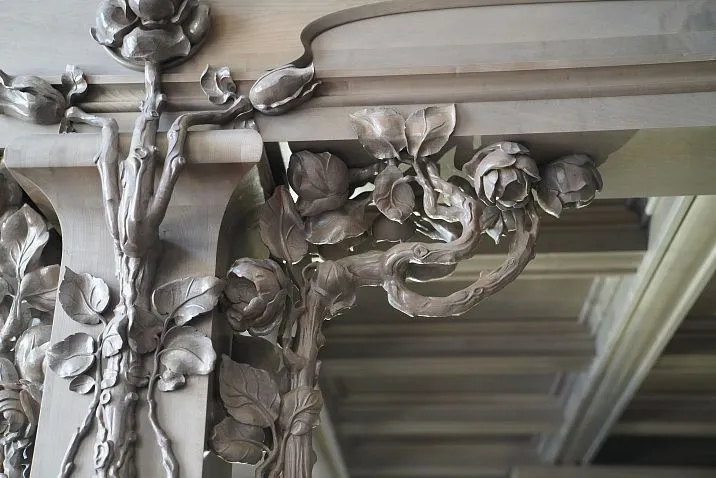
Dense wood forms the character of space more strongly than any decorative gesture. Oak is a species that disciplines planes, gathers shadows, and holds the edge for years. The interior wins where the material does not promise but delivers: elements, made of oakwithstand daily loads, do not lose geometry, and remain aesthetically convincing under any light — morning, daylight, evening.



The flesh of wood: why oak sounds convincing
Oak is weight, elasticity, and pattern without fuss. Grains are readable without roughness, bevels are fine but durable, surface is warm and alive. On light stains, oak does not turn into 'plastic'; on dark stains, it does not lose relief: profile steps gather soft shadow, not formless half-darkness. In this material there is calm strength: it does not try to please, it maintains order.




Light and tone: how the material works with lighting
— Oil systems give a silk-matte depth, emphasizing the difference between early and late wood.
— Satin varnishes even out traffic and reduce glare, preserving the 'living' optics of the grain.
— Stains from 'honey' to graphite change the temperature of space without losing texture.
This optics is important for any items, made of oak: shadow remains organized, glare — disciplined, and surface — repairable.
Our factory also produces:



Low as support: skirting that doesn't give in
Skirting is the first line of defense for walls and the first measure of room scale. In everyday life, here live vacuum cleaners, chair wheels, children's scooters, bags on long straps. Oak takes impact and does not crumble at the edge; the line remains straight over lengths, the joint with the casing — clean.
— For modern interiors, height 70–100 mm with a strict profile is appropriate.
— For classicism and neoclassicism — 110–140 mm with stepped shadow.
— For passageways — reinforced finish with emphasis on wear resistance.
The choice of specific geometry is made in the wooden skirting section, where the profile is selected not 'by picture', but by light, proportions, and planned load.
Knots that make the appearance flawless
— Inside corner — chamfered 'in the shape of a V' with micro-bevel to prevent side light from revealing the joint.
— Outside corner — factory corner or precisely mitered with fine touch-up.
— Long walls — hidden compensation combined with panel rhythm.
Get Consultation
Walls as a score: moldings, panels, wainscoting
Walls cannot be 'decorated' — they can be organized. Oak moldings are not about decoration, but about plane discipline: thin profiles hold graphics, stepped profiles create body shadow, panels dampen empty sound and gather long surfaces into readable rhythm. The choice of configurations and profiles — in the display of moldings, cornices, skirtings: from delicate frames to confident friezes.
Wainscoting adds vertical rhythm and acoustic benefit. On one accent wall — it's an architectural gesture; in a large room — a way to dampen echo signals and establish perspective.
Top as a concluding chord: cornice that gathers volume
Cornice is not 'crown', but the closing phrase of composition. In oak, the profile holds the step of shadow, does not 'drift' over lengths, and works with backlighting without parasitic gaps through the grain. When a large overhang or complex curved geometry is required, the top can be lightened — without changing the material in the zone of hand and gaze — through partner solutions from the polyurethane product line. For local ornament on doors and panels, point polyurethane appliqués are appropriate. This is not a replacement for oak, but an engineering economy of weight where it is not required.
Ornament with self-assurance: house carving and appliqués
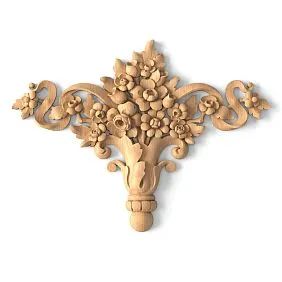
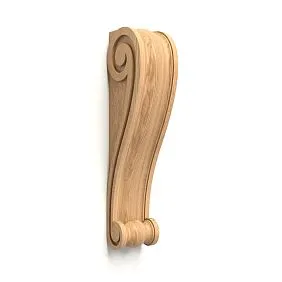
Carved motif in oak sounds deep and noble if kept in measure. Dense grain allows fine carving: ribs do not 'drift' under varnish, shadow is readable, and edge does not tear. Complete solutions — casings, corner elements, pediments, medallions — are selected in the house carving section. The correct logic is simple: one ornamental code for the entire scene, point accents instead of 'noisy' carpet decoration.
Three scenes of one house
Morning: living room on the northeast
Diffused light falls on panelled walls. Shadows on molding steps remind of a sharply honed tool: no spreading, no fuzziness. Skirting holds the horizon and does not argue with floor texture. On a white ceiling, the cornice opens a soft shadow that gathers the entire volume. In this room there are no 'dramatic' gestures — there is confident order.
Day: office where it's important to maintain concentration
Light becomes denser, shadows shorter. On satin varnish, oak does not glare in the eye; grain works as a calm texture, pleasant to bring the palm close. Narrow moldings form frames for shelves; wainscoting behind the work desk corrects acoustics. Here, there is no argument: objects and lines live in one tonality.
Evening: staircase and hand on the handrail
Oak is warm. At the staircase turn, the external angle is intact — the corner took luggage impacts and did not give in. The lower band of skirting dampens 'domestic encounters' and remains silent. On the cornice, soft light that does not destroy shadow and does not turn the plane into television gloss. Evening — the time when material passes the tactile test. Oak passes.
Tactile authenticity: why the palm trusts oak
An object is beautiful when it has tactile confirmation. Oak under the fingers — elastic, warm, not overly smooth in proper measure. Oil with hard wax gives dry gloss without 'glass', varnish — calm film without 'laminate' coldness. Any details, made of oakunite one thing — surface does not perform for the audience, it works for the user.
Geometry without compromises: how edges and joints are assembled
— The edge bonds rigidly with fasteners; the screw does not tear fibers.
— The end after clean sawing does not require "filling" of the sawdust.
— The joint with a micro-bevel survives under side lighting and does not reveal the assembly.
Hence — rare interventions in the future: local sanding, oil restoration, tonal touch-up.
Combinations: wood, stone, metal, fabric
Oak balances the cold of stone and the hardness of metal. A fireplace portal with oak inlays does not contradict the stone surface but gently outlines it. Bronze and brass against oak appear quieter and more luxurious. Dense fabrics next to oak moldings absorb echoes and return a "voice" to the room.
For architects: a short decision matrix
|
Task |
Element |
Material |
Reason for selection |
Finish |
Comment |
|
Wall base protection and horizontal organization |
Baseboard |
Oak |
Impact resistance, geometric stability |
Oil / semi-gloss lacquer |
Height according to proportion |
|
Plane discipline |
Molding |
Oak |
Clean shadow, fine bevel |
Lacquer / oil |
Panels, frames |
|
Volume finishing |
Crown molding |
Oak |
Stability over lengths |
Lacquer / oil |
Compatible with backlighting |
|
Rhythm and acoustics |
Rail |
Oak |
Clean geometry |
Oil |
Accent Wall |
|
Corner protection |
Corner |
Oak |
Pointed Strikes |
Oil |
Passage Zones |
|
Ornamental Accents |
Inlays, Medallions |
Oak |
Relief Depth |
Lacquer |
Controlled |
|
Lightening Upper Sections |
Rosettes, Complex Moldings |
Polyurethane |
Weight Reduction |
— |
Paired with Oak |
Simple Formulas for Different Space Types
Modern Apartment
Skirting Board 80–100 mm, Narrow Moldings in One Tier, One Wall with Recessed Rhythm, White Ceiling with Thin Cornice. Light Tones. No "Rich" Gestures; Only Accurate Geometry and Quality Material.
House with Measured Classicism
Skirting Board 120–140 mm, Wall Panels, Step Profiles, Cornice with Soft Shadow. Ornament — Pointed: Fireplace Arch, Mirror, Top of Doors. Warm Palette: Honey, Cognac, Tobacco.
Public spaces
Reinforced Skirting, Acoustic Rails, Cornice with Continuous Lighting. Semi-Gloss Lacquers with High Wear Resistance. Protected Exterior Corners. Here, Oak serves as a uniform tone for the room and withstands usage rhythm.
Installation as a Culture: No "Engineering Theater", But by Rules
— Base — Dry, Level, Primed; Details Matched Within the Room.
— Mounting — Adhesive + Hidden Mechanical Fastening with Even Spacing.
— Trimming — On Calibrated Tools, Edges — Clean.
— Joints — With Micro-Fillet and Light Touch-Up; Long Spans — With Hidden Compensation.
— Finish — Restoration of Finish in Intervention Areas and Control of Shadow on Side Lighting.
This is not bureaucracy, but a way to preserve the material’s dignity from day one.
Care Without Rituals
Dust — With Soft Cloth. Pointed Scratches — Light Sanding and Restoration of Oil/Lacquer. Dents — "Lift" with Steam Through Cloth, Then Level and Touch-Up. Oil Systems Periodically Refresh in Tactile Zones. No Mysticism.
Errors That Ruin the Appearance
— Gloss on Trim in Living Spaces — Fatiguing Glare.
— Absence of Micro-Fillet on Joints — Light Will Reveal the Fault.
— Ornament without measure — noise instead of meaning.
— Too low skirting board under a heavy portal — disrupted proportion.
Oak forgives much, but not bad taste.
Material narrative: what constitutes the feeling of quality
Quality arises from the quietness of lines. Base — straight and confident. Walls — disciplined and expressive. Top — calm, but not empty. Inside — accents that do not shout, but persuade. All this is possible when the interior's foundations made of oak: this material has a safety margin visible even to someone distant from craftsmanship.
Real arguments in favor of oak
— Geometric stability on long lines.
— Impact resistance in the skirting board area and on external corners.
— Repairability without dismantling and repainting the entire field.
— Wide range of finishes and tones without loss of pattern.
— Tactile authenticity that does not age over the seasons.
When oak — the only correct solution
— Private homes with intimate geometry and desire to live years without cosmetic 'patches'.
— Apartments with minimalist language, where the quietness of lines and warm surface matter.
— Public spaces with predictable usage and demand for 'indestructible' bases and corners.
Everywhere where the material must behave like an adult.
Short confirmation scenes
— Skirting board after a year in a child's room: a couple of superficial marks that vanished with light sanding and oil.
— External corner in a restaurant corridor: the oak corner absorbed cart impacts but did not 'fall apart'.
— Panel wall in the living room: under winter side sunlight, no joint revealed itself with glare.
Interior assembly in one language
The most beautiful in oak — wholeness. When base, walls, top, and accents speak the same language, the feeling of 'catalog-bought' disappears. What remains is the feeling of a home that matures, not ages. For this purpose, there are cohesive sections: solid wood base items, profiled moldings, cornices, skirting boards, applied wooden skirting boards, ornamental house carving, and for lighter upper tasks — polyurethane items and local polyurethane overlays. This is not a 'points' catalog, but one dictionary of forms.
Final formula
Interior persuades not by photographs, but by material behavior. Oak — a species that keeps its word: line remains a line, shadow remains a shadow, edge remains an edge. Things, made of oak, require no justification. They simply live and age gracefully, leaving behind order, warmth, and quiet. In this sense, oak is not a 'trend', but a tool of mature architecture, delivering results today and preserving them tomorrow.
About the company
STAVROS — a manufacturer that works with solid wood as a responsible material: precise profiles, clean milling, stable geometry, disciplined finishes, and curated collections for interior and facade. Within one line, solutions for base, walls, top, and ornamental layer are gathered — everything needed to build honest spaces based on oak, not imitations.