Article Contents:
- Visual room height: how the cornice changes proportions
- Light cornice matching the ceiling: visual blending
- Contrasting dark cornice: accent on horizontal line
- Cornice size and visual height: direct relationship
- Cornice profile: smoothness versus sharpness
- Joining to the ceiling: technology of perfect contact
- Reasons for gaps between cornice and ceiling
- Preparing the ceiling for cornice installation
- Technologies for compensating unevenness
- Mounting cornice considering the joint
- Hiding unevenness: cornice as a masking element
- Types of unevenness and ways to hide them
- Calculating cornice size for masking
- Preparing problem areas before installation
- Classic profile: anatomy of traditional cornice
- Main elements of classic profile
- Proportions of classic profile
- Stylistic variations of classic profile
- Manufacturing classic profile from solid wood
- Neat joints: craftsmanship in details
- Straight joints: longitudinal connection of elements
- Corner joints: connection at 45 degrees
- Profile joining: pattern alignment
- Final processing of joints
- Final finishing: from solid wood to finished product
- Transparent finishes: oil, wax, varnish
- Covering finishes: paint and enamel
- Staining and patination
- Finish according to interior style
- Installing ceiling cornice: step-by-step technology
- Preparation stage
- Marking and Calculation
- Cutting and Fitting of Elements
- Crown Installation
- Final Finishing After Installation
- Frequently Asked Questions About Ceiling Crowns
- How to Choose the Height of a Crown for a Standard Apartment with 2.7-Meter Ceilings?
- Light or Dark Crown — Which is Better for Visually Increasing Room Height?
- Can Large Wall Irregularities (Up to 15-20 mm) Be Hidden Behind a Crown?
- What Adhesive to Use for Attaching the Crown to the Ceiling?
- How to Achieve a Perfect Corner Joint Without Gaps?
- After How Long Can Gaps Be Filled with Sealant After Installation?
- What Finish is Best for a Crown in the Kitchen?
- Is a Lintel Needed Under the Crown in a Drywall Ceiling?
- How Often Should the Finish of a Wooden Crown Be Renewed?
- Can a Ceiling Crown Be Used with a Suspended Ceiling?
- Conclusion: An Architectural Detail That Creates Space
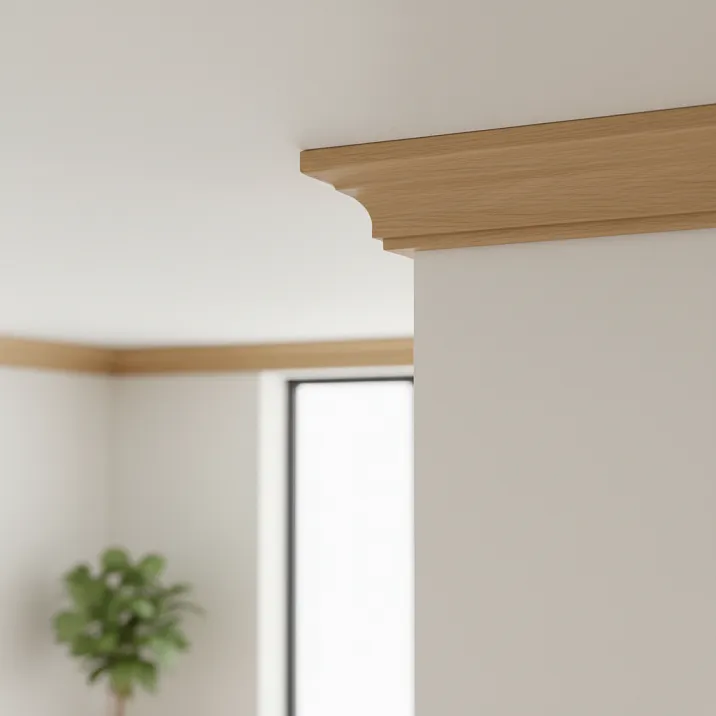
Ceiling corniceMade from solid wood — this is not just a decorative strip at the junction of wall and ceiling, but an architectural tool capable of radically altering the perception of space. A properly chosen crown visually raises the ceiling, making the room feel lighter and more spacious, or, conversely, creates a cozy, intimate atmosphere. The junction with the ceiling — a critical zone — is where any irregularities, gaps, or level differences become noticeable. A quality crown masks these defects, creating a perfectly level horizontal line. Neat joints between elements without gaps or unevenness — a sign of craftsmanship that distinguishes professional installation from amateur work. A classic profile and final finish complete the composition, transforming a technical solution into a stylistic element.


Visual Height of the Room: How a Crown Changes Proportions
The human eye perceives space as a whole, but focuses on contrasts, boundaries, and transitions. When the wall and ceiling are painted the same color and there is no clear boundary between them, the space is perceived as a single volume. Introducing a crown creates a clear dividing line, and depending on the characteristics of this crown, the perception of height changes.
The human eye perceives space as a whole, but focuses on contrasts, boundaries, and transitions. When the wall and ceiling are painted the same color and there is no clear boundary between them, the space is perceived as a single volume. Introducing a crown creates a clear dividing line, and depending on the characteristics of this crown, the perception of height changes.




Light Crown in Ceiling Tone: Visual Blending
WhenBuy wooden crownIn white or painted to match the ceiling, it visually blends with the ceiling plane. The wall appears to end lower than it actually does, while the ceiling seems to start higher. This technique visually raises the ceiling, adding height to the room.
The effect is enhanced if the walls are painted a darker color than the ceiling and crown. The contrast between the dark wall and light crown creates a clear horizontal line, perceived as the upper boundary of the wall. Everything above this line — the crown and ceiling — is read as a single light zone, visually increasing the height.
To enhance the effect, hidden lighting is used. An LED strip placed on the upper surface of the crown and directed toward the ceiling creates a soft glow that visually separates the ceiling from the walls, making it appear to float. The lighting blurs the boundary, and the ceiling appears higher than it actually is.
This technique is especially effective in rooms with low ceilings — 2.5–2.7 meters — where every visual centimeter of height is valuable. A light crown in ceiling tone, enhanced with backlighting, can visually add 10–15 cm of height.
Our factory also produces:


Contrasting Dark Crown: Emphasis on the Horizontal
The opposite approach — a dark crown contrasting with light walls and ceiling. Such a crown creates a clear, noticeable horizontal line that visually lowers the ceiling, making it feel heavier and closer to the viewer.
A dark crown does not reduce the actual height, but changes the visual proportions. The room is perceived as more intimate, cozy, and protected. This effect is sought in very high rooms — from 3.5 meters and above — where excessive vertical space creates a sense of emptiness.
Classic interiors with high ceilings often use large wooden crowns in natural tones — oak, walnut, wenge — against light walls. The dark horizontal line structures the space, returns the human scale to giant volumes, and creates a sense of stability.
In rooms with standard ceiling heights of 2.7–3.0 meters, a contrasting dark crown is used with caution. It may visually lower the ceiling, making the room feel more cramped. However, in spacious rooms of large area — living rooms, halls — a dark crown creates a noble, respectable appearance.
Get Consultation
Crown size and visual height: direct relationship
The height of the crown profile directly affects the perception of space. A slender, elegant crown of 40-60 mm height almost does not affect the visual height of the ceiling. It creates a delicate frame, emphasizes the boundary, but does not dominate.
A massive crown of 100-150 mm becomes a significant architectural element that actively shapes perception. If such a crown is light and matches the ceiling color, it visually expands the ceiling area, adding mass. If dark, it creates a powerful horizontal line that visually lowers the ceiling.
For visually increasing room height, an optimal solution is a slender, light-colored crown with a small overhang. It creates a clear but non-intrusive boundary, without overloading the space. For high rooms where volume structuring is needed — a massive crown with a large overhang, possibly contrasting in color.
Crown profile: smoothness versus sharpness
The cross-sectional shape of the crown — its profile — also affects visual perception. A classic multi-level profile with protrusions, recesses, and rounded edges creates a smooth transition between wall and ceiling. The eye follows the steps of the profile, and the boundary blurs, becoming non-point-like but zonal.
Such a crown visually softens the angle between wall and ceiling, making it less sharp. This creates a sense of softness and smoothness in space. For visually increasing height, this is a neutral solution — the crown neither raises nor lowers the ceiling, but makes the transition comfortable for the eye.
A rectangular simple profile creates a clear, geometrically strict boundary. It is one line, one transition, without intermediate steps. Such a crown emphasizes the horizontal, making it graphic. Depending on color and size, the effect may vary: a light, slender rectangular crown highlights the line without affecting height; a dark massive one creates a powerful horizontal line that lowers the ceiling.
A concave profile — a molding or fillet — creates a smooth rounded transition between wall and ceiling. This is the softest transition, almost imperceptible. A molding visually opens the angle, making it wider and airier. For low rooms, a molding is the optimal choice: it does not consume visual height, creating a smooth transition.
For rooms with ceilings 2.5-2.7 meters, moldings or simple light-colored rectangular crowns of 40-60 mm height are recommended. For standard rooms 2.7-3.0 meters, classic multi-level profiles of 60-90 mm height are suitable. For high rooms over 3.5 meters — massive multi-level crowns of 100-150 mm height.
Measure wall lengths to the millimeter. Account for the fact that cornices meet at 45° angles in corners, so the actual length of the element is not equal to the wall length. For internal corners, reduce the length by an amount depending on the profile height.
Crown attachment to ceiling: technology of ideal contact
The crown-to-ceiling junction is critical from a visual quality standpoint. Any gaps, seams, or level discrepancies here are noticeable and ruin the finish impression. Achieving quality junction requires understanding the causes of gaps and knowledge of elimination technologies.
Ideal junction — when the top edge of the crown tightly adheres to the ceiling along its entire length, without visible gaps. In practice, achieving this is difficult due to surface irregularities, material deformations, and installation errors. However, technologies exist that minimize the visibility of defects.
Causes of gaps between crown and ceiling
Ceiling unevenness — the main cause of gaps. Even in new apartments, the ceiling level variation may be 5-10 mm over a 3-4 meter length. Older buildings have even greater unevenness — up to 20-30 mm. If the crown is straight and the ceiling is wavy, gaps form in the recessed areas.
Crown deformation also creates gaps. A wooden crown — a living material — reacts to humidity and temperature. Under changing conditions, wood may warp or twist, creating a gap with the ceiling. This is especially characteristic of long elements — 2.5-3 meters — made from unstable species such as pine.
Installation errors — incorrect mounting, insufficient number of fixing points, absence of clamping — result in the crown not tightly adhering to the ceiling. The crown may sag under its own weight or detach from the ceiling between mounting points.
Building settlement creates gaps in new homes. During the first 1-2 years after construction, building structures settle, walls and floors shift by several millimeters. A crown rigidly fixed to the wall may detach from the ceiling during such settlement.
Preparing the ceiling for crown installation
Before installing the crown, the ceiling in the junction zone must be leveled. Use a laser level or water level to determine the lowest point of the ceiling. From this point, measure downward the distance equal to the planned gap (usually 5-10 mm), and draw a horizontal line around the room perimeter.
Ceiling sections below this line are left as-is. Sections above are leveled. If the excess is small — up to 5 mm — it can be ignored, as the crown compensates for the gap with its thickness. If the excess is larger — the ceiling must be leveled with putty or plaster.
For stretch ceilings, leveling is not required — the fabric is stretched perfectly flat. However, another issue arises: the crown cannot be mounted directly to a stretch ceiling. It is mounted to the wall, and the top edge must either touch the ceiling or leave a small 3-5 mm gap, which is concealed by a decorative insert.
For gypsum board ceilings, it is important that there is a frame or built-in support in the crown junction zone. If the crown is heavy — a massive oak wooden crown — it must be mounted not to gypsum board, but to a load-bearing structure. For this, a wooden beam of 40×40 or 50×50 mm is installed in the crown mounting zone, attached to the base ceiling.
Technologies for compensating unevenness
Flexible sealant — the simplest way to hide small gaps between crown and ceiling. After crown installation, gaps are filled with white acrylic sealant or in the crown’s color. Sealant is applied with a gun, smoothed with a wet finger or trowel, forming a smooth transition.
The advantage of sealant — simplicity, speed, ability to cover gaps up to 5-7 mm. The disadvantage — sealant yellows, cracks, and peels off wood over time. Renewal may be required after 3-5 years.
Decorative insert — a flexible strip made of rubber, silicone, or thermoplastic polymer, inserted into the gap between crown and ceiling. The insert has a T- or L-shaped cross-section, one part entering the gap, the other covering it externally.
Decorative inserts are primarily used with stretch ceilings, where a 3-5 mm gap is left between crown and fabric. The insert covers this gap, creating a neat joint. The insert color is matched to the crown or ceiling.
Flexible crown — a special type of crown made from elastic material or composite construction, capable of bending to follow ceiling irregularities. Such crowns are rare and expensive, used in rooms with severe unevenness where other methods fail.
Adjustable mounting allows changing the position of the cornice relative to the wall and ceiling during installation. The cornice is mounted on special brackets with adjustment screws, which allow pressing the cornice against the ceiling at each mounting point, compensating for unevenness.
Mounting the cornice with regard to junctions
The number of mounting points affects the quality of the junction. The closer the mounting points are spaced, the better the cornice adheres to the ceiling and wall, and the fewer gaps there are. For solid wood cornices, the optimal mounting spacing is 40-60 cm. For lightweight cornices — 60-80 cm, for heavy ones — 30-40 cm.
The type of mounting is also important. Screws driven from below through the cornice into the wall press the cornice against the wall, but not against the ceiling. To press against the ceiling, use adhesive applied to the top edge of the cornice, or special brackets that press the cornice simultaneously against both the wall and the ceiling.
Combined mounting — adhesive plus screws — provides the best result. The adhesive creates a continuous contact with the ceiling, while the screws fix the cornice to the wall and press it against the ceiling during the adhesive setting time. After the adhesive has polymerized, the screws can be removed or left in place for additional security.
For heavy cornices over 100 mm in height and over 2.5 meters in length, additional mounting to the ceiling may be required. Use metal brackets mounted to the ceiling with anchors and to the cornice with screws. The brackets are hidden within the cornice body or on its upper surface, invisible from below.
Hiding irregularities: the cornice as a masking element
The junction between the wall and ceiling is a problematic area in any room. Here, defects concentrate: plaster unevenness, gaps, level differences, signs of building shrinkage, poorly fitted finishing materials.Wooden cornicesThey perform a masking function, hiding these defects beneath them.
The masking principle is simple: the cornice covers the problematic area with its body, and the defects become invisible. However, for effective masking, the cornice must be properly selected in size and shape, and installation must be carried out taking into account the nature of the defects.
Types of irregularities and ways to hide them
Wall waviness — smooth changes in level within 3-10 mm over a length of 2-3 meters. Such irregularities are typical for old buildings with plaster applied to guides. Waviness is hidden by a cornice of sufficient width — at least 60 mm in profile height. The cornice covers the wavy zone, creating a smooth horizontal line.
For effective masking, the cornice should fit tightly to the wall with its lower part, but does not need to replicate all curves. Small gaps between the cornice and wall in the middle of the profile are not noticeable — tight contact is important at the lower and upper points.
Steps and level differences — sharp height changes of 5-15 mm at junctions of different materials or plaster sections. Such defects are hidden by a cornice with a large overhang — 70-100 mm. The cornice projects over the defective zone, and the level difference appears in the shadow beneath the cornice, invisible from below.
Gaps between the wall and ceiling occur due to building shrinkage or poor finishing. Gaps up to 10 mm are hidden by the cornice, which covers them with its body. For wider gaps — up to 20 mm — additional filling with construction foam or putty is required before installing the cornice.
Ceiling irregularities in the junction zone with the wall are hidden by the cornice, whose upper edge touches the ceiling at the highest points. In recessed areas, gaps form, which are filled with sealant or left unfilled if they are small — up to 3-4 mm and located in the shadow beneath the cornice.
Calculating cornice size for masking
The height of the cornice profile should be greater than the width of the problematic zone. If wall defects are concentrated in a 50 mm wide strip from the ceiling, the cornice should have a height of at least 70-80 mm to cover this zone with a margin.
The overhang of the cornice determines how far from the wall plane it can hide defects. For protrusions and steps on the wall, the overhang should exceed the depth of the defect by 20-30%. If a protrusion has a depth of 10 mm, the optimal cornice overhang is 12-15 mm.
For rooms with severe wall and ceiling irregularities, heavy multi-level cornices of 90-120 mm height and 60-90 mm overhang are recommended. Such cornices create a wide masking zone, hiding almost any defects.
For rooms with smooth walls and ceilings, compact cornices of 50-70 mm height and 40-50 mm overhang are sufficient. They create a neat frame without overloading the space with excessive bulk.
Preparing problem areas before installation
Even if the cornice hides defects, large irregularities are better addressed in advance. This improves installation quality and construction longevity. Wall protrusions obstructing cornice installation are trimmed, chipped, or bypassed, creating local recesses in the cornice.
Gaps wider than 10 mm are filled with construction foam or putty. After drying, excess material is trimmed and the surface is leveled. This prevents cornice sagging at gap locations and ensures tight fitting.
Loose plaster or paint in the cornice installation zone is removed. The cornice must be mounted on a strong base, not on loose layers of old finish. If plaster is peeling, it is chipped down to a solid base, then primed.
Dust, dirt, and grease on surfaces reduce adhesive bond. Before installation, the installation zone is wiped with a damp cloth, allowed to dry, and primed with acrylic primer. This ensures reliable adhesion of the adhesive to the surface.
Classic profile: anatomy of a traditional cornice
The classic ceiling cornice profile is a multi-century tradition dating back to ancient architecture. It is based on the order system, where each element has a name, proportions, and function. Understanding the anatomy of the classic profile helps select a cornice matching the interior style.
A classic cornice consists of several horizontal elements arranged in steps from the wall to the ceiling. Each level creates a projection or recess, forming a complex play of light and shadow. The number of levels varies from three to five depending on style and scale.
Main elements of the classic profile
The crown molding (astragal) — a convex semicircular element at the top of the cornice, directly under the ceiling. The astragal creates a smooth transition from the vertical plane of the cornice to the horizontal plane of the ceiling. The diameter of the astragal is usually 10–20 mm, creating a delicate rounding.
The soffit (plank) — a horizontal flat surface projecting forward. The soffit creates the main overhang of the cornice, casts a shadow, and gives the profile a distinct appearance. The width of the soffit ranges from 30 to 80 mm, and the thickness is 15–25 mm. The soffit can be one or several, positioned at different levels.
The cavetto (cavetto) — a concave element, opposite to the astragal. If the astragal protrudes, the cavetto is recessed, creating a smooth transition between levels. The cavetto enhances the play of light and shadow and adds complexity to the profile. The radius of the cavetto is usually 15–40 mm.
The gusset (gusset-cavetto) — an S-shaped element combining convex and concave parts. The gusset creates a smooth wavy transition characteristic of Baroque and rococo profiles. The height of the gusset is 20–50 mm.
Grooves — vertical grooves creating a rhythmic pattern. Grooves are used in the most decorative classical cornices, adding a vertical component to the horizontal element. The width of the groove is 8–15 mm, and the depth is 3–7 mm.
Beads (pearls) — a row of small semicircular protrusions resembling a string of pearls. Beads are a decorative element adding detail. The diameter of each bead is 5–10 mm, and the spacing is 10–15 mm.
Proportions of the classical profile
In a classical profile, the ratio of height to overhang is usually 2:1 or 3:2. This means that a cornice 90 mm high has an overhang of 45–60 mm. Such proportions create a harmonious, balanced element that does not appear either too flat or excessively projecting.
The size of profile elements is proportional to the overall height of the cornice. For a 90 mm high cornice, the crown astragal has a diameter of 12–15 mm, the soffit is 40–50 mm wide, and the cavetto has a radius of 20–25 mm. For a 150 mm high cornice, the elements increase proportionally.
The number of levels determines the complexity of the profile. A three-level profile — the minimum for a classical cornice — includes the crown astragal, the main soffit, and the finishing cavetto. Four- or five-level profiles include additional intermediate elements, creating a richer profile.
The rhythm of elements — alternating convex and concave parts — creates dynamism in the profile. The classical principle: after a protruding element comes a recessed one, and vice versa. This alternation creates a wavy relief that beautifully plays with light.
Stylistic variations of the classical profile
The Doric profile — the most strict and minimalist. Minimal decoration, clear geometric forms, right angles or simple rounded corners. A Doric cornice consists of a soffit, supporting cavetos, and a finishing astragal. No beads, gussets, or grooves.
The Ionic profile adds softness. Instead of sharp angles — smooth transitions, instead of flat surfaces — curved ones. An Ionic cornice includes gussets, cavetos with a larger radius, sometimes beads. The proportions are more elegant, and the elements are thinner.
The Corinthian profile — the most decorative. Complex multi-level structure, abundance of small details, carving, ornamentation. A Corinthian cornice may include all types of elements simultaneously: astragals, soffits, cavetos, gussets, grooves, beads. The height of the profile is significant — 120–150 mm and more.
For residential interiors, simplified versions of classical profiles — neoclassical — are more commonly used. They retain the basic proportions and structure but simplify details, reduce height, and make the profile more restrained. A neoclassical cornice 70–90 mm high may have three levels instead of five, simple rounded corners instead of gussets.
Manufacturing a classical profile from solid wood
A complex multi-level profile requires precise milling. CNC milling machines are used, which cut the profile according to a digital model with an accuracy of 0.1 mm. This ensures identical elements along the entire length and at joints.
Manual milling is possible for simple profiles using a hand-held router and profile bits. The craftsman guides the router along the blank, forming the profile. However, manual processing accuracy is lower, and deviations may occur, complicating jointing.
For carved elements — grooves, beads, ornaments — carving is done manually or on copying milling machines. Carving adds uniqueness but increases cost by 2–3 times. Carved cornices are an attribute of elite interiors.
Joining from multiple elements is used for particularly complex or heavy profiles. The base is made from a simple block, then profiled parts are glued on, forming a multi-level structure. This technology reduces the consumption of expensive wood but requires precise fitting of elements.
Accurate joints: craftsmanship in details
The quality of cornice joints — the main indicator of professional installation. An ideal joint is invisible: no gaps, height discrepancies, or misalignment of the profile pattern. Achieving such a result requires precise cutting, proper fitting, and proper finishing.
Joints come in two types: straight (ends at 90°) for long walls where one cornice does not cover the entire length, and angled (ends at 45°) at room corners. Each type has its own installation technique.
Straight joints: longitudinal connection of elements
The standard length of wooden cornices is 2.4–2.6 meters. For longer walls, joints of several elements are required. The joint location is chosen to be least noticeable — on a minimally lit area, in a shadowed zone, behind furniture or decor.
Ends for straight joints are cut perpendicular to the end-cutting saw with a fine-toothed disc (80–100 teeth). The cut must be perfectly flat, without chips, perpendicular to the side faces. Check with a square — any deviation over 0.5° will create a gap.
Before joining, ends are sanded with 180–220 grit sandpaper, removing burrs and smoothing minor irregularities. Ends must be smooth, without wood fibers that interfere with tight fitting.
Joints are glued with carpenter’s PVA or polyurethane glue. Glue is applied in a thin, even layer to one end, elements are aligned, and pressed tightly together. Any excess glue protruding outward is immediately wiped off with a damp cloth.
To secure the joint during glue setting, use painter’s tape or clamps. Tape is applied across the joint, pulling the elements together. Clamps are placed every 20–30 cm, with soft pads between clamp jaws and the cornice to avoid damaging the wood.
After the glue dries (24 hours for PVA, 6-12 hours for polyurethane), the joint is inspected. If there is a small gap — up to 0.5 mm — it is filled with wood-grade acrylic putty matched to the cornice color. The putty is pressed into the gap with a putty knife, then sanded smooth with fine-grit sandpaper after drying.
For additional strength, the joint is reinforced from the back with a wooden strip or metal plate using glue and self-tapping screws. The reinforcement is hidden and does not affect the appearance, but significantly increases the joint’s strength.
Corner joints: connection at 45 degrees
Room corners — the most complex areas for cornice joints. Here, two elements meet at a 90° angle, and their ends must be beveled at 45° for a tight fit. However, in practice, room corners are rarely perfectly straight, which complicates the task.
The angle is measured using a protractor or laser level. If the angle differs from 90° — for example, 88° or 92° — the bevel angles are adjusted: for 88°, bevel at 44°; for 92°, bevel at 46°. Accuracy is critical: a 1° deviation will create a gap of several millimeters.
The bevel direction depends on whether it is an internal or external corner. For internal corners (standard room corners), the front side of the cornice is wider, and the back side is narrower — the cut goes from the front to the back. For external corners (projections, columns), it is reversed — the cut goes from the back to the front.
Beveling is done with a table saw set to the required angle — 45° or the corrected value. The cornice is placed on the table with the front side up, pressed against the fence, and cut. It is crucial that the cornice does not shift during cutting — any displacement will ruin the cut’s accuracy.
For complex multi-level profiles, the orientation of the cornice during beveling is critical. The cornice must lie on the saw table in the same position it will be installed on the wall. If flipped, the bevel angle will be mirrored, and the joint will not align.
After beveling, the elements are fitted together dry, without glue. The joint must be tight, with no gaps, and the profile pattern must match. If there is a gap, determine its cause: inaccurate room angle, beveling error, or element deformation. Correct by re-beveling or sanding the ends.
Gluing corner joints is similar to straight joints: glue on ends, align, clamp, and let dry. However, due to the angle, clamping is more difficult — use corner clamps or wedge systems that spread the elements into the corner. Tape is less effective here.
Corner joint reinforcement is especially important. From the back, attach and screw on a triangular wooden strip that fills the corner and connects the elements. Alternatively, use a metal angle bracket attached to both elements with self-tapping screws.
Profile jointing: pattern alignment
For multi-level classic profiles, pattern alignment at the joint is critical. Each protrusion and each recess of one element must precisely continue onto the other. A mismatch of 1-2 mm is noticeable and breaks the illusion of continuity.
The problem arises if elements are milled from different blanks or on different machines with setting deviations. Factory-made cornices from the same manufacturer are usually identical, but when purchased from different batches, minor deviations may occur.
Before installation, compare the profiles of the elements by fitting them together. If the pattern matches perfectly — all is well. If there is a mismatch — choose the best jointing option where the mismatch is minimal and located in the least noticeable part of the profile.
For mismatched profiles, use local finishing: sand protruding parts and fill recesses with putty. This is labor-intensive but allows achieving visual alignment. After finishing, paint or tint the joint to match the color.
Final processing of joints
Even a perfectly executed joint often requires final finishing. Micro-gaps are filled with wood-grade acrylic putty. The putty is selected to match the cornice color exactly — many manufacturers offer putties in different colors, mimicking wood species.
Apply putty with a rubber putty knife, pressing it into the gap. Remove excess by running the knife along the joint. After drying (usually 2-4 hours), sand with 220-320 grit sandpaper to smooth the surface.
If the cornice is painted, the joint is touched up with the same paint. Apply with a brush in one or two thin coats, blending the edges. For cornices with natural finishes, use a touch-up marker or matching furniture wax.
Sealing the joint protects against moisture and dust intrusion. Apply a thin bead of transparent or white acrylic sealant along the joint line, smoothing it with a wet finger. The sealant fills micro-pores and creates a smooth surface.
Final finishing: from raw wood to finished product
Solid wood cornices require final finishing, which protects the wood from moisture, dirt, mechanical damage, and simultaneously highlights its beauty. The type of finish depends on the wood species, interior style, and usage conditions.
Final finishes can be transparent, preserving the natural color and texture of the wood, or opaque, completely covering the wood under a paint layer. Transparent finishes are valued in interiors where material naturalness is important. Opaque finishes allow the cornice to blend into any color scheme.
Transparent finishes: oil, wax, varnish
Wood oil is a natural product based on linseed, tung, or other vegetable oils. Oil penetrates into the wood, filling pores, highlighting the texture, and creating a matte silk-like surface. Oil does not form a film on the surface, leaving the wood tactilely natural.
Advantages of oil: natural appearance, pleasant tactile surface, ease of application and renewal. Disadvantages: low protection against moisture and dirt, requires regular renewal (every 2-3 years).
Apply oil with cloth or brush in 2-3 thin coats with intermediate drying of 6-12 hours. After each coat, allow the oil to penetrate for 15-20 minutes, then wipe off excess with dry cloth. Polish the final coat with soft cloth to a light sheen.
Wood wax creates a thin protective film with matte or semi-matte gloss. Wax offers better protection than oil, repels water, and simplifies maintenance. Wax finish feels warm to the touch and is pleasant tactilely.
Apply wax with cloth or putty knife in a thin layer, let dry (2-4 hours), then polish with soft cloth or polishing machine. Repeat the process 2-3 times for even coverage. Wax finish should be renewed every 3-5 years.
Wood varnish is a synthetic coating that forms a durable protective film. Varnish can be water-based (acrylic) or solvent-based (alkyd, polyurethane, nitrocellulose). Varnish protects wood from moisture, mechanical damage, and ultraviolet light.
Advantages of varnish: high protection, durability (5-10 years without renewal), variety of effects (from matte to glossy). Disadvantages: the film on the surface reduces tactile naturalness, repair complexity (when damaged, the entire coating must be removed and reapplied).
Varnish is applied with a brush or spray gun in 3-5 thin layers with intermediate drying and sanding. The first layer is a primer, which penetrates deeply, filling pores. Subsequent layers are protective, forming a film. The final layer determines the gloss level: matte varnish creates a velvety surface, glossy varnish creates a mirror finish.
Forwith a classic profile creates a sense of solidity, reliability.Use the same types of coatings as for cornices, creating a unified finish.
Covering coatings: paint and enamel
Paint completely hides the wood texture, creating a smooth, even color surface. For wooden cornices, use acrylic water-based paints, alkyd enamels, or polyurethane enamels. The choice depends on usage conditions and desired effect.
Acrylic paint on water-based is eco-friendly, odorless, dries quickly (2-4 hours between layers). It creates a matte or satin surface, suitable for most interiors. Disadvantage — lower durability compared to enamels.
Alkyd enamel creates a strong glossy or semi-glossy surface. It is more durable than acrylic paint and better protects wood from moisture. Disadvantages — strong odor during application, long drying time (12-24 hours between layers), yellows over time.
Polyurethane enamel — premium option. Maximum strength, resistance to abrasion, water, and chemicals. Does not yellow, retains color for decades. Disadvantage — high cost, complex application (requires spray gun).
Preparation of wood for painting is critical. Surface is sanded with 180-220 grit sandpaper, removing all irregularities, burrs, and contaminants. Then, it is primed with acrylic primer in 1-2 layers. Primer equalizes absorption and improves paint adhesion.
Paint is applied with a brush or spray gun in 2-3 thin layers. The first layer is often uneven — wood grain shows through, brush strokes are visible. The second layer evens out the color, the third creates a uniform surface. Between layers — intermediate drying and light sanding with 320-400 grit sandpaper.
Final layer — protective varnish (for acrylic paints) or finish enamel (for alkyd systems). It creates the final surface with the desired gloss level and protects the paint from abrasion.
Staining and Patination
Staining with dye changes the wood color while preserving visible texture. Dye (beyts) is a pigment that penetrates wood pores, coloring from within. Dyes come in water-based, alcohol-based, and oil-based, each giving a different effect.
Water-based dye penetrates deeply into wood, creating an even color. It raises wood fibers, so sanding is required after drying. Alcohol-based dye dries quickly (15-30 minutes), does not raise fibers, but may color unevenly. Oil-based dye gives the most even color, dries slowly (6-12 hours).
Dye is applied with a brush, cloth, or rag along the wood grain. The first layer absorbs quickly, color is not saturated. For a darker tone, apply 2-3 layers with intermediate drying. After staining, the cornice is coated with varnish for protection.
Patina creates an aged effect, emphasizing the profile’s relief. On the cornice, apply a base color (usually light), then patina compound (dark) into the profile’s recesses. Patina is applied with a brush, excess is wiped off with a rag, leaving dark color only in recesses.
Result — effect of long-term use, with dirt and natural patina accumulating in recesses. This is characteristic of Provence, shabby chic, vintage interiors. Patina can be gold, silver, bronze, creating a luxurious look.
Coating according to interior style
Classic interiors often use cornices painted white or with natural wood color under varnish. White cornice — universal solution, suitable for any wall color. Natural oak, ash under varnish — for interiors where material nobility is valued.
Modern interiors prefer matte finishes — oil, wax, matte varnish, matte paint. Gloss is associated with classic style, matte with modern. Colors are neutral: white, black, gray, light natural wood tones.
Provence and country styles require natural finishes with visible wood texture. Oil or wax emphasize naturalness. Light toning is acceptable — whitewashed oak, gray, beige. Patina creates an aged effect.
Loft and industrial styles can use rough cornices with minimal finish — brushed wood, oiled. Visible texture, knots, cracks — not defects, but style elements. Colors are dark, natural, or toned to wenge, black.
Installation of ceiling cornice: step-by-step technology
Quality installation — guarantee of durability and aesthetics of the cornice. The process includes several stages: preparation, marking, cutting, installation, finishing. Each stage is critical; an error at any stage reduces final quality.
Preparation Stage
Acclimatization of cornice — leave in room for 2-3 days before installation. Wood absorbs or releases moisture, reaching equilibrium with room climate. If installing immediately after delivery from a cold warehouse, it may deform after installation.
Check completeness and quality — inspect each element for defects: cracks, chips, warping, profile mismatch. Defective elements are returned or used on short sections where defects can be concealed.
Tool preparation: circular saw with 60-80 tooth blade, drill or screwdriver, level (laser or water), tape measure, pencil, putty knife, sandpaper, glue, self-tapping screws, wall plugs. All tools must be in good condition and properly adjusted.
Room preparation: move furniture, cover floor with plastic sheet or cardboard to protect from sawdust and debris. Ensure good lighting — cornice is installed under ceiling, where natural light may be insufficient.
Marking and calculation
Determine cornice installation height. Usually, its bottom edge is located 10-30 mm below the ceiling. Measure this distance from the ceiling downward, mark the point, then use a level to draw a horizontal line around the room’s perimeter.
Check line levelness. Laser level automatically projects a horizontal line. Water level requires two people: one holds one end at the starting point, the other moves the second end, aligning the water level with the starting point.
Calculate the number of elements. Standard length is 2.4–2.6 m. For a 4-meter wall, you need two elements with a straight joint in the middle. Choose joint locations to be symmetrical (on long walls) or hidden (behind furniture, in dark zones).
Cutting and fitting elements
Cutting corners at 45° for corner joints. Set the saw blade at 45°, place the cornice on the table with the front side up (or in working position for complex profiles), clamp it to the fence, and cut. Check the cut piece with a square — the angle must be exactly 45°.
Cutting straight ends at 90° for straight joints and end finishes. The technology is similar, but the saw is set at 90°. Check the perpendicularity of the cut with a square.
Dry fitting elements without glue. Attach them to the wall, check for alignment of lengths, joints, and fit against the ceiling and walls. If there are misalignments, adjust by recutting or sanding the ends.
Numbering elements. After successful dry fitting, number the elements on the reverse side, indicating their position (wall, sequential number). This prevents confusion during installation.
Item numbering. After successful try-on, items are numbered on the reverse side, indicating their position (wall, sequential number). This prevents confusion during installation.
Installing the cornice
Start installation from one corner. Mount the first element, aligning its bottom edge with the marking line. Clamp it to the wall and ceiling, and check for levelness with a level.
Marking screw points on the wall through the cornice. Drill holes 6–8 mm in diameter (depending on the anchor diameter) at 40–60 cm intervals. Holes must be in thick parts of the profile where the screw won’t split a thin element.
Installing anchors into holes. For concrete and brick walls, use plastic spread anchors 6×40 or 8×50 mm. For drywall walls, use special drywall anchors (butterflies, mollies).
Applying adhesive to the back of the cornice. Apply adhesive in a 10–15 mm wide strip along the entire length. Use carpentry PVA, polyurethane adhesive, or liquid nails. Adhesive strengthens the bond, fills micro-irregularities, and prevents squeaking.
Screwing the cornice to the wall through anchors. Screw the screws in partially, leaving 1–2 turns before final tightening. Check the cornice’s position with a level, adjust if necessary, then fully tighten the screws.
Checking fit against the ceiling. If gaps appear, fill them with sealant in the next step. Large gaps (over 5 mm) indicate an uneven ceiling or improper installation — reinstall the cornice.
Installing subsequent elements. Join the second element to the first, aligning the ends and pressing the joint until snug. The mounting technique is similar. Repeat until the entire room is framed.
Finishing After Installation
Filling gaps between cornice and ceiling with sealant. Apply white acrylic or matching-colored sealant from a caulking gun in a thin bead. Smooth with a wet finger or rubber spatula to form a seamless transition. Wipe excess with a damp cloth.
Covering screw heads. Insert wooden plugs into holes, sand flush. Or apply acrylic putty over wood, sand after drying. For painted cornices, match plugs and putty to the color.
Sanding joints. If there are minor height discrepancies at joints, sand them with fine-grit sandpaper (220–320 grit). Sand carefully to avoid damaging the finish around the joint.
Touch-up or toning. If scratches, chips, or scuffs appear during installation, touch them up. For painted cornices, use the same paint; for natural finishes, use touch-up marker or furniture wax.
Final cleaning. Remove leftover adhesive, sealant, putty, and dust. Wipe the cornice with a slightly damp soft cloth. For lacquered or painted surfaces, use furniture polish to add shine and protect the surface.
Frequently Asked Questions about ceiling cornices
How to choose the height of a cornice for a standard apartment with 2.7-meter ceilings?
For 2.7-meter ceilings, cornices 60–80 mm high are optimal. This creates noticeable architectural framing without overwhelming the space. A too-high cornice (over 100 mm) visually lowers the ceiling, making the room feel smaller. A too-low cornice (under 50 mm) will be lost and fail to create the desired effect.
Is a light or dark cornice better for visually increasing room height?
A light cornice matching the ceiling visually increases room height. It blends with the ceiling plane, creating the impression that the ceiling begins higher. A dark cornice contrasting with a light ceiling creates a clear horizontal line that visually lowers the ceiling. For low rooms, choose a light cornice.
Can a cornice hide large wall irregularities up to 15–20 mm?
A cornice can hide irregularities if its height and overhang are sufficient. For irregularities up to 20 mm, you need a cornice at least 90–100 mm high with an overhang of 70–80 mm. The cornice will cover the defective area, but large irregularities should be pre-levelled with plaster — this improves installation quality.
What adhesive to use for attaching the cornice to the ceiling?
For wooden cornices, optimal adhesives are polyurethane glue or liquid nails. Polyurethane glue (Kleiberit, Titebond) creates a strong, flexible bond, withstands vibrations, and is moisture-resistant. Liquid nails (Moment Montazh, Titan) are easy to apply and set in minutes. Carpentry PVA is suitable for dry rooms but not for humid ones.
How to achieve a perfect corner joint without gaps?
Accuracy of cutting angles is key to a quality joint. Use a miter saw with a sharp blade, cut precisely at 45° (or adjusted angle if the room angle is not straight). Check the room angle with a protractor. Dry-fit the elements, adjust if necessary. Apply adhesive to the ends, press tightly into the corner. Fill small gaps with putty.
After how long after installation can gaps be filled with sealant?
If the cornice was mounted with adhesive, wait for full polymerization — 24 hours for PVA and liquid nails, 12 hours for polyurethane adhesive. If mounted mechanically (with screws), sealant can be applied immediately after installation. The sealant will fill gaps and create a neat transition.
What finish is best for a kitchen cornice?
For kitchens, a moisture-resistant finish is required — lacquer (preferably polyurethane or yacht lacquer), alkyd enamel, acrylic paint with protective lacquer. Oil and wax are insufficient to protect against moisture and grease. A lacquered cornice is easy to wipe with a damp cloth, does not absorb odors, and does not darken from soot.
Is a mounting bracket needed for a cornice on a gypsum board ceiling?
For lightweight cornices (up to 70 mm high), a mounting bracket is not required — securing with gypsum board screws into the frame profiles is sufficient. For heavy cornices (over 90 mm high, made of oak), a mounting bracket is recommended — a wooden beam attached to the base ceiling. The mounting bracket distributes the load and prevents sagging.
How often should the finish on a wooden cornice be renewed?
Lacquered cornices last 5-10 years without renewal. Oil-based finishes require renewal every 2-3 years. Wax-based finishes every 3-5 years. Painted cornices with quality paint last 7-10 years. Signs of needing renewal: dullness, flaking, cracks in the finish. In dry rooms, the finish lasts longer; in humid rooms, it deteriorates faster.
Can a ceiling cornice be used with a stretch ceiling?
Yes, but the cornice is mounted to the wall beneath the stretch ceiling, not to the ceiling fabric. Leave a 3-5 mm gap between the top edge of the cornice and the fabric, which is covered with a decorative insert. Alternatively, install the cornice before mounting the stretch ceiling, and tuck the fabric into the gap between the cornice and the base ceiling — resulting in hidden lighting.
Conclusion: an architectural detail that creates space
Ceiling cornice made of solid wood— is an architectural tool that influences space, capable of altering the visual perception of room height, concealing construction defects, and creating stylistic coherence in the interior. Proper fitting to the ceiling ensures visual cleanliness, absence of gaps and seams that ruin the impression of finishing. Quality concealment of irregularities transforms the problematic junction between wall and ceiling into a neat architectural line. A classic profile introduces tradition, nobility of proportions, and connection to architectural history. Final finish protects the wood and highlights its beauty, creating a surface that serves for decades.