Article Contents:
- How Rosettes Form the Center of the Ceiling
- Compositional Role of the Ceiling Rosette
- Types of Ceiling Rosettes by Construction
- Ornamental Motifs and Their Significance
- Combining with Cornices and Moldings
- Principles of Harmonious Combination
- Classic Composition Schemes
- Practical Aspects of Combination
- Rules for Choosing the Diameter of a Ceiling Rosette
- Dependence on Room Area
- Relationship with Chandelier Size
- Influence of Ceiling Height
- Installation and Painting of Ceiling Rosettes
- Preparing the Ceiling for Installation
- Technology of Rosette Installation
- Preparation for Painting and Coloring
- Design Solutions for Different Styles
- Classic Interiors
- Modern styles
- Hi Wood and STAVROS Products
- Conclusion

The ceiling is the canvas on which the symphony of architectural decoration unfolds.ceiling rosettesAnd cornices play the role of soloists in this composition, transforming an ordinary living space into a thoughtfully designed architectural environment. What was once a privilege of palaces and aristocratic mansions is now accessible thanks to modern polystyrene production technologies — a material that combines the aesthetics of classical moldings with the practicality and affordability of mass-produced products.
The ceiling rosette is not merely a decorative trim for a chandelier. It is a compositional center around which the entire visual structure of the room is arranged. Combined with cornices along the perimeter and moldings on the walls, the rosette forms a cohesive architectural system that defines the interior style, corrects spatial proportions, and creates that very atmosphere of completion which distinguishes professionally designed interiors from amateur ones.
But how to choose the rosette diameter correctly so that it does not disappear on a large ceiling and does not overwhelm a small room? How to harmoniously combine the rosette withceiling cornice polystyreneand wall moldings? What installation secrets ensure a flawless result? How to properly prepare and paint the elements? Which design solutions suit classic and modern interiors? Answers to these questions are in our detailed guide.


How Rosettes Form the Center of the Ceiling




Compositional Role of the Ceiling Rosette
The ceiling rosette performs the function of a visual center, attracting the gaze and organizing the perception of the entire room space. This role is determined by several factors.
Accentuating the central point is a basic principle of composition. In most rooms, the chandelier is located at the geometric center of the ceiling, providing even lighting. The rosette framing the chandelier enhances the significance of this point, transforming a utilitarian fixture into a compositional center. The gaze of someone entering the room naturally rises to the ceiling and focuses on the decorated rosette, from which visual lines radiate outward to the perimeter defined by cornices.
Creating a visual hierarchy is achieved through the size and decorative quality of the rosette. A large, luxurious rosette dominates, subordinating other decorative elements — cornices, moldings, baseboards become secondary, framing. A modest, minimalist rosette plays a supporting role, not competing with other decorative elements. Proper hierarchy creates visual harmony; improper hierarchy creates chaos and imbalance.
The masking of technical elements is a practical function often underestimated. The point where electrical wiring exits to the ceiling rarely looks aesthetically pleasing — grooves, holes, installation marks. A decorative rose cover elegantly conceals all these imperfections, creating an illusion of a perfectly smooth surface. The pendant light’s mounting bracket, fasteners, and wires — all are hidden behind the decorative ornament of the rose cover.
The expressiveness of a chandelier is enhanced by visual contrast. A luxurious crystal chandelier against a plain white ceiling appears isolated, as if floating in emptiness. The same chandelier, framed by a rose cover with a matching ornament, acquires architectural context and becomes part of a thoughtfully designed composition. The size, shape, and decoration of the rose cover must correspond to the character of the light fixture.
Correction of visual proportions of a room — a design technique based on perceptual properties. A large, expressive rose cover on the ceiling visually reduces its height, making an excessively high room feel cozier. A small rose cover or its absence emphasizes ceiling height. In low rooms, it is better to use small flat rose covers or even omit them in favor of a minimalist solution.
Our factory also produces:


Types of ceiling rose covers by construction
Modern ceiling rose covers made of polystyrene differ not only in size and ornamentation, but also in structural design.
Flat surface-mounted rose covers — the most common type. They are discs 10–25 mm thick with decorative relief on the front side and a smooth back for gluing. The relief protrudes 5–15 mm above the main plane, creating a three-dimensional decorative effect. Installed directly onto the ceiling, forming a protruding element. Installation is simple — glue is applied to the back, and the rose cover is pressed onto the ceiling. Suitable for any interiors.
Three-dimensional multi-tiered rose covers have a complex stepped construction with several levels of relief. Thickness can reach 40–60 mm, with relief protruding 20–40 mm. They create a pronounced three-dimensional effect, casting deep shadows. Particularly effective in rooms with high ceilings, where the depth of relief is clearly visible from below. Require stronger glue due to their significant weight.
Rose covers with a central hole are specially designed for chandeliers on long rods. The hole diameter is usually 50–150 mm, allowing the rod to pass through. The rose cover is slipped over the rod and glued to the ceiling, concealing the mounting bracket. Very convenient, eliminating the need for precise hole fitting.
Multi-segment rose covers — a solution for very large diameters of 100–150 cm and more. A single item of such size is difficult to transport and install. A segmented rose cover consists of 2–8 parts that fit together on the ceiling, forming a single composition. Joints become invisible after spackling and painting.
Cupolas and coffered ceilings — volumetric elements that protrude not above the ceiling plane, but create recesses. Visually complex, they create an impression of multidimensionality of the ceiling space. Installation requires professional skills. Used in luxury interiors and rooms with very high ceilings.
Get Consultation
Ornamental motifs and their meaning
The decorative relief of a rose cover carries not only aesthetic, but also semantic load, referring to certain historical styles and cultural traditions.
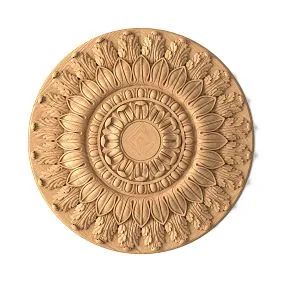
Plant motifs — the most common motif, originating from classical architecture. Acanthus leaves, laurel and oak wreaths, grapevines, floral rosettes, intertwined stems — all of these refer to antiquity, baroque, and empire. Plant decoration symbolizes abundance, prosperity, natural beauty. Suitable for classical interiors, creating a sense of historical continuity.
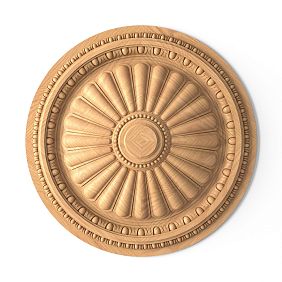
Geometric patterns — circles, ovals, meanders, serrated lines, concentric circles — are characteristic of neoclassicism and art deco. Geometry creates a strict rhythm, emphasizes symmetry, appeals to rationality and order. Such rose covers fit well into modern interiors, where classical forms are adapted to current aesthetics.
Architectural elements — imitation of coffered ceilings, beam structures, domed vaults — create an illusion of complex architectural structure on a plain ceiling. Such rose covers visually transform space, adding depth and multidimensionality. Require high ceilings for proper perception.
Minimalist smooth rose covers without ornament — a modern solution for minimalist and Scandinavian interiors. A simple disc with barely noticeable concentric circles or completely smooth. The task — to mark the center of the ceiling, frame the chandelier, without creating decorative noise. Diameter is usually small — 300–500 mm.
Author-designed artistic compositions — unique rose covers with individual design, created for a specific project. May include coats of arms, monograms, complex narrative compositions, modern abstract forms. Produced to order, significantly more expensive than standard models.
Combination with cornices and moldings
Principles of harmonious combination
Creating a unified decorative system from rose covers, cornices, and moldings requires understanding of compositional principles and stylistic unity.
Unity of ornamental language — the first and main rule. All decorative elements must speak the same language of forms and motifs. If the rose cover has a plant ornament with acanthus leaves,Polystyrene decorative crownit should contain similar motifs. Mixing baroque scrolls with geometric modernist forms creates a stylistic dissonance, destroying the integrity of the interior.
Proportionality of elements creates visual balance. A large luxurious rose cover with a diameter of 800–1000 mm requires corresponding scale cornices — wide, 120–200 mm, with pronounced relief. An elegant small rose cover 300–400 mm harmonizes with delicate cornices 60–100 mm. A crude violation of proportions — a massive rose cover with a thin, unexpressive cornice — creates a sense of incompleteness.
Repetition of rhythmic elements strengthens compositional connection. If beads of a certain size are used in the rose cover’s ornament, their repetition in the cornice’s decoration creates a visual rhyme. Concentric circles of the rose cover may correspond to horizontal grooves on the cornice. These subtle correspondences are subconsciously perceived, creating a sense of harmony.
Hierarchy of decorative elements determines dominance. Usually, the rose cover — the most decorative element of ceiling decoration, rich in ornamentation. Cornices — secondary level, with more restrained decoration.Polystyrene moldingon walls — third level, even more minimalist. This hierarchy creates a visual pyramid, where each element knows its place.
Color scheme can be unified or contrasting. Classic option — all elements are white, creating a monolithic architectural system. Alternative — rose cover white or gilded, cornices in ceiling color, moldings in wall color. Such layered coloring creates a more complex, multi-level composition.
Classic composition schemes
Time-tested compositional schemes guarantee a harmonious result.
Central rose cover with cornice around the perimeter — basic classic scheme. The rose cover in the center of the ceiling frames the chandelier,The ceiling molding creates a frame around the perimeter. Between them is a smooth ceiling surface. This scheme suits rooms of any size and is universally stylish. It is important to correctly choose the proportions — the rosette should not be too large relative to the room's perimeter.A rosette with corner elements and a cornice creates a more complex composition. In addition to the central rosette, decorative corner elements — quarter-rosettes, corner ornaments — are placed at the corners of the ceiling. The cornice ties all elements into a single system. This scheme is typical for classical interiors and requires sufficient ceiling area — at least 25-30 sq. m.
Several rosettes on one ceiling — a solution for very large rooms with an area of 40 sq. m or more. In long living rooms, halls, two or three rosettes can be installed along the room's axis. It is important to maintain symmetry and rhythmic placement. Rosettes should be identical or from the same collection.
A rosette combined with a coffered ceiling — an elegant solution for rooms with high ceilings. The ceiling is divided into rectangular or square coffered sections by moldings. A rosette with a chandelier is placed in the central coffer. Other coffers may be empty or filled with smaller rosettes. This creates a complex multi-level structure typical of palace interiors.
Asymmetric composition — a modern solution for non-standard rooms. The rosette is offset from the geometric center, creating dynamism. The cornice may have different widths on different walls. Moldings form asymmetric panels. Requires a developed sense of composition; suitable for eclectic, designer interiors.
Practical aspects of combining elements
When selecting a set of elements, practical considerations are important.
Buying elements from one collection guarantees stylistic unity and matching white shade. Leading manufacturers produce collections where rosettes, cornices, moldings, and corner elements perfectly complement each other. The South Korean brand Hi Wood (Hai Wood) offers complete collections with thoughtfully coordinated decorative elements.
Calculating the required amount of materials is done in advance. Measure the room's perimeter for cornices, determine the number of moldings, select the rosette size. Order with a 10-15% reserve for cuts and possible installation errors. Buying the exact same material later may be difficult — collections are updated.
The sequence of installation matters. First, install the rosette — it serves as the starting point of the composition. Then, mount the cornices around the perimeter. After that, if planned, install wall moldings. Final finishing — sealing joints, priming, painting — is done after installing all elements simultaneously.
Using pre-made corner elements simplifies the installation of cornices and moldings. Instead of precise 45-degree cuts, pre-made corner pieces are used, guaranteeing perfect alignment. Particularly relevant for profiles with relief ornamentation.
Rules for selecting the diameter of a ceiling rosette
Dependence on room area
The rosette diameter should match the room size to create harmonious proportions.
For small rooms of 10-15 sq. m, rosettes with a diameter of 300-400 mm are optimal. In a small bedroom, office, or children's room, a large rosette would look inappropriate, visually overloading the ceiling. A compact rosette will mark the center, frame the light fixture, and not dominate the space. The relief depth should also be moderate — 10-15 mm.
For standard rooms of 15-20 sq. m, rosettes with a diameter of 400-550 mm are suitable. This is a universal size for typical city apartments — living rooms, bedrooms, kitchen-dining areas. Such a rosette is expressive enough to create a compositional accent, yet does not overwhelm the space. The relief can be of medium depth — 15-25 mm.
For spacious rooms of 20-30 sq. m, rosettes with a diameter of 550-700 mm are recommended. In a large living room, dining room, or hall, a small rosette will be lost against the vast ceiling surface. A large-scale rosette will create the necessary visual weight, balancing the room's proportions. Deep relief of 25-40 mm adds expressiveness.
For very large spaces of 30 sq. m or more, large rosettes with a diameter of 700-1000 mm or more are required. In grand living rooms, banquet halls, or vestibules, an elegant rosette becomes an architectural focal point. Deep multi-level relief of 40-60 mm creates an impressive three-dimensional effect, clearly visible even from a distance.
For rooms of non-standard shapes — elongated, L-shaped — oval rosettes oriented along the long axis can be used. An oval visually corrects proportions, making an elongated room appear more balanced.
Relationship with chandelier size
The rosette and chandelier should form a harmonious pair, proportionally matched to each other.
The classical rule states: the rosette diameter should equal or slightly exceed the chandelier diameter. If the chandelier has a 600 mm diameter, the optimal rosette is 600-700 mm. This creates visual balance — neither element dominates, they are perceived as a single composition.
For large, luxurious chandeliers with multiple arms and pendants, the rosette may be slightly smaller than the chandelier diameter. The chandelier is so expressive that it does not require additional emphasis. The rosette plays a supporting role, framing and completing the composition.
For compact modern pendant lights, the rosette may be significantly larger than the light fixture. A minimalist light fixture with a 200-300 mm diameter against a 500-600 mm rosette creates an interesting scale contrast. This technique works well in eclectic interiors where classical and modern elements are mixed.
For chandeliers on long rods, the visual weight of the entire structure matters more than the diameter of the shades. The chandelier may hang 80-100 cm from the ceiling, with a small shade diameter, yet still convey a sense of massiveness. In this case, focus on overall dimensions, not just the diameter.
When selecting, also consider the chandelier's style. A classical bronze chandelier with crystal requires a rosette with matching ornamentation — botanical decor, scrolls. A modern minimalist light fixture harmonizes with a simple smooth rosette or even without one.
Influence of ceiling height
Room height determines not only the diameter but also the depth of the rosette.
For low ceilings of 2.4-2.6 meters, choose flat rosettes with shallow relief. Moderate diameter — 300-500 mm. A voluminous protruding rosette visually lowers an already low ceiling, creating a sense of pressure. A flat rosette marks the center without sacrificing precious height.
For low ceilings 2.4-2.6 meters, choose flat outlets with shallow relief. Moderate diameter - 300-500 mm. A protruding volumetric outlet visually lowers an already low ceiling, creating a sense of pressure. A flat outlet marks the center without consuming precious height.
For standard ceilings 2.7-2.9 meters, any type of rose - from flat to moderately voluminous - is suitable. Diameter 400-700 mm depending on area. Relief of medium depth 15-30 mm is clearly visible from floor level, creating an expressive decoration.
For high ceilings 3.0-3.5 meters, voluminous multi-level roses with deep relief are recommended. Diameter 600-1000 mm. From great height, small details are poorly discernible; large scale and expressive volume are required. Deep relief 30-60 mm casts clear shadows and is clearly visible from below.
For very high ceilings from 3.6 meters, coffered structures, domes, multi-tiered compositions of several roses can be used. Such height allows creating complex volumetric solutions that would be impossible in low rooms.
Ceiling rose installation and painting
Preparing the ceiling for installation
Quality preparation of the base is critically important for reliable rose mounting.
Cleaning the ceiling surface begins with removing all dirt, whitewash, peeling paint. Whitewash is completely washed off with warm water mixed with vinegar - it does not provide adhesive bond, and the rose may detach. Use a sponge or cloth, regularly changing water. After washing, allow the ceiling to dry completely for 12-24 hours.
Levelness check is performed by applying a long straightedge. A large-diameter rose requires a flat surface for tight fitting. Bumps deeper than 3-5 mm are sanded or ground down. Depressions are filled with putty, then sanded after drying. For large roses with diameter 70-100 cm, even minor irregularities may cause gaps at the edges.
Deep-penetration acrylic primer is mandatory. Apply with a roller to a ceiling area 10-15 cm larger than the rose. Primer strengthens the base, reduces absorbency, and improves adhesive bond of the glue. Drying time 4-6 hours. On old porous ceilings, apply two coats with intermediate drying.
Center marking is performed for precise rose positioning. Find the geometric center of the ceiling by measuring diagonals. Mark the point with a pencil. From this point, draw a circle with a compass or string and pencil, equal to the rose's diameter. This will help control centering during gluing.
Acclimatization of the rose is necessary if it was stored in a cold room. Bring the item into the room 24 hours before installation. The material's temperature should match room temperature. This prevents thermal deformation after installation.
Rose mounting technology
Correct installation technique guarantees secure mounting and longevity.
Choosing adhesive is critical for heavy roses. For small roses up to 500 mm diameter, acrylic mounting glue or liquid nails are suitable. For large roses 60-100 cm in diameter, use professional MS-polymer adhesive - it ensures maximum bonding strength. Glue consumption for a 700 mm diameter rose is 300-500 ml.
Adhesive is applied to the back of the rose using a brush or grid. For small roses, a spiral from center to edge is sufficient. For large roses, apply adhesive with a grid spaced 10-15 cm apart, ensuring full perimeter coverage. Do not economize on adhesive - insufficient amount will cause heavy rose detachment.
Gluing to the ceiling requires precision and care. Lift the rose to the ceiling, aligning the center with the mark. Press evenly across the entire surface, distributing pressure. For large roses, a helper is required. Press for 60-120 seconds until initial adhesive setting. Immediately wipe off any excess adhesive with a damp sponge.
Temporary fixation ensures secure gluing of heavy roses. Support the rose from below with a ladder with soft padding or a special telescopic stand. Leave for 24-48 hours until adhesive fully dries. For especially large roses, additionally fix with temporary screws at several points around the perimeter (not in the center, where the chandelier will be). After adhesive dries, remove screws and fill holes with putty.
Installing a chandelier through the rose is performed after the adhesive has fully dried. If the rose has a central hole, thread the chandelier rod through and secure the mounting cup. If no hole exists, carefully drill a hole of the required diameter at the center of the rose. Use a wood drill bit, drill at low speed to avoid cracking polystyrene.
Preparation for painting and finishing
Finishing decoration transforms a white rose into a completed decorative element.
Sealing gaps around the perimeter is performed if gaps form between the rose and ceiling due to uneven base. Use acrylic putty or sealant. Carefully fill the gap and smooth with a wet finger. After drying, sand with fine P240 sandpaper.
Priming the entire surface of the outlet is mandatory before painting. Water-based acrylic primer is applied in a thin layer with a brush. Carefully treat all recesses of the relief. The primer creates a uniform surface with even absorption, ensuring paint lays without streaks. Drying time: 2-4 hours.
Painting is done with water-based acrylic paint in 2-3 thin coats. Apply the first coat with a brush, carefully painting all relief recesses. Allow to dry 4-6 hours. Apply the second coat after light sanding with fine sandpaper. For deep relief, a third coat may be required.
Decorative painting techniques allow creating unique effects. Patination - applying gold, silver, or colored patina to raised relief parts. Two-tone painting - white base, contrasting relief color. Weathered effect - multi-layer painting with partial sanding to reveal lower layers.
Design solutions for different styles
Classic Interiors
For classical styles, the rose is a mandatory element of ceiling decoration.
Baroque requires luxurious roses 60-100 cm in diameter with rich vegetal ornamentation. Acanthus leaves, scrolls, floral rosettes, multi-level deep relief. White paint with gilding on raised elements. Paired with wide cornices 150-200 mm with similar decoration.
Neoclassicism prefers strict symmetrical roses 50-80 cm in diameter with geometric ornamentation. Concentric circles, meanders, beads, laurel wreaths. Moderate, clear relief. White or ivory color. Cornices 100-150 mm with Ionic or Doric motifs.
Empire uses monumental roses 70-100 cm with imperial symbolism. Wreaths, stars, military trophies, eagles. Deep relief, clear detailing. Often gilded. Cornices massive 150-200 mm with rich decoration.
Rococo - elegant roses 50-70 cm with light asymmetrical ornamentation. Scrolls, shells, floral garlands. Light, uncluttered relief. Pastel tones - pale pink, blue, gold. Cornices 80-120 mm with delicate decoration.
Modern Styles
Modern aesthetics reinterpret classical forms or abandon them altogether.
Neoclassicism uses outlets 50-80 cm with simplified stylized ornamentation. Classical motifs, but graphic and minimalist. Shallow relief. Color: white, gray, beige. Cornices 80-120 mm in the same style.
Minimalism often completely avoids outlets or uses the simplest ones — a smooth disk 30-50 cm without ornamentation. The goal is to mark the center without creating decoration. Cornices are simple 40-70 mm or absent.
Scandinavian style allows small outlets 30-50 cm in simple white form. Or it may entirely omit outlets. Cornices are narrow 40-60 mm and smooth.
Loft traditionally does not use outlets — this contradicts industrial aesthetics. The ceiling remains exposed, and utilities are not concealed.
Eclecticism allows bold experiments — a classical outlet with a modern chandelier, unexpected color schemes, non-standard combinations of elements.
Hi Wood and STAVROS products
The South Korean brand Hi Wood (Hi Wood) offers more than 100 models of ceiling outlets with diameters from 300 to 1200 mm. Environmentally friendly phytopolymer with density 50-65 kg/m³ ensures exceptional strength and clarity of relief. Korea Eco-Label certification confirms safety.
STAVROS company — official Hi Wood partner in Russia — offers a full range of outlets, cornices, moldings with professional consultations and delivery throughout Russia.
Conclusion
Ceiling outlets and cornices form an architectural system defining the style and character of the interior. Correct selection of sizes, harmonious combination of elements, quality installation, and proper finishing create a professional, finished result. Modern materials make classic beauty accessible to everyone.