Article Contents:
- Anatomy of Perfection: Polyurethane as the Material of the Future
- Physical Characteristics: Science Serving Beauty
- Moisture resistance: protection against climate whims
- Architectural Typology of Ceiling Moldings
- Cornices: Architectural Logic of Space
- Rosettes: Central Compositional Accents
- Mouldings: Universal Decorative Elements
- Coffers: Three-Dimensional Ceiling Compositions
- Stylistic Directions: From Baroque to Minimalism
- Classicism: eternal harmony of proportions
- Baroque: Theatrical Luxury
- Empire Style: Imperial Grandeur
- Modernism: natural forms in architecture
- Modern minimalism: beauty of simplicity
- Technological aspects: from production to installation
- Logistics and packaging: preserving perfection
- Quality control: standards of perfection
- Packaging and Logistics: Preservation During Transport
- Practical Aspects of Installation: From Planning to Finishing
- Preparatory Work: Foundation of Success
- Marking: Precision as the Foundation of Beauty
- Adhesive Formulations: Chemistry of Reliable Bonding
- Installation Technology: Step-by-Step Process
- Final Finishing: Perfection in Details
- Color Solutions: Psychology of Ceiling Decoration
- Classic Solutions: Eternal Relevance of White
- Contrast Solutions: Drama in Interior Design
- Monochromatic Solutions: Refined Modesty
- Metallic Finishes: Luxury and Shine
- Ceiling Moldings Lighting: Play of Light and Shadow
- Central Lighting: Classical Scheme
- Hidden Lighting: Modern Technologies
- Spot Lighting: Accents and Details
- Regional Characteristics and Climatic Factors
- Humid Climate: Special Requirements
- Tropical climate: Protection from intense UV radiation
- Northern Regions: Extreme Conditions
- Economic Aspects: Investments in Beauty and Comfort
- Comparative analysis of materials
- Cost of Installation Work
- Long-Term Economic Efficiency
- Trends in development: looking into the future
- Smart Technologies in Molded Decoration
- Ecological innovations
- Personalization and Individual Design
- International Experience: Best Practices of Global Design
- European standards
- American innovations
- Asian Technologies
Look up. What do you see? A boring white surface or an endless canvas for creativity? The ceiling — that very 'fifth wall' — is often forgotten when designing interiors, yet it is precisely this element that can radically change the perception of the entire space. When one understands the importance of the upper plane of a room, a natural desire arises Buy ceiling mouldings of the highest quality, to transform an ordinary space into a true architectural masterpiece.
Ceiling molding is not just a decorative element — it is a philosophy of space, capable of creating volume where there is none, adding character where there is sterility. Throughout architectural history, ceilings have always played a key role: recall the Sistine Chapel, the palaces of Peterhof, or the halls of the Hermitage. Today, modern technologies allow everyone to create their own architectural masterpiece, without spending a fortune on master masons' services.
The revolution in decorative materials has made the dream of a luxurious ceiling a reality for millions of people. Polyurethane molding has become the tool that democratized the art of decoration, allowing the most daring design ideas to be realized within a reasonable budget and in the shortest time.


Anatomy of perfection: polyurethane as the material of the future
Why exactly polyurethane became a revolutionary material in the world of ceiling decoration? The answer lies in the unique combination of physical and aesthetic properties that make this material ideal for creating decorative elements.




Physical characteristics: science at the service of beauty
The density of polyurethane is only 500-800 kg/m³, which is four times lighter than natural stone and twice lighter than plaster. This means that a ceiling rose with a diameter of 80 centimeters weighs no more than two kilograms, allowing it to be mounted on any type of ceiling without additional structural reinforcement.
Compressive strength reaches 25 MPa, comparable to that of quality concrete. At the same time, the material retains elasticity, which prevents cracking due to natural building deformations. The modulus of elasticity of polyurethane is 1200-1800 MPa, ensuring shape stability even under significant temperature fluctuations.
The coefficient of thermal expansion of polyurethane is minimal — only 80×10⁻⁶ K⁻¹. This means that an element two meters long will change its dimensions by less than 1.6 mm when the temperature changes by 100°C. Such stability eliminates gaps at joints and deformation of decorative elements.
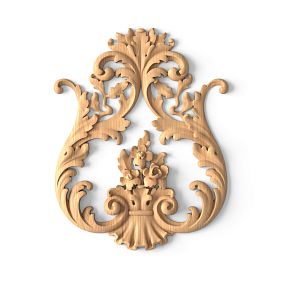
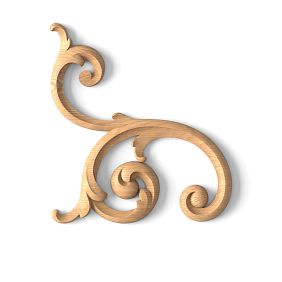
Our factory also produces:




Moisture resistance: protection against climate caprices
The water absorption of polyurethane does not exceed 1.5% by volume, making the material practically insensitive to humidity. This is critically important for ceiling molding, which is often exposed to condensation, especially in rooms with poor ventilation.
The material's vapor permeability is 0.05 mg/(m·h·Pa), allowing the ceiling to 'breathe' and preventing moisture accumulation under decorative elements. At the same time, low vapor permeability protects the base from humidity, which is especially important when using molding in bathrooms, kitchens, or pool areas.
The hydrophobic properties of polyurethane are enhanced by special additives that create a microscopic film on the material's surface, repelling water. Water droplets do not penetrate the material's structure but roll off the surface, preventing the development of mold and fungal microorganisms.
Get Consultation
Architectural typology of ceiling molding
The world of ceiling decoration is amazed by the diversity of forms and functions. Each type of element solves specific tasks and creates unique visual effects.
Crown moldings: architectural logic of space
Ceiling moldings perform the most important function of visual completion of space. They create a smooth transition from vertical wall surfaces to the horizontal ceiling plane, eliminating sharp geometric contrasts and adding harmony to the room.
Simple profiled moldings with minimal relief are ideal for modern interiors. Their geometry is based on strict mathematical proportions, creating a sense of order and stability. The width of such a molding is usually 5-12 centimeters, with a height of 3-8 centimeters.
Complex multi-profile moldings consist of several parallel grooves and protrusions, creating a play of light and shadow. Their dimensions can reach 20-30 centimeters in width and 15-20 centimeters in height. Such elements require high ceilings — at least 3 meters — to avoid overwhelming the space with their mass.
Polyurethane ceiling cornices Moldings with a channel for hidden lighting have become a trend in recent years. Built-in LED strips create soft diffused lighting, visually lifting the ceiling and adding modernity to the interior.
Roses: central accents of composition
Ceiling roses were traditionally placed in the center of the ceiling to mount chandeliers, but modern designers use them much more broadly. They can create decorative compositions from multiple elements, place roses asymmetrically, or use them for zoning space.
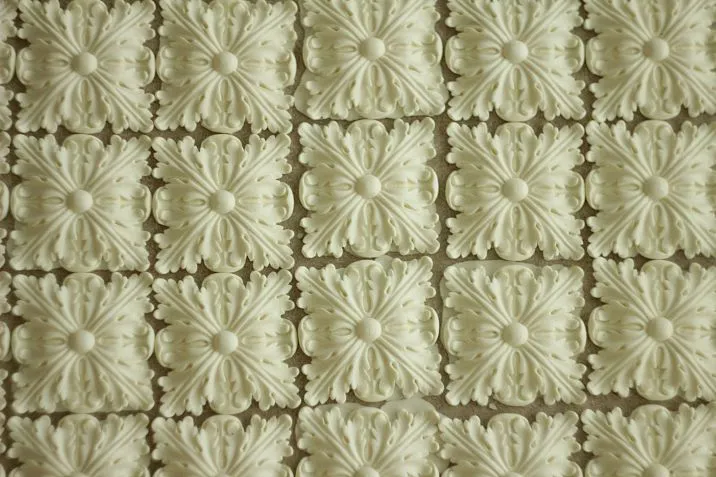
Classic roses with diameters of 40-80 centimeters are adorned with plant motifs — acanthus leaves, grapevines, roses. The depth of relief can reach 15-20 millimeters, creating a striking play of light and shadow. Such elements require appropriate lighting — the central chandelier must be sufficiently powerful to highlight all ornament details.
Modern minimalist roses are distinguished by simple forms and restrained decoration. Their diameter is usually no more than 30-50 centimeters, and the relief is weak — only 5-10 millimeters. Such elements suit interiors in modern, high-tech, or Scandinavian styles.
Composite roses consist of several concentric rings or sectors, allowing the creation of compositions of any size and complexity. This approach gives the designer complete creative freedom and allows adapting the decoration to any room size.
Moldings: universal decorative elements
Ceiling moldings are linear elements that can be used to create geometric compositions on the ceiling. They allow dividing a large ceiling into zones, creating decorative panels, or simply adding architectural logic to the space.
Straight moldings with simple geometric profiles create strict compositions in the spirit of neoclassicism. They can be used to create rectangular or square panels that visually structure the ceiling and make it more interesting.
Flexible moldings allow creating curved compositions — ovals, circles, wave-like forms. They look especially effective combined with hidden lighting, which emphasizes the smoothness of lines.
Decorative elements for the ceiling As moldings, they can have various widths — from thin 2-centimeter profiles to wide 15-centimeter elements. The choice depends on the room's size and the overall scale of the interior.
Coffers: volumetric ceiling compositions
Coffered ceilings are a tradition rooted in antiquity. Square, rectangular, or polygonal recesses create a rhythmic composition that visually increases ceiling height and adds monumentality to the room.
Modern polyurethane coffers allow you to create the effect of a recessed ceiling without complex construction work. The elements simply adhere to the ceiling surface, creating an illusion of architectural recesses. Coffer sizes can vary from 30×30 cm for small rooms to 120×120 cm for spacious halls.
Lighting coffered ceilings requires a special approach. Built-in fixtures in each coffer create even lighting and highlight the composition's geometry. An alternative option is hidden perimeter lighting around each coffer, creating the effect of floating panels.
Stylistic directions: from Baroque to Minimalism
The choice of ceiling decoration style determines the character of the entire interior and must correspond to the architectural features of the room and the owner's personal preferences.
Classicism: eternal harmony of proportions
The classical style in ceiling decoration is based on principles of ancient architecture — symmetry, proportionality, use of order elements. Polyurethane ceiling rosettes In the classical style, traditional motifs — palmettes, meanders, laurel wreaths — are used.
The color palette of a classical ceiling is restrained — white, cream, light gray. Decorative elements are usually painted in one color matching the ceiling, creating the effect of a single relief surface. Light toning in warm shades — ivory, milk — is permitted.
Lighting for classical ceilings should emphasize the relief of the molding. The central chandelier is placed at the geometric center of the main rosette, additional lighting can be built into cornices or mounted as wall sconces.
Baroque: theatrical luxury
Baroque ceilings are the apotheosis of decorative art. Complex interweavings of plant motifs, putti, garlands of flowers, cartouches create a sense of festive luxury. Such ceilings require high rooms — at least 3.5–4 meters — so that the richness of decoration does not overwhelm the space.
Asymmetric compositions of Rococo add elegance and lightness to Baroque opulence. Shells, scrolls, garlands of roses create picturesque compositions that seem created by nature itself, not by the hand of a master.
The color solution for Baroque ceilings can be very diverse. The traditional solution — white decoration on a colored background — creates maximum contrast. A more complex approach involves using multiple shades — from white to gold — creating an effect of volume and depth.
Empire: Imperial Grandeur
The Empire style is characterized by strict compositions and the use of symbols of power and victory. Eagles, laurel wreaths, bundles of arrows, military armor — all of this is reflected in ceiling decoration. This style suits representative rooms — offices, libraries, formal drawing rooms.
The geometry of Empire ceilings is based on strict mathematical proportions. The central rosette is surrounded by concentric molding rings, corners are decorated with symmetrical compositions. The color palette is restrained — white, cream, gold.
Modern: natural forms in architecture
The Modern style brought smooth plant lines and asymmetric compositions to ceiling decoration. Stylized images of flowers — irises, lilies, poppies — create a unique ornament. Motifs featuring insects — butterflies, dragonflies — are especially popular, symbolizing lightness and changeability.
The color solution for Modern style may include natural shades — green, brown, ochre. Decorative elements are often painted in multiple colors, emphasizing their connection to nature.
Modern minimalism: beauty of simplicity
Minimalist ceilings are characterized by simplicity of form and restraint in decoration. Polyurethane moldings for ceilings In this style, they have clear geometry and minimal relief. The main task is to create a structure without overloading the space with details.
Hidden lighting plays a key role in minimalist interiors. LED strips built into cornices or moldings create soft diffused lighting that visually increases ceiling height.
Technological Aspects: from Production to Installation
Modern ceiling molding production uses high-tech processes that ensure ideal product quality and full compliance with design requirements.
Production cycle: precision and quality
Polyurethane molding production begins with creating a master model. Modern technologies allow using both traditional hand carving and 3D printing to create samples of the most complex geometry. The accuracy of 3D printing reaches 0.1 mm, ensuring perfect reproduction of the smallest ornament details.
Silicone molds are produced by pouring liquid silicone around the master model. A quality mold serves 500–1000 casting cycles, maintaining geometric accuracy and detail clarity. Two-component silicone ensures mold elasticity and easy removal of finished products.
Injection molding occurs in special machines that dose polyurethane components and ensure their even distribution in the mold. The injection pressure is 2–5 atmospheres, guaranteeing complete filling of all mold details and absence of voids in the finished product.
Polymerization time depends on the size of the item and ranges from 15 minutes for small elements to several hours for large compositions. Temperature control during polymerization ensures uniform material structure and absence of internal stresses.
Quality Control: Standards of Perfection
Each item undergoes multi-stage quality control. Visual inspection reveals surface defects — bubbles, chips, unevenness. Geometric parameters are measured using coordinate measuring machines, ensuring accuracy to 0.05 mm.
Strength tests include compression, bending, and impact tests. Material samples are subjected to cyclic loads simulating operating conditions. Temperature tests are conducted in the range from -40°C to +80°C with monitoring of dimensional changes and crack formation.
Moisture resistance testing includes exposing samples to 100% humidity at 40°C for 30 days. Quality polyurethane should not change its dimensions by more than 0.1% and should not lose strength by more than 5%.
Packaging and logistics: preservation during transport
Polyurethane moldings require careful handling during packaging and transport. Small elements are packed in individual plastic bags with air cushions. Large elements — cornices, big rosettes — are protected by polystyrene inserts and cardboard boxes.
For long elements — cornices, moldings — special tubular packaging is used, which prevents deformation during transport. The maximum length of elements in standard packaging is 2.4 meters, corresponding to the dimensions of most vehicles.
Marking includes information on dimensions, material, production date, and installation recommendations. The QR code on the packaging contains a link to the installation instructions and manufacturer technical support.
Practical aspects of installation: from planning to finishing
Successful installation of ceiling moldings requires careful planning, proper surface preparation, and adherence to installation technology.
Preparatory work: the foundation of success
Ceiling diagnosis begins with checking its levelness using a laser or water level. Deviations exceeding 5 millimeters per linear meter require leveling. This is done using gypsum plaster or self-leveling polymer-based compounds.
Surface cleaning includes removing dust, grease stains, and remnants of old coatings. Special solvents are used for degreasing, which do not damage the substrate. After cleaning, the surface must be dry — humidity should not exceed 4% for concrete and 12% for gypsum board.
Surface cleaning includes removing dust, grease stains, and remnants of old coatings. For degreasing, special solvents are used that do not damage the substrate. After cleaning, the surface must be dry — humidity should not exceed 4% for concrete and 12% for gypsum board.
Marking: precision as the foundation of beauty
Geometric marking of the ceiling begins with determining the central point of the room. For rectangular rooms, this is the intersection of diagonals; for complex shapes, the center is determined by construction methods. From the central point, axes of symmetry are drawn using a laser level.
Placement of decorative elements should consider room proportions. The central rosette is positioned exactly at the center, with deviation not exceeding 50 millimeters for rooms up to 30 m² and 100 millimeters for larger spaces.
Cornices are marked parallel to walls at a distance of 50–200 millimeters from them, depending on the element's width. It is important to ensure uniform offsets around the entire perimeter, creating a harmonious composition.
Selection of adhesive depends on the type of substrate and operating conditions. For dry rooms, water-based acrylic adhesives are suitable. They have no odor, set quickly (15–20 minutes), and provide adhesion strength up to 2 MPa.
Polyurethane adhesives are recommended for wet areas and heavy elements. Setting time is 5–10 minutes, requiring fast work, but final strength reaches 5 MPa. These adhesives are resistant to moisture and temperature fluctuations.
MS-polymer adhesives combine the advantages of acrylic and polyurethane formulations. They contain no solvents, have a neutral odor, provide adhesion strength of 3–4 MPa, and retain elasticity after polymerization.
MS-polymer adhesives combine the advantages of acrylic and polyurethane compositions. They contain no solvents, have a neutral odor, provide a strength of 3–4 MPa, and retain elasticity after polymerization.
Installation technology: step-by-step process
Adhesive is applied in zigzag motions to the back of the element. The adhesive layer thickness should be 2–3 millimeters to compensate for minor surface irregularities. Even distribution of adhesive is critically important for connection strength.
Positioning the element requires special precision. The central element — the rosette — is installed first, from which further marking is conducted. The element is pressed against the ceiling with a force of 50–100 N/m² for 30–60 seconds until the adhesive begins to set.
Joint assembly is performed with minimal gaps — no more than 1 millimeter. For long elements, connecting sleeves are used or elements are cut at a 45° angle to create invisible joints. Cutting accuracy is ensured by a saw or a circular saw.
Final finishing: perfection in details
Joint sealing is performed with white acrylic sealant. Excess sealant is removed with a damp cloth until fully dry. Drying time is 2–4 hours depending on joint thickness and air humidity.
Surface sanding is performed with fine-grit sandpaper (grit 240–400). The goal is to create smooth transitions between elements and the substrate. After sanding, the surface is cleaned of dust with a vacuum cleaner or dry cloth.
Priming is done with deep-penetration acrylic primer. Primer improves paint adhesion, equalizes the surface’s absorbency, and ensures uniform coloring. Primer drying time is 4–6 hours.
Color solutions: psychology of ceiling decoration
Choosing the color of ceiling moldings significantly affects the perception of space and psychological comfort of people in the room.
Classic solutions: timeless relevance of white
White ceiling moldings are a classic that never goes out of style. They visually increase ceiling height, create a sense of spaciousness and cleanliness. White reflects the maximum amount of light, which is especially important in rooms with insufficient natural lighting.
Matte white surfaces do not create glare and evenly reflect light. This is an ideal choice for classic interiors. Semi-matte finishes add a subtle gloss that highlights the molding’s relief and creates play of light and shadow.
Matte white surfaces do not create glare and evenly reflect light. This is an ideal choice for classic interiors. Semi-matte finishes add a subtle sheen that highlights moldings' relief and creates play of light and shadow.
Contrasting solutions: drama in interior design
Dark molding on a light ceiling creates a striking contrast and makes decorative elements the main accents of the interior. This solution suits modern interiors where it is important to emphasize the architectural structure of the space.
Color contrasts should be balanced. Too sharp a contrast may create a sense of disharmony, especially in small rooms. The optimal ratio is a light background with decor 3-4 tones darker.
Monochromatic solutions: refined restraint
Painting molding in the color of the ceiling creates an effect of a single relief surface. This solution suits minimalist interiors where overall harmony is important, rather than accents on individual elements.
Ceiling molding polyurethane In monochromatic execution, it requires quality lighting to reveal the relief. Directional light creates shadows that emphasize the decor's volume even without color contrast.
Metallic finishes: luxury and shine
Gold, silver, bronze tones add luxury and grandeur to the interior. Such finishes look especially effective under artificial lighting, creating a play of highlights and reflections.
The technique of applying metallic finishes requires special skills. Special paints with metallic pigments or patina application — applying thin metallic sheets — are used. The finish must be even, without streaks or spots.
Patina — creating an effect of artificial aging — adds depth and nobility to metallic finishes. Dark shades in the recesses of the relief contrast with light raised parts, creating an effect of centuries-old history.
Ceiling molding lighting: play of light and shadow
Proper lighting can turn even simple molding into a work of art, highlighting every detail of the ornament and creating a unique atmosphere.
Central lighting: classic scheme
A central chandelier placed in the geometric center of the ceiling rose is a traditional solution suitable for most interiors. The chandelier's power should correspond to the room's size — 20-25 W per square meter for general lighting.
The height of the chandelier's suspension affects the character of the molding's lighting. A close-mounted fixture creates bright contrasts of light and shadow, emphasizing the depth of the relief. A high-suspended chandelier provides more even lighting with soft shadows.
The shape of the lampshades is also important for lighting quality. Open lampshades direct light upward, creating reflected ceiling lighting. Closed lampshades concentrate light downward, leaving the ceiling in half-shadow.
Hidden lighting: modern technologies
LED strips built into cornices or moldings create a floating ceiling effect. Soft diffused lighting visually increases room height and adds a futuristic touch to the interior.
The color temperature of LEDs affects the perception of the interior. Warm light (2700-3000 K) creates a cozy atmosphere suitable for living areas. Neutral white light (4000-4500 K) ensures good color rendering and is suitable for workspaces. Cool light (5000-6500 K) creates a feeling of freshness and modernity.
Dimming allows adjusting the brightness of lighting depending on the time of day and mood. Modern control systems allow creating various lighting scenarios — from bright daylight to intimate evening lighting.
Spot lighting: accents and details
Built-in fixtures allow creating even lighting for large ceilings. The distance between fixtures should be 1.5-2 times the installation height to ensure even lighting without dark zones.
Directional spotlights can be used to highlight individual molding elements — large roses, sculptural details, especially interesting ornament fragments. An angle of 15-30° creates a focused beam that highlights a detail against the overall composition.
Colored backlighting allows creating theatrical effects and changing the interior's mood. RGB LEDs allow choosing any color from the spectrum and creating dynamic light shows.
Adaptation to Russian climate
Choosing ceiling molding should take into account the climatic characteristics of the region and the specifics of local construction traditions.
Humid climate: special requirements
In regions with high humidity — coastal areas, areas with frequent rain — moisture resistance of materials is especially important. Polyurethane molding is ideal for such conditions due to its hydrophobic properties and resistance to mold.
Ventilation of rooms becomes critically important in humid climates. Ceiling molding should not impede natural air circulation. When planning the composition, it is important to leave gaps between elements to allow free airflow.
Antiseptic treatment may be required in particularly humid conditions. Special additives in paint prevent the growth of microorganisms on the molding surface even at high air humidity.
Continental Climate: Temperature Fluctuations
Sharp temperature fluctuations, characteristic of continental climates, create additional requirements for material stability. Polyurethane, due to its low coefficient of thermal expansion, handles such conditions exceptionally well.
The heating season creates special conditions — low humidity and high temperatures near the ceiling. This may cause some materials to dry out, but polyurethane maintains stability across a wide range of temperatures and humidity levels.
Northern regions: extreme conditions
In the Far North, where temperatures can drop to -50°C, material frost resistance is especially important. Polyurethane retains elasticity even at extremely low temperatures, preventing cracking.
Polar night creates special requirements for lighting. Ceiling moldings must look good under artificial lighting for extended periods. This requires careful planning of lighting scenarios.
Economic aspects: investments in beauty and comfort
Ceiling moldings represent a long-term investment in quality of life and property value. Proper budget planning will help achieve maximum effect at reasonable costs.
Material comparison analysis
Polyurethane moldings cost 3–5 times less than gypsum moldings at comparable quality. Simple cornices cost from 500 rubles per linear meter, complex multi-profile elements up to 2000 rubles. Ceiling rosettes cost from 1500 to 15000 rubles depending on size and ornament complexity.
Foam moldings cost 2–3 times less than polyurethane moldings, but require mandatory protective coating and have a limited service life — 7–10 years versus 25–30 years for polyurethane.
Gypsum moldings remain the most expensive — from 3000 rubles per linear meter for simple elements to 50,000 rubles per square meter for complex compositions. Additionally, the weight of gypsum elements requires reinforcement of ceiling structures, further increasing costs.
Installation costs
The ease of installing polyurethane moldings allows significant savings on labor. Many elements can be installed independently following the manufacturer’s instructions. Professional installation costs 30–50% of material costs.
Complex compositions with many joints require professional skills. Such installation may cost 70–100% of material costs, but the quality ensures longevity and aesthetic result.
Long-term economic efficiency
Polyurethane ceiling moldings require no special maintenance or regular renewal. The only requirement is repainting every 10–12 years to maintain a fresh appearance. Repainting costs 15–20% of initial expenses.
Property value increase due to quality decorative finishing is 8–15%. In monetary terms, this may exceed molding costs by 2–3 times, making such investments economically justified.
Energy-saving effect is achieved through improved ceiling insulation. An additional 15–20 mm polyurethane layer reduces heat loss by 5–8%, saving 1000–2000 rubles annually on heating for an 80–100 m² apartment.
Trends in development: looking toward the future
The ceiling molding industry is developing toward integration with smart technologies, eco-friendly production, and individualized design.
Smart technologies in molding decor
Integrating sensors into decorative elements opens new possibilities for creating smart interiors. Motion sensors built into ceiling rosettes can automatically turn on lighting upon entering a room.
Climate control systems can use molding elements as hidden air ducts for discreet ventilation. This is especially relevant for large rosettes and cornices that can conceal ventilation channels.
Adjustable lighting allows creating various lighting scenarios for different times of day or moods. Control via mobile apps provides full freedom in setting lighting.
Ecological Innovations
Biodegradable additives in polyurethane accelerate disposal after the product’s service life. Meanwhile, the material’s operational properties remain unchanged throughout its entire service life.
Recycling polyurethane allows using production waste to create new products. This reduces environmental impact and makes production more sustainable.
Using renewable energy sources in production reduces the product’s carbon footprint. Solar panels on factory roofs can meet up to 30% of electricity demand.
Personalization and individual design
3D printing opens unlimited possibilities for creating unique molding elements. Any ornament or shape can be realized in the material with precision down to tenths of a millimeter.
Artificial intelligence helps create optimal compositions, considering room size, owner’s stylistic preferences, and lighting characteristics. Machine learning algorithms analyze thousands of successful projects and propose the best solutions.
Augmented reality allows seeing the result before work begins. Special apps create a virtual model of the room with selected molding elements, eliminating planning errors.
International experience: best practices of global design
Studying foreign experience in using ceiling moldings helps adapt the best solutions to Russian conditions and avoid typical mistakes.
European standards
German quality standards set strict requirements for the accuracy of dimensions and surface quality of decorative elements. Dimensional tolerances must not exceed ±0.5 mm, ensuring perfect alignment of elements.
The French design school places special emphasis on proportions and harmony of compositions. The golden ratio is applied when positioning elements relative to each other and the size of the room.
Italian masters are renowned for their skill in creating complex ornaments and their ability to combine different styles within a single composition. Their experience demonstrates the importance of detailed refinement of each element.
American innovations
Modular systems developed in the USA allow creating complex compositions from standard elements. This reduces production costs and simplifies installation.
Quick-installation systems use special locking connections that allow installing moldings without adhesive. This is especially convenient for temporary installations or modular housing.
Asian technologies
Japanese principles of minimalism are reflected in the creation of simple, clean forms of ceiling moldings. Simplicity and functionality become the main criteria of design.
South Korean manufacturers implement robotic production lines that ensure high precision and consistent quality at large production volumes.
In the world of modern interior design, ceiling moldings are experiencing a true renaissance. New materials and technologies have made this form of decoration accessible to a wide range of consumers without compromising quality or aesthetic value. Each element of a ceiling composition can become a work of art if approached with proper attention to detail.
Modern possibilities allow realizing any design idea — from strict classicism to avant-garde modernism. It is important to remember that a ceiling is not just a functional surface, but a full-fledged interior element that can become its main decoration.
STAVROS stands at the forefront of the development of ceiling decoration industry, offering its clients not just materials, but comprehensive solutions for creating unique interiors. Decades of experience with polyurethane technologies, deep understanding of the Russian market needs, continuous product improvement, and impeccable quality have made STAVROS a synonym of reliability and innovation in the world of decorative arts. Choosing STAVROS products guarantees that your ceilings will become true masterpieces of architectural art, delighting the eye and inspiring for many years.