Article Contents:
- Scientific Basis of Material Superiority
- Molecular Advantages of Polyurethane
- Hydrophobic Properties
- Thermal Stability
- Aesthetic Possibilities and Design Solutions
- Accuracy of Detailing
- Variety of Stylistic Solutions
- Classic White
- Technological aspects of production
- Molding and Casting Process
- Quality Control and Standards
- Environmental Standards
- Installation: The Art of Creating Perfection
- Surface Preparation: The Foundation of Beauty
- Marking and Planning Composition
- Installation Technique for Polyurethane Elements
- Jointing Elements and Final Finishing
- Comparative Analysis with Alternative Materials
- Polyurethane vs. gypsum
- Polyurethane vs. Polystyrene
- Polyurethane vs. Natural Wood
- Stylistic Directions and Design Solutions
- Classic Styles: Baroque and Rococo
- Neoclassicism and Empire
- Modern Interpretations
- Special applications and non-standard solutions
- Wet Areas
- Exterior Applications
- Commercial interiors
- Economic Aspects and Investment Appeal
- Initial investments
- Operational costs
- Impact on property value
- Maintenance and Care: Simplicity in Perfection
- Regular maintenance
- Repair and restoration
- Updating Appearance
- Innovations and Future Prospects
- 3D Printing and Personalization
- Smart materials
- Ecological innovations
- Psychological Aspects of Perception
- Effect of Historical Presence
- Impact on Self-Esteem
- Stimulation of Creative Thinking
- Conclusion
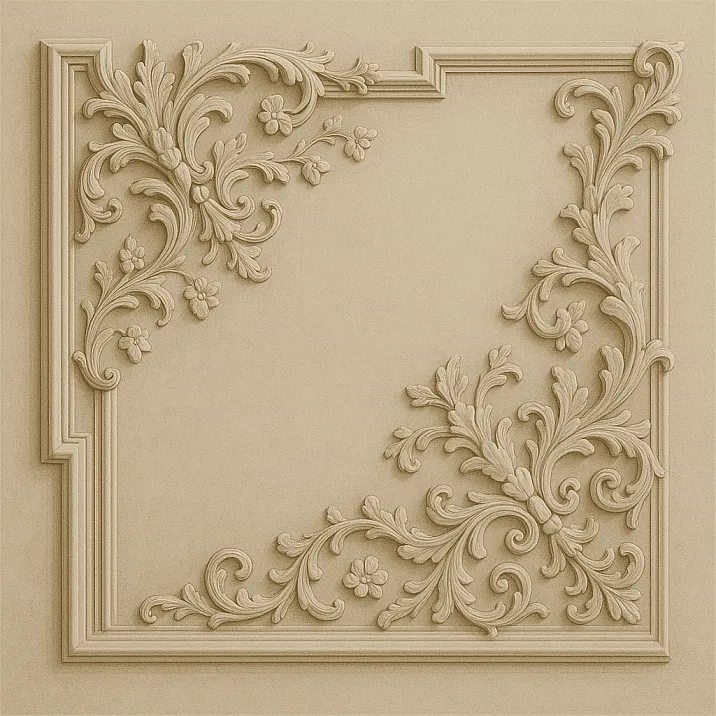
Have you ever noticed how the mood in a room changes when your gaze accidentally falls upon an elegantly decorated ceiling? This is not magic—it is the result of thoughtful use of decorative elements, among which Polyurethane Ceiling Moldings holds a special place. Modern technologies have given us a material that combines the beauty of classical forms with the practicality of the 21st century.
Forget everything you knew about traditional plaster moldings! The era of heavy, fragile, and temperamental materials is fading into the past. Polyurethane Ceiling Moldings opens new horizons in interior design, offering limitless creative possibilities without compromising on quality and durability.
What makes polyurethane moldings a true breakthrough? Imagine a material that does not fear moisture, does not crack under temperature fluctuations, weighs dozens of times less than plaster, yet is capable of conveying the finest details of the most complex ornament. This is precisely the set of properties that modern polyurethane moldings possess, transforming the decoration process from a technical challenge into an engaging creative journey.




Scientific Basis of Material Superiority
Why do professional designers increasingly choose polyurethane for creating ceiling decor? The answer lies in the unique molecular structure of this material, which ensures a comprehensive set of outstanding characteristics.




Molecular advantages of polyurethane
Polyurethane is a polymer with a special three-dimensional structure that imparts exceptional strength while maintaining elasticity. This feature is critically important for ceiling structures, which are subjected to constant temperature fluctuations and mechanical loads.
Unlike gypsum, which has a crystalline structure with natural lines of stress, polyurethane has isotropic properties — it is equally strong in all directions. This means that Ceiling molding elements polyurethane does not have a tendency to crack along specific lines.
Our factory also produces:


Hydrophobic characteristics
One of the revolutionary qualities of polyurethane is its natural moisture resistance. The molecular structure of the material prevents moisture penetration, making polyurethane ceiling moldings an ideal solution for rooms with high humidity — kitchens, bathrooms, pools, saunas.
This property opens up completely new design possibilities. Now it is possible to create luxurious interiors in spa zones, bath complexes, seaside homes, where traditional gypsum molding would be doomed to rapid deterioration.
Get Consultation
Thermal stability
Polyurethane demonstrates outstanding stability over a wide temperature range. Unlike some other polymers, quality polyurethane does not deform when heated to 80°C and retains elasticity when cooled to -40°C. This characteristic is especially important in Russian climatic conditions with their extreme temperature fluctuations.
Aesthetic possibilities and design solutions
Beauty of polyurethane ceiling moldings lies not only in the ability to precisely reproduce classical ornaments, but also in creating entirely new, modern forms that would be impossible using traditional materials.
Detail accuracy
Polyurethane — means obtaining a product indistinguishable in quality of detail from the work of the best craftsmen of past centuries. Buy ceiling molding Especially impressive are the capabilities of polyurethane in reproducing complex multi-layered compositions. Rosettes with multiple relief levels, cornices with complex profiles, decorative panels with interwoven ornaments — all of this is reproduced with perfect accuracy.
Polyurethane moldings are especially impressive in reproducing complex, multi-layered compositions. Rosettes with multiple relief levels, moldings with intricate profiles, decorative panels with interwoven patterns — all of this is reproduced with perfect accuracy.
Variety of stylistic solutions
The technological capabilities of polyurethane allow for the realization of decoration in any style — from strict classicism to avant-garde modernism. ceiling molding rosette can be executed as a geometrically strict circle with minimalist relief or represent a baroque composition with garlands, festoons, and complex floral motifs.
Modern designers especially value the possibility of creating eclectic solutions, where classical motifs combine with geometric elements or natural forms. Polyurethane allows to realize any fantasy without technical limitations.
Color Solutions and Finishing
Polyurethane is an ideal base for any type of finish. The material holds paint exceptionally well, does not absorb it, and does not fade over time. This opens up limitless possibilities for color experiments.
Classic white finish remains popular, but designers increasingly turn to bolder solutions. Metallic finishes — gold, silver, bronze, copper — create effects of luxury and aristocracy. Patination adds a noble patina of antiquity. Contrasting color solutions emphasize the architectural expressiveness of the decoration.
Technological aspects of production
Understanding the production technology will help you make the right choice and evaluate the quality of the offered products. Not all polyurethane moldings are created equal — the quality of the final product directly depends on adherence to technological processes.
Molding and casting process
Creating quality of polyurethane ceiling moldings begins with the creation of a master model. Leading manufacturers create master models using computer modeling or by copying historical samples using 3D scanning.
The next stage is mold making. The quality of the mold determines the quality of all subsequent products. Professional molds are made from high-quality silicone capable of capturing the finest details and enduring thousands of molding cycles.
The casting process requires precise adherence to temperature regimes and curing times. Insufficient polymerization leads to reduced product strength, while excessive polymerization results in brittleness and loss of elasticity.
Quality control and standards
Professional manufacturers apply multi-stage quality control. Each item undergoes visual inspection for surface defects, geometric parameter checks, and strength tests.
Quality polyurethane molding should have a uniform structure without pores or voids, clear relief without blurred details, correct geometry without distortions or deformations. The surface should be smooth and ready for finishing without additional processing.
Environmental standards
Modern Polyurethane Ceiling Moldings Produced in strict compliance with environmental standards. Quality polyurethane does not emit harmful substances, has no odor, and is safe for use in residential spaces.
Leading manufacturers obtain certificates of compliance with European and Russian environmental standards, guaranteeing product safety for human health.
Installation: the art of creating perfection
Correct installation is half the success of any decorative project. Polyurethane Ceiling Moldings Forgives many errors due to its lightness and strength, but adherence to installation technology ensures longevity and flawless appearance.
Surface preparation: the foundation of beauty
Any, even the highest quality molding, will look sloppy on poorly prepared surfaces. The ceiling must be flat, dry, clean, and strong. All cracks, unevenness, and water stains must be removed before beginning the installation of decorative elements.
Special attention is paid to surface priming. Primer not only improves adhesive bond but also strengthens the base, preventing flaking and cracking. For polyurethane molding, it is recommended to use acrylic-based deep-penetration primers.
Marking and composition planning
Precise marking is key to creating a harmonious composition. Central elements — rosettes, medallions — must be placed strictly at the center of the room or in accordance with the architectural logic of the space.
For complex compositions, it is recommended to create a scaled drawing or use computer visualization programs. This will help avoid errors and visualize the final result before beginning work.
Polyurethane element installation technique
The lightness of polyurethane allows using adhesive mounting even for large elements. Special polyurethane adhesive ensures reliable bonding with any surfaces and dries in 15-30 minutes.
Adhesive is applied in an even layer using a notched trowel. It is important to avoid excess adhesive, which may protrude on the surface and spoil the appearance of the item. For large elements, additional temporary fastening with self-tapping screws is recommended, which are removed after the adhesive has fully dried.
Jointing elements and final finishing
Quality jointing of elements is a sign of professional installation. Moldings and cornices Elements must be joined without gaps or unevenness. For this, special corner elements are used or joints are made at a 45-degree angle with precise fitting.
All joints are carefully filled with acrylic putty, which is sanded smooth to a perfectly even finish after drying. Only then is the final painting of the entire composition performed.
Comparative analysis with alternative materials
To properly appreciate the advantages of polyurethane ceiling moldingsIt is important to compare its characteristics with other materials used for creating decorative elements.
Polyurethane vs. Gypsum
Traditional gypsum has long been the only material for producing quality molding. It offers excellent detailing and a noble matte finish, but has critical drawbacks: heavy weight, brittleness, susceptibility to moisture, complex installation, and high cost.
Polyurethane solves all these problems while maintaining the quality of detailing at the level of the best gypsum products. The weight of polyurethane molding is 8-10 times less than gypsum, which dramatically simplifies installation and reduces load on structural elements.
Polyurethane vs. Polystyrene Foam
Polystyrene foam (expanded polystyrene) offers low cost and light weight, but quality detailing and durability leave much to be desired. Polystyrene molding quickly yellows, becomes brittle, poorly holds paint, and has a coarse texture.
Polyurethane, at only slightly higher cost, offers quality incomparable to polystyrene foam. The service life of polyurethane molding is decades, compared to 3-5 years for polystyrene molding.
Polyurethane vs. Natural Wood
Wooden carved moldings are individual works of art, but their application is limited by high cost, complex manufacturing, and demanding operating conditions. Wood is susceptible to drying, cracking, moisture, and insect damage.
Polyurethane can imitate wood texture with remarkable accuracy, yet it lacks all the drawbacks of natural material. Ceiling molding elements Made of polyurethane, they are stable, long-lasting, and require no special maintenance.
Stylistic directions and design solutions
The versatility of polyurethane as a material allows for decoration in any stylistic direction — from historical reconstructions to avant-garde experiments.
Classic styles: Baroque and Rococo
Baroque's complex, multi-layered compositions with their theatrical opulence are ideally suited to demonstrate polyurethane's capabilities. Rosettes with amorini and garlands, cornices with shells and scrolls, decorative panels with mythological scenes — all reproduced with museum-level accuracy.
Rococo, with its refined asymmetry and natural motifs, is also beautifully realized in polyurethane. Delicate vegetal ornaments, intertwining branches, floral garlands — every detail is rendered with jewel-like precision.
Neoclassicism and Empire
The strict geometry of neoclassicism and the grandeur of Empire find their ideal material in polyurethane. Laurel wreaths, military trophies, eagles and fasces — all imperial style symbols reproduced with historical accuracy.
Compositions in the Empire style with gilding look especially striking. Polyurethane holds metallic finishes perfectly, creating the impression of authentic gilded bronze pieces.
Modern Interpretations
Modern designers are not limited to copying historical samples. Polyurethane allows for creating fundamentally new forms — minimalist geometric compositions, abstract reliefs, biomorphic elements.
Hybrid solutions are particularly interesting, where classical motifs are reinterpreted in a modern context. For example, traditional rosettes acquire simplified forms, and cornices — clean geometric profiles.
Special applications and non-standard solutions
Unique properties of polyurethane open up possibilities for using ceiling moldings in environments where traditional materials would be unsuitable.
Wet areas
Polyurethane Ceiling Moldings Revolutionizes bathroom, sauna, and pool design. Now it is possible to create luxurious classical interiors in spaces with extremely high humidity.
Solutions for home spa zones are especially effective, where the combination of natural materials — stone, wood — with refined moldings creates an atmosphere reminiscent of ancient thermal baths or oriental baths.
Exterior applications
Polyurethane's resistance to atmospheric effects allows its use for exterior cladding. Polyurethane facade elements are not afraid of rain, snow, temperature fluctuations, or ultraviolet radiation.
This opens new possibilities for creating a unified stylistic solution for interior and exterior. Interior decor motifs can be extended onto the building's facade, creating a cohesive architectural composition.
Commercial interiors
Polyurethane's strength and durability make it an ideal material for commercial interiors with high foot traffic — hotels, restaurants, shopping centers, offices. Unlike plaster, polyurethane molding withstands vibrations, impacts, and frequent cleaning.
Economic aspects and investment attractiveness
Choosing of polyurethane ceiling moldings It is not only an aesthetic, but also an economically justified solution. Let us consider various aspects of the economic efficiency of this choice.
Initial investments
The cost of polyurethane molding falls between budget materials (polystyrene) and premium ones (plaster, wood). However, when calculating the total project cost, polyurethane is often the most cost-effective option.
Cost savings are achieved through simple installation (less labor), no need for structural reinforcement (light weight), universal application (one material for all conditions).
Operating expenses
Polyurethane molding requires virtually no maintenance over its service life. It does not crack, flake, absorb moisture, or suffer from mold. Periodic painting is the only thing required to maintain its appearance.
For comparison: plaster molding requires regular repair of cracks, moisture protection, and careful handling. Wooden molding requires regular treatment with antiseptics, insect protection, and restoration of elements.
Impact on property value
Quality molding significantly increases the perceived value of an interior and, consequently, the value of real estate. Polyurethane molding creates an effect of luxury indistinguishable from the result of using traditional premium materials.
Market research shows that the presence of quality molding can increase the value of a property by 10-20%, which significantly exceeds the cost of its installation.
Maintenance and care: simplicity perfected
One of the main advantages of polyurethane ceiling moldings Minimal maintenance is required. This aspect is especially important for ceiling decoration, which is difficult to access.
Regular Maintenance
The only thing required to maintain the appearance of polyurethane moldings is periodic dust cleaning. Due to the smooth surface of the material, dust does not penetrate into the structure and can easily be removed with a vacuum cleaner using a soft attachment or slightly damp cloth.
For wet cleaning, any non-abrasive cleaning agents can be used. Polyurethane is not afraid of household chemicals, allowing effective removal of any dirt.
Repair and restoration
In case of mechanical damage, polyurethane molding is easily repairable. Small chips and scratches are filled with acrylic putty and then painted over. Serious damage can be corrected by replacing individual elements without dismantling the entire composition.
This repairability is especially important in commercial interiors or homes with children, where the risk of mechanical damage is higher.
Updating the Appearance
Polyurethane holds any type of paint exceptionally well, allowing easy color scheme changes in the interior without replacing decorative elements. Want to transition from classic white to trendy gray? Simply repaint the molding!
The ability to repaint multiple times makes polyurethane molding a practically eternal interior element that can adapt to changing tastes and fashion trends.
Innovations and Future Prospects
The industry of polyurethane molding is not standing still. Continuous technological improvements expand application possibilities and enhance product quality.
3D Printing and Customization
The development of 3D printing technology opens new horizons for creating individual molding elements. Today, it is already possible to manufacture unique items according to custom sketches with minimal time and financial costs.
This technology is especially attractive for restoration work, where it is necessary to recreate lost historical elements, or for creating original designer compositions.
Smart Materials
Research into smart materials promises the emergence of polyurethane molding with additional functions. For example, materials with color-changing properties depending on temperature or lighting, antibacterial coatings, and air ionizing additives.
Ecological Innovations
The development of biotechnology leads to the creation of polyurethanes based on renewable raw materials — vegetable oils, cellulose. These materials possess all the advantages of traditional polyurethane, but are fully biodegradable.
Psychological Aspects of Perception
The influence of decorative elements on a person's psychological state is the subject of numerous studies. Polyurethane Ceiling Moldings It plays an important role in creating a comfortable psychological environment.
The Effect of Historical Presence
Classic ornaments and forms create a connection with cultural heritage, evoking a sense of stability and continuity. This is especially important in today's rapidly changing world, where people seek points of reference and constancy.
Influence on Self-Esteem
Surrounding oneself with beautiful, high-quality items positively influences self-esteem and self-confidence. decorative interior ornaments High-quality items create a sense of success and achievement of a certain social status.
Stimulation of Creative Thinking
Complex, detailed ornaments stimulate visual perception and activate creative zones of the brain. This makes polyurethane molding especially suitable for office spaces, studios, and creative environments.
Conclusion
Polyurethane Ceiling Moldings It represents an ideal synthesis of beauty and practicality, tradition and innovation. This material opens up limitless possibilities for creating exquisite interiors without compromising on quality, durability, and functionality.
Choosing polyurethane molding is investing in beauty that will delight you for decades. Ease of installation, minimal maintenance requirements, and universal application make it the optimal solution for any project — from modest apartments to luxurious mansions.
Modern manufacturing technologies guarantee quality comparable to the best historical examples, while innovative material properties expand application areas to previously unattainable limits. Buy ceiling molding Choosing polyurethane today means choosing in favor of future decorative art.
Each element of polyurethane molding is not just decoration, but an investment in comfort, beauty, and increased value of your space. In a world where details make all the difference, the right choice of decorative elements becomes the key to creating the dream interior.
STAVROS is a recognized leader in the production of high-quality polyurethane molding. Years of experience, use of advanced technologies, and constant quality control allow STAVROS to create products that serve as benchmarks in the decorative materials industry. Every STAVROS molding element undergoes strict quality checks and meets the highest international standards. Choosing STAVROS products means you get not only beautiful decorative elements, but also a guarantee of durability, reliability, and flawless appearance for many years. The STAVROS team of professionals is ready to assist in implementing any design ideas, offering a full range of services from consultation to custom manufacturing of unique elements.