Article Contents:
- Concept of vertical composition in interior design
- Why the connection between top and bottom is important
- Historical examples
- Ceiling moldings as the compositional tuning fork
- Types of ceiling decoration
- Ornamental motifs of moldings
- Scale and proportions
- Cornices and rosettes: how they affect the staircase
- Cornice as a horizontal element
- Rosettes and central axis
- Coffers and geometry
- Balusters as reflections of ceiling motifs
- Turned balusters and curved moldings
- Carved balusters and floral moldings
- Simple balusters and minimalist moldings
- Color solutions: creating unity
- White ceiling and dark wood
- Monochromatic palette
- Accent colors
- Wood and polyurethane in the same tone
- Transitions between zones: stair run, landing, hall
- Stair run: beginning of the vertical axis
- Landing: moment of pause
- Hall: final composition
- Practical aspects of design
- Concept development
- Working with scale
- Color design
- Contractor coordination
- Common Mistakes and How to Avoid Them
- Error: style mismatch
- Error: Overload by decor
- Error: Incorrect scale
- Error: Color chaos
- Error: Ignoring lighting
- Materials and their combinations
- Polyurethane for ceiling
- Wooden array for staircase
- Metal and glass as accents
- Lighting as a compositional element
- Chandelier and ceiling rose
- Crown molding lighting
- Staircase lighting
- Examples of Implemented Projects
- Project 1: Classic mansion
- Project 2: Neoclassical apartment
- Project 3: Modern minimalism
- Care recommendations
- Care for moldings
- Care for wooden staircase
- Frequently Asked Questions
- Should moldings and staircase be coordinated during the design phase, or can one be done first?
- Which style of molding suits a modern glass and metal staircase?
- Can colored molding be used instead of traditional white?
- How much does it cost to decorate a hall with moldings and a wooden staircase?
- Is a ceiling rose needed if there are recessed lights instead of a chandelier on the ceiling?
- What if the staircase is already installed, but the ceiling is not yet finished?
- Can moldings from different collections be combined?
- What height should balusters be relative to the room's height?
- Should the second-floor ceiling molding match the first-floor style?
- How often should the finish of moldings and staircase be renewed?
- Conclusion

Enter the house, where the grand staircase ascends into a high hall. The gaze glides upward—and there it is, the ceiling. Not just a plain white surface, but an architectural canvas with cornices, roses, and ornamentation. And now the gaze descends—there too, rhythm:wooden balusters for staircasesforms verticals, the handrails flow in a smooth line, creating a connection between levels. And here’s the question: do you see a unified composition? Or does the ceiling live its own life, while the staircase lives its own?
In classical architecture, there is a concept of visual axis—a hypothetical line that unites elements of space. Whenceilings with moldingsThe staircase railing works in a unified style, repeating each other in details, ornaments, proportions — a magic of wholeness emerges. The space is perceived as a single composition, where each element is thoughtfully designed and connected to the rest. But how to achieve this? What principles to follow? What details to consider? Let’s explore this architectural dialogue between top and bottom.

Concept of vertical composition in interior design




Why the connection between top and bottom is important
The human eye perceives space as a whole, even if we are not consciously aware of it. When entering a room, the brain instantly scans the ceiling, floor, walls, and all objects. If elements are disconnected and not linked by a common logic — discomfort and a sense of chaos arise. But if there is rhythm, repeating motifs, visual correspondences between top and bottom — the space is perceived as harmonious.
In a hall with a staircase, this principle is especially important. The staircase is a vertical object, physically connecting levels. But visually, it must be linked to the ceiling and floor using decorative means.Ceiling molding decorationAnd wooden balusters can become these connecting elements, if properly selected and arranged.
Our factory also produces:



Historical examples
In baroque and classical palace architecture, this connection was a mandatory rule. Ceilings were decorated with molded rosettes featuring plant motifs — and the same plant motifs were repeated in balustrade carvings, door casing decorations, and fireplace portals. The rhythm of columns and pilasters found reflection in the verticals of balusters. Ceiling cornices corresponded with handrail profiles.
These principles remain relevant today. Modern materials — polyurethane for ceiling decoration, solid wood for staircase elements — allow recreating classical compositions or creating new ones, while adhering to the same laws of harmony.
Get Consultation
Ceiling moldings as the compositional keynote
Types of ceiling decoration
ceilings with moldingsInclude several types of elements. Cornices — wide profiled strips running along the perimeter under the ceiling. They frame the ceiling plane, creating a transition from wall to ceiling. Rosettes — circular or oval decorative elements, usually placed in the center of the ceiling, often around a chandelier. Moldings and coves — additional strips creating frames, coffers, geometric compositions on the ceiling.
Each of these elements carries a specific ornament, profile, and stylistic character. And this stylistic character must find a counterpart below — in the staircase railing, in the hall wall decoration.
Ornamental motifs of moldings
Classical moldings use several types of ornaments. Plant motifs — acanthus leaves, grapevines, floral rosettes. Geometric patterns — meanders, Ionic scrolls, beads, pearls. Architectural elements — modular units, brackets, denticles (tooth-like projections).
If the ceiling cornice is decorated with acanthus leaves, it is logical thatwooden handrails and balustersshould have carved elements with the same plant motifs. It is not necessary to copy exactly — it is enough to have a general character: curvilinear forms, lushness, organic lines.
If the molding is geometric, strict, with clear lines — balusters should be minimalist, possibly square in cross-section or with simple turning from geometric forms.
Scale and proportions
The size of ceiling decoration elements sets the scale for the entire space. A wide, massive cornice (20-30 cm) in a high hall (3.5-4 m) requires proportionally sized elements below. Balusters should be sufficiently large — 8-10 cm in diameter if turned, or 7x7 cm if square. Handrail — wide, 8-10 cm.
In a compact hall with 2.7 m ceilings, a narrow cornice (10-12 cm) harmonizes with slender balusters of 5-6 cm diameter and a narrow handrail of 6-7 cm. Proportions must correspond.
Cornices and rosettes: how they affect the staircase
Cornice as a horizontal line
The ceiling cornice is a horizontal line running along the entire perimeter of the room. It creates a visual boundary, separating the ceiling from the walls. In a hall with a staircase, this horizontal line contrasts with the verticality of the staircase. And it is important that there is a dialogue between them.
If the cornice has a complex profile with numerous protrusions and curves, it sets a tone of rich, elaborate decoration. The staircase should support this richness. If the cornice is simple and minimalist — the staircase should not be overloaded with details.
Rosettes and central axis
The ceiling rosette is usually located in the center of the room, often directly above the center of the hall. If the staircase is located to the side, the rosette creates a compositional center from which visual axes radiate. If the staircase is central, the rosette may be placed above the staircase or above the landing.
In this case, the rosette becomes the visual apex of the composition. The eye rises vertically along the balusters, along the handrail line — and ends at the ceiling rosette. This creates a strong vertical axis that structures the entire space.
The ornament of the rosette may correspond to the shape of the balusters. A circular rosette with radial rays — and turned balusters with circular cross-sections. An oval rosette with plant ornament — and carved balusters with leaves.
Coffers and geometry
A coffered ceiling is a ceiling divided into square or rectangular sections (coffers) using beams or moldings. Each coffer can be recessed, painted in a contrasting color, or adorned with a rosette.
Such a ceiling establishes a strict geometry. The staircase must match it. Square balusters installed at regular intervals, a rectangular-section handrail, clear lines — all of this will support the geometric nature of the coffers.
An interesting approach is to position the coffers so that their axes align with the axes of the stair treads. For example, if the stair runs from north to south, the coffers are elongated in the same direction. This creates a visual direction, enhancing the dynamism of movement.
Balusters as a reflection of ceiling motifs
Turned balusters and curved molding
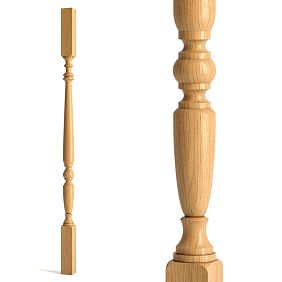
wooden balusters for staircasesClassically turned balusters have a complex profile: bases, balusters (convex parts), returns (narrow sections), bands. These forms create play of light and shadow, volume, relief.
If the ceiling molding has curved forms — curves, scrolls, volutes — turned balusters will perfectly support this plasticity. The convexities of the balusters correspond to the relief of the cornice. Narrow returns match the recesses in the ornamental molding.
There is no need to seek absolute similarity. It is sufficient to have a general character — both forms are curved, both create volume, both are based on classical proportions.
Carved balusters and vegetal molding
If the ceiling molding is rich with vegetal motifs — leaves, flowers, garlands — carved balusters with vegetal carving will naturally continue them. Carved leaves on the baluster body, grape clusters on stair stringers, rosettes on treads — all of this creates an ornamental unity.
It is important to maintain the scale of the carving. If the ceiling molding is large, relief-rich, the carving on the balusters should be proportionate — not delicate and lace-like, but expressive and readable from a distance. If the molding is refined, with fine details, the carving may be more elegant.
Simple balusters and minimalist molding
Modern interiors often use simplified molding — smooth cornices without complex profiles, simple ceiling moldings that create geometry without ornamentation. In such caseswooden handrails and balustersthey should be minimalist.
Square or rectangular posts, without turning or carving. Possibly with beveled edges for softness. A simple rectangular or rounded-section handrail. Such a staircase will not compete with the ceiling decoration, but support its restraint.
Color solutions: creating unity
White ceiling and dark wood
Classic combination: white ceiling with white molding and dark wooden staircase made of oak, walnut, or ash. Contrast creates expressiveness. White molding is clearly visible against the white ceiling due to relief and shadows. Dark staircase stands out against light walls.
In such a combination, it is important that whiteness be uniform — on the ceiling, on the walls, and on the moldings. Different shades of white (cool, warm, cream, gray-white) will create disharmony.
Monochromatic palette
Ceiling, walls, and staircase in one color palette, but with gradation in lightness. For example, ceiling is the lightest (white or light beige), walls slightly darker (beige, light gray), staircase dark (dark brown, graphite). Molding stands out on the ceiling due to tone — half a tone lighter or darker than the main ceiling color.
Such a solution creates a soft, enveloping atmosphere. There are no sharp contrasts; everything flows into one another. Suitable for interiors in neoclassical or modern classical styles, where elegance without drama is desired.
Accent colors
Bold solution — colored molding or colored staircase. For example, ceiling is white, molding is painted gold or silver (gilding, patina). Staircase is dark wood. Gold molding on a white ceiling conveys luxury and grandeur. Dark wood enhances this luxury with its noble texture.
Or vice versa: ceiling is colored (blue, peach, pale green), molding is white. Staircase made of light wood (white oak, ash). Colored ceiling creates intimacy and coziness. White molding clearly structures the colored surface.
Wood and polyurethane in the same tone
Modern technologies allow polyurethane molding to be painted to imitate wood. Then both the ceiling decoration and the staircase appear to be made of the same material. This creates an effect of unified wooden finish, as in historical interiors where both ceiling beams and staircases were wooden.
It is important to achieve exact tonal match. Even a slight mismatch will be noticeable and spoil the impression. It is better to use samples, paint the molding and test board simultaneously, selecting an identical shade.
Transitions between zones: stair run, landing, hall
Stair run: beginning of the vertical axis
The stair run is the sloped section of the staircase where ascent or descent occurs. Here, balusters form a frequent vertical, the handrail runs at an angle, and the treads create horizontal lines. This is a dynamic zone full of movement.
The ceiling above the stair run can be finished in various ways. If the stair run runs along a wall, the ceiling is typically plain and horizontal. The cornice runs around the perimeter, creating a frame. You can add moldings on the ceiling parallel to the stair run — this will emphasize the direction of movement.
If the stair run is open and located in the middle of the hall, the ceiling above it is the central part of the composition. Here, a ceiling rose or a group of roses is appropriate, along with a cornice around the perimeter of the hall. The molding should be sufficiently expressive to compensate for the activity of the staircase below.
Landing: moment of pause
The staircase landing is the horizontal area between stair runs. Here, movement slows down, and one can stop and look around. The ceiling above the landing is an excellent place for accent decoration.
A rose precisely centered above the landing creates a compositional focal point. If a chandelier is hung beneath the rose, it forms a grand focal point — light, ornament, and the vertical staircase converge at one point.
On the landing, pillars are often installed — supporting posts, heavier than balusters. These pillars may have carved capitals (upper parts) that correspond with the ornament of the ceiling rose. This creates a strong visual connection between the top and bottom.
Hall: the finale of the composition
The upper hall, where the staircase exits, is the culmination of the vertical path. Here, there should be a visual reward for the ascent: an attractive ceiling, dramatic molding, and harmonious space.
ceilings with moldingsIn the upper hall, elements can be especially expressive. Coffered ceilings, several roses, cornices with brackets — all of this creates a sense of grandeur and significance. The balustrade (the railing of the staircase opening on the second floor) supports this grandeur with its forms.
It is important that the ceiling of the upper hall be finished in the same style as the ceiling of the lower hall. Identical cornices, similar roses (possibly smaller in size), the same ornamental motifs. This creates continuity and unity throughout the verticality of the house.
Practical aspects of design
Concept development
Before starting work, create a clear concept. Sketches, visualizations, material samples. Define the style: classic, baroque, neoclassical, modern. Choose ornamental motifs: botanical, geometric, mixed.
Select specific items: baluster shapes from the catalog, ceiling cornice profiles, rose types. Ensure they coordinate. Create a collage or 3D model to see how everything will look together.
Working with scale
Use the rule of proportions: large ceiling elements correspond to large staircase elements. Measure the room’s height, the stair run’s width, and the span’s length. The cornice should be no less than 1/20 of the room’s height. For 3-meter ceilings, this is a minimum of 15 cm.
Balusters are typically 80–90 cm tall (standard for staircase railings according to building codes). Their thickness is chosen in proportion 1:10 or 1:12. A 90 cm baluster has a diameter of 7–9 cm.
Color design
Create a color palette. Three to four main colors used in the space. For example: white (ceiling, molding, walls), dark brown (staircase, doors), beige (floor), gold (accent details in molding).
Determine where each color is applied. Order paint and wood stain samples. Paint small sections and observe under different lighting — daylight and artificial. Only after ensuring the colors harmonize, begin final finishing.
Coordination of contractors
Ceiling molding is typically installed by decorators or finishers. The staircase is installed by carpenters or specialized crews. It is important that they work in coordination.
The staircase is installed first — it is the load-bearing structure. Then, finish wall and ceiling work, and install molding. Afterward, finish sanding and painting the staircase. If the sequence is disrupted, one element will have to be finished at the expense of another, potentially causing damage.
Typical mistakes and how to avoid them
Error: style mismatch
Baroque ceiling molding with scrolls and amorini — and a minimalist staircase made of glass and metal. Or vice versa: a modern smooth ceiling without decoration — and an ornate, carved staircase in the Louis XV style. Such combinations create dissonance.
Solution: determine the style before beginning work. If the staircase already exists and its style cannot be changed, select ceiling decor to match it. If the ceiling is already finished, design the staircase to match it.
Error: over-decorating
Complex multi-level ceiling molding, coffered ceilings, several roses, cornices with modillions — and yet an ornate, heavily carved staircase with many details. This results in visual chaos, where the eye does not know where to look.
Solution: balance. If the ceiling is heavily decorated, the staircase should be simpler. If the staircase is the main feature with carving and ornamentation, let the ceiling be a restrained background. Two main elements in one space rarely coexist harmoniously.
Error: incorrect scale
Narrow cornice 8 cm in a 4 m high room disappears, is unreadable. Or massive cornice 25 cm in a compact hall with 2.5 m ceilings presses down, creates a cramped feeling.
Solution: use the formula. Cornice = 1/20 of room height ± 20%. For 3 m this is 12–18 cm. For 4 m this is 16–24 cm. Balusters are selected proportionally to the cornice.
Error: color chaos
White ceiling, beige moldings, gray walls, black staircase, light floor. Too many colors, no dominant tone, space feels scattered.
Solution: the three-color rule. One main (usually neutral — white, beige, gray), one secondary (wall or staircase color), one accent (metallic hardware, gilding on moldings). All other shades are variations of these three.
Error: ignoring lighting
Beautiful moldings, but flat, frontal lighting — relief is unreadable. Or carved balusters, but light falls evenly from above — carving appears flat.
Solution: plan lighting during the design stage. For moldings, use side lighting (spotlights on ceiling, angled toward the cornice). For staircases — multi-level lighting (uplight, step lighting, wall sconces).
Materials and their combinations
Polyurethane for ceiling
Ceiling molding decorationPolyurethane — optimal choice for modern construction. Lightweight material does not impose load on floors. Resistant to humidity and temperature fluctuations. Allows creating complex shapes with fine detailing.
Polyurethane moldings are painted with acrylic paints. Any color and finish can be achieved — from matte to glossy. Can imitate patina, gilding, wood. Service life — decades without change in shape or color.
Solid wood for staircase
wooden balusters for staircasesClassic, proven over centuries. Oak, ash, beech — hardwoods, withstand loads, do not deform over time. Natural wood texture adds nobility and warmth.
Wood can be painted, stained, varnished, or brushed (highlighting texture). Each board is unique in pattern. It is a living material that breathes and has energy. Combination of polyurethane moldings and wooden staircase — alliance of modern technology and traditional craftsmanship.
Metal and glass as accents
Modern staircases often include metal elements (frame, balusters) and glass railings. If the staircase is in a modern style, ceiling moldings should be restrained and geometric.
Simple rectangular cornices, smooth ceiling moldings, possibly one central simple-shaped rose — this is enough. Molding color — white or matching walls. Metal staircase (chrome steel, black steel) and glass create modernity; molding adds structure without excess.
Lighting as a compositional element
Chandelier and ceiling rose
Classic place for a chandelier — center of the ceiling rose. The rose creates a decorative frame for the light fixture, enhancing its significance. If the rose is above the staircase, the chandelier becomes the visual apex of the entire vertical composition.
Choose a chandelier whose style matches both the molding and the staircase. Classic multi-armed chandelier with crystal pendants — for rich moldings and carved staircases. Modern minimalist chandelier with geometric shapes — for simple moldings and sleek staircases.
Cornice lighting
Modern approach — hidden ceiling cornice lighting. LED strip is installed behind the cornice (if it is mounted with clearance from the ceiling) or in a special groove in the cornice. Light is directed upward, illuminating the ceiling, creating soft diffused lighting.
Such lighting makes the cornice light and floating. In the evening, when main lighting is off, the glowing cornice line creates a cozy atmosphere. The color of the lighting can be changed (RGB strip), adapting to mood or event.
Staircase Lighting
Staircase requires functional lighting. Step lighting (LED strips in risers or handrails) ensures safety at night. Wall sconces along the staircase provide general lighting.
It is important that the style of light fixtures on the staircase matches the ceiling chandelier and overall concept. Classic sconces with candle imitation — for classic interiors. Modern minimalist shades — for modern interiors.
Implemented project examples
Project 1: Classic mansion
Two-story mansion in classic style. Hall on the first floor, 4.2 m high. Ceiling with coffers: wooden (more precisely, polyurethane under wood) beams form 1.2x1.2 m squares. In the center of each square — molded rose with acanthus leaves. Around the perimeter — wide cornice (22 cm) with modillions and dentils.
Oak staircase, main, 1.4 m wide. Turned balusters, complex profile, 9 cm diameter, installed at 12 cm spacing. Posts on the landing - massive, 12x12 cm, with carved capitals, featuring the same acanthus leaves as the ceiling rosettes.
Color scheme: ceiling white, beams and moldings - dark oak (polyurethane painted), staircase - natural oak, stained to dark walnut. Result: a unified wooden space where ceiling and staircase appear to be made of the same material. Clear, powerful visual axis - from oak treads through carved capitals to ceiling rosettes and coffered panels.
Project 2: Neoclassical Apartment
Two-level apartment in neoclassical style. Ceiling height 3.2 m. Ceiling white, smooth, with a medium-width (14 cm) simple-profile cornice along the perimeter without ornament. Center - circular rosette 60 cm in diameter with geometric ornament (concentric circles and radial lines).
Staircase made of whitewashed oak. Balusters square-sectioned, 6x6 cm, with small bevels. Handrail rectangular, 8x5 cm. Treads and risers from the same whitewashed board. Walls alongside the staircase - light gray, with white moldings forming vertical panels.
Color palette: white (ceiling, moldings, trim), light gray (walls), whitewashed wood (staircase), chrome (hardware, lighting). Style restrained, elegant. Moldings are not overloaded with decoration but clearly structure the ceiling. Staircase is simple yet high-quality, with perfect geometry. Visual axis is read through repetition of white color and geometric forms.
Project 3: Modern Minimalism
Rural house in minimalist style. Hall with high ceilings 3.8 m, fully open, second light. Ceiling gray, concrete. Perimeter - narrow cornice (10 cm) simple rectangular shape, painted dark gray. No rosettes, only smooth surface. Lighting - track lights on rails.
Combined staircase: metal frame (black steel), treads from dark oak, railing - glass, transparent. No balusters, but metal supports holding the glass - square-sectioned, 4x4 cm, black, matte.
Color scheme: gray concrete (ceiling, part of walls), white (part of walls), black (staircase metal, cornice), dark wood (treads). Minimal decoration, maximum materials in pure form. Visual axis created not by ornament, but by rhythm of vertical supports, handrail line, tread direction. Simple cornice on ceiling defines horizontal, balancing the staircase’s vertical.
Care recommendations
Care for moldings
Polyurethane moldings require no complex maintenance. Dust is removed with a dry soft cloth or long-bristled brush. For deep cleaning (once a year) use slightly damp cloth with mild detergent. Do not use abrasive agents or solvents — they may damage the paint.
If moldings are painted with matte paint, the coating may require renewal over time. This is simple: surface is cleaned, primed if needed, fresh paint layer applied. Polyurethane holds paint well, allowing multiple repaints.
Care for wooden staircase
wooden handrails and balustersRequire regular care. Weekly dry cleaning - dust removed with soft cloth. Monthly wet cleaning - wipe with slightly damp cloth, then dry.
Every 2-3 years, wooden elements must be treated with protective compounds. If staircase is lacquered, apply fresh lacquer layer (light sanding for adhesion first). If treated with oil, apply oil-wax (rubbed in, excess removed).
Avoid excessive humidity and direct sunlight — they may cause wood deformation and fading. Use mild cleaning agents, free of aggressive chemicals.
Frequently asked questions
Should molding and staircase be coordinated during the design phase, or can one be done first?
It is strongly recommended to design both elements simultaneously. If staircase is installed first and molding is selected afterward (or vice versa), there is a high risk of stylistic mismatch. Develop a unified concept, choose style, materials, colors — and only then proceed with implementation.
What style of molding suits a modern glass and metal staircase?
Minimalist molding suits a modern staircase: simple rectangular cornices without ornament, smooth ceiling moldings, possibly one central geometric rosette. Ornate classical molding with scrolls will conflict with a modern staircase.
Can colored molding be used instead of traditional white?
Yes, but with caution. Colored molding is a bold choice. Suitable for interiors where color is part of the concept. For example, pastel colors in children’s rooms. Dark, noble tones in offices. Mainly, molding color must harmonize with overall palette and not conflict with staircase color.
How much does it cost to finish a hall with molding and wooden staircase?
Cost depends on many factors: hall area, ceiling height, molding complexity, staircase wood species, presence of carving, etc. Approximate: polyurethane molding - from 800 to 3000 rubles per linear meter (depending on width and complexity). Wooden staircase with balusters - from 150,000 to 500,000 rubles (depending on size, wood species, presence of carving). Installation work - 30-50% of material cost.
Is a ceiling rosette needed if ceiling has recessed lights instead of chandelier?
Rosette is not mandatory but desirable as a decorative element. Even without chandelier, rosette creates a compositional center on ceiling, a visual focal point toward which the eye is drawn. If hall is large and ceiling appears empty, rosette (or several) structures the space. In minimalist interiors, rosette may be omitted, limiting to cornice only.
What if staircase is already installed, but ceiling is not yet finished?
Study the style of existing staircase. Determine key characteristics: baluster shape (turned, carved, simple), material, color, scale. Select ceiling molding matching these characteristics. If balusters are classical — use classical molding. If modern — use minimalist molding. Use color as unifying element: if staircase is dark, use dark accents in molding (patina, tinting).
Can molding from different collections be combined?
Yes, but with caution. Elements must be in the same style and scale. For example, cornice from one classical collection, rosette from another — if both have similar ornamentation and profiles, it will work. But mixing baroque and modern, or classical and minimalist is not advisable — it results in eclecticism that is difficult to harmonize.
What height should the balusters be relative to the room's height?
The height of balusters is determined by construction safety norms: from the top of the step to the top of the handrail, it should be 90 cm (allowable 85-95 cm). This does not depend on the room's height. However, the thickness of the balusters should correspond to the scale of the ceiling decoration: the higher the room and the wider the cornice, the thicker the balusters.
Should the ceiling molding on the second floor be in the same style as on the first?
Yes, it is desirable. This creates continuity and unity throughout the house. You can vary the scale: on the second floor, the cornice may be slightly narrower, the rosettes smaller. But the style, ornaments, and color should be consistent. This is especially important if the staircase connects both levels—the visual axis should be cohesive from top to bottom.
How often should the ceiling molding and staircase be refreshed?
Polyurethane molding, painted with quality acrylic paint, retains its appearance for 7-10 years without refreshment (under normal usage conditions). A wooden staircase coated with varnish requires refreshment every 5-7 years. Oil-based coating needs more frequent refreshment—every 2-3 years. Frequency depends on usage intensity: in a family with children, wear is faster; in a home with two adults, it is slower.
Conclusion
Creating a harmonious space whereceilings with moldingsandwooden balusters for staircasesworks as a unified whole—is both an art and a science. Art involves seeing connections, feeling proportions, and selecting details. Science involves knowing compositional rules, understanding materials, and calculating scales.
the visual axis "top to bottom" is not an abstract concept but a specific design tool. When the ornament of the ceiling rosette corresponds to the carving on the staircase baluster. When the rhythm of the cornice is supported by the rhythm of the balusters. When the colorceiling molded decorharmonizes with the wood tone. This is precisely the axis that transforms a collection of elements into a cohesive space.
Mistakes here are costly—not materially, but aesthetically. Style mismatch, incorrect scale, color chaos destroy the entire composition. But if everything is done correctly, the result exceeds expectations. Entering such a hall, you feel harmony, completeness, and thoughtful detail. The space does not shout about its grandeur—it confidently demonstrates it through perfect proportions and unified concept.
Company STAVROS offers everything needed to create such an interior:polyurethane ceiling moldingin all styles—from classic cornices with rich ornamentation to modern minimalist strips, rosettes of various sizes and complexity, corner elements, and decorative overlays. And alsowooden handrails and balustersmade from solid oak, ash, beech—precision-turned, carved, simple geometric shapes, suitable for any style and concept.
Quality materials, precision manufacturing, wide assortment—all this allows implementing projects of any complexity. From a classic mansion with ornate molding and carved balusters to a modern minimalist space with clean lines. From a compact city apartment to a spacious country house. With STAVROS products, your interior will acquire that very vertical axis which will connect the sky and the earth, the ceiling and the floor, top and bottom into a single harmonious composition.