Article Contents:
- Polyurethane: the scientific basis of aesthetic perfection
- Molecular architecture of the material
- Technological innovations in production
- Superiority over traditional materials
- Revolutionary lightness
- Water resistance as a key advantage
- Mechanical strength and impact resistance
- Variety of Forms and Stylistic Solutions
- Classic stylistic directions
- Modern Interpretations
- Application areas: from interior to exterior
- Interior solutions
- Exterior Applications
- Technical characteristics: science of precision
- Physical and Mechanical Properties
- Production Technologies
- Quality criteria: how to distinguish superiority
- Visual Quality Assessment
- Technical Testing
- Installation technologies: the path to perfection
- Preparation stage
- Fastening technology
- Final finishing
- Painting and final finishing
- Preparation for painting
- Painting Technologies
- Economic Aspects of Usage
- Comparative cost analysis
- Increase in property value
- Ecological Aspects and Safety
- Ecological safety
- Waste disposal and recycling
- Market development trends
- Technological Innovations
- Design trends
- Regional application specifics
- Northern Regions
- Southern Regions
- Coastal zones
- Professional recommendations for selection
- Manufacturer evaluation
- Technical expertise of products
- Conclusion: investments in beauty and quality of life
The world of architectural decoration is undergoing a true revolution. What was once accessible only to owners of luxurious mansions and palaces has today become a reality for anyone who strives for beauty and perfection. Polyurethane moldings buy It is now possible not only in specialized showrooms, but also with delivery to your home, opening up boundless opportunities for creative self-expression in interior design.
But what lies behind this accessibility? What innovative technologies enabled the creation of a material that surpasses traditional plaster in every parameter? And why is polyurethane molding the choice of professional designers and architects around the world?
This article will lift the veil of secrets of the wonderful world of polyurethane decoration, where each element is born as a result of precise scientific calculation, yet carries the spirit of classical art. Here you will learn not only about the technical advantages of the material, but also how to properly choose decorative elements that will become a harmonious part of your living space.


Polyurethane: the scientific basis of aesthetic perfection
To understand the phenomenon of success of polyurethane moldings, it is necessary to look into the very essence of the material. Polyurethane is not just another synthetic polymer; it is the result of complex chemical processes, where each molecule plays its role in creating unique properties of the finished product.




Molecular architecture of the material
The structure of polyurethane is formed as a result of polymerization reaction between polyols and isocyanates. This process creates a three-dimensional network structure, where rigid segments alternate with elastic sections. It is precisely this structure that ensures polyurethane its unique properties: high strength at relatively low weight, resistance to deformation, and ability to retain the finest relief details.
The density of polyurethane for decorative items is 450-650 kg/m³, which is almost twice less than the density of quality plaster. At the same time, the compressive strength reaches 60-80 MPa, and the bending strength — 40-50 MPa, which significantly exceeds the indicators of traditional materials.
Our factory also produces:


Technological innovations in production
Modern Production polyurethane molding decoration It is a high-tech process where each stage is controlled with mathematical precision. The polymerization temperature is maintained at 70-90°C, and the curing time varies from 30 minutes to 2 hours depending on the thickness of the item.
Modern catalysts allow regulating the reaction speed, ensuring uniform curing throughout the volume of the item. Special stabilizers prevent premature aging of the material, and UV filters protect against destructive effects of solar radiation.
Get Consultation
Superiority over traditional materials
Comparing polyurethane moldings with classic analogs, it is impossible not to notice fundamental differences in favor of the modern material. These advantages are not only theoretical — they manifest at every stage of working with the material.
Revolutionary lightness
One of the most obvious advantages of polyurethane is its amazing lightness. A two-meter-long cornice made of polyurethane weighs only 800-1200 grams, while a similar plaster element may weigh up to 5-7 kilograms. This difference is critically important not only for installation, but also for the durability of the structure.
Light decorative elements do not create additional load on load-bearing structures, which is especially important when working with gypsum board ceilings and partitions. Polyurethane moldings Can be installed even on the lightest bases without risk of deformation or collapse.
Moisture resistance as a key advantage
Gypsum molding fears moisture as much as fire. Even slight increases in humidity can lead to deformation, cracking, and mold growth. Polyurethane, however, demonstrates remarkable resistance to moisture.
The water absorption coefficient of polyurethane is less than 1% by volume within 24 hours. This means decorative elements can be used in bathrooms, kitchens, saunas, swimming pools, and for exterior finishing without any risk to their integrity.
Mechanical strength and impact resistance
Polyurethane possesses a unique combination of rigidity and elasticity. The material can withstand significant mechanical loads without cracking or deforming. The impact resistance of polyurethane is 5-8 times greater than that of gypsum.
This feature is especially important in areas of intensive use — corridors, stairwells, children's rooms. A random ball impact or careless handling of furniture, which could crack a gypsum element, would leave only a minor dent on polyurethane, easily repairable.
Variety of Forms and Stylistic Solutions
The modern market of decorative molding is astonishing in its variety of offerings. From minimalist profiles to lavish baroque compositions — polyurethane technologies allow for the realization of the most daring design ideas.
Classic stylistic directions
Baroque and Rococo in modern interpretation
Baroque style requires a special approach to the detailing of decorative elements. Complex floral ornaments, scrolls, cartouches, and masks — all these elements must be crafted with jewel-like precision. Modern manufacturing technologies allow recreating baroque opulence with detail unattainable by hand in the 18th century.
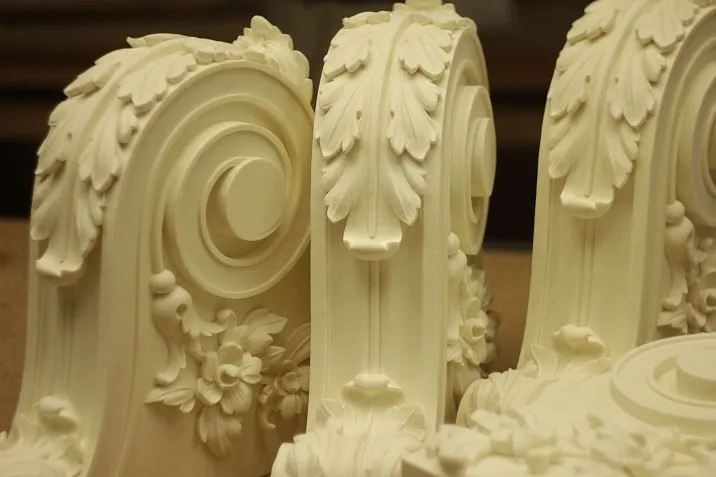
Polyurethane Rosettes Baroque compositions impress with their complexity and depth of relief. Each acanthus leaf, each scroll is meticulously crafted with mathematical precision, creating volumetric compositions capable of becoming the central element of ceiling decoration.
Neoclassicism: balance of tradition and modernity
Neoclassical style requires a special sense of proportion. Here, the opulence of baroque is not important, but noble restraint, clear proportions, and mathematical accuracy of ornaments. Polyurethane technologies are ideally suited for embodying neoclassical principles, allowing the creation of elements with flawless geometry.
Symmetry, repetition of motifs, clear boundaries between elements — all of this becomes possible thanks to the high precision of modern production. Deviations in size do not exceed ±0.5 mm, ensuring perfect element alignment and harmonious compositions.
Modern Interpretations
Minimalism with Accents
Modern minimalism does not completely reject decorative elements, but uses them selectively as accents in space. Simple geometric profiles, minimalist forms, absence of excessive detailing — these are the main principles of minimalist decor.
Surface quality plays an important role. In minimalist interiors, any defects become noticeable, so requirements for geometric precision and finish quality are especially high.
Loft and industrial aesthetics
Industrial style has brought the aesthetics of industrial objects into interior design. Rough textures, deliberate simplicity of forms, imitation of structural elements — all of this is reflected in modern collections of polyurethane decor.
Decorative beams imitating metal trusses, profiles styled as industrial pipes, elements with deliberately rough texture — such items allow creating authentic loft interiors.
Applications: from interior to exterior
The versatility of polyurethane opens up vast possibilities for its application in various fields — from delicate interior finishing to large-scale facade projects.
Interior solutions
Ceiling decoration
The ceiling is the fifth wall of a room, and its decoration plays a key role in creating the overall architectural image. Polyurethane cornices allow creating a smooth transition between walls and ceiling, visually altering the proportions of the room.
Multi-level cornices with hidden lighting create a "floating" ceiling effect, visually increasing the height of the room. LED strips placed in special grooves of the cornices provide soft diffused light, creating a cozy atmosphere.
Coffered ceilings are the pinnacle of ceiling decoration. A system of intersecting beams and decorative elements creates a volumetric composition, lending the room a sense of grandeur and formality. The lightness of polyurethane allows creating complex coffered structures without risking overloading load-bearing elements.
Wall decoration
Walls provide maximum opportunities for creative self-expression. Decorative panel-bouazeries create an atmosphere of aristocratic interiors, moldings allow structuring wall space, creating visual accents, framing works of art.
Vertical elements visually raise ceilings, horizontal elements — expand space. Properly placed moldings can radically change the perception of room proportions, making a narrow room visually wider, and low ceilings — higher.
Exterior application
Facade finishing
Polyurethane molding has revolutionized facade decoration. Resistance to atmospheric effects, frost resistance, and UV stability make this material ideal for outdoor use.
Facade cornices, pilasters, sashings, decorative panels can radically change the architectural appearance of a building. Installation does not require lifting equipment due to the lightweight nature of the elements.
Modern protective coatings allow polyurethane elements to resemble natural stone, aged metal, or valuable wood. Coloring technologies ensure color retention for 15–20 years without the need for renewal.
Technical specifications: the science of precision
The quality of polyurethane products is determined by numerous technical parameters, understanding which is critically important for the correct selection of materials.
Physical and mechanical properties
Strength characteristics
The tensile strength is 35–55 MPa, comparable to aluminum alloys. Under compression, the material withstands loads up to 80–100 MPa. The modulus of elasticity varies from 1500 to 3000 MPa depending on the polymer composition.
These characteristics ensure the longevity of products under variable loads. Temperature deformations of buildings, wind loads, and vibrations from traffic — all of these polyurethane elements withstand without compromising structural integrity.
Temperature stability
The operating temperature range is from -50°C to +80°C for standard compositions and from -60°C to +120°C for special heat-resistant modifications. The linear expansion coefficient is minimal — 6×10⁻⁵ 1/°C, which is several times lower than that of most construction materials.
This means that seasonal temperature fluctuations practically do not affect the dimensions of decorative elements, excluding the appearance of gaps at joints and deformation of fastening nodes.
Operational characteristics
Durability and resistance to aging
Properly manufactured polyurethane products retain their properties for 25–30 years without visible changes. Special stabilizers prevent oxidative degradation of the polymer, UV filters protect against solar radiation.
Accelerated aging tests show that even after 5000 hours of exposure to intense ultraviolet radiation, changes in physical and mechanical properties do not exceed 5%, which is considered negligibly small.
Chemical resistance
Polyurethane is inert to most household chemicals. It does not degrade under the influence of detergents, water-based solvents, weak acids, and alkalis. The material does not absorb odors and does not support microbial growth.
Quality criteria: how to distinguish excellence
The market offers polyurethane products of varying quality — from elite to outright mediocre. The ability to distinguish quality products from substitutes is key to a successful project.
Visual quality assessment
Geometric accuracy
Quality products have ideal geometry along the entire length. The profile must be maintained with precision ±0.5 mm, edges must be straight and sharp. Any deviations in geometry will cause problems during installation and spoil the overall impression of the finish.
To check geometry, simply place several elements next to each other. Quality products fit together perfectly, without gaps or steps.
Surface quality
The surface must be absolutely smooth, without pores, pits, or chips. All relief details must be clearly defined, without blurred or underdeveloped areas. Special attention should be paid to deep relief areas — defects in molding often manifest here.
Material uniformity
Quality polyurethane has uniform density throughout the entire volume of the product. Void spaces, delamination, and inclusion of foreign materials are unacceptable. A quality product produces a dull, uniform sound when tapped.
The database contains results of material technical tests by various parameters: strength, wear resistance, moisture resistance, fire safety. This information is critically important for correct material application.
Density control
The density of quality decorative elements should be 450–650 kg/m³. Lighter products may be insufficiently strong, while heavier ones may contain excess fillers that degrade material properties.
Bending tests
Quality polyurethane has a certain degree of elasticity. When carefully bending a thin element, the material should deform elastically, returning to its original shape after the load is removed. Brittleness or excessive softness indicates violations of the manufacturing process.
Installation technologies: the path to perfection
Quality installation is half the success of any decorative project. Modern installation technologies for polyurethane molding have significantly simplified compared to traditional methods, but require adherence to certain rules.
Preparation Stage
Planning and material calculation
A successful project begins with careful planning. It is necessary to create a detailed plan for placing decorative elements, indicating all dimensions, alignment with architectural elements of the room, calculating the required amount of materials with allowance for trimming and possible defects.
Modern 3D modeling programs allow creating a virtual model of the future interior, assessing the visual impact of decorative elements, and making adjustments before beginning installation work.
Preparation of the base
The base for mounting decorative elements must be strong, flat, dry, and free of dust and contaminants. The moisture content of the base should not exceed 4% for mineral surfaces and 8% for wooden surfaces.
Unevenness of the base exceeding 2 mm per linear meter requires leveling. For this purpose, special leveling compounds are used, ensuring an ideal flat surface for installing decorative elements.
Fastening Technology
Adhesive connections
Modern polyurethane adhesives provide bond strength exceeding the strength of the material itself. The setting time is 10-15 minutes, allowing adjustment of element positions during installation.
Adhesive is applied using a notched trowel in an even layer on both surfaces to be joined. The adhesive layer thickness should be 2-3 mm. After application, a technological pause of 2-3 minutes is maintained for partial solvent evaporation.
Mechanical fastening
For particularly critical elements or under increased loads, the adhesive joint is reinforced with mechanical fasteners. Special concealed-head screws are used, which are subsequently filled with putty and become invisible after installation.
The distance between mechanical fastening points is determined by the weight of the element and operating conditions, but should not exceed 600 mm for horizontal elements and 400 mm for vertical ones.
Final finishing
If gaps remain at the edges, fill them with sealant or putty, and after drying, the surface can be sanded.
Joints between elements are filled with special acrylic sealants or polyurethane putties. The filling material must have the same elasticity as the base material to prevent cracking due to thermal deformation.
After painting, the joint filling should be completely invisible. This requires high skill and the use of special tools to form an ideal joint profile.
Painting and final finishing
Most polyurethane products are supplied in a basic white color and require final finishing to integrate into the overall interior concept.
Preparation for painting
Cleaning and degreasing
The surface of the items must be thoroughly cleaned of dust, fingerprints, and adhesive residue. For degreasing, special compounds without aggressive solvents are used, which could damage the polyurethane.
Priming
Priming ensures reliable adhesion of paint coatings to polyurethane. Special primers compatible with polyurethane substrates are used. Primer is applied in a thin, even layer and dried for 4-6 hours at room temperature.
Painting technologies
Water-dispersible paints
The most popular type of coatings for interior use. Modern acrylic paints provide even coverage, dry quickly, and have no odor. A wide color range allows selecting any shade.
Paint is applied in two to three coats with intermediate drying. Each layer must be thin and even. Using high-quality brushes and rollers ensures a flawless surface without streaks or runs.
Special decorative coatings
Modern technologies allow creating coatings that mimic various materials — marble, precious wood, patinated metal. Multi-layer painting systems include a base color, decorative layers, and protective coating.
Applying decorative coatings requires special skills and tools. The effect is achieved through various techniques — using sponges, rags, and special brushes that create a distinctive surface texture.
Economic aspects of use
Choosing polyurethane molding is not only an aesthetic but also an economically justified decision, especially when considering long-term prospects.
Cost comparison analysis
Initial investments
The cost of polyurethane elements is 60-80% of the price of quality gypsum analogs and 30-40% of the cost of natural stone elements. Meanwhile, polyurethane's operational characteristics often exceed traditional materials.
Cost savings are achieved not only on the cost of the items themselves but also on installation work. The ease of installing polyurethane elements allows reducing labor costs by 40-60% compared to gypsum molding.
Operational expenses
Polyurethane molding requires virtually no maintenance throughout its entire service life. The absence of need for regular repairs, replacement of damaged elements, or special care makes operational expenses minimal.
The ability to repaint multiple times allows updating the interior without replacing decorative elements. This is especially important for commercial spaces where periodic design updates are required.
Increase in property value
Quality finishing using decorative elements increases the market value of real estate by 15-25%. This is especially relevant for luxury housing, where aesthetic characteristics play a decisive role in pricing.
Ecological aspects and safety
Modern polyurethane molding production is based on principles of ecological responsibility and human health safety.
Ecological safety
Quality polyurethane does not contain formaldehyde, toluene, xylene, or other harmful substances. Emission of volatile organic compounds does not exceed norms for children's facilities. The material does not emit odors and does not absorb foreign aromas.
Polyurethane products have environmental safety certificates confirming compliance with the strictest hygiene requirements. They can be used in children's rooms, medical facilities, and food production.
Disposal and recycling
At the end of their service life, polyurethane products are subject to recycling. Mechanical recycling allows obtaining secondary raw material for producing various technical items. Energy recovery ensures high thermal energy output without producing toxic combustion byproducts.
Market Development Trends
The market for polyurethane molding continues to develop, reflecting changes in architectural trends and technological capabilities.
Technological Innovations
Nanotechnology in decorative materials
The introduction of nanotechnology opens new possibilities for creating materials with unique properties. Self-cleaning surfaces with titanium dioxide nanoparticles, antibacterial coatings with silver ions, thermochromic additives that change color — all of this is already a reality of modern production.
Digital production technologies
3D printing and computer milling allow creating decorative elements of any complexity according to individual projects. Production times are reduced to several days, and execution accuracy reaches the micrometer level.
Design Trends
Ecological minimalism
Rising consumer ecological awareness influences design preferences. Simple forms, natural colors, absence of excessive decoration — these are the main principles of modern ecological design.
Smart interiors
Integration of decorative elements with "smart home" systems opens new possibilities. Cornices with built-in lighting controlled by voice commands, motion sensors integrated into decorative panels — the future has already arrived.
Regional application specifics
Climate conditions in various regions influence the choice of materials and the technology of their application.
Northern regions
Extremely low temperatures require the use of special frost-resistant adhesive and sealant compositions. Polyurethane retains elasticity down to -50°C, but mounting materials must meet the conditions of operation.
The short construction season makes the possibility of year-round installation of polyurethane elements indoors especially valuable.
Southern regions
Intense solar radiation and high temperatures require the use of UV-resistant materials and special protective coatings. Modern compositions ensure color and property retention for 15-20 years without renewal.
Coastal zones
High humidity and salty air create an aggressive environment for many materials. Polyurethane demonstrates exceptional resistance to marine atmosphere, making it an ideal choice for coastal regions.
Professional recommendations for selection
Choosing quality polyurethane molding requires consideration of multiple factors and nuances, knowledge of which will help avoid mistakes and disappointments.
Manufacturer evaluation
Reputation and work experience
Choose manufacturers with a long history and positive reputation in the market. Experienced companies better understand client needs, have refined technological processes, and ensure consistent product quality.
Review the portfolio of completed projects, customer reviews, presence of quality and standard compliance certificates. Serious manufacturers are always ready to provide detailed technical information about their products.
Production capacities
Modern production of polyurethane molding requires significant investment in equipment and technology. Presence of own production, modern equipment, quality control systems — important factors when choosing a supplier.
Technical expertise of products
Documentation and certificates
Quality products are always accompanied by a complete set of technical documentation — certificates of compliance, quality passports, installation and operation instructions.
Pay special attention to environmental and fire safety certificates, especially if the product is intended for use in children's facilities or public buildings.
Warranty obligations
Serious manufacturers provide a warranty on their products for at least 5 years. The warranty should cover not only manufacturing defects but also compliance of declared technical characteristics with actual product properties.
Conclusion: Investments in beauty and quality of life
Polyurethane moldings buy Today — it is the opportunity to realize the most daring design ideas, create an interior that will delight and inspire for many years. Modern production technologies have reached such a level of perfection that polyurethane products not only do not fall short of traditional materials, but also surpass them on most parameters.
Choosing polyurethane molding means investing not just in decorative elements, but in quality of life, in creating a space that reflects your taste and individuality. This decision will pay off not only aesthetically, but also practically — durability, ease of maintenance, and the possibility of interior transformation.
The modern market offers a vast variety of solutions — from budget options to exclusive premium-class items. The key to success — choosing the right supplier, understanding your needs, attention to details and quality.
Technologies continue to evolve, opening new opportunities for creativity and self-expression. Nanotechnology, digital production, integration with "smart home" systems — all of this makes polyurethane molding not just a decorative material, but a high-tech tool for creating modern interiors.
The future belongs to materials that combine beauty, functionality, ecological safety, and accessibility. Polyurethane molding already embodies these principles today, offering everyone the opportunity to create a dream space.
Buy polyurethane molding: secrets of the superiority of modern decorative material | Company STAVROS