












































































Article Contents:
- Barnaul and its climate: challenges for finishing materials
- Harsh reality of continental climate
- Humidity and precipitation: second factor in selection
- Sunshine: an unexpected threat
- Local market specifics of Barnaul
- Supply structure: from hypermarkets to specialized stores
- Price specificity of the region
- Seasonality of demand and purchasing strategy
- Selecting profile according to local conditions
- Optimal sizes for Barnaul apartments
- Style selection: what is popular in Barnaul
- Color and final finish
- Polystyrene skirting boards: pros and cons
- Uncontested Advantages
- Objective Disadvantages
- Comparison with alternative materials
- How to organize installation: from planning to finish
- Preparation stage: calculation and material purchase
- Material acclimatization: critical moment for Barnaul
- Surface preparation: guarantee of longevity
- Installation Technology: Step-by-Step Guide
- Color solutions and decorative finishing
- Resources and installation complexities
- DIY installation: feasible for beginners?
- Professional services: when is it justified?
- Typical problems and their solutions
- Installation specifics in Barnaul's climate
- Examples of projects in Barnaul
- Residential apartments: classic genre
- Commercial properties: practicality and prestige
- Country houses: scale and possibilities
- Public spaces: durability in operation
- Where to buy in Barnaul: overview of sales points
- Large construction stores
- Specialized stores and small shops
- Online stores with delivery
- Conclusion

Barnaul - a city of contrasts, where summer heat above +38 degrees is replaced by winter frosts down to minus 50. It is the climatic features of the capital of the Altai Krai that dictate strict requirements for finishing materials. Polystyrene decorative elements have gained recognition among Barnaul residents due to their unique combination of frost resistance, practicality, and affordable price. In the sharply continental climate, where the annual temperature amplitude reaches 90 degrees, choosing the right materials becomes not just an aesthetic issue, but a necessity.
MarketCornices Barnaul polystyreneDemonstrates steady growth: more and more Barnaul residents are turning away from traditional materials in favor of modern polymer solutions. What makes polystyrene decoration an ideal choice for the Siberian climate? How to organize quality installation under significant temperature fluctuations? What local market features should be considered when purchasing? All this — in detail in our article.


Barnaul and its climate: challenges for finishing materials




The harsh reality of the continental climate
Barnaul is located in the zone of a sharply continental climate, creating extreme conditions for any construction and finishing materials. The average annual temperature is only +2.6 degrees, but this figure does not reflect the true picture. In winter, the thermometer regularly drops to -30 to -40 degrees, and the absolute minimum reached -51.5 degrees. In summer, the temperature rises to +35-38 degrees, creating a colossal temperature difference of 80-90 degrees.
Such temperature swings are a real test for interior decorative elements. Materials expand when heated and contract when cooled, which can lead to cracking, peeling from the surface, and deformation. Gypsum molding, popular in the European part of Russia, often develops microcracks within a year or two of use in Barnaul conditions. Wooden elements dry out from low humidity in winter and swell during rainy summer months.
Polystyrene has frost resistance down to minus 40 degrees and retains its properties when heated up to +60-70 degrees. Its coefficient of thermal expansion is minimal, which eliminates deformation during seasonal temperature fluctuations. This is whyBarnaul polystyrene decorative corniceit has become the optimal solution for local conditions.
Our factory also produces:


Humidity and precipitation: the second factor in selection
The average annual precipitation in Barnaul is 433 mm, with 65 percent falling during the warm season. Relative air humidity fluctuates from 55 percent in summer to 79 percent in winter. Apparently, these are low figures, but sharp fluctuations in humidity create additional stress on finishing materials.
In winter, with central heating on, humidity in apartments drops to 20-30 percent — critically low levels at which natural materials lose moisture and crack. In spring and autumn, when heating is off and the outdoors is damp and cold, humidity in rooms can rise to 70-80 percent, causing swelling and deformation of materials.
Polystyrene is absolutely inert to moisture: its water absorption is only 0.2 percent when fully submerged for a day. The material does not swell, does not rot, does not develop mold.Barnaul plinth buy polystyreneYou can be confident that it will serve for decades even in rooms with unstable humidity.
Get Consultation
Sunshine: an unexpected threat
Barnaul is one of the sunniest cities in Russia: the duration of sunshine here is 2180 hours per year, exceeding the figures for Sochi. Large windows, characteristic of Siberian housing, allow a great deal of ultraviolet radiation, which destructively affects many materials.
Ordinary expanded polystyrene does indeed yellow under direct sunlight. However, modern manufacturers add UV stabilizers to the composition, which protect the material from ultraviolet radiation. High-density polystyrene products maintain whiteness and structural integrity even under constant sun exposure. The key is to choose products from reputable manufacturers with appropriate certifications.
Local market specifics of Barnaul
Supply structure: from hypermarkets to specialized stores
The construction market in Barnaul has undergone significant changes in recent years. If previously the main source of finishing materials were markets and small shops, today the city has large chain hypermarkets, specialized stores, and active online trade. This has created healthy competition and led to lower prices while simultaneously improving the quality of offered products.
Large construction hypermarkets — AAA Alterra, Hermes-Strой, Formula M2 network — offer a basic assortment of polystyrene decorative elements. Here you can find classic ceiling cornices, standard-sized baseboards, simple moldings. Price range — average, product quality corresponds to the mass segment. The advantage of hypermarkets — the ability to immediately pick up the product and receive basic consultation.
Specialized stores for molding decoration are fewer in number but offer a broader and higher-quality assortment. Here you can find designer collections, elements of complex shapes, items with imitation of hand molding. Prices are higher than in hypermarkets, by 20-40 percent, but quality is commensurate. Professional consultants will help select elements in a unified style, calculate the required quantity, and provide installation recommendations.
Online stores with delivery from Moscow, Novosibirsk, and other major cities are actively capturing the Barnaul market. The advantages are obvious: a wide selection, detailed descriptions, customer reviews, often — lower prices due to the absence of costs for maintaining retail space. Delivery takes 3-7 days, cost depends on order volume and ranges from 500 to 2000 rubles.
Regional pricing specifics
Prices for polystyrene decorative elements in Barnaul are lower than in Moscow by approximately 10-15 percent. This is due to a lower level of population income and correspondingly lower purchasing power. However, the difference is not as significant as in other product categories, since major manufacturers are located in the European part of Russia, and logistics costs add their own percentage to the price.
Average retail prices in Barnaul as of October 2025: ceiling cornices — from 180 to 1000 rubles per linear meter depending on width and profile complexity; baseboards — from 120 to 550 rubles per meter; wall moldings — from 90 to 800 rubles. Prices in specialized stores are 15-25 percent higher than in hypermarkets, due to higher quality products and expanded service.
An interesting feature of the Barnaul market — high demand for mid-priced products. Barnaul residents are willing to pay for quality, but are not inclined to overspend on the premium segment. Therefore, items in the range of 250-450 rubles per meter — decent quality at a reasonable price — are the most popular.
Seasonality of demand and purchasing strategy
In Barnaul, the demand for finishing materials clearly exhibits seasonality. The peak occurs in April-June, when the active repair season begins. During this period, prices are at their maximum, and the product range in stores may be limited due to high demand. The second surge in activity occurs in September-October, when garden work concludes and people shift focus to urban housing.
Winter months - January, February, March - are periods of low activity on the construction market. Sellers are eager to move inventory and are willing to offer discounts that can reach 20-30 percent. For those planning repairs in advance, this is the ideal time to purchase materials.Buy polystyrene cornices in BarnaulIt is significantly more advantageous in winter than during peak season.
Important note: when purchasing and transporting decorative elements in winter, extra care must be taken. Polystyrene becomes more brittle in cold weather, and careless loading/unloading may result in cracks. After delivery, allow the material to acclimate in a warm room for 48-72 hours before installation.
Profile selection based on local conditions
Optimal sizes for Barnaul apartments
Barnaul's housing stock is very diverse: from old wooden houses and Khrushchev-era buildings with ceiling heights of 2.5 meters to modern new constructions with ceilings of 2.7-3.0 meters. The choice of decorative element sizes directly depends on the room's parameters.
For typical Soviet-era apartments with low ceilings, optimal cornices are 50-80 mm wide. More substantial profiles visually lower the already low ceiling, creating a sense of pressure. For such rooms, baseboards are better chosen at 60-80 mm height - they protect the lower wall section but will not appear bulky.
Modern apartments with ceilings of 2.7-3.0 meters allow for more expressive decoration. Here, cornices 100-150 mm wide, tall baseboards 100-120 mm, and wide moldings for creating wall panels are appropriate. Spacious rooms require more substantial elements; otherwise, the decoration will be lost and fail to make the desired impression.
Private homes with high ceilings of 3.0-3.5 meters offer ample room for design solutions. Multi-level cornices can be used, various molding types can be combined, and complex architectural compositions can be created. Profiles 150-200 mm wide will look harmonious and emphasize the interior's status.
Style selection: what is popular in Barnaul
Barnaul is a conservative city where time-tested solutions are valued. Classic styles are most popular: neoclassicism, modern classicism, Scandinavian minimalism. Avant-garde, high-tech, loft styles are less common and mostly found in apartments of young people or premium-class modern new constructions.
For classic interiors, cornices with moderate relief, imitating traditional plaster molding, are chosen. Popular profiles feature repeating ornamentation - meanders, floral motifs, geometric patterns. Color - predominantly white or ivory shades, creating a sense of purity and freshness.
The Scandinavian style, gaining popularity in recent years, requires more minimalist forms. Smooth or minimally textured profiles, strict lines, absence of decorative excesses. Such decoration is ideal for small apartments, visually expanding the space and filling it with light.
An important feature of Barnaul preferences - practicality above all. Complex relief surfaces, which accumulate dust, are less popular than smooth or shallow-relief surfaces. Climate dictates its conditions: a long winter with heating creates a lot of dust, and residents prefer surfaces that are easily cleaned with a damp cloth.
Color and final finish
The vast majority of polystyrene decorative elements are supplied in white, ready for painting. This is a universal solution, allowing decoration to be adapted to any interior color scheme. In Barnaul, the following final finish options are most popular.
Classic white - eternal classicism that never goes out of style. After installation, cornices and baseboards are painted with acrylic paint to match the ceiling and walls or contrast with them. White decorative elements visually expand the space, giving the interior a fresh and light feel.
Painting to match wall color - a popular technique creating a monolithic surface. Baseboards and moldings are painted to match the main wall finish, becoming its continuation. This visually increases the room's height and creates a modern minimalist look.
Contrasting combinations are used less frequently but produce a striking effect. Dark baseboards against light walls or vice versa clearly structure the space, making the interior more graphic. Popular combinations include white with gray, beige, or blue tones.
Imitating natural materials - wood, stone, metal - is achieved through special painting techniques. Experienced masters create effects of patina, artificial aging, and metallic surfaces. Such finishing requires a professional approach, but the result impresses with its realism.
Polystyrene baseboards: pros and cons
Uncontested advantages
To understand whypolystyrene baseboards pros and conswhich are actively discussed on construction forums, have become so popular in Barnaul, we will consider their key advantages in relation to local conditions.
Frost resistance is the first and main advantage for the Siberian climate. Polystyrene retains its properties at temperatures down to minus 40 degrees without cracking, deformation, or loss of strength. In unheated rooms, on balconies, and in suburban homes with intermittent heating, the material performs flawlessly.
Moisture resistance is the second critically important factor. The water absorption of polystyrene is less than 0.5 percent; the material does not rot, swell, or develop mold even under high humidity. This makes it an ideal choice for kitchens, bathrooms, and toilets — rooms with unstable microclimate.
Lightweight — a quality that simplifies transportation and installation. A standard skirting board weighs only 150-300 grams per meter, and a cornice weighs 200-400 grams. One person can easily transport the material throughout an apartment and install it themselves without helpers. No special tools or professional skills are required.
Ease of processing — polystyrene can be easily cut with a fine-toothed hacksaw or a stationery knife. Angles are formed using a miter box without chips or cracks. If necessary, an element can be sanded with a file or sandpaper to achieve perfect fit against uneven surfaces.
Affordable price is the most important factor for mass consumers. The cost of polystyrene elements is 2-3 times lower than similar polyurethane ones, and 5-10 times lower than gypsum molding. With a limited budget, this allows creating a beautiful interior without significant financial expenses.
Ecological safety — modern polystyrene does not emit harmful substances during normal use, is safe for health, and has no odor. The material is chemically inert and does not react with other finishing materials, water-based paints, or adhesives.
Objective disadvantages
Fairness requires mentioning the drawbacks of polystyrene decorative elements so that buyers have a complete picture before making a decision.
Brittleness — the main drawback of the material. Polystyrene is easily damaged by impacts, sharp objects, or careless handling during transport. During use, baseboards may be damaged by vacuum cleaners, mops, or furniture. However, minor damages can easily be repaired with spackling and touch-up paint.
Flammability — polystyrene belongs to combustible materials of class G3-G4. When exposed to open flame, it melts and sustains combustion, releasing toxic products. However, under normal use in residential spaces, the risk of fire is minimal. Modern manufacturers add flame retardants to reduce flammability.
Limited color palette upon purchase — practically all items are delivered white for painting. If colored elements are needed, they must be painted manually or ordered painted from the manufacturer at an additional cost. Nevertheless, most buyers consider this more of an advantage — the ability to create exactly the shade needed.
Possibility of yellowing under prolonged UV exposure — characteristic of cheap items without UV stabilizers. Quality products do not have this drawback. It is important to choose reputable manufacturers and avoid suspiciously low prices.
Less detailed relief compared to polyurethane — due to lower material density, fine decorative details may not be rendered as precisely. For most applications, this is not critical, but may be considered a drawback by admirers of high-artistic molding.
Comparison with alternative materials
To objectively evaluate polystyrene, compare it with the main competitors on the Barnaul market for decorative elements.
Polystyrene vs. polyurethane: polyurethane is denser, stronger, has a sharper relief, and never yellows. However, it is 2-3 times more expensive, heavier, and more difficult to process. For most applications in standard apartments, the quality difference is not critical enough to pay double or triple the price.
Polystyrene vs. gypsum: gypsum is more ecological, allows creating unique shapes, and has a noble matte surface. However, it is heavy, brittle, afraid of moisture, 5-10 times more expensive, and requires professional installation. In Barnaul’s climate with its temperature fluctuations, gypsum often cracks, requiring regular repairs.
Polystyrene vs. wood: wood is natural, warm, and has a noble texture. However, it is expensive, heavy, requires special care, prone to rotting in high humidity, and cracks when drying out. Wooden baseboards are 3-5 times more expensive than polystyrene ones, with significantly less practicality.
Polystyrene vs. PVC: PVC baseboards are cheaper, have built-in cable channels, and are easy to install on clips. However, they look obviously plastic, are unsuitable for classic interiors, and are limited in design. Polystyrene looks more noble and offers more creative possibilities.
How to organize installation: from planning to finishing
Preparation stage: calculation and purchase of materials
Successful installation begins long before the first tool movement — with careful planning and precise calculation of required materials. For Barnaul, with its climatic peculiarities, this stage is especially important.
First step — precise room measurements. Measure the perimeter of each room where decoration will be installed. Account for all protrusions, niches, door and window openings. Record dimensions to the nearest centimeter — measurement errors will result in insufficient material or excess that is difficult to use.
Second step — calculation of linear meters with allowance for waste. Each room corner requires two 45-degree cuts, yielding 15-25 cm waste per side. With a standard profile length of 2 meters and a room with four corners, losses will be about 1-1.5 meters. Add 10-15 percent extra to the calculated length for possible cutting errors and damage during transport.
Third step — selection of corner elements and accessories. Ready-made corner elements significantly simplify installation, especially for beginners. They eliminate the need for precise 45-degree trimming and guarantee perfect joints. However, they are more expensive and may not fit all profiles. Additionally, you may need rose decorations for light fixture mounting points, consoles, or additional molding for decorative purposes.
Fifth step — purchase of consumables. You will need adhesive (acrylic or MS-polymer based), spackling for joints, primer, and paint if coloring is required. For a standard two-room apartment, you will need 3-5 tubes of adhesive (300 ml each), 2-3 kg of spackling, 1-2 liters of primer, and 3-4 liters of paint.
Fifth step — preparation of tools. The minimum set includes: a miter saw for angled cuts, a fine-toothed hacksaw, a tape measure, a pencil, a glue gun, spackling knives of various widths, sandpaper, painter’s tape, and clean rags for removing excess glue. A professional set also includes a circular saw, a laser level, and an airless paint sprayer.
Material acclimatization: a critical moment for Barnaul
In Barnaul’s significant temperature fluctuations, the material acclimatization stage before installation becomes especially important. Ignoring this step is a common cause of problems: gaps at joints, decoration peeling, and deformations.
After delivery, especially during winter, bring packaged elements into the room where installation will take place. The room temperature should be stable, within the range of +18 to 24 degrees. Do not unpack the material immediately — allow it to rest for at least 24 hours, preferably 48-72 hours. This is necessary to equalize the temperature of the profiles with the room temperature.
If starting installation with cold material, during its heating to room temperature, thermal expansion will occur. Elements that were tightly fitted during installation will separate, forming gaps. The reverse situation — installing warm material on a hot summer day in a room with an operating air conditioner — will cause the decoration to contract after cooling.
Important point: acclimatization must occur horizontally on a flat surface. Do not place profiles vertically — they may deform under their own weight. Place soft material — cardboard, polystyrene, fabric — under the bottom row to prevent contact with the cold floor.
Check the humidity in the room. Optimal conditions for installation are 50-60 percent. At higher humidity, the glue will dry slower; at lower humidity, it will dry faster but poorly. In winter, with heating on, humidity often drops to 20-30 percent — use a humidifier or hang wet towels on radiators.
Surface preparation: the key to longevity
The quality of installation depends 70 percent on the preparation of the base. Polystyrene elements are glued directly to walls or ceilings, and any surface defects will affect the result.
Clean the installation area from dust, dirt, and grease stains. Use a vacuum cleaner, then wipe with a damp cloth with detergent. Especially thoroughly clean kitchens — grease residue prevents adhesive bonding. After wet cleaning, allow the surface to dry completely.
Check the strength of the base. Remove old whitewash, peeling paint, and crumbling plaster. Simple test: stick a piece of painter’s tape and quickly pull it off. If particles of the coating remain on the tape, the surface requires additional preparation. Sand weak areas with a putty knife until reaching a solid base.
Prime the surface with an acrylic deep-penetration primer. This will strengthen the base, improve adhesive bond, and reduce absorption. Apply the primer with a brush or roller in one to two coats, allowing intermediate drying for 2-4 hours. Priming is especially important for loose, porous, highly absorbent surfaces.
Level significant unevenness. If the wall has height differences exceeding 3-5 mm over the profile length, the baseboard or cornice will not fit tightly, resulting in gaps. Trim protrusions and fill depressions with spackle. After drying, sand smooth with sandpaper. A perfectly level base is not required, but critical defects must be corrected.
Installation technology: step-by-step instructions
Start installation from the most visible corner of the room — usually the corner that first catches the eye upon entry. If pre-cut corner pieces are available, use them. If not, cut the profiles at a 45-degree angle using a miter box.
Mitering corners — the most critical step. Place the profile in the miter box with the front side up, pressing it firmly against the back wall. For inside corners, the bottom part of the profile should be longer than the top; for outside corners, it should be the reverse. Cut smoothly without pressing down to avoid chipping. Check the accuracy of the cut by fitting two pieces together — the gap should not exceed 0.5–1 mm.
Applying adhesive — next step. Use a special acrylic or MS-polymer-based adhesive for polystyrene. Liquid nails also work, but choose solvent-free formulations — solvents may damage the material. Apply adhesive evenly and continuously with a roller over the entire length of the contact surface. For ceiling cornices — on both surfaces (ceiling and wall); for baseboards — also on both sides.
Installing the element — press the profile into place, aligning it with the marking. Press evenly along the entire length for 30–60 seconds. The adhesive should slightly protrude at the edges — this indicates sufficient quantity. Immediately wipe off excess with a damp sponge. If the adhesive does not protrude, it means there is not enough — loosen the pressure, add more adhesive, and press again.
Temporary fixation — while the adhesive is not yet set, decorative elements may slide under their own weight. Secure them with painter’s tape, attaching to the ceiling or wall. You can also use thin finishing nails or tacks in inconspicuous areas — remove them after the adhesive dries and fill the holes with spackle. Drying time for the adhesive — 12–24 hours, depending on type and room conditions.
Joining elements — apply adhesive not only to the surfaces contacting the wall or ceiling, but also to the ends of the joining profiles. Use a special joint adhesive or standard construction adhesive. Press the second element against the first, achieving a tight joint without gaps. Do not immediately remove excess adhesive protruding at the joint — let it partially dry (30–60 minutes), then trim with a putty knife or blade.
Finishing: perfection in details
After the adhesive has fully dried (24–48 hours), proceed with finishing. Inspect all joints — there may be small gaps or fitting inaccuracies. Fill them with acrylic spackle using a narrow putty knife. Level the spackle with the decorative surface, immediately wiping off excess with a damp sponge.
After the spackle dries (2–4 hours), sand the repaired areas with fine-grit sandpaper. Movements should be light and circular — avoid pressing hard to prevent damaging the polystyrene surface. Wipe the decor with a dry cloth to remove sanding dust.
Priming before painting — mandatory step if planning to paint. Use acrylic primer, applying with a brush in one coat. Primer fills pores, equalizes absorption, and ensures better paint adhesion. Drying time — 2–4 hours.
Paint using high-quality interior acrylic paint. Apply a minimum of two coats with intermediate drying. For smooth surfaces, use a short-pile roller; for textured surfaces, use a medium-sized brush. Apply the first coat in longitudinal strokes, the second in crosswise strokes for better coverage. If an ideal smooth finish is desired — lightly sand the first coat after drying before applying the second.
Protective coating — for high-traffic areas (kitchens, hallways), we recommend a matte or semi-gloss acrylic finish. It creates a protective film, simplifies maintenance, and increases resistance to stains and abrasion. One coat is sufficient.
Resources and installation complexity
DIY installation: realistic for beginners?
Many Barnaul residents prefer to perform repairs themselves, saving on professional services. How realistic is it to installPolystyrene floor baseboardbaseboards or ceiling cornices without experience or special skills?
Objectively assessing — it is entirely realistic, provided you are careful, patient, and follow instructions. Installing polystyrene decor does not require professional equipment or years of experience. Basic carpentry skills, the ability to use a tape measure and saw — that’s all that’s needed.
Time required for beginners: a standard 18–20 sq. m room with ceiling cornices and baseboards will take 10–14 hours of pure time. This includes surface preparation, marking, cutting elements, installation, and joint filling. Finishing (sanding, priming, painting) adds another 6–8 hours. Total — a full workweek in the evenings or two weekend days.
Financial savings are significant. Professional installation services in Barnaul cost 200–500 rubles per linear meter depending on complexity. For a standard two-room apartment, this is 15,000–30,000 rubles just for labor. Savings from DIY installation are obvious.
Risks of DIY work: possible errors during corner cutting (damaged cuts), poor joint filling (visible seams), uneven painting. However, most errors are easily corrected with additional spackle and touch-ups. Critical irreversible defects when working with polystyrene are practically nonexistent.
Professional services: when is it justified?
Despite its apparent simplicity, there are situations when hiring professional installers is justified — and even necessary.
Complex room geometry — bay windows, rounded corners, multi-level ceilings, complex architectural elements require specialized skills and experience. A beginner may struggle to accurately fit elements in such conditions. A professional knows techniques for working with complex shapes and will achieve an ideal result.
Large-scale work — if renovation is being done throughout an apartment or cottage, DIY installation will take weeks. A crew of two professionals will complete the entire job in 2–3 days. If time is critical — it’s better to hire professionals.
Design projects — creating multi-level cornices, complex molding panels, and combined compositions require a professional approach. The designer develops the project, and installers accurately bring it to life. It is extremely difficult to implement a complex design without experience on your own.
Quality guarantee — reputable companies provide a warranty on their work for 1 to 3 years. If, after half a year, the decor peels off or cracks appear — the professionals will fix the defects free of charge. With DIY installation, full responsibility lies with you.
Installation service costs in Barnaul vary. Private contractors charge 200–350 rubles per linear meter for simple baseboard or cornice installation. Specialized companies — 300–500 rubles. Complex work (multi-level structures, panel creation) — 500–1000 rubles per meter. Painting adds 100–200 rubles per meter.
Typical problems and their solutions
Even with careful adherence to technology, problems may arise. Let's consider the most common ones and ways to resolve them.
Gaps at joints are a common problem, especially at corners. Causes: inaccurate cutting, shrinkage of adhesive, temperature deformations. Solution: fill gaps with white acrylic putty or sealant. Apply carefully, smooth with a wet finger or narrow putty knife. After drying, paint to match.
Detached decoration occurs due to poor surface preparation, insufficient adhesive quantity, or low-quality adhesive. Solution: carefully remove the detached element, clean it and the base of old adhesive, apply fresh adhesive, and reattach. Secure with painter's tape until dry.
Deformation due to temperature fluctuations - a rare problem, but possible in Barnaul under significant temperature changes. Solution: ensure a stable temperature regime indoors, avoid sharp fluctuations. When installing, leave minimal compensatory gaps at corners (0.5-1 mm).
Deformation due to temperature fluctuations — a rare problem, but possible in Barnaul under significant temperature changes. Solution: ensure a stable temperature regime indoors, avoiding sharp fluctuations. When installing, leave minimal compensatory gaps at corners (0.5–1 mm).
Installation specifics for Barnaul climate
Installation specifics for the Barnaul climate
The climate of Barnaul dictates certain installation specifics that must be considered for long-term results.
Winter installation is possible but requires adherence to conditions. Indoor temperature must be no lower than +15 degrees, ideally +18-22 degrees. Material must be acclimatized for 48-72 hours before installation. Use adhesives suitable for low temperatures. Winter drying time increases by 30-50 percent - account for this when planning work.
Installation in new constructions requires special attention. New homes undergo shrinkage during the first year, walls may shift slightly. It is recommended to wait at least 6-8 months after handing over the house before installing decoration. If waiting is impossible, use elastic adhesives that compensate for minor foundation movements.
Installation in homes with intermittent heating (cottages, suburban homes) - the most complex case. Temperature fluctuations may reach 40-50 degrees between heated and unheated periods. Use the highest quality, high-density polystyrene, MS-polymer based elastic adhesives, and always paint decoration with elastic paint. Make compensatory gaps at joints slightly larger than usual.
Examples of objects in Barnaul
Examples of projects in Barnaul
Residential apartments: genre classic
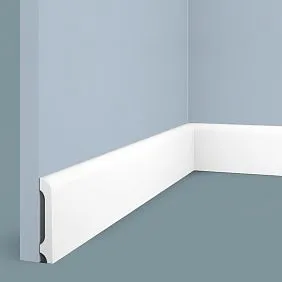
Height 100 mm with a classic profile installed throughout the apartment, creating a unified space.white polystyrene baseboardwith a height of 100 mm and a classic profile, installed throughout the apartment, creating a unified space.
The living room features ceiling cornices 120 mm wide with moderate relief, imitating plaster molding. Additional decoration includes wall moldings creating panels on the accent wall behind the sofa. All elements are painted in classic white, contrasting with gray-beige walls. Result - an elegant interior that does not look cheap, despite the affordable cost of materials.
Modern studio in the new-build complex 'Panorama' - the opposite example of a minimalist approach. Here, polystyrene decoration is used as sparingly as possible: narrow, smooth cornices 40 mm with hidden lighting, thin skirting boards 60 mm, painted to match the wall color. Decoration is not eye-catching but performs its function - it completes the interior, hides technical joints, and emphasizes clean lines.
Commercial objects: practicality and prestige
Office of a company on Papannin Street - example of polystyrene decoration in a business interior. Spacious reception with high ceilings is styled in a classic manner: wide cornices with minimalist ornamentation, tall skirting boards, moldings dividing walls into zones. Everything is painted in corporate white-blue tones. Decoration creates a sense of solidity and stability - exactly what is needed for a business image.
Cafe-confectionery in the city center - a vivid example of creative material use. The designer created a cozy interior in the style of French countryside, actively using polystyrene elements. Ceiling cornices with floral ornamentation, wall panels from moldings, decorative rosettes, mirror frames - all polystyrene, painted in soft pastel tones. Result - a romantic atmosphere attracting visitors.
Beauty salon on Pavlovskoye Highway - example of glamorous interior using budget materials. Polystyrene cornices and moldings are painted with a metallic effect - silver and gold. Decorative consoles, rosettes, pilasters made of the same material are added. The artist's skill transformed inexpensive polystyrene into luxurious finishing that is indistinguishable from expensive materials.
Suburban homes: scale and possibilities
Cottage in the Lesnoy settlement - demonstration of polystyrene decoration possibilities in private home construction. Two-story house with high ceilings allowed the use of large-scale elements. In the living room, multi-level cornices are installed: a wide main profile 180 mm supplemented by a narrow 40 mm profile, creating a complex composition. Skirting boards 150 mm high harmonize with the overall concept.
Interesting solution - using polystyrene elements for facade decoration. Window frames, cornices under roof overhangs, decorative consoles under balconies - all made from frost-resistant high-density polystyrene, painted with facade paint. The material withstands Barnaul's frost well and retains its appearance for several years without updating.
An interesting solution — using polystyrene elements for facade decoration. Window frames, cornices under roof overhangs, decorative consoles under balconies — all are made from frost-resistant, high-density polystyrene, painted with facade paint. The material withstands Barnaul’s frost well and retains its appearance for several years without needing refreshment.
Cottage in the Urozhay gardening community - example of budget-friendly but effective solution. Small cottage with intermittent heating is decorated with polystyrene. Simple profiles without complex relief were used - they better withstand extreme temperature fluctuations. All elements are carefully painted in multiple layers for maximum protection. Result - a cozy interior that pleases the eye and requires no constant maintenance.
Public spaces: durability in operation
Kindergarten in the Industrial District - example of polystyrene use in high-load institutions. The most durable profiles from high-density polystyrene were selected. Skirting boards are installed with additional mechanical fastening using self-tapping screws for reliability - children are active and may accidentally damage decoration. All elements are painted with washable paint resistant to frequent wet cleaning with disinfectants.
Library on Socialist Prospect - restoration of the interior of a building-monument. Historical appearance required rich molding, but the budget was limited. Solution - polystyrene elements precisely replicating historical samples. After professional painting with patina effect, the decoration is indistinguishable from original plaster molding. Visitors even do not realize they are admiring modern polymer, not works of masters from the past century.
Sports club on Malakhov - an example of minimalist approach in public space. Simple smooth profiles without relief were used - they do not collect dust, are easy to clean, and resistant to mechanical damage. Painted in bright corporate colors of the club - red, black, white. Decoration serves not only aesthetic but also practical purposes - protects lower wall sections from damage by sports equipment.
Where to buy in Barnaul: overview of sales points
Large construction stores
Formula M2 network is represented by several retail points throughout the city and is considered one of the largest suppliers of construction and finishing materials in Barnaul. The assortment includes basic polystyrene decor items: 10-15 ceiling moldings, 8-12 baseboards, several types of moldings. Prices are average for the market, quality corresponds to the mass segment. Advantage - developed retail network, you can choose the nearest one to your home.
AAA Alterra - another major player in Barnaul's construction market. Stores operate on a hypermarket principle: large trading areas, wide assortment of different product categories. Polystyrene decor is well represented: about 20-25 positions of moldings and baseboards from different manufacturers. You can visually and tactilely compare options. Regular promotions and sales are held.
Hermes-Strой specializes in the professional segment, targeting construction crews and finishers. The assortment of polystyrene decor is not the widest, but the quality of materials is above average. Wholesale discounts are offered for large purchases. Consultants are experienced specialists who can provide professional advice on selection and installation.
Saturn - a regional network operating in Barnaul and Altai Krai. Positioned as a store with affordable prices for mass consumers. The assortment of polystyrene decor is modest - 10-15 basic positions, but prices are 10-15 percent lower than competitors. Good choice for budget repairs when cost savings are important.
Specialized salons and small stores
Small specialized stores for finishing materials operate practically in every district of Barnaul. They cannot compete with hypermarkets in terms of assortment breadth, but they offer a personalized approach. The owner often personally consults customers, can recommend trusted installers, and organize delivery using their own transport.
Prices in such stores are usually slightly higher than in chain hypermarkets, but a flexible discount system allows for negotiation. Especially advantageous purchases during comprehensive repairs, when you buy not only decor but also other materials - paints, putties, wallpapers. The owner is interested in retaining customers and is willing to accommodate requests.
Online stores with delivery
Online trade is actively developing, offering Barnaul residents access to the assortments of major manufacturers and suppliers from Moscow, Novosibirsk, and other cities. Advantages are obvious: vast selection, detailed descriptions, photos, reviews, and the ability to calmly study options at home.
Company STAVROS - one of the leading manufacturers and suppliers of decorative elements made of polystyrene and polyurethane. The official website offers a complete product catalog with detailed technical specifications, dimensions, and prices. Delivery to Barnaul is organized by transport companies, taking 5-10 days. Delivery cost is calculated individually depending on the volume and weight of the order.
Large federal marketplaces - Ozon, Wildberries, Yandex Market - also offer polystyrene decor. The assortment is wide, prices are competitive due to a large number of sellers. You can read reviews from real customers, compare offers from different suppliers. Delivery to Barnaul is usually free or nominal when ordering a certain amount.
Specialized online stores for molding decor offer the highest quality products and professional service. Here, consultants work who will help select elements in a unified style, calculate the required quantity, and provide installation recommendations. Prices are higher than in the mass segment, but quality matches accordingly.
Conclusion
The Barnaul market for polystyrene decorative elements demonstrates steady growth and offers wide opportunities to create beautiful, long-lasting interiors under Siberian climate conditions. Harsh winters with temperatures down to -40 degrees, hot summers, and significant humidity fluctuations require finishing materials to have exceptional strength and stability - qualities fully possessed by quality polystyrene.
Correct material selection, proper installation organization, and adherence to technology - three pillars of a successful result. Barnaul residents have access to products from leading global and Russian manufacturers, enabling them to realize the most daring design ideas without multimillion budgets. The variety of profiles, sizes, and styles will satisfy the requirements of any project - from a modest one-room apartment to a luxurious country mansion.
Particular attention deserves the product of the South Korean brand Hi Wood (Hi Wood, Hi Wood) - a global leader in producing decorative elements from phytopolymer with over 30 years of experience. HiWood products are made from high-density polystyrene, ensuring exceptional strength, moisture resistance, and longevity. The material's eco-friendliness is confirmed by international certifications, and the wide range of profiles allows implementing projects of any complexity. Hi Wood moldings, baseboards, and moldings are ideally suited for Barnaul's climate, retaining their original shape and color for decades.
Company STAVROS - official supplier of Hi Wood and other leading Russian manufacturers of decorative elements - offers Barnaul residents a full range of quality materials for interior finishing. Cooperation with proven manufacturers, strict quality control, professional consultations, and organized logistics make STAVROS a reliable partner for implementing any interior projects. Wide selection of polystyrene and polyurethane products, accessible prices, and convenient delivery to regions allow Barnaul residents to obtain premium materials without extra costs or delays.
DIY installation of polystyrene decor - a real opportunity to significantly save without compromising quality. The material's ease of processing, availability of tools, and abundance of instructional information make this process accessible even for beginners. Meanwhile, professional installation services in Barnaul remain available for those who value time or are working on complex projects.
Creating a beautiful, cozy interior that will delight the eye and serve faithfully for many years - a task entirely achievable with the right approach. The climatic features of Barnaul are not an obstacle but merely an additional factor determining the choice of quality materials from proven manufacturers. Polystyrene decorative elements open up boundless creative possibilities, allowing every Barnaul resident to realize the dream of an ideal home.


