Article Contents:
- What is polystyrene: chemistry and production technology
- Extruded and expanded polystyrene: key differences
- Structure and density
- Water resistance and hygroscopicity
- Thermal insulation properties
- Strength and durability
- Price and availability
- Advantages of polystyrene for ceiling and wall finishing
- Unbelievable lightness
- Ease of processing
- Variety of shapes and textures
- Affordable price
- Compatibility with various substrates
- Possibility of final finishing
- Ecological safety
- Shapes and profiles: from cornices to complex compositions
- Cornices and picture rails
- Floor skirting boards
- Moldings and decorative strips
- Corner elements and outlets
- Pilasters and Half Columns
- 3D panels and false beams
- Compatibility with paints, adhesives, and finishing coatings
- Adhesives for mounting
- Paints and enamels
- Primers and putties
- Protective Coatings
- Ecology, fire safety, and sanitary norms
- Chemical inertness
- Biological Durability
- Fire safety
- Sanitary and hygienic certificates
- Application scenarios in apartments and private homes
- Living Room
- Bedroom
- Children's room
- Kitchen
- Bathroom and toilet
- Hallway and corridor
- Staircase (for private homes)
- Typical installation errors and how to avoid them
- Error #1: Installation on unprepared substrate
- Error #2: Saving on adhesive
- Error #3: Incorrect cutting of corners
- Error #4: Insufficient curing time
- Error #5: Ignoring thermal expansion gaps
- Error #6: Painting immediately after installation
- Error #7: Using solvents for cleaning
- Error #8: Ignoring acclimatization
- Care for polystyrene decor and service life
- Regular dust cleaning
- Stain Removal
- Touch-up and renewal
- Repair of damage
- Service Life
- Project calculation: calculating materials and budget
- Room measurements
- Calculating linear meters
- Standard element length
- Corner Elements
- Additional elements
- Adhesive
- Paint
- Final budget
- Frequently Asked Questions (FAQ)
- Conclusion

When it comes to creating an expressive interior without unnecessary expenses and complex installation, polystyrene emerges as the top choice — a material that has remained a leader in the finishing industry for decades. Lightweight, pliable, affordable, and remarkably versatile in application, decorative polystyrene opens up boundless possibilities for designers and DIY enthusiasts to transform spaces. From minimalist cornices to complex ceiling compositions, from classic baseboards to ultra-modern 3D panels — this entire decorative arsenal rests on the shoulders of one polymer.
But what exactly is polystyrene in the context of interior decoration? Why has it earned the trust of millions of apartment and private home owners? What secrets lie behind its simple installation, and how can one avoid typical mistakes when working with this material? Let’s explore all the nuances of using polystyrene to create a stylish and long-lasting interior.


What is polystyrene: chemistry and production technology
Polystyrene is a synthetic polymer obtained by polymerizing styrene. In its basic form, it is a hard transparent plastic that becomes the familiar lightweight white material after special processing. Two main technologies are used to produce decorative elements: foaming and extrusion.
Foamed polystyrene is created by saturating the polymer mass with gas-forming substances — usually pentane or isopentane. When heated, these substances expand, forming millions of tiny closed cells filled with air within the material. It is precisely this porous structure that gives the material its lightness, thermal insulation properties, and ease of processing.
Extruded polystyrene is produced differently: polymer granules melt and are forced through a die under high pressure. The resulting material has a denser and more uniform structure, with small closed cells and increased strength. Such polystyrene holds its shape better, breaks down less when cut, and has a smoother surface.
For interior decoration, foamed polystyrene is most commonly used — it is easier to process, has less weight, and is ideal for creatingdecorative profilesof various configurations. The extruded variant is used where higher mechanical strength or moisture resistance is required.




Extruded and foamed polystyrene: key differences
Choosing between extruded and foamed polystyrene is not just a matter of price or appearance. It’s about fundamentally different performance characteristics that determine the application area of each material type.
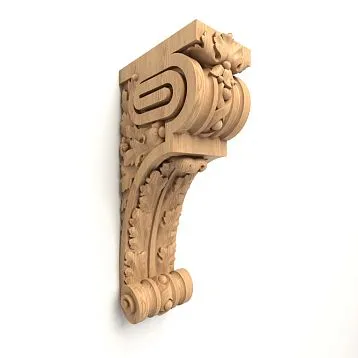
Our factory also produces:


Structure and density
Foamed polystyrene has a density ranging from 10 to 40 kg/m³ and consists of granules bonded together, each containing air bubbles. This structure is clearly visible to the naked eye — the material appears grainy and slightly rough. Extruded polystyrene is denser — from 25 to 50 kg/m³ — its structure is uniform, fine-pored, and its surface is smooth and silky to the touch.
Forcornices made of polystyreneand other interior elements, these differences are critical. Foamed material can be easily cut with a regular knife, but edges may crumble, leaving characteristic 'bubbles'. Extruded material provides a clean, straight cut, which is important when joining elements at corners and straight sections.
Get Consultation
Moisture resistance and hygroscopicity
Foamed polystyrene can absorb moisture — up to 4% of its own volume. This is not critical for dry rooms, but in bathrooms and kitchens it may lead to deformation of the decor. Extruded polystyrene practically does not absorb water — its water absorption rate does not exceed 0.2–0.4%. Such a material will withstand increased humidity and direct splashes without issue.
Thermal insulation properties
Both types of polystyrene retain heat well, but the extruded variant shows more stable results — its thermal conductivity coefficient is 0.028–0.034 W/(m·K) compared to 0.036–0.050 W/(m·K) for foamed polystyrene. For decorative elements, this parameter is secondary, but if we’re talking about comprehensive insulation, the difference becomes noticeable.
Strength and Durability
Extruded polystyrene withstands higher mechanical loads — compressive strength reaches 250–500 kPa compared to 50–150 kPa for foamed polystyrene. This means that large decorative elements made from extruded material are less likely to sustain damage during transportation and installation. However, for standardbaseboards made of polystyreneand ceiling cornices, the strength of the foamed variant is more than sufficient.
Price and availability
Foamed polystyrene is cheaper to produce and, consequently, in retail. The price difference can reach 30-50%, which translates into noticeable savings during large-scale renovations. That's why foamed material is often preferred for mass interior decoration, leaving extruded polystyrene for specific tasks.
Advantages of polystyrene for ceiling and wall finishing
Why has polystyrene become so popular in interior design? It's not only about affordability — although this factor certainly plays its part. The material's comprehensive characteristics make it nearly the ideal choice for decorative finishing.
Unbelievable lightness
The density of foamed polystyrene is 30-40 times lower than that of plaster and 10-15 times lower than that of wood. A three-meter-longPolystyrene Corniceweighs only 300-500 grams — it can be easily lifted with one hand and installed under the ceiling without helpers. This fundamentally changes the approach to finishing: no strong fasteners, special tools, or physical strength are required. A woman of average build can install ceiling decor as well as a professional finisher.
The lightness of the material is also safety. Even if a decorative element accidentally detaches and falls, it will not cause serious harm. This is an important advantage for families with children.
Ease of processing
Polystyrene decorative material can be cut with a standard construction knife, sawed with a fine-toothed saw, and sanded with sandpaper. No electric tools, special skills, or protective gear are required. Adjusting an element to size, making a clean 45-degree angled cut for corner joints — all of this can be done in minutes, even by a beginner craftsman.
Moreover, polystyrene can be routed to create complex reliefs and patterns on its surface. Manufacturers of decorative elements use this feature to produce items with exquisite detailing — from classical ornaments to modern geometric patterns.
Variety of shapes and textures
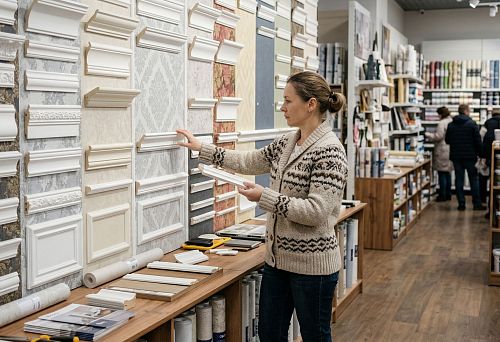
Injection molding technology allows creating polystyrene elements of practically any configuration. Straight and curved cornices, corner and baseboard moldings, rosettes and pilasters, moldings and casings — the list can be extended indefinitely. The surface can be smooth or textured, imitating stucco, wood carving, stone, or even leather.
Especially impressive are the capabilities of polystyrene in creatingceiling decorationmulti-level cornices with hidden lighting, coffered ceilings, columns and half-columns. What once required the work of sculptors and molders is now accessible to everyone.
Affordable price
The cost of decorative polystyrene elements is 5-10 times lower than analogs made of plaster, polyurethane, or wood. A linear meter of quality cornice costs 150-400 rubles, whereas plaster cornice costs 1,500 rubles and more. When finishing a standard three-room apartment, savings amount to tens of thousands of rubles — an amount that can be allocated to other renovation items.
Compatibility with various substrates
Polystyrene installation is possible on any substrate — concrete, brick, drywall, wood, plaster, wallpaper. The material does not create point loads and does not require preliminary reinforcement of walls or ceilings. The only condition — the substrate must be relatively flat and clean from dust.
Possibility of final finishing
Polystyrene takes paint excellently — water-based, acrylic, latex. Decor can be painted in any color, create a patina or gold effect, use pearlescent or metallic coatings. Painting polystyrene transforms a budget material into a premium interior element — no one can tell the difference between a painted polystyrene cornice and a plaster one.
Ecological safety
Modern polystyrene does not contain toxic substances and does not emit harmful vapors at room temperature. The material is inert, does not react with household chemicals, and is not a nutrient medium for mold and fungi. This is especially important for bedrooms, children's rooms, and spaces where allergy sufferers and people with heightened sensitivity live.
Shapes and profiles: from cornices to complex compositions
Interior polystyrene is not just a ceiling baseboard, although it is often the first element encountered when getting acquainted with the material. The range of decorative elements is so wide that it allows implementing almost any design idea.
Cornices and picture rails
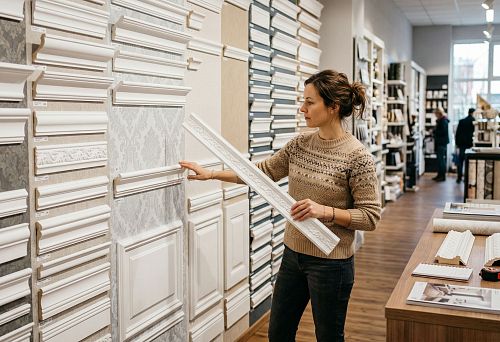
Ceiling cornices are the most popular category of polystyrene decor. They perform several functions simultaneously: hide the junction between wall and ceiling, mask imperfections and irregularities, visually raise or lower the ceiling, and create a finished room look. Cornice widths vary from modest 3-4 cm to impressive 20-25 cm. The surface relief can be minimalist geometric or complex classical with floral ornaments.
A separate category —cornices with hidden lightingThey have a special shelf on which an LED strip is mounted. The light reflecting off the ceiling creates a floating ceiling effect — a popular technique in modern interior design.
Floor skirting boards
If a ceiling cornice crowns the room from above, then a floorPolystyrene SkirtingCompletes the base trim. Modern polystyrene skirting boards have a height ranging from 5 to 20 cm and can imitate classic wooden skirting, plaster molding, or ultra-modern minimalist profiles.
The advantage of polystyrene skirting over wooden or MDF is the material's flexibility. They easily follow minor floor and wall irregularities, fitting tightly along their entire length. This eliminates the need for meticulous leveling or using putty to fill gaps.
Moldings and decorative strips
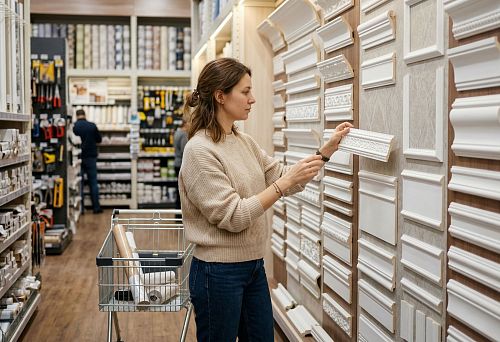
Moldings are narrow decorative strips used to divide walls into zones, frame mirrors and paintings, or create panels. Polystyrene can be molded into moldings of various profiles — from simple rectangular to complex ornamental shapes with multiple protrusions and recesses.
Wall panels assembled from moldings look especially striking. A classic approach is to divide the wall horizontally into three sections: the plinth (up to 80 cm from the floor), the main section, and the frieze (under the ceiling). Each zone is distinguished by its color or texture, with moldings marking the boundaries. This solution visually raises the ceiling and imparts an aristocratic feel to the interior.
Corner Elements and Rosettes
Corners are the most challenging areas when installing cornices and skirting boards. Perfectly aligning two elements at a 45-degree angle is not always possible, especially if the room’s corners are not straight. Polystyrene decor manufacturers offer pre-made corner pieces — internal and external. They simply adhere to the corner, and straight sections of the cornice are attached to both sides. Installation becomes dramatically simpler, and joints turn out perfectly even.
Ceiling rose — round or polygonal decorative elements installed at the center of the ceiling around a chandelier. The diameter of roses ranges from 20 cm to over a meter. They can be smooth, with concentric circles, or with floral or geometric ornamentation. A rose completes the ceiling composition, draws attention to the central chandelier, and conceals the electrical wiring outlet.
Pilasters and half-columns
For creating interiors in a classical style, vertical decorative elements — pilasters and half-columns — are used. A pilaster is a flat protrusion on a wall, imitating a column. It consists of three parts: the base (foundation), the shaft (body), and the capital (top section). A half-column has a semicircular cross-section and protrudes from the wall more prominently.
All three elements are manufactured separately from polystyrene, allowing you to assemble a pilaster of the desired height. Capitals replicate classical orders — Doric, Ionic, Corinthian. Such decoration suits spacious rooms with high ceilings — living rooms, halls, offices.
3D Panels and False Beams
A relatively new direction in polystyrene usage — volumetric wall panels. They have complex relief, creating play of light and shadow on the wall surface. Popular textures include waves, brickwork, geometric patterns, and floral motifs. 3D panels are mounted on walls edge-to-edge, forming a seamless covering.
Polystyrene false beams imitate wooden ceiling beams but are hollow inside and weigh only a few kilograms. They are mounted to the ceiling using special brackets and create an illusion of strong load-bearing structures. Particularly popular in loft, country, and chalet-style interiors.
Compatibility with Paints, Adhesives, and Finishing Coatings
Choosing the right accompanying materials is half the success when working with polystyrene. Using an inappropriate adhesive or paint may cause the decor to deform, peel off, or change color.
Adhesives for Installation
The main rule when selecting adhesive for polystyrene — it must not contain solvents. Acetone, toluene, xylene, and other organic solvents dissolve polystyrene literally in front of your eyes. The following types of adhesives are suitable:
Acrylic mounting adhesives — a universal option for any polystyrene elements. They are available in tubes for dispensers, have a thick consistency, and quick setting. Applied in dots or lines to the back of the element, the piece is pressed against the wall for 10–20 seconds. Final hardening occurs over 12–24 hours.
Water-based polymer adhesives — a budget option suitable for lightweight elements. They are less viscous than acrylics, require longer pressing (up to a minute), and take longer to dry. However, they are cheaper and odorless.
Liquid nails — a strong adhesive for heavy and large elements. They provide strong adhesion even on imperfectly flat surfaces. It is important to choose compositions labeled "for polystyrene" or "for foam."
Plaster-based putties — an old, proven method used by professional finishers. The finishing putty is applied to the back of the cornice or skirting board, the element is pressed against the surface. Excess putty protruding at the edges is immediately scraped off and used to fill joints between elements. The method is advantageous because mounting and joint sealing occur simultaneously.
Solvent-based compositions, silicone sealants (they do not provide reliable adhesion), and hot-melt adhesives (which melt polystyrene when heated) are absolutely unsuitable for mounting polystyrene.
Paints and Enamels
Painting polystyrene allows integrating it into any interior color scheme. But there are also nuances here.
Water-emulsion paints — the optimal choice for painting polystyrene decor. They are water-based, contain no solvents, are easily applied with a brush or roller, and dry quickly. After drying, they form a matte or semi-matte surface. Suitable paints include PVA-based, acrylic, latex, and silicone paints.
Acrylic paints — provide a denser and more durable coating compared to standard water-emulsion paints. They are resistant to wet cleaning, fade less in sunlight, and offer a rich range of shades. For interior use, water-based acrylic paints are employed.
Special paints for foam — produced by some manufacturers. They are developed specifically for the material, have optimal viscosity and coverage. However, they cost more than universal water-emulsion paints, even with comparable coating quality.
Oil-based paints, alkyd enamels, and nitro enamels are unsuitable for polystyrene — all of them contain solvents. Even if the instructions state "for all surfaces," it is better to avoid using them on polystyrene.
Primers and Putties
Priming polystyrene before painting is not mandatory — paint adheres well to the surface anyway. However, if you want a perfectly smooth finish or plan to use a glossy paint, priming will not hurt. Water-based acrylic deep-penetration primers are used.
Acrylic putties are used to fill joints between elements and minor surface defects. They are elastic, do not crack over time, and are easily sanded after drying. Plaster putties are also suitable, but they are stiffer and may crack if the polystyrene slightly shifts due to temperature fluctuations.
Protective coatings
For rooms with high humidity - bathrooms, kitchens - it is advisable to cover the painted polystyrene with a protective coating. This can be a water-based acrylic lacquer - matte, satin, or glossy. The lacquer creates a water-repellent film and simplifies maintenance of the decor.
Ecological safety, fire safety, and sanitary norms
There are many myths surrounding polystyrene's safety. Some consider it completely harmless, while others accuse it of all mortal sins. Where is the truth?
Chemical Inertness
At room temperature, polystyrene is chemically stable and does not emit volatile substances. It has no odor (fresh material may smell, but this odor quickly dissipates), does not cause allergic reactions in the majority of people. The material does not contain formaldehyde, phenols, and other hazardous compounds commonly found in construction materials.
Polystyrene does not react with water, weak acids and alkalis, alcohols, and most household cleaning agents. This means that decor can be washed or wiped with a damp cloth without fear of chemical damage.
Biological Durability
Mold and fungi do not grow on polystyrene - the material is not a nutrient medium for microorganisms. It does not attract insects or rodents (although the latter may chew through it mechanically, but do not eat it). This makes polystyrene safe for use in any rooms, including children's rooms and bedrooms.
Fire safety
The most controversial point is polystyrene's flammability. Yes, the material burns, and during combustion, it releases toxic substances - styrene and its decomposition products. According to Russian classification, standard polystyrene belongs to Group G4 (highly flammable) and Group B3 (easily ignitable).
However, modern manufacturers introduce flame retardants into polystyrene - substances that hinder combustion. Such modified polystyrene has an "S" (self-extinguishing) index and belongs to Groups G2-G3. It does not support combustion - if the fire source is removed, the material extinguishes within a few seconds.
It is important to understand the context: decorative polystyrene elements occupy a small area (cornices around the room perimeter, a few moldings on walls), they are located under the ceiling or near the floor. In case of fire, they will not be a source of ignition, but may contribute to fire spread. To minimize risks, it is recommended:
-
Choose self-extinguishing polystyrene with flame retardants
-
Do not install polystyrene elements near open flame sources (fireplaces, candles)
-
Use non-combustible decor options (gypsum, polyurethane) in rooms with heightened fire safety requirements
Sanitary-hygienic certificates
Polystyrene intended for interior finishing must have a sanitary-epidemiological conclusion confirming its safety for health. When purchasing decorative elements, request certificates from the seller and ensure the material is approved for use in residential spaces.
Application scenarios in apartments and private homes
Theory aside, but how to practically use all this decorative arsenal? Let's consider typical application scenarios for polystyrene in different rooms.
Living Room
Living room - the face of the house, the space where the entire family gathers and receives guests. Here, polystyrene decor works to create a festive yet cozy atmosphere.
Classic variant: ceilingPolystyrene Cornicewith plant ornamentation around the room perimeter, ceiling rose around the chandelier, tall baseboard. Walls can be divided into panels with moldings and painted in different shades of one color.
Modern variant: minimalist cornice with hidden LED lighting, creating a floating ceiling effect. On accent walls - 3D panels with geometric relief. Minimalist baseboard matching wall color.
Neo-classical: wide multi-level cornice, pilasters at room corners or beside the fireplace (if present), moldings imitating picture or mirror frames.
Bedroom
In the bedroom, a calm, soothing atmosphere is important. The decor should be restrained, without excessive opulence.
Solution for a small bedroom: narrow smooth cornice visually lifting the ceiling. Baseboard in floor color for visual space expansion. Moldings on the wall above the bed headboard, forming a rectangular frame.
Solution for a spacious bedroom: medium-width cornice with subtle relief. Moldings dividing walls into panels. False beams on the ceiling can be used to create a cozy chalet or country-style atmosphere.
Children's room
Here, material safety takes precedence. Polystyrene is ideal for children's rooms - it is lightweight (won't cause harm in case of accidental falls), contains no toxins, and is easy to clean.
Decor can be made playful: paint the cornice and baseboard in bright colors, stick moldings on walls forming frames, inside which draw or stick children's patterned wallpaper. 3D panels with wave relief suit a seaside theme, while cloud-themed panels suit a sky-toned room.
Kitchen
In the kitchen, polystyrene decor should be functional - easy to clean and not absorb odors. It is better to choose smooth profiles without deep relief, where grease and soot may accumulate.
A cornice under the ceiling visually separates the kitchen from the dining area (if the layout is open). Baseboard protects the junction between floor and wall from water during wet cleaning. Moldings can be used to frame the backsplash or zone walls.
After installation, all decor must be painted with durable acrylic paint and covered with matte or satin lacquer - this will simplify maintenance and extend service life.
Bathroom and toilet
Wet areas are not the best place for expanded polystyrene, which can absorb moisture. But if you really want to add decoration, choose extruded polystyrene and definitely cover it with a water-resistant paint and varnish.
Alternative - use polystyrene decor only in areas away from direct water exposure. For example, a ceiling cornice or wall molding far from the shower enclosure.
Hallway and corridor
In the hallway, polystyrene decor solves two tasks at once: it decorates the space and visually corrects proportions. A narrow, long corridor can be divided into squares using moldings, painted in a checkerboard pattern with two colors — this visually expands the space. A cornice and tall baseboard add a touch of elegance.
Staircase (for private homes)
The staircase (for private homes) can be adorned with a baseboard running along the steps and mirroring their geometry. Molding along the wall beside the staircase looks natural framing photographs or paintings. A cornice under the ceiling of the staircase visually unifies the space.
Typical installation errors and how to avoid them
Even a material as easy to work with as polystyrene requires adherence to certain rules. Installation errors may result in the decor detaching quickly, deforming, or looking unattractive.
Error #1: Installation on an unprepared surface
Many think that polystyrene is so light that it will stick to anything. This is not true. Dust, grease stains, peeling plaster, loose wallpaper — all of this hinders reliable adhesion.
Solution: Before installing polystyrene, thoroughly clean the surface of dust (can be vacuumed), degrease if necessary, remove peeling fragments of old finishes. If the surface is loose, treat it with a deep-penetration primer.
Error #2: Cutting Corners on Glue
Applying adhesive in thin lines or dots with large gaps saves adhesive but does not ensure reliable adhesion. This is especially critical for wide cornices and heavy elements.
Solution: Apply adhesive in a continuous zigzag or frequent dots (every 3-5 cm). For cornices wider than 10 cm, apply two parallel adhesive lines. Don't be stingy with adhesive — its consumption is still minimal.
Error #3: Incorrect cutting of angles
Joining cornices or baseboards at angles is the most critical moment of installation. Errors in angle calculation or uneven cuts lead to gaps and misalignment.
Solution: Use a miter saw for precise 45-degree angle cuts. If the room’s angles are not straight (which is common), you’ll need to adjust the angle by eye or use pre-made corner pieces. Before gluing, dry-fit the elements and ensure the joint is tight.
Error #4: Insufficient drying time
Glued the cornice, held it for 10 seconds — and released it. Several hours later, the element detaches because the adhesive didn’t have time to set under the weight of the piece.
Solution: Press polystyrene elements against the surface for at least 30–60 seconds. For heavy pieces, use temporary fastening — prop the element with a board and secure it with painter’s tape. Do not load or touch the decor (do not paint or move it) for at least 12 hours after installation.
Error #5: Ignoring thermal expansion gaps
Polystyrene, like any material, expands when heated and contracts when cooled. If elements are installed flush without gaps, temperature fluctuations will cause them to 'butt' into each other, leading to deformation and detachment.
Solution: Leave a 1–2 mm gap between elements. After installation, fill it with acrylic putty — it is elastic and compensates for thermal deformation.
Error #6: Painting immediately after installation
Freshly installed decor has not yet firmly adhered. Brush or roller movements during painting may shift or even detach the elements from the wall.
Solution: Do not paint polystyrene decor until at least one day after installation. Even better — paint the elements on the floor one day before installation. Then, only touch up the joints after mounting.
Error #7: Using solvents for cleaning
Accidentally stained polystyrene with glue, paint, or something else — and grabbed a solvent. Within a second, a hole appears where the decor was.
Solution: Use only water, soapy solution, or alcohol to clean polystyrene. No acetone, white spirit, or other chemicals. Most stains are easily removed with a damp cloth while still fresh.
Error #8: Ignoring acclimatization
Bought polystyrene decor in winter, brought it from the cold into a warm apartment, and immediately started installation. The material developed condensation, the adhesive didn’t set, and the elements warped.
Solution: Allow the material to acclimatize. Bring it into the room at least one day before installation, unpack it (if the packaging is sealed), and leave it at room temperature. This is especially important for long elements — cornices and baseboards.
Care for polystyrene decor and its lifespan
Proper care extends the life of any material, and polystyrene is no exception. Good news: caring for it is simple.
Regular dust cleaning
Dust settles on all surfaces, and polystyrene decor is no exception. Especially much accumulates on relief elements - ornamental cornices, moldings, and rosettes.
Once a month or so, go over the decor with a soft vacuum cleaner brush or a special microfiber broom. For hard-to-reach areas (top of a high cornice, inner corners of a rosette), use a narrow vacuum cleaner attachment.
Painted polystyrene can be wiped with a slightly damp cloth. Unpainted is better cleaned only with a dry method - moisture may leave dark spots on the surface.
Removing stains
Greasy spots on the kitchen, fingerprints, accidental splashes - all of this is removed with a soapy solution. Dilute a little liquid soap or dishwashing detergent in warm water, dampen a soft cloth, wring it out well, and wipe the soiled area. Then wipe with a clean damp cloth and dry thoroughly.
For stubborn stains, you can use alcohol - it does not harm polystyrene and effectively dissolves grease. Do not use abrasive cleaning agents - they will scratch the surface.
Touch-up and refreshment
Over time, painted polystyrene may fade in the sun, dull, and in places flake (especially if the paint was applied in a thin layer). Refreshing the decor is simple - just repaint it.
The surface is sanded with fine sandpaper (if there are peeling paint areas), dusted, primed if necessary, and repainted. The entire procedure takes a couple of hours, but the decor looks brand new.
Repair of damage
Polystyrene is a soft material, easily damaged by impact or careless movement. Small dents and scratches can be masked with acrylic putty. Apply the putty in a thin layer, let it dry, sand it, and repaint it to match the decor color.
If an element breaks or a piece detaches, you can glue it with acrylic glue. Fill the glued area with putty, sand it, and repaint it.
Service Life
With proper installation and care, polystyrene decor lasts for decades. Manufacturers provide a 10-15 year warranty, but in practice, polystyrene cornices and baseboards last 20-30 years and more.
The only enemy of the material is ultraviolet light. In the sun, polystyrene yellows and becomes brittle. But indoors, where there are no direct sunlight rays, this process proceeds extremely slowly.
Project calculation: calculating materials and budget
Before purchasing decorative elements, you must accurately calculate the amount of material. It seems simple - measure the room's perimeter and divide by the length of one element. But there are nuances.
Room measurements
Measure the length of each wall with a tape measure. Do not rely on data from the apartment plan - they often do not match reality. For ceiling cornices, measure along the ceiling (the room may be slightly wider at the ceiling than at the floor). For baseboards - along the floor.
Record the dimensions of all door and window openings - at these locations, the cornice or baseboard is interrupted.
Pay attention to the room's configuration. If there are niches, protrusions, or bay windows - their perimeter must also be taken into account.
Calculating linear meters
Add up the lengths of all walls, subtract the width of door openings (for baseboards), and add a 10% reserve for cuts and errors. This will be the required amount of linear meters.
Example: room 4x5 meters, perimeter 18 meters, one door opening 0.8 meters wide. Calculation: 18 - 0.8 = 17.2 meters. With reserve: 17.2 x 1.1 = 18.9 meters. Round up to 19 meters.
Standard element length
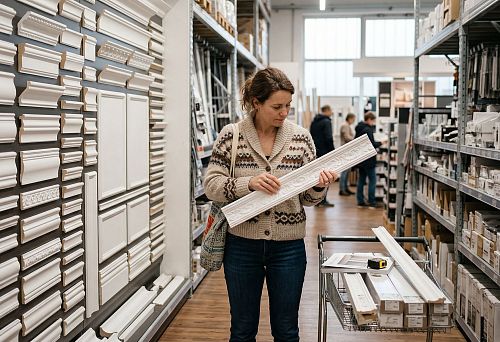
Ceiling cornices and floor baseboards made of polystyrene are produced in 2-meter long strips (rarely 1.2 or 2.4 meters). Divide the calculated linear meters by the length of one strip and round up.
In our example: 19 / 2 = 9.5. Round up to 10 strips.
Corner elements
Calculate the number of internal and external corners in the room. For each corner, you need one corner element (if you decide to use pre-made corners, rather than joining strips at 45 degrees).
Additional elements
If you plan to install a ceiling rosette - one per room (usually in the center of the ceiling, where the chandelier hangs).
Moldings for creating wall panels are calculated by the length of all lines you wish to highlight.
Adhesive
The amount of glue depends on its type and the area of the surfaces being glued. On average, one tube of acrylic mounting glue (310 ml) is sufficient for 15-20 linear meters of cornice or baseboard. For our example, 1-2 tubes will be needed.
Paint
If you plan to paint the decorative elements, calculate the area to be painted. For a cornice, this is the profile width multiplied by the length. Paint consumption is indicated on the package — usually 1 liter covers 8-12 m² in one layer.
It is better to paint polystyrene in two layers, so multiply the calculated area by two.
Final budget
List all required materials with prices:
-
Crown molding or baseboards (number of pieces × price per piece)
-
Corner elements (quantity × price)
-
Adhesive (number of tubes × price)
-
Paint (number of liters × price)
-
Primer, putty (if needed)
Add up all items — this will be the total project cost.
For a standard room of 15-20 m², the budget for polystyrene decorative elements (cornice + baseboard) will be 3000-8000 rubles depending on the profile complexity. This is significantly cheaper than gypsum molding or polyurethane decor.
Frequently Asked Questions (FAQ)
Can polystyrene decor be used in a bathroom?
Yes, but with restrictions. Choose extruded polystyrene (it absorbs less moisture) and always cover it with water-resistant paint and varnish. Do not install decor in areas directly exposed to water (above the bathtub, near the shower).
How does polystyrene differ from expanded polystyrene?
In essence, it is the same material — expanded polystyrene. "Expanded polystyrene" is a common name, while "polystyrene" is technically correct. For decorative elements, higher-density, higher-quality polystyrene is used compared to packaging-grade material.
How long does polystyrene adhesive take to dry?
Initial setting occurs within 30-60 minutes, but full curing takes 12-24 hours. You can paint or load the decor only after the adhesive has fully dried.
Can polystyrene be glued to wallpaper?
Yes, if the wallpaper is firmly glued to the wall and does not bubble. However, it is safer to glue to bare walls — the bond will be stronger. If gluing to wallpaper, use quality adhesive and allow it to dry thoroughly.
Is it necessary to paint polystyrene decorative elements?
Not necessary, but recommended. Paint protects the material from yellowing, makes the surface smoother and easier to maintain. Plus, painted decor looks more elegant.
What tool to use to cut polystyrene?
Thin elements can be cut with a utility knife or a fine-toothed saw. For thicker elements, it is more convenient to use a jigsaw with a blade for soft materials.
Can polystyrene be bent?
Expanded polystyrene is practically un-bendable — it breaks when bent. For curved surfaces (arches, bay windows), use flexible polyurethane molding or special flexible polystyrene.
How to remove gaps between elements?
Fill gaps with acrylic putty, let it dry, sand with fine-grit sandpaper, and paint. The putty is elastic and compensates for minor material thermal expansion.
Can polystyrene decorative elements be used outdoors?
Not recommended. Outdoors, polystyrene deteriorates under ultraviolet radiation, moisture, and temperature fluctuations. For facade decoration, use special materials — facade polystyrene, polyurethane, or fiberglass.
How to remove polystyrene decorative elements from the wall?
Carefully pry the element off the wall with a putty knife and detach it. Remove any remaining adhesive with the same putty knife. If the decor is glued to gypsum putty, moisten the joint with water — the putty will soften, and the element will come off more easily.
Conclusion
Polystyrene for interior decoration is a universal tool for those who want to create a beautiful and stylish interior without unnecessary expenses and complexities. The material's lightness, ease of installation, wide variety of shapes and profiles, and affordable price — all these advantages make polystyrene decoration an indispensable solution for most renovation projects.
Yes, the material has limitations — it is not suitable for wet areas without additional protection, it is flammable, and may yellow in sunlight. However, with the right choice of polystyrene type, proper installation, and simple maintenance, these drawbacks are minimized.
Modern manufacturers continuously improve technologies, introducing modifiers into the polystyrene composition to enhance its properties. Today, dozens of decorative collections are available on the market to suit any taste and budget — from minimalist profiles to luxurious baroque compositions.
Company STAVROS offers a wide range of high-qualitydecoration made of polystyrene and polyurethanefor any interior design solutions. In the catalog, you will find cornices, baseboards, moldings, rosettes, and other elements that will transform an ordinary living space into a work of designer art. Professional consultants will help you choose the optimal decoration, calculate the required material quantity, and provide installation recommendations.
Create beauty around you — it's simpler than it seems!