Article Contents:
- Fundamental Principles of Selection: What Every Buyer Should Know
- Load Capacity as the Foundation of Safety
- Geometric Compatibility with the Countertop
- Ergonomic Requirements
- Material Base: Choosing by Characteristics, Not by Fashion
- Metallic Structures: Strength and Universality
- Wood: Traditions and Innovations
- Composite materials: technologies of the future
- Structural Solutions: Engineering in Detail
- Mounting Systems to the Countertop
- Height Adjustment and Stabilization
- Mobility Systems
- Technical specifications: numbers that matter
- Strength parameters
- Geometric Tolerances
- Durability Indicators
- Stylistic Directions: Aesthetics and Functionality
- Classic Solutions
- Modern Styling
- Industrial Motifs
- Specifics of Use: Practical Aspects
- Usage Conditions
- Load Modes
- Requirements for maintenance
- Economic Component: Investment Approach
- Cost of Ownership Analysis
- Impact on the Overall Table Cost
- Residual Value
- Decision-Making Process: Step-by-Step Algorithm
- Defining Requirements
- Proposal Analysis
- Making a decision
- Development prospects: looking into the future
- Technological Innovations
- Ecological Aspects
- Production Personalization
- Regional Characteristics: Adaptation to Local Conditions
- Climate factors
- Cultural preferences
- Economic Conditions
- Quality Control: Guarantees of Reliability
- Incoming material inspection
- International Standards and Certification
- Acceptance Testing
- Conclusion: The Choice That Shapes the Future
Choosing the right countertop supports can dramatically change not only the appearance of your interior, but also the functionality of the entire workspace or dining area. After fifty years in the furniture industry, I have come to realize: most people underestimate the importance of the table base, focusing exclusively on the countertop. This is a critical error that may lead to disappointment and financial losses.
Modern table base is not just a set of legs or supports. It is a complex engineering system that must ensure stability, durability, and aesthetic appeal. Every element of the structure affects the final result: from the material used to the method of attachment, from the geometry of forms to the quality of finish processing.


Fundamental selection principles: what every buyer should know




Load-bearing capacity as the basis of safety
The first and most important criterion — the base's ability to withstand planned loads. A standard dining table base must withstand a static load of at least 150 kg evenly distributed over the surface. For work tables, this figure increases to 200-250 kg, taking into account possible placement of office equipment, documents, and other work materials.
Dynamic loads present a special danger. A person leaning on the edge of a table creates a moment of force that can reach 50-80 kg·m. A quality base must compensate for these impacts without deformation or loss of stability.
Our factory also produces:


Geometric compatibility with the tabletop
The dimensions and shape of the base are directly related to the tabletop parameters. For rectangular tabletops up to 180 cm in length, two supports located 15-20 cm from the ends are optimal. Longer tabletops require additional intermediate supports or a reinforced base structure.
Circular tabletops up to 120 cm in diameter can rest on a single central support, provided the base diameter is at least 50% of the tabletop diameter. For larger round tables, three or four supports arranged symmetrically are preferred.
Get Consultation
Ergonomic Requirements
The height of the base should correspond to the anthropometric data of the users. The standard height of a dining table, 72-75 cm, is suitable for people 165-180 cm tall. For taller individuals, adjustments toward increased height are necessary.
Legroom is a critically important parameter. The width should be at least 60 cm, and the depth — at least 40 cm. Any obstacles in this zone create discomfort and may lead to injuries.
Material base: choose by characteristics, not by fashion
Metallic structures: strength and versatility
Steel grade St3 — the optimal choice for most applications. Tensile strength of 370-470 MPa ensures reliability at relatively low cost. The wall thickness of the profile should be no less than 2 mm for household tables and no less than 3 mm for commercial use.
Stainless steel AISI 304 is recommended for kitchens, medical facilities, and areas with high humidity. Corrosion resistance compensates for the higher cost of the material.
Aluminum alloys of series 6000 combine low weight with sufficient strength. Particularly effective for mobile structures and spaces where furniture needs frequent rearrangement.
Wood: traditions and innovations
Solid oak remains the gold standard for wooden bases. Density of 650-700 kg/m³ and high compressive strength ensure longevity. Radial shrinkage does not exceed 4%, minimizing deformation under humidity changes.
Beech with density 680 kg/m³ demonstrates excellent workability. Its uniform structure allows creating complex shapes without risk of cracking. Particularly effective for bent elements.
Ash combines high strength with elasticity. Its ability to withstand impact loads makes it ideal for children's furniture and heavily used tables.
Composite Materials: Technologies of the Future
High-density fiberboard (HDF) with thickness 25-32 mm is suitable for budget solutions. Quality boards of class E1 are safe for residential use and provide sufficient strength with proper construction.
Birch plywood FSF demonstrates excellent strength characteristics. Layered structure prevents delamination and ensures dimensional stability. Water resistance allows using the material in variable humidity conditions.
Structural solutions: engineering in detail
Mounting systems to the tabletop
The mounting method determines the reliability of the entire structure. Threaded connections M8-M10 provide sufficient strength while allowing disassembly. The insertion depth should be at least 2.5 times the thread diameter.
Built-in mounting using metal anchor elements increases contact area and evenly distributes load. This method is especially effective for solid wood tabletops.
Adhesive joints using structural adhesives ensure monolithic construction. Modern polyurethane adhesives create bonds stronger than the bonded materials themselves.
Height adjustment and stabilization
Screw supports with ±15 mm adjustment compensate for floor unevenness and allow precise leveling of the tabletop. Plastic washers prevent damage to the floor covering.
Gas cylinders provide smooth height adjustment in the range of 200-300 mm. Load capacity must match the tabletop weight with a safety factor of 1.5-2.0.
Mobility systems
Polyurethane rollers with a diameter of 50-75 mm ensure silent movement on hard surfaces. Brake mechanisms must lock at least two of the four rollers.
Folding structures allow compact storage of tables during irregular use. Hinged joints must withstand at least 10,000 opening-closing cycles.
Technical specifications: figures that matter
Strength parameters
The bending strength for wooden elements must be at least 80 MPa. For metal structures, this value increases to 240 MPa. The safety factor is taken as 2.5 for static loads and 4.0 for dynamic loads.
Structural stiffness is characterized by deflection under load. For dining tables, the allowable deflection is 1/300 of the span length; for work tables, it is 1/400. Exceeding these values creates discomfort during use.
Geometric Tolerances
Vertical deviation of support elements must not exceed 1 mm per 1 m of height. Non-planarity of support surfaces — no more than 0.5 mm per 1 m of length. These requirements ensure stable installation and even load distribution.
Dimensional tolerances affect compatibility with various tabletops. Linear dimensions tolerance ±1 mm, angular dimensions tolerance ±0.5°.
Durability indicators
The service life of movable joints must be at least 25,000 cycles for home use and 50,000 cycles for commercial use. Static load must be sustained for 10 years without residual deformation.
Corrosion resistance of metal elements is ensured by protective coatings with a thickness of at least 60 micrometers. Adhesion of the coating — at least 2 points by the grid-cut method.
Stylistic directions: aesthetics and functionality
Classic solutions
Traditional forms rely on time-tested proportions. A height-to-base-width ratio of 3:2 creates visual stability. Decorative elements must be functionally justified and not create obstacles for cleaning.
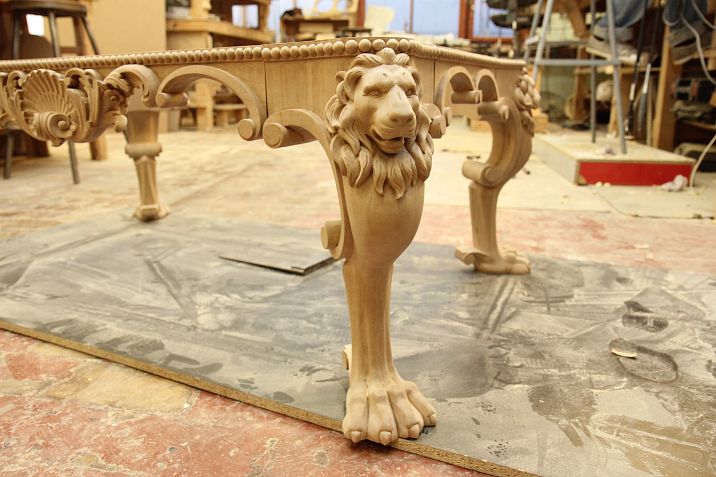
Carved elements require special attention to execution quality. A carving depth of 3-5 mm ensures expressiveness without compromising strength. All recesses must have smooth transitions to prevent stress concentration.
Modern stylistics
Minimalist Baseboards for countertops differ by minimalist forms and functionality of each element. The thickness of support elements is minimized to the limits ensuring necessary strength.
Geometric forms must be mathematically precise. Deviations from the specified geometry immediately become noticeable and ruin the overall impression. Manufacturing quality must be flawless.
Industrial motifs
Loft aesthetics imply showcasing structural elements. Weld seams can be decorative if executed with quality and uniform geometry. Bolted connections become design elements.
Patina and artificial aging should appear natural. Chemical methods are most effective, creating a realistic surface texture.
Specifics of operation: practical aspects
Usage conditions
Operating temperature range for wooden elements: +10...+40°C. Relative humidity 40-60%. Sudden fluctuations in these parameters may cause deformation and cracking.
Metal structures are less sensitive to climatic conditions but require protection from condensation. Regular room ventilation prevents moisture accumulation.
Load regimes
Usage intensity affects material and construction selection. Home tables are used 2-4 hours per day, office tables — 8-10 hours, restaurant tables — 12-14 hours. Requirements for strength and wear resistance must accordingly differ.
Load characteristics are also important. Static loads are less critical than dynamic ones. Impact loads require increased material strength and damping properties.
Maintenance requirements
Regular cleaning should be simple and require no special tools. Smooth surfaces are easier to maintain but may become slippery when wet. Textured surfaces hide minor dirt but are harder to clean.
Technical maintenance frequency depends on usage intensity. Checking bolted joint tightness — every 6 months. Lubricating moving parts — annually. Inspecting protective coatings — during each general cleaning.
Economic component: investment approach
Analysis of ownership cost
The initial cost of a quality pedestal may exceed the price of budget alternatives by 3-5 times. However, the service life of quality products is 5-10 times longer, making them economically advantageous in the long term.
Operating costs include the cost of maintenance, repair, and replacement of worn-out components. Quality furniture frames practically require no maintenance during the first 10 years of operation.
Impact on the overall table cost
The base accounts for 30-50% of the table's total cost. Saving on this element may necessitate replacing the entire table within a few years. A quality base allows using various tops, adapting furniture to changing needs.
The possibility of modernization and repair also affects economic efficiency. Modular constructions allow replacing individual elements without fully replacing the item.
Residual value
Quality furniture retains value when resold. Well-known manufacturers and tested materials guarantee stable pricing on the secondary market. Antique bases may cost more than new equivalents.
Documenting origin and usage history increases residual value. Quality certificates, warranty cards, service records—all of this affects the price upon resale.
Decision-making process: step-by-step algorithm
Requirement definition
The first step is clearly defining operating conditions. Room size, number of users, usage intensity, stylistic preferences—all these factors influence the choice of a specific solution.
Preparing a technical specification helps systematize requirements. Mandatory parameters are separated from desirable ones, priorities and constraints are defined.
Analysis of proposals
Comparing different options should be comprehensive. Not only price and appearance, but also technical specifications, manufacturer reputation, warranty and after-sales service conditions are considered.
Expert evaluations and user reviews provide insight into actual operational characteristics. Special attention should be paid to reviews regarding durability and reliability.
Making a decision
The final decision is based on a weighted assessment of all factors. The most expensive option is not always optimal. It is important to find a balance between price, quality, and functionality.
The opportunity to test before purchase allows evaluating ergonomic qualities and ensuring alignment with expectations. Many manufacturers provide demonstration samples or showrooms.
Development prospects: looking to the future
Technological Innovations
The implementation of "smart" technologies transforms bases into intelligent systems. Sensors for load, temperature, and humidity transmit information about the structure's condition. Predictive diagnostic systems warn of the need for maintenance.
Materials with memory shape allow creating adaptive constructions. The base can automatically adjust its height depending on the user's height or the nature of the work performed.
Ecological aspects
Requirements for ecological safety are constantly becoming stricter. Manufacturers switch to renewable materials, non-toxic coatings, energy-efficient production technologies.
The concept of circular economy implies designing products with subsequent recycling in mind. Modular constructions allow reusing components in new products.
Customized production
Individual production technologies make unique solutions accessible. 3D printing, laser cutting, robotic assembly allow manufacturing single units according to individual parameters.
Online configurators allow users to create a base design themselves. Virtual reality allows seeing the result in the interior even before manufacturing.
Regional characteristics: adaptation to local conditions
Climate factors
Different climate zones impose specific requirements on materials and construction. High humidity requires using moisture-resistant materials and coatings. Sharp temperature fluctuations may cause deformation.
Seasonal changes in humidity particularly strongly affect wooden structures. Radial and tangential shrinkage must be considered when designing connections.
Cultural preferences
Different cultures have their own views on beauty and functionality. Asian traditions value minimalism and functionality. European — elegance and durability. American — comfort and practicality.
National standards and norms also influence construction. Requirements for safety, ecological safety, and ergonomics vary across countries.
Economic conditions
The level of household income determines demand for different price categories. Developed markets prefer high-quality, durable items. Developing markets — affordable solutions.
Logistical features affect material and construction selection. Transportation to remote regions requires compact packaging and resistance to transportation impacts.
Quality Control: Guarantees of Reliability
Incoming material inspection
The quality of the finished product is determined by the quality of raw materials. Each batch must undergo tests to verify compliance with technical specifications. Moisture content of wood, chemical composition of metal, strength of joints — all parameters must meet standards.
Supplier quality certificates confirm that materials meet declared characteristics. Regular supplier audits ensure quality stability.
Production Control
Each technological operation must be controlled. Geometric dimensions, surface finish quality, joint strength — all of this affects the final product quality.
Statistical control methods allow deviations to be identified early. Corrective actions prevent the production of defective products.
Acceptance testing
Finished products undergo comprehensive tests before shipment. Tests for strength, durability, and longevity confirm compliance with technical requirements.
Sample destructive tests provide information on actual strength characteristics. Results are used to adjust technological processes.
Conclusion: The choice that determines the future
Modern Countertop substructure — is a high-tech product combining engineering thought, designer craftsmanship, and manufacturing innovations. The correct choice of base not only determines the table’s appearance but also ensures long-term comfort of use.
Investments in quality table bases pay off many times over. Durability, reliability, aesthetic appeal — all of this makes quality furniture a worthwhile investment. Saving on the base may result in the need to replace the entire table several years later.
Technological progress constantly expands manufacturers’ capabilities. New materials, advanced technologies, innovative solutions allow creating bases for tableswhich were once considered science fiction. But the main principles remain unchanged: functionality, reliability, beauty.
Choosing a table base is choosing a lifestyle. A quality base creates an atmosphere of stability and comfort, transforming an ordinary table into a center of family life or productive work. Each day of using a quality base confirms the correctness of the choice made.
The future of furniture production lies in integrating traditional craftsmanship with advanced technologies. furniture frames are becoming increasingly refined, but the requirements for quality, functionality, and aesthetics remain unchanged.
Company STAVROS has remained a leader in producing elite furniture structures for decades. Our craftsmen combine rich experience with the use of the most modern technologies, creating table supportswhich become benchmarks of quality and reliability. Every STAVROS product undergoes strict quality control and is manufactured according to individual customer requirements. Choosing STAVROS products means investing in the future — in beauty, comfort, and reliability that will serve you for many years, creating a foundation for successful work and pleasant rest.