Article Contents:
- Availability and price
- Cost: the main advantage of polystyrene
- Availability in stores
- Savings on delivery
- Saving on Glue
- Overall project cost-effectiveness
- Ease of installation and wide variety
- Installation by yourself without experience
- Wide variety of shapes and sizes
- Variety of manufacturers
- Ability to paint in any color
- Compatibility with different types of finishes
- Cons: fragility, limited service life, care nuances
- Fragility and low mechanical strength
- Limited service life
- Yellowing over time
- Electrostatic charge and dust accumulation
- Installation restrictions near heat sources
- Flammability
- Difficulty repairing damage
- Comparison with duroplastic, polyurethane, and MDF
- Polystyrene vs Duroplastic
- Polystyrene vs Polyurethane
- Polystyrene vs MDF
- Comparison summary table
- When polystyrene is the optimal choice, and when it's better to choose an alternative
- Polystyrene - the best choice
- When it's worth choosing an alternative
- Compromise option: combining materials
- Recommendations from STAVROS and Hi Wood
- Conclusion: balanced choice based on priorities

Repair is nearing completion. Walls are leveled, floor is laid, ceiling gleams white. Only one final detail remains, which either completes the composition or spoils the entire impression — the skirting board. You stand in a hardware store before long rows of skirting boards made from different materials. Polystyrene attracts attention with its price — 3-4 times cheaper than polyurethane, 2 times cheaper than MDF. But doubt creeps in: will the low cost turn into disappointment?
The internet is full of conflicting reviews. Some praise polystyrene as the ideal solution, others criticize it for its fragility and short lifespan. Where is the truth? Is it worth saving money or better to pay more upfront for a more expensive material? Let's honestly and objectively examine all theadvantages of polystyrene skirting boardsand their drawbacks, so you can make the right decision for your interior.


Availability and price




Cost: the main advantage of polystyrene
Price is the first thing that attracts buyers to polystyrene skirting boards. And this is not surprising: the difference in cost compared to alternative materials is impressive.
Price comparison per linear meter (average market values):
Standard polystyrene: 40-80 rubles
High-density polystyrene (Hi Wood): 60-100 rubles
Laminated MDF: 80-150 rubles
Polyurethane: 200-350 rubles
Duro-polymer: 250-400 rubles
Wooden: 150-500 rubles
Let's calculate the real savings using the example of a standard two-room apartment of 60 sq.m. The perimeter of all rooms (including the hallway) is approximately 80 meters. Subtracting door openings (about 10 meters) — we get 70 meters of pure skirting board.
Polystyrene: 70m × 70 rub = 4,900 rub
MDF: 70m × 120 rub = 8,400 rub
Polyurethane: 70m × 280 rub = 19,600 rub
Duro-polymer: 70m × 320 rub = 22,400 rub
The difference between polystyrene and polyurethane is almost 15,000 rubles! For many, this is a significant sum, especially with a limited renovation budget. With this money, you could buy a good chandelier, quality wallpaper, or simply save it for other needs.
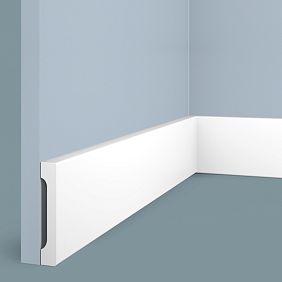
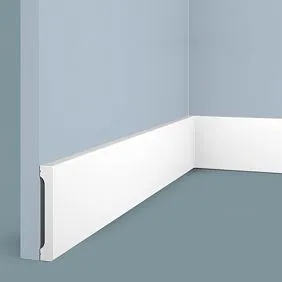
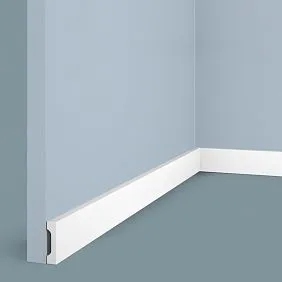
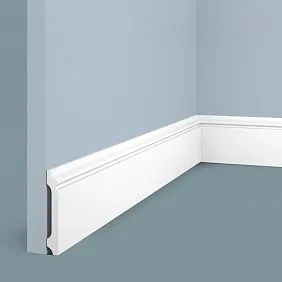
Our factory also produces:


Availability in stores
Polystyrene skirting boards are available everywhere. Any hardware store, from large chain hypermarkets to small local outlets, carries polystyrene. This means:
Ability to see in person — you can come, touch, assess the quality, hold it in your hands, attach sample wallpapers or paint.
Immediate purchase — no need to wait weeks for an order. Buy today, install tomorrow.
Easy transportation — 2-meter-long boards weighing 80-150 grams easily fit into a car. You can even bring them via public transport.
Ability to buy additional pieces — if you run short or damage them during cutting, you can buy more the same day at the nearest store.
With premium materials, it's more complicated. Duro-polymer is not available in all stores and often requires an order. High-quality polyurethane with elaborate molding may even be imported from Europe, with a wait time of 2-4 weeks.
Get Consultation
Savings on delivery
The lightness of polystyrene is not only convenient for installation, but also saves on delivery. Skirting boards for a three-room apartment weigh only 6-8 kg. You can pick them up yourself in your car, avoiding paid delivery (500-1500 rub depending on the city).
Polyurethane skirting boards for the same apartment weigh 25-35 kg, MDF — 35-45 kg. This is already a serious load, not every car can handle it, especially considering the length of the boards. Delivery becomes necessary.
Savings on adhesive
Light polystyrene does not require expensive high-strength adhesive. Standard liquid nails (200-250 rubles per tube) or even acrylic putty (500 rubles per 25 kg, enough for 150-200 meters of skirting) will suffice.
Overall project cost savings
Overall project cost savings
Summing up savings for a 60 sq.m apartment:
-
Material: 10,000-15,000 rubles (compared to polyurethane)
-
Delivery: 500-1500 rubles
-
Adhesive: 500-800 rubles
-
Installation (if hiring): 3000-5000 rubles (polystyrene is easier to install, masters charge less)
Total: 14,000-22,000 rubles saved!
This is very significant for most families. Yes, polyurethane lasts longer, but the difference of 20,000 rubles often outweighs it.
Ease of installation and wide variety
Installation by yourself without experience
Polystyrene is the only material that an absolute beginner without construction skills can handle. This is a real opportunity to save on installation (150-300 rubles per meter of work) and gain invaluable experience.
Why polystyrene is easy to install:
Minimal weight - one hand holds the plank, the other applies adhesive or presses down. No helper needed, hands don't tire, convenient even at height.
Easy to cut - a standard metal hacksaw for 200 rubles works perfectly. No need for a 15,000 rubles circular saw. A construction knife can cut thin skirting. The cut is clean, without chips or scratches.
Forgives mistakes - cut incorrectly? No problem, the plank costs 80-150 rubles, take a new one. With duro-polymer at 300 rubles per meter, a mistake costs three times more, and the fear of damaging the material restricts you.
Does not require strong fasteners - adhesive is sufficient, screws are not needed (if walls are flat). No need to drill, dust, or make noise. This is important in an occupied house.
Flexibility with uneven walls - light skirting follows minor wall irregularities. Heavy polyurethane hangs in the air, creating gaps.
Real user experience:
"I did renovation for the first time, never held tools. I was afraid I wouldn't manage the skirting. I took polystyrene from Hollywood, a simple miter saw, and a hacksaw. In one evening, I installed 18 meters of skirting in the living room. Everything worked out! The corners aligned, it looks professional. I saved 3,500 rubles on professionals. If I had taken heavy polyurethane, I definitely wouldn't have managed." - Elena, Saint Petersburg"
Wide variety of profiles and sizes
Polystyrene is the most versatile material for choosing profiles. Manufacturers offer dozens, even hundreds of options for any taste and style.
Floor skirting:
Height from 40 to 150 mm. For standard apartments with ceilings 2.5-2.7 m, optimal height is 70-80 mm. For high ceilings (3+ meters) - 100-120 mm. For small rooms - 50-60 mm.
Profiles: from simple rectangular cross-sections to complex multi-step forms with ovals, grooves, and relief. You can find skirting with a cable channel for hidden wiring.
Ceiling skirting (cornices, moldings):
Width from 30 to 200 mm. Narrow (30-50 mm) for small rooms and minimalism. Medium (50-100 mm) are universal. Wide (100+ mm) for classic interiors with high ceilings.
Decor: smooth without relief, with simple geometric patterns, with complex moldings imitating plaster. You can find cornices with a groove for LED lighting - a popular feature in modern interiors.
Decorative elements:
Corners, outlets, moldings, pilasters, columns — all made of polystyrene. This allows creating a unified ensemble in a classic style.
Variety of manufacturers
The market for polystyrene skirting boards is very competitive. Dozens of manufacturers offer their products. This creates healthy competition, stimulating quality improvement and price reduction.
Quality manufacturers:
Hi Wood (High Wood) — partner of the company STAVROS, offering high-density polystyrene (32–35 kg/m³). Distinguished by its snow-white color, clear profile geometry, and high surface quality. Service life is 30–50% longer than standard polystyrene due to improved material structure.
NMC (Belgium) — European quality, high relief detail, wide assortment. Price is above average, but quality matches.
Europlast (China) — optimal price-to-quality ratio. Wide selection, affordable prices, acceptable quality.
Format — Russian manufacturer, budget segment. Suitable for temporary housing or the most economical renovation.
Ability to paint in any color
White skirting board is universal, but does not always fit the interior concept. Polystyrene can be easily painted with any water-based paint, opening up endless creative possibilities.
Can create:
-
Skirting board in wall color (visually increases room height)
-
Contrasting accent (black, graphite, dark blue)
-
Pastel shades for romantic interiors
-
Wood imitation using special paints
-
Gilding or patina for classic styles
-
Repainting when changing interior design
MDF with laminate finish cannot be repainted. Tired of the color? Buy a new skirting board. Polystyrene can be repainted endlessly.
Compatibility with different types of finishes
Polystyrene is universal and suitable for any walls, floors, and ceilings:
Walls: wallpaper, paint, plaster, drywall, concrete, brick, tiles
Floors: laminate, parquet, linoleum, tiles, poured floor, carpet
Ceilings: whitewash, paint, drywall, stretch (with reservations)
Does not require special surface preparation (except standard cleaning and priming).
Drawbacks: fragility, limited service life, care nuances
Fragility and low mechanical strength
The main and most significant drawback of polystyrene is its softness and fragility. This is the flip side of its lightness.
Manifestations of fragility:
Dents from impacts — accidentally hit with a vacuum cleaner, struck with a suitcase, or knocked with a child’s toy — a dent remains on the skirting board. Polystyrene easily deforms under point loads.
Scratches — claws of household pets, sharp edges of furniture, stiff brushes during cleaning leave noticeable scratches. Over time, the skirting board develops a network of minor damage.
Chips at corners — outer corners are especially vulnerable. A hit — and a piece chips off. In homes with children, baseboard corners suffer especially often.
Brittleness during cutting — with careless cutting using a dull tool, the material chips and forms chips at the ends.
Deformation during transportation — improper transport (vertically in a car with bending) leads to dents forming.
Real damage scenarios:
Hallway: Shoes, umbrellas, suitcases constantly hit the baseboard. After one or two years, the lower part is covered with dents and scratches.
Living room: The vacuum cleaner regularly hits the baseboard. Visible dents in areas of frequent cleaning.
Children's room: Toys, bicycle, active play. The baseboard quickly acquires a "worn" appearance.
Corridor: High foot traffic, bag impacts. Corners chip, and wear marks appear.
In comparison with alternatives:
Duro-polymer withstands the same impacts without visible damage. Polyurethane absorbs impact energy due to its elasticity. MDF is also significantly stronger.Polystyrene baseboard drawbacksMechanical strength deficiencies are obvious upon comparison.
Limited service life
Polystyrene baseboard is not eternal. Actual service life depends on usage conditions.
In ideal conditions (bedroom, low load, no direct sunlight, careful use): 20–25 years. High-quality polystyrene from Hi Wood may last up to 30 years.
In normal conditions (residential rooms with moderate load): 15–20 years until loss of appearance.
In harsh conditions (hallway, corridor, children's room, sunny side without painting): 10–15 years. By this time, mechanical damage accumulates, and yellowing may occur.
Factors shortening service life:
Ultraviolet — direct sunlight causes polymer photodegradation. Material yellows and becomes more brittle. Cheap polystyrene without UV stabilizers yellows within 3–5 years. High-quality (Hi Wood) lasts longer, but painting is mandatory for longevity.
Mechanical loads — each impact, scratch, dent worsens the appearance. Cumulative effect leads to replacement before the calculated service life.
Temperature fluctuations — with sharp temperature changes (over 20°C), polystyrene expands/contracts. Stresses arise at adhesive joints, and the baseboard may detach.
Humidity — polystyrene itself does not fear water, but at high humidity, it may detach (if the adhesive is not moisture-resistant) or mold may appear in gaps.
Service life comparison:
-
Polystyrene: 15–25 years
-
Duro-polymer: 30–50 years
-
Polyurethane: 30–50 years
-
MDF: 15–25 years (in dry rooms)
-
Wooden: 20–40 years
Yellowing over time
A white baseboard acquires a yellowish tint after several years — a typical problem with cheap polystyrene.
Causes of yellowing:
Photo-oxidation - under UV radiation, molecular bonds of the polymer break, chromophoric groups form, imparting a yellow color.
Absence of UV stabilizers - quality polystyrene contains additives that block ultraviolet radiation. Cheap versions are produced without them for cost savings.
Thermal aging - at elevated temperatures (near radiators, in sunlight), the process accelerates.
How to avoid:
-
Buy quality polystyrene with UV stabilizers (Hi Wood, NMC)
-
Paint the skirting board - paint blocks UV
-
Avoid installing on the sunny side without painting
How to fix:
-
Repaint the yellowed skirting board
-
In severe cases - only replacement
Electrostatic charge and dust accumulation
Polystyrene accumulates static electricity, which attracts dust and small particles.
Manifestation:
The upper surface of the ceiling skirting board quickly becomes covered with a layer of dust. Floor skirting boards in recessed areas collect dirt. Wiped today - again dusty in a week.
How to combat:
-
Anti-static agents during cleaning
-
Painting reduces electrostatic charge
-
Frequent wet cleaning
Polyurethane and duroplastic exhibit this problem less due to their denser structure.
Installation restrictions near heat sources
Polystyrene begins to soften at 80-100°C. This creates restrictions:
Cannot be installed:
-
Directly against fireplaces and stoves
-
Near powerful heating radiators (within 5-10 cm)
-
Near open flames
-
Near powerful halogen lamps
When heated, the skirting board deforms, sags, may detach. In extreme cases (open flame), it ignites.
Polyurethane and duroplastic are more heat-resistant (up to 90-110°C), wood and MDF tolerate such temperatures calmly.
Flammability
Polystyrene belongs to the flammability group G3-G4 (normally flammable - highly flammable). Even with flame retardant additives, it cannot be better than G2.
What this means:
When burning, polystyrene ignites, supports combustion, melts, and releases toxic gases (styrene, combustion products). This limits its use in areas with heightened fire safety requirements.
Where it cannot be used:
-
Evacuation routes (corridors, staircases in multi-apartment buildings)
-
Children's and medical facilities (strict regulations)
-
Production rooms
For ordinary residential rooms, this is acceptable, but should be considered when choosing.
Duro-polymer and special fire-retardant polyurethane belong to groups G1-G2 (slightly to moderately flammable), which is safer.
Difficulty repairing damage
A dent or chip on polystyrene is difficult to repair inconspicuously.
Problem: Spackle does not adhere well to the smooth, dense surface of polystyrene. Even after painting, the patched area is visible — the texture differs, and the spackle may degrade.
Especially difficult: Restoring relief decor. A dent can be spackled, but recreating a complex pattern is practically impossible.
Solution: Local replacement of the damaged area (cut out, insert a new piece). However, this is labor-intensive and noticeable.
With duro-polymer and polyurethane, repair is easier — the dense material holds spackle better.
Comparison with duro-polymer, polyurethane, and MDF
Polystyrene vs Duro-polymer
Similarities:
Both materials are modified expanded polystyrene. Their chemical composition is similar, and they may be visually indistinguishable.
Differences:
| Parameter | Polystyrene | Duropolymer |
|---|---|---|
| Density | 15-35 kg/m³ | 50-70 kg/m³ |
| Strength | Low | High (3-4 times) |
| Price | 40-100 rub/m | 250-400 rub/m |
| Weight of a 2m plank | 160-250 g | 400-600 g |
| Relief detail | Medium | High |
| Service life | 15-25 years | 30-50 years |
| Resistance to damage | Low | High |
When to choose polystyrene:
-
Limited budget
-
Living rooms with low load
-
Temporary housing
-
Simple forms without complex relief
When to choose duro-polymer:
-
You can afford the premium for quality
-
Hallways, corridors with high load
-
Homes with children and pets
-
Classic interiors with rich moldings
-
Long-term perspective
Polystyrene vs Polyurethane
Fundamental differences:
These are different polymers with different molecular structures and properties.
| Parameter | Polystyrene | Polyurethane |
|---|---|---|
| Base | Expanded polystyrene | Polyurethane polymers |
| Density | 15-35 kg/m³ | 200-700 kg/m³ |
| Elasticity | No | High (bends) |
| Strength | Low | Very High |
| Price | 40-100 rub/m | 200-350 rub/m |
| Weight of a 2m plank | 160-250 g | 600-1000 g |
| Ability to bend | No | Yes (by radius) |
| Detailing | Medium | Maximum |
| Service life | 15-25 years | 40-50 years |
Unique advantage of polyurethane:
Flexibility. Can be bent along a radius to shape columns, arches, bay windows.polystyrene baseboards pros and consIncludes rigidity - this is both a plus (holds shape) and a minus (cannot be bent).
When to choose polystyrene:
-
Straight walls, standard geometry
-
Limited budget
-
Simple forms
-
Do-it-yourself installation
When to choose polyurethane:
-
Curved surfaces, columns, arches
-
Rich classical moldings
-
Maximum requirements for durability
-
Rooms with high mechanical load
-
Luxury interiors
Polystyrene vs MDF
Fundamental differences:
Polystyrene - synthetic polymer, MDF - pressed wood.
| Parameter | Polystyrene | MDF |
|---|---|---|
| Base | Polymer | Wood fibers |
| Density | 15-35 kg/m³ | 600-800 kg/m³ |
| Moisture resistance | Good | Poor |
| Price | 40-100 rub/m | 80-150 rub/m |
| Weight of a 2m plank | 160-250 g | 800-1200 g |
| Appearance | White, paintable | Wood imitation |
| Paintability | Yes | No (laminate) |
| Mechanical strength | Low | High |
| Service life (dry) | 20-25 years | 15-20 years |
| Service life (wet) | 15-20 years | 3-5 years |
Key difference - water resistance:
Polystyrene is completely unaffected by water. Water absorption is less than 2% - practically zero. Can be used in bathrooms, showers, and kitchens without restrictions.
MDF is critically afraid of moisture. Water absorption is 15-25%. When in contact with water, it swells, deforms, and delaminates. Even "water-resistant" MDF can only withstand elevated air humidity, but not direct contact with water.
When to choose polystyrene:
-
Wet areas (bathrooms, kitchens)
-
Need the ability to paint
-
Important to be lightweight (DIY installation)
-
Limited budget
When to choose MDF:
-
Dry areas (living room, bedroom, office)
-
Important to mimic natural wood
-
High mechanical strength is required
-
To match furniture and door colors
Comparison summary table
| Criterion | Polystyrene | Duropolymer | Polyurethane | MDF |
|---|---|---|---|---|
| Price | ★★★★★ | ★★ | ★★ | ★★★★ |
| Strength | ★★ | ★★★★ | ★★★★★ | ★★★★ |
| Moisture resistance | ★★★★★ | ★★★★★ | ★★★★★ | ★ |
| Ease of installation | ★★★★★ | ★★★★ | ★★★ | ★★★ |
| Durability | ★★★ | ★★★★★ | ★★★★★ | ★★★ |
| Decor detail | ★★★ | ★★★★★ | ★★★★★ | ★★★ |
| Paintability | ★★★★★ | ★★★★★ | ★★★★★ | ★ |
| Ecological | ★★★★★ | ★★★★★ | ★★★★★ | ★★★ |
When polystyrene is the optimal solution, and when to choose an alternative
Polystyrene - best choice
1. Limited repair budget
If the budget is critically limited, polystyrene is the optimal choice without sacrificing result quality. For 5000 rubles, you can install baseboards throughout a two-room apartment. Duropolymer costs 20,000 - a 4x difference.
Important: Save wisely. Choose high-quality polystyrene (Hi Wood), not the cheapest. The difference is 20-30 rubles per meter, but the quality is significantly better, and the service life is 30-50% longer.
Temporary housing
Rented apartment, dormitory, dacha you plan to sell — everywhere where long-term use is not planned, polystyrene is ideal. Why pay extra for 50-year durability of duro-polymer if you’ll be moving in 2-3 years?
3. First DIY renovation experience
It’s better to learn on inexpensive materials. Damaged the profile while cutting? No problem — 80 rubles. Made a mistake with the angle? Just redo it. With duro-polymer at 300 rubles/meter, every mistake hurts, and fear of damaging it restricts you.
4. Ceiling skirting (any rooms)
For ceilings, polystyrene is the best choice among all materials:
-
No mechanical load — brittleness is not an issue
-
Lightweight is critical — it holds only by adhesive
-
Affordable price allows installing decorative cornices even with a modest budget
-
Wide range of profiles with lighting
5. Living rooms with low load
Bedroom, office, living room without children and pets — here polystyrene will serve 20-25 years without problems. Load is minimal, no damage will occur, brittleness won’t appear.
6. Wet rooms with limited budget
Bathroom, kitchen, toilet — polystyrene is absolutely moisture-resistant. This is an advantage over MDF (which will degrade) at a price 3 times lower than polyurethane.
7. When frequent interior changes are planned
Love changing the decor every 5-7 years? Polystyrene easily repaints to any color. Tired of white — paint it gray. In three years you want beige — repaint again. MDF doesn’t offer such flexibility.
8. White minimalist interiors
Scandinavian style, minimalism, modern style imply white skirting without decoration. Polystyrene is ideal — snowy white, smooth, minimalist, and inexpensive.
9. Non-standard color solutions
Want skirting in fuchsia, gold, with patina effect? Polystyrene can be painted any color. Ready-made colored skirting from other materials is limited to standard palette and more expensive.
When to choose an alternative
Choose duro-polymer when:
-
Entryway, corridor with high traffic
-
Homes with children (toys, activity)
-
Homes with pets (claws, impacts)
-
Classic interiors with ornate moldings
-
Long-term perspective (apartment for 20+ years)
-
You can afford the premium for quality
Choose polyurethane when:
-
Curved walls, columns, arches
-
Maximum mold detail required
-
Luxury interior (palatial style, art deco)
-
Maximum requirements for durability
-
Commercial spaces with high load
Choose MDF when:
-
Dry rooms (living room, bedroom)
-
Natural wood imitation is needed
-
Baseboard should match doors and furniture
-
Willing to sacrifice moisture resistance for appearance
Compromise option: combining materials
It is not necessary to use one material everywhere. Save wisely:
Option 1: By load
-
Hallway, corridor: duro-polymer (high load)
-
Living rooms: Hi Wood polystyrene (low load)
-
Ceilings everywhere: polystyrene (no load)
-
Savings: 40-50%
Option 2: By visibility
-
Formal rooms (living room): duro-polymer
-
Bedrooms, storage rooms: polystyrene
-
Savings: 30-40%
Option 3: By humidity
-
Bathroom, kitchen: polystyrene (moisture-resistant)
-
Dry rooms: MDF (beautiful wood imitation)
-
Optimal use of each material's advantages
Recommendations from STAVROS and Hi Wood
STAVROS company, working in partnership with HiWood (HiWood) manufacturer, recommends the following approach:
For a standard economy-class apartment:
High-density Hi Wood polystyrene everywhere. Density 32-35 kg/m³ ensures strength and durability at an affordable price. Service life 25-30 years with proper use.
For a middle-class apartment:
-
Hallway: duroplastic
-
The rest: Hi Wood polystyrene
-
Ceilings: polystyrene
Price-quality balance, savings 30-40%
For luxury housing:
-
Grand areas: polyurethane or duro polymer with rich moldings
-
Wet areas: premium polyurethane
-
Technical rooms: Hi Wood polystyrene
Quality where it matters, savings where possible
Golden rule: Do not cut corners on material quality within the chosen type. The difference between cheap polystyrene at 40 rubles/m² and quality Hi Wood at 80 rubles/m² is only 2,800 rubles for the entire apartment. But quality will last 1.5 times longer, won’t yellow, and will be stronger.
Conclusion: balanced choice based on priorities
Polystyrene skirting board is not an ideal material. It is brittle, has a limited service life, and requires careful handling. But for the overwhelming majority of tasks, its characteristics are more than sufficient, given undeniable advantages in price, ease of installation, and versatility.
The key to the right choice is an honest assessment of operating conditions and priorities. If you have three children, a large dog, and an active lifestyle — polystyrene in the hallway won’t last long; choose duro polymer. If you are a careful couple of retirees in a quiet bedroom — polystyrene will last for a quarter of a century.
Budget matters. The difference of 15-20 thousand rubles between polystyrene and duro polymer is significant for many families. These funds can be spent on quality paint, good wallpaper, and other renovation elements. Polystyrene allows completing a renovation with limited funds, achieving a quite satisfactory result.
The possibility of self-installation is a huge advantage. Saving 5-7 thousand rubles on master services plus invaluable experience. Even a person who has never held a saw can handle polystyrene. This is a real opportunity to do the renovation yourself.
Choose quality polystyrene from reputable manufacturers. Hi Wood from the company STAVROS — increased density (32-35 kg/m³), snow-white color without yellowing, precise profile geometry, UV stabilizers for longevity. The price difference compared to cheap polystyrene is minimal (30-40%), while quality and service life are 30-50% higher.
Polystyrene is a reasonable compromise between price and quality for most tasks. It is the optimal solution under a limited budget, temporary housing, DIY renovation, and standard operating conditions. At the same time, do not hesitate to combine materials, using duro polymer or polyurethane where polystyrene is not suitable.
Make a conscious choice based on real conditions, not on abstract aspirations for "the best." Sometimes "good enough" at a reasonable price is better than "perfect" with unjustified overpayment. Polystyrene from HiWood is exactly such "good enough" solution that will satisfy 8 out of 10 buyers.