












































































Article Contents:
- Main types of polystyrene baseboards
- Classification by material density
- Classification by profile and design
- Classification by size
- Advantages of polystyrene as a material for baseboards
- Physical and Mechanical Properties
- Operational Advantages
- Economic advantages
- Features of installing polystyrene baseboards
- Preparation stage
- Installation Technology
- Features of installation on different types of floors
- Painting and final finishing of baseboards
- Preparation for painting
- Painting Technology
- Care and longevity of polystyrene baseboards
- Regular maintenance
- Prevention of Damage
- Repair of damage
- Tips for selecting baseboard profile
- Selection according to interior style
- Selection according to ceiling height
- Selection according to floor covering type
- Hi Wood products: benchmark of quality
- Conclusion

Baseboard - an element that many underestimate during renovation planning, considering it a secondary detail. However, it is precisely this modest element that completes the interior, creates a visual connection between the floor and walls, hides technical gaps, and protects the lower part of walls from damage. Modernpolystyrene baseboardrepresent an ideal combination of practicality, aesthetics, and affordable price.
In recent years, polystyrene baseboards have made a real breakthrough in the market of finishing materials, displacing traditional wooden, MDF, and PVC analogs. Ease of installation, moisture resistance, ability to paint in any color, durability, and affordable price have made them a choice for millions of homeowners around the world. But the main advantage - versatility of application: from a modest one-room apartment to a luxurious country estate.
However, the variety of offerings on the market may confuse an unprepared buyer. How to choose the right profile among hundreds of options? Which technical characteristics are truly important? How do budget models differ from premium ones? How to properly install to ensure results that please for decades? What painting secrets do professionals know? Answers to these and many other questions - in our detailed guide.

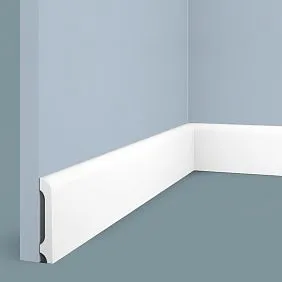
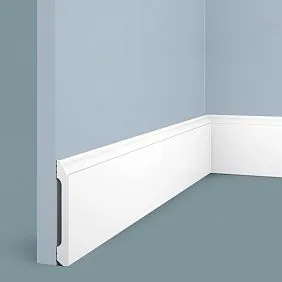
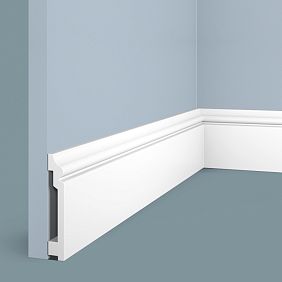
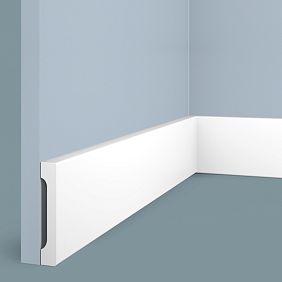
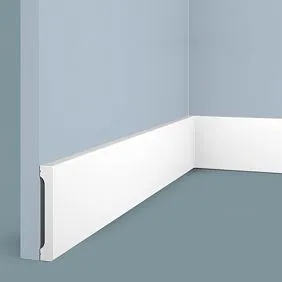
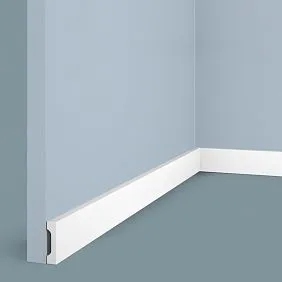
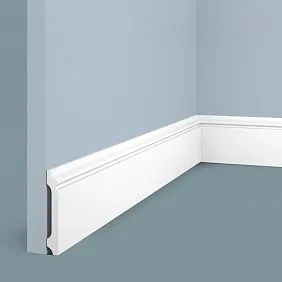
Main types of polystyrene baseboards




Classification by material density
Not all polystyrene baseboards are the same - they differ by material density, which directly affects operational characteristics, durability, and, of course, price.
Standard expanded polystyrene has a density of 15-30 kg per cubic meter. This is the most common and affordable option, suitable for most residential rooms with normal load. The material is lightweight - a meter of 80 mm high baseboard weighs only 120-180 grams. The structure is porous, providing good thermal insulation. Price is affordable - from 150 to 300 rubles per meter. However, strength is average - under strong impact, dents or chips may appear.
Polystyrene of medium density 30-45 kg per cubic meter - an intermediate option with improved characteristics. Weight increases to 200-250 grams per meter, but strength is noticeably higher. Surface is denser, smoother, holds paint better. Suitable for rooms with increased load - kitchens, hallways, children's rooms. Price 300-500 rubles per meter. Optimal price-to-quality ratio for most applications.
Impact-resistant polystyrene of high density 45-65 kg per cubic meter - premium segment with maximum operational characteristics. Weight reaches 250-400 grams per meter, but strength increases 2-3 times compared to standard. Material withstands significant mechanical impacts without visible damage. Surface is very dense, practically non-porous, with a characteristic slight gloss. Suitable for commercial spaces, public areas, homes with children and pets. Price 500-900 rubles per meter, but longevity pays for the investment.
Extruded polystyrene - a special category with density up to 35-40 kg per cubic meter, but with a closed-cell structure providing increased strength and minimal water absorption (less than 0.2 percent). Used in rooms with extreme humidity - saunas, swimming pools, bathrooms. Price is 30-50 percent higher than standard models, but for specific conditions this is the optimal choice.
Our factory also produces:


Classification by profile and design
The appearance of the baseboard is determined by the profile shape, which can be simple or complex depending on the interior style.
Rectangular baseboards - minimalist solution for modern interiors. Simple geometric shape without decorative elements, strict lines, sharp angles. Height varies from 40 to 120 mm, thickness 10-20 mm. Such baseboards fit perfectly into Scandinavian style, minimalism, high-tech, loft. Easy to maintain - easy to wipe, does not collect dust. Price is the most affordable in the category.
Baseboards with bevels have a sloped top edge at a 30-45 degree angle, creating a smooth transition from the baseboard to the wall. This is a classic profile, proven over decades. The bevel can be simple straight or slightly concave. The height of such baseboards is usually 60-100 mm. A universal solution suitable for most interiors — from classic to modern. Creates a balance between decorative appeal and restraint.
Baseboards with decorative grooves have one or several horizontal recessed lines, creating a visual rhythm. The grooves can be wide or narrow, deep or barely noticeable. Such a profile adds architectural expressiveness to the baseboard without overloading it with decoration. Height 70-150 mm, suitable for neoclassical interiors, modern classics, transitional styles.
Baseboards with relief decoration have three-dimensional ornaments — botanical motifs, geometric patterns, classical architectural elements. The relief can be moderate or rich, depending on the style. Height is significant — 100-180 mm — to ensure the decoration is visible from a distance. Suitable for classic interiors, palace styles, luxurious spaces. Require a corresponding environment — in a simple interior, they will look out of place.
Baseboards with cable channels combine decorative and utilitarian functions. On the back side, there is a special channel or several channels for laying wires — electrical, telephone, internet cables. This eliminates the need for wall grooving. Height is usually 80-120 mm to accommodate wires. The front side can have any design — from simple to decorated. A practical solution for modern homes with abundant electronics.
High baseboards 150-200 mm — a modern trend originating from Europe. Such massive elements visually raise the ceiling, making the interior more spacious and prestigious. Require rooms of corresponding size — in a small room, they will appear bulky. The profile can be simple or decorated. Often used in luxury interiors, showrooms, commercial spaces.
Get Consultation
Classification by size
Polystyrene floor baseboardAvailable in a wide range of sizes, allowing selection of the optimal option for any room parameters.
Low baseboards 30-50 mm — a compact solution for small rooms or minimalist interiors. They do not overload space, creating a neat transition between floor and wall. Suitable for rooms with low ceilings, where higher baseboards would visually reduce height. Also used in technical rooms, where functionality rather than decoration is key.
Standard baseboards 60-80 mm — the most popular category, suitable for most apartments and houses. This height has been proven over decades of practice, creating harmonious proportions in rooms with standard heights of 2.5-2.7 meters. Sufficiently expressive to complete the interior, yet not dominant. The widest selection of profiles is available in this size range.
High baseboards 90-120 mm — choice for spacious rooms with ceilings 2.7-3.0 meters. More substantial elements are proportionate to large walls, creating a solid impression. Often have more expressive profiles with decorative elements. Suitable for living rooms, halls, offices, dining rooms — representative spaces.
Very high baseboards 130-200 mm — premium segment for special interiors. Such massive elements require high ceilings of 3.0 meters and corresponding room area. Used in luxury apartments, country mansions, commercial spaces. Often have complex multi-level profiles, imitating classic wooden panels.
Standard baseboard length is 2000 mm or 2400 mm depending on the manufacturer. Some premium brands produce elements 2700 mm long, reducing the number of joints during installation. Thickness varies from 10 to 25 mm depending on height and profile construction.
Advantages of polystyrene as a material for baseboards
Physical and mechanical properties
Polystyrene baseboard whitePossesses a unique set of characteristics making it the optimal choice for floor applications.
Lightness — the first and most obvious advantage. A meter of standard baseboard 70 mm high weighs only 150-200 grams — this is 3-4 times lighter than wooden and 10-15 times lighter than gypsum. Lightness is critical for installation: one person can easily transport and install baseboards throughout an apartment without helpers. No strong adhesive or mechanical fasteners are required — ordinary acrylic-based mounting adhesive is sufficient. Lightweight baseboards do not exert load on walls, which is especially important for gypsum board partitions.
Water resistance — a critical advantage for floor applications. The water absorption of polystyrene is less than 3 percent when fully submerged for 24 hours. In practice, this means absolute resistance to moisture. Can be confidently installed in bathrooms, kitchens, toilets, hallways — rooms with high humidity or risk of water exposure. The material does not swell, does not deform, does not rot even with direct contact with water. After wet cleaning with abundant water, the baseboard remains unchanged.
Temperature stability is ensured by a wide operating range — from minus 50 to plus 70 degrees Celsius. Within these limits, the material retains its shape and properties without deformation. The coefficient of thermal expansion is minimal — about 0.00006 per degree. This practically eliminates the appearance of gaps at joints during seasonal temperature fluctuations. Can be installed in unheated rooms, on balconies, in country homes with intermittent occupancy.
Biological inertness means that polystyrene is not a nutrient medium for microorganisms, fungi, mold, insects. The material does not rot, is not attacked by wood-boring insects, does not develop mold even in humid environments. This is especially important for toilets, basements, rooms on the first floor, where there is a high risk of biological damage. The service life is not reduced by biological factors.
Ease of processing — polystyrene is easily cut with a fine-toothed hacksaw or even a sharp office knife. No special tools or professional skills are required. Angles are formed using a simple mitre box without chips or cracks. If necessary, the element can be sanded with a file or sandpaper. This makes DIY installation accessible even for beginners.
Thermal insulation properties are due to the porous structure of the material. The thermal conductivity of polystyrene is 0.035-0.040 W/(m×K) — one of the lowest values among construction materials. The baseboard creates an additional thermal insulation barrier at the junction of floor and wall, where cold bridges often form. This is especially relevant for first-floor rooms, rooms above cold basements, exterior walls.
Sound insulation characteristics are also above average due to the porous structure. The baseboard partially dampens impact noises transmitted through walls. This is not full sound insulation, but a certain contribution to acoustic comfort in the room.
Operational advantages
Practical advantages of polystyrene baseboards become apparent during daily use.
Ease of maintenance — the polystyrene surface is smooth, non-porous, easily cleaned with a damp cloth. Does not absorb dirt, grease, odors. Regular wet cleaning with a mild detergent completely removes all dirt. No special products or complex maintenance procedures are required. Painted baseboards are even easier to maintain — paint provides an additional protective layer.
Ability to paint in any color — one of the main advantages.white polystyrene baseboardSupplied in a basic white color, which can be left as is or painted in any desired shade. Standard water-based acrylic paints are used. Color can be matched to the floor or walls, create contrast, or realize any design idea. When changing the interior, baseboards can easily be repainted in a new color.
Durability — with proper use, the service life of polystyrene baseboards is 25-50 years. The material does not age, does not degrade, does not lose properties over time. Not susceptible to rotting, corrosion, or biological damage. If the baseboard is not subjected to extreme mechanical impacts, it will retain its original appearance for decades. This is significantly longer than MDF (10-15 years), PVC (15-20 years), comparable to quality wood.
Repairability — minor damage is easily repaired with putty and touch-up paint. If a section of the baseboard is severely damaged, it can be replaced without dismantling the entire system. Cut out the damaged piece, install a new element, fill the joints with putty, touch up — repair takes 1-2 hours. This is impossible with solid wooden baseboards or clip systems.
Hygiene — polystyrene does not absorb moisture, dirt, odors, is not a medium for bacterial or fungal growth. This makes it suitable for medical facilities, kindergartens, food production — rooms with high hygiene requirements. The surface can be easily disinfected with any means without damaging the material.
Ecological safety — modern polystyrene meets all ecological standards. Does not emit harmful substances during normal use, has no odor, is safe for human and pet health. Products from leading manufacturers have appropriate certificates and sanitary-epidemiological service approvals.
Economic advantages
Financial attractiveness — one of the factors contributing to the popularity of polystyrene baseboards.
Affordable price - the main competitive advantage. The cost of polystyrene skirting boards is 2-4 times lower than wooden ones, 3-5 times lower than polyurethane, comparable to MDF and PVC. With a limited budget, this allows creating a beautiful, finished interior without significant financial expenses. Savings on material for a standard two-room apartment can amount to 15,000-30,000 rubles compared to wooden skirting boards.
Savings on installation - ease of installation allows performing the work yourself without hiring professionals. Professional installers' services cost 200-400 rubles per linear meter. For an apartment with a skirting board perimeter of 60 meters, savings amount to 12,000-24,000 rubles. Even with the purchase of a minimal set of tools (miter saw, hacksaw, putty knives), savings are significant.
Savings on transportation - the lightweight material reduces transportation costs. Skirting boards for the entire apartment can be easily transported in a regular car. No need to rent a truck or hire movers. One person can easily carry the material to any floor.
Long-term savings - a long service life means that skirting boards will not need replacement during subsequent renovations. Investing once, you get a solution for 25-50 years. Calculated per year of use, the cost becomes minimal. Adding the absence of special maintenance costs, the benefit becomes obvious.
Features of installing polystyrene skirting boards
Preparation Stage
Quality preparation - the foundation of successful installation, determining the durability and appearance of the result.
Cleaning the lower part of the wall begins with removing all dirt, dust, and remnants of old materials. If the wall was covered with wallpaper, remove it to the height of the skirting board plus 3-5 cm. Residual glue is scraped off with a putty knife. Paint and whitewash are checked for adhesion - if they peel off, remove them down to a solid base. Grease stains on the kitchen are cleaned with a cleaning agent.
Checking wall flatness is critical for tight skirting board fit. Place a long straightedge or level board against the wall along the skirting board installation line. Any bumps deeper than 3-5 mm are sanded or ground down. Depressions are filled with putty. After the putty dries, the surface is sanded to smoothness. An uneven wall is the main cause of gaps between the skirting board and the wall, which spoil the appearance.
Checking floor flatness is also important, especially if using skirting boards with a wide lower section. If the floor has significant unevenness, the skirting board may not fit tightly along its entire length. For localized unevenness, you can place thin shims under the skirting board at problem areas.
Surface priming is mandatory for good adhesive bond. Use an acrylic deep-penetration primer. Apply with a roller or brush to the wall area up to the height of the skirting board plus 5 cm. The primer strengthens the base, improves adhesive bond, and reduces absorption. Allow the primer to dry completely - usually 4-6 hours. On very porous or loose surfaces, apply two layers of primer with intermediate drying.
Material acclimatization is necessary if the skirting boards were stored in a cold room or delivered in winter. Bring packaged items into the room where installation will take place and leave them there for 24-48 hours. The material temperature should equalize with room temperature. Installing cold material will cause it to expand later upon heating, creating gaps at joints.
Marking is not mandatory for skirting boards, but helps maintain a straight horizontal installation line. Mark several control points on the wall at the height of the top edge of the skirting board with a pencil. Check horizontal alignment with a level. These points will make it easier to align during gluing.
Tool and material preparation includes checking the availability of everything needed: miter saw for cutting angles, fine-tooth hacksaw for polystyrene, tape measure, pencil, adhesive gun, adhesive tubes (acrylic adhesive or liquid nails), putty knives for applying adhesive and sealing joints, acrylic putty, painter’s tape for temporary fixation, clean cloth for removing excess adhesive, sandpaper for trimming cuts.
Installation technology
Correct sequence of actions and adherence to technological techniques guarantee a quality result.
Start installation from the corner - standard practice. Choose the most visible corner of the room - usually the corner first seen upon entry. Here, the joint must be perfect. Measure the length of the first wall from corner to corner. If the wall is shorter than the standard skirting board length (2 meters) - cut the element to the required length. If longer - you will need to join several elements.
Cutting angles - the most critical step. For skirting board joints in interior corners, both elements are cut at a 45-degree angle. Use a miter saw - a special tool with slots for required angles. It is important to correctly orient the skirting board in the miter saw: it should stand vertically, with the wide side pressed against the back wall of the saw. Cut smoothly without heavy pressure to avoid chipping.
For interior corners: the left element is cut so that the left end is longer than the right (cut from right to left). The right element - conversely, the right end is longer than the left (cut from left to right). For exterior corners, the cutting direction is opposite. Check the joint of the elements before gluing - place them together in the corner. The gap should not exceed 1 mm. If the joint is not ideal - adjust it with sandpaper.
Adhesive is applied to the back surface of the skirting board. Remove the cap from the adhesive tube and insert it into the adhesive gun. Apply adhesive in a zigzag pattern along the entire length of the surface that will adhere to the wall. If the skirting board is tall (more than 100 mm), also apply adhesive to the lower part that will rest on the floor. Do not apply excessive amounts - when pressing, the adhesive will squeeze out, creating drips. Optimal - a continuous line 5-7 mm thick.
Gluing to the wall is done by carefully pressing the skirting board exactly along the marked line. Start from one end, gradually pressing along the entire length. Press evenly with the entire palm, not point by point with fingers - this may leave dents on soft polystyrene. Hold the press for 30-60 seconds until the adhesive begins to set. Immediately wipe away excess adhesive squeezed out at the edges with a damp cloth or rag while the adhesive is still wet.
Temporary fixation ensures secure adhesion. Cut strips of painter’s tape 15-20 cm long. Attach them every 50-70 cm along the length of the skirting board, one end to the skirting board, the other end to the wall above the skirting board, creating pressure. You can use weights - place heavy books, toolboxes, or paint cans along the skirting board. Temporary fixation can be removed after 12-24 hours, when the adhesive is fully dry.
Joining elements along the length is required when connecting two skirting boards on a straight wall section. The ends of both elements must be cleanly cut perpendicular to the length - use a miter saw with a 90-degree slot. Apply adhesive to the surface that will adhere to the wall and to the end of the first element. Glue the first element. Apply adhesive to the end of the second element and to the surface. Press the second element tightly against the first, achieving a tight joint without gaps. Remove excess adhesive that protrudes from the joint after slight drying (after 20-30 minutes) - it is easier to trim carefully than to spread fresh adhesive.
Exterior corners are less common than interior ones but require the same care. Cutting is done at 45 degrees in the opposite direction to interior corners. Check the joint - exterior corners are more noticeable, and the joint must be perfect. To protect exterior corners, you can additionally use special plastic corner caps, which simultaneously protect against mechanical damage and mask the joint.
Avoiding obstacles - doorways, heating pipes, protrusions - requires precise measurements and careful trimming. In doorways, the skirting board is cut flush with the door frame. Around pipes, cut a semicircular recess of the required diameter - use a circular saw or jigsaw. When avoiding protrusions, measure the depth of the protrusion, mark it on the skirting board, and cut the corresponding section.
Features of installing on different types of floors
The type of flooring affects the installation technology of skirting boards.
Installation on laminate and parquet boards requires accounting for the technological gap. These coverings are laid with a floating method with an 8-12 mm gap from walls to compensate for thermal expansion. The skirting board is attached only to the wall, not to the floor. The bottom edge of the skirting board should slightly overlap the edge of the covering, covering the gap, but not pressing the covering against the wall. Check that the covering can move freely under the skirting board - this is important for the longevity of the floor.
Installation on linoleum and carpet is simpler - these coverings do not require a compensatory gap. The skirting board is glued to the wall, with its bottom edge resting on the floor. If linoleum or carpet extends onto the wall (which is done to hide the edge), the skirting board is glued over the covering. Ensure the covering on the wall is securely glued, otherwise the skirting board may peel off along with it.
Installation on tile requires a flat base - ceramic tile creates an ideally flat vertical surface. However, grout lines may interfere with tight skirting board fit. Before installation, check if the grout lines protrude. If necessary, sand down the protrusions. Tile is an excellent base for gluing, but requires a stronger adhesive - regular acrylic may be insufficient, use liquid nails or MS-polymer adhesive.
Installation on poured floor provides ideal conditions - absolutely flat horizontal and vertical surfaces. The skirting board fits tightly along the entire length without gaps. However, the smooth surface of the poured floor requires good adhesive bond - wall area priming is mandatory.
Painting and finishing skirting boards
Preparation for painting
Quality preparation ensures an ideal painting result.
Joint filling is performed after the glue has fully dried (24-48 hours). Inspect all joints — corner, end, and those adjacent to door frames. Where there are gaps, fill them with acrylic putty. Use a narrow putty knife, applying putty carefully to fill the gap flush with the baseboard surface. Wipe away excess immediately with a damp cloth. Allow the putty to dry completely — 2-4 hours depending on layer thickness.
Sanding filled areas ensures smoothness. Use fine-grit sandpaper P180-P240. Sand gently with circular motions without pressing down. Polystyrene is a soft material; excessive pressure will leave scratches. The goal is to make filled areas invisible, blending seamlessly with the main surface. After sanding, wipe baseboards with a dry cloth to remove dust.
Surface degreasing improves adhesion of primer and paint. Wipe baseboards with a cloth slightly dampened with cleaning solution (1 tablespoon per liter of water). Then wipe with a clean damp cloth to remove any cleaning residue. Allow to dry completely. Do not use aggressive solvents — they may damage polystyrene.
Protecting adjacent surfaces is mandatory for neat work. Apply painter’s tape to the floor along the baseboard, leaving 1-2 mm from its bottom edge. Apply tape to the wall above the baseboard, also leaving 1-2 mm. This protects against accidental paint splatters. Also cover the floor with plastic sheeting or old newspapers, extending 30-40 cm from the wall.
Protection of adjacent surfaces is necessary for neat work. Apply painter's tape to the floor along the baseboard, leaving 1-2 mm from its bottom edge. Also apply tape to the wall above the baseboard, leaving 1-2 mm clearance. This will protect against accidental paint splatters. Additionally, cover the floor with plastic sheeting or old newspapers for a 30-40 cm width from the wall.
Painting Technology
Proper painting technique ensures even coverage without streaks or missed spots.
Paint selection is critically important. Use only water-based paints — acrylic, latex, or emulsion. Solvent-based paints (alkyd, oil, nitro) are strictly prohibited — they will degrade polystyrene. Choose paints labeled 'for interior use'. Sheen level is a matter of preference: matte paint hides minor defects and creates a noble surface; satin is practical and easy to clean; glossy highlights the shape but reveals all flaws.
Paint tinting is done at the store using special equipment or manually with tinting pastes. For precise color match, bring a wallpaper sample, a painted wall section, or an interior photo. Computer matching ensures exact shade accuracy. When tinting manually, add pigment gradually, thoroughly mixing and checking the shade on a test surface. Tint the entire required volume at once — replicating the exact shade manually is nearly impossible.
Painting tools are selected based on the baseboard profile. For smooth baseboards, a velvet roller 10-15 cm wide is optimal — it provides even coverage without fibers or streaks. For textured baseboards, use a brush 50-70 mm wide with medium bristle stiffness. Synthetic bristles are preferable when working with water-based paints. For filling deep recesses, use a fine brush 20-30 mm wide.
The first coat is applied thinly and evenly. Mix paint thoroughly. Dip the brush or roller, lightly squeezing out excess. Apply paint with long, continuous strokes along the baseboard. When using a brush, avoid pressing down hard — this leaves streaks and bristle marks. When using a roller, work with smooth, even pressure. Carefully paint textured areas with a brush, ensuring paint fills all recesses. Do not apply a thick layer at once — two thin layers are better than one thick layer with drips. First coat drying time is 2-4 hours, but allow 6-8 hours for full drying.
The second coat is applied after the first coat has fully dried. Before applying, inspect the surface — if there are rough spots, raised bristles, or minor defects, lightly sand with fine sandpaper P320-P400. Wipe away dust with a damp cloth, then allow to dry. Apply the second coat perpendicular to the first for better coverage — if the first coat was applied horizontally along the baseboard, apply the second coat vertically from top to bottom. The second coat can be slightly thicker than the first. After drying, evaluate the result — usually two coats are sufficient for ideal coverage.
A third coat may be needed when painting in saturated dark colors, if the paint has insufficient coverage, or when transitioning from dark to light shades. Application technique is similar to the second coat. Remember: three thin coats are better than two thick ones. Thin coats dry faster, provide a smoother surface, and reduce the risk of drips.
The finishing stage includes removing painter’s tape. Do this after the final paint layer has fully dried — after 6-12 hours. Carefully peel the tape at an acute angle, slowly, to avoid damaging the paint edges. Inspect painted baseboards — if necessary, touch up missed spots or uneven areas with a fine brush.
Care and longevity of polystyrene baseboards
Regular Maintenance
Proper care extends the lifespan of baseboards and preserves their original appearance.
Dry cleaning is performed weekly. Wipe baseboards with a soft dry microfiber cloth or a specialized dust brush. You can also use a soft vacuum cleaner attachment on low power. Regular dry cleaning prevents dust buildup and maintains a fresh appearance. This is especially important for textured baseboards, where dust settles in recesses.
Wet cleaning is performed once a month or as needed. Use a slightly damp (not wet) microfiber cloth. To enhance effectiveness, add a drop of mild dish soap to the water. Wipe baseboards with gentle motions without pressing hard. Then wipe with a clean damp cloth to remove soap residue. Allow to dry naturally. Do not use abrasive cleaners, stiff sponges, or aggressive chemicals — they may damage the paint or the material itself.
Local stains should be removed immediately upon detection. Fresh stains are easily removed with a damp cloth. For stubborn stains, use a soft melamine sponge — it effectively removes dirt without chemicals. Work carefully, avoiding vigorous rubbing of one spot — this may remove paint. After cleaning, wipe with a clean damp cloth.
Care considerations vary by room based on usage specifics. In entryways, baseboards are exposed to the most dirt — dust, dirt, outdoor moisture. Here, more frequent wet cleaning is required — once a week. In kitchens, baseboards may accumulate grease. Use grease-cleaning agents, thoroughly rinsing off any residue. In bathrooms, ensure water does not accumulate on baseboards — wipe dry immediately after bathing or showering.
Damage Prevention
Preventing problems is easier than fixing them.
Protection against mechanical damage includes caution during cleaning, moving furniture, and children’s play. Explain to household members that baseboards require careful handling. When moving furniture, lift it rather than dragging it across the floor — this may leave scratches on the baseboard. When vacuuming, use a soft attachment and avoid hitting the baseboard with the attachment. In high-contact areas (near doors, narrow passages), consider installing impact-resistant models.
Protection against fading is achieved by using quality paints with UV filters. If baseboards are located near windows on the sunny side, choose paints resistant to ultraviolet light. Poor-quality paint fades within 2-3 years. Quality paint retains color for 10-15 years. You can use curtains or blinds to shield from direct sunlight during peak daylight hours.
Monitoring wall adhesion includes periodic inspection. Check every six months for any signs of peeling. If you detect early peeling — immediately reattach, without waiting for complete detachment. Carefully lift the peeling edge (do not fully detach), apply fresh adhesive, press firmly, and secure with painter’s tape for 12-24 hours.
Although polystyrene is moisture-resistant, prolonged direct water exposure is undesirable. In bathrooms and kitchens, ensure water does not accumulate near baseboards. Wipe up puddles immediately upon detection. For additional protection, you can apply a water-resistant acrylic lacquer over painted baseboards — it creates an additional barrier.
Repair of damage
Minor defects are easily corrected without replacing the entire baseboard.
Repairing scratches and chips involves filling with putty and touch-up painting. Clean the damaged area of dirt. Fill the chip or scratch with acrylic putty using a narrow putty knife. Level it flush with the surface. Allow to dry 2-4 hours. Sand lightly with fine sandpaper. Wipe with a damp cloth to remove dust. Prime the repaired area. After the primer dries, touch up with a fine brush, matching the original paint color precisely. Apply two coats if necessary.
Replacing a damaged section is performed if the damage is significant. Mark the replacement boundaries — step back 10-15 cm from the damaged area in both directions to the nearest joints or corners. Carefully cut out the damaged section with a hacksaw or utility knife. Remove old adhesive from the wall. Prepare a new baseboard piece of the required length, trimming ends at 90 degrees. Apply adhesive, install the new piece, and secure with painter’s tape. After the adhesive dries, fill, sand, prime, and paint the repaired area.
Removing peeling involves reattaching. If the baseboard has peeled off over a significant area, gently peel it away from the wall without breaking it. Remove old adhesive with a scraper. Clean the wall and the back of the baseboard of dust and dirt. Apply fresh adhesive. Press the baseboard firmly against the wall and secure with painter’s tape or weight. Wipe away excess adhesive. Leave for 24 hours until fully dried.
Tips for selecting baseboard profile
Matching the interior style
The skirting board should harmoniously fit into the overall stylistic concept of the room.
For classic interiors, choose skirting boards 100-150 mm high with a pronounced relief. Decorative grooves and elements imitating classical architectural moldings will create a sense of luxury and solidity. Color - white or painted in noble shades: ivory, cream, light gray.
For modern styles (minimalism, Scandinavian, high-tech), simple rectangular skirting boards 60-100 mm high without decorative elements are suitable. Clean lines, absence of ornament, matte surface. Color - white or matching the wall color, creating a monolithic space.
For eclectic mixed styles, you can experiment with height and profile. The main thing is a sense of proportion. The skirting board should match the scale of the room and not conflict with other interior elements.
Matching the ceiling height
The height of the skirting board should correspond to the ceiling height for harmonious proportions.
For low ceilings 2.4-2.5 meters, choose skirting boards 50-70 mm high. Higher ones will visually steal precious centimeters of height, making the room appear low. A narrow skirting board in wall color will visually raise the ceiling.
For standard ceilings 2.6-2.8 meters, skirting boards 70-90 mm high are optimal. This is a classic proportion, time-tested, suitable for most interiors.
For high ceilings 2.9-3.2 meters, skirting boards 100-150 mm high can be used. Larger elements will be proportionate to large walls, creating an impressive appearance.
For very high ceilings from 3.3 meters, skirting boards 150-200 mm high are suitable. Such large elements will not be lost on large surfaces, creating architectural expressiveness.
Matching the floor covering type
The skirting board should harmonize with the floor covering in color and style.
Skirting boards match well with laminate and parquet flooring, either in the floor color or contrasting white. A modern trend is white skirting boards with any floor color, creating a fresh, contemporary look.
With dark floors (wenge, dark oak, black), white skirting boards look striking - a classic contrasting combination. Alternatively, skirting boards in the floor color for a monolithic effect.
With light floors (white oak, light beech, maple), white skirting boards in matching or slightly darker tones create a subtle contrast.
With linoleum and carpet, skirting boards are usually chosen in neutral white or wall color, as these coverings often have busy patterns that are difficult to match with colored skirting boards.
Hi Wood products: quality standard
South Korean brand Hi Wood (hawood, hay wood) is a globally recognized leader in producing decorative elements from high-density polystyrene, including premium-grade skirting boards. Over 30 years of experience, use of eco-friendly plant polymer, international quality and safety certifications - all of this makes HiWood products a benchmark in their segment.
The skirting board assortment includes more than 80 models of different heights, designs, and purposes. From compact profiles 40 mm high for minimalist interiors to luxurious skirting boards 180 mm high with rich decoration for classic spaces. Each model is thought out in detail - precise geometry, ideal surface, thought-out ergonomic installation.
Technical specifications are impressive: material density 50-65 kg per cubic meter - 2-3 times higher than standard polystyrene. This ensures exceptional impact resistance, durability, and resistance to deformation. Hi Wood skirting boards withstand significant mechanical impacts without visible damage - ideal solution for commercial spaces, homes with children and pets.
Ecological safety is confirmed by the international Korea Eco-Label certification - the highest level of eco-friendliness. The material does not emit harmful substances, is safe for human health and the environment, suitable for children's rooms, medical facilities, food production.
Company STAVROS - official partner and supplier of Hi Wood products in Russia - offers a full range of skirting boards, cornices, moldings, and other decorative elements for implementing projects of any complexity. Working directly with the leading manufacturer, STAVROS guarantees authenticity of products, fair prices, professional consultations, and organized logistics with delivery throughout Russia.
Conclusion
Polystyrene skirting boards have rightfully earned recognition from professionals and homeowners as the optimal solution for floor finishing. Their unique combination of practicality, aesthetics, and affordable price makes them a universal choice for interiors of any style and budget.
Choosing the right profile, matching the interior style, ceiling height, and floor covering type, is the first step toward creating a harmonious space. Quality installation following the technology ensures longevity and flawless appearance. Proper painting allows you to realize any design ideas, adapting skirting boards to individual preferences.
Modern materials and technologies make creating a beautiful, finished interior accessible to everyone. Polystyrene skirting boards are a sensible investment in the comfort and beauty of your home, which will pay off for decades of flawless service.


