Article Contents:
- Why baseboards create interior completeness
- Architectural logic
- Functional purpose
- Aesthetic value
- Wooden baseboards - natural texture, durability, longevity
- Wood species for baseboards
- Aesthetic advantages of natural wood
- Technical specifications
- Types of wooden skirting boards
- Polyurethane baseboards - ease of installation, water resistance, flexibility
- Technological advantages of polymer
- Variety of profiles and sizes
- Finishing options
- Installation and mounting
- Color solutions and combinations with flooring
- Baseboard matching floor color
- Baseboard matching wall color
- Contrasting solutions
- Combination with doors and door casings
- Application in classical and modern design
- Classic Interiors
- Modern styles
- Maintenance and operation
- Regular Cleaning
- Local repair
- Recoating
- Seasonal maintenance
- Conclusion: aesthetics in details
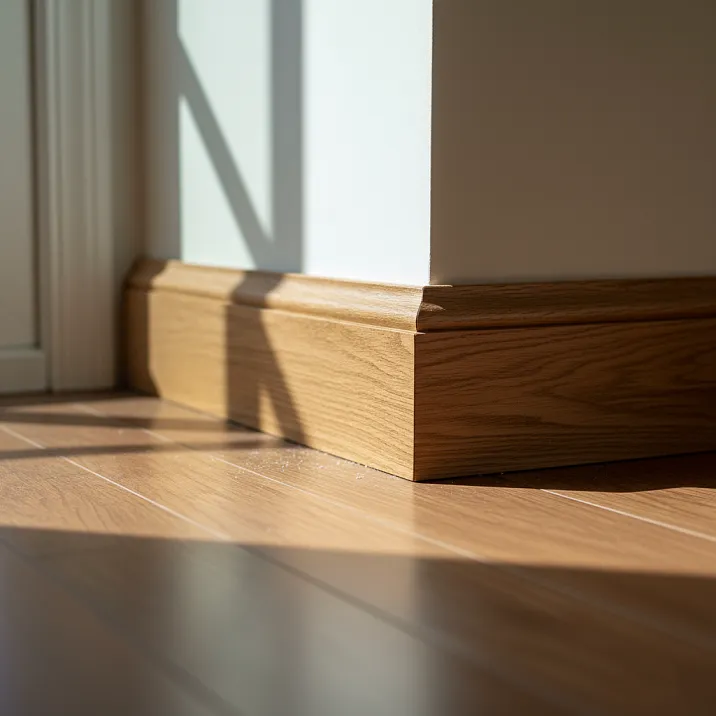
Baseboard - an architectural element that many underestimate, considering it a secondary finishing detail. However, it is precisely this modest element that completes the floor composition, creates a visual transition between horizontal and vertical planes, masks technological gaps, and protects the lower part of walls from damage. Without a baseboard, even the most luxurious flooring material looks unfinished, like a painting without a frame or a book without a binding.
The history of floor baseboards goes back to an era when architects sought harmony of proportions and completeness of every building element. In classical architecture, the baseboard represented the continuation of a column base, creating a visual connection between the floor and walls. Wealthy homes were adorned with carved wooden baseboards from precious woods, emphasizing the owner's status. Simple dwellings were content with painted wooden strips, but even they fulfilled an important role in completing the interior.
The modern market offers two fundamentally different materials for manufacturing baseboards - natural wood and innovative polyurethane.Wooden baseboardembodies centuries-old traditions, the nobility of natural material, the uniqueness of natural texture.Polyurethane baseboarddemonstrates achievements of modern technology - practicality, universality, accessibility. Choosing between these materials determines not only the interior's aesthetics, but also functionality, durability, and ease of use.
A properly selected baseboard harmonizes with flooring, doors, and door casings, creating a cohesive composition. It can be practically invisible, painted to match wall color, or, conversely, become a striking accent, drawing attention with contrasting color or rich texture. The height, profile, color, and material of the baseboard influence spatial perception - visually expanding or narrowing a room, raising or lowering ceilings, adding coziness or formality.


Why baseboards create interior completeness
Visual completeness of space - a basic psychological need of humans. Incomplete lines, broken transitions create a subconscious sense of discomfort and incompleteness.Decorative baseboardsolves this task, creating a clear boundary between floor and walls, logically concluding the vertical development of the interior.




Architectural logic
The baseboard continues the tradition of architectural orders, where each element has a base, body, and finish. The base of a column, the foundation of a building, the pedestal of a sculpture - all these elements create visual support, the foundation for the parts above. A floor baseboard performs a similar function in interior design - it creates a visual base for walls, completing the floor composition.
Without a baseboard, walls seem to merge into the floor, the junction line appears random and unprotected. The technological gap between the flooring and the wall, necessary to compensate for material thermal expansion, remains visible, disrupting aesthetics. Wires and cables laid along the walls remain unmasked. The lower part of walls is unprotected from furniture impacts, dirt during cleaning, and mechanical damage.
A properly selected baseboard structures space, creates rhythm, directs the gaze. A horizontal framing line visually expands the room, making it appear more spacious. A contrasting baseboard highlights the floor boundary, clearly defining the space's geometry. A baseboard matching the flooring color visually extends the floor plane, creating an illusion of greater area.
Our factory also produces:


Functional purpose
The protective function of the skirting board is critically important for maintaining the quality of the finish. The lower part of the walls is the most vulnerable zone, subjected to constant impacts. During vacuum cleaning, floor mopping, and furniture rearrangement, walls inevitably receive scratches, scuffs, and dirt. The skirting board takes on these impacts, protecting the expensive wall finish.
Masking technological gaps is a basic function of floor trim. Laminate, parquet, and engineered flooring require a deformation joint around the perimeter of the room, 10-15 millimeters wide, to compensate for thermal expansion. Without skirting, this gap remains open, allowing dust, dirt, and moisture to enter. The skirting elegantly covers the technological joint, transforming it into an architectural element.
Modern skirting boards are equipped with cable channels — special cavities for concealed wiring. Electrical cables, TV antennas, internet cables, and smart home system wires are neatly placed within the skirting, remaining accessible for maintenance. This is especially relevant in modern, technology-rich interiors, where the number of wires continues to grow.
Get Consultation
Aesthetic Value
The skirting board creates a visual frame for the floor covering, highlighting its beauty and value. Expensive exotic hardwood parquet, premium marble-patterned ceramic tiles, and artistic assembled parquet deserve a worthy frame. High-quality skirting board made from the same wood species as the parquet creates visual unity, emphasizing the status of the floor covering.Wooden baseboardMade from the same material as the parquet, it creates visual unity and emphasizes the status of the flooring.
Color accents are created by contrasting skirting boards. A white skirting board on a dark floor with colorful walls highlights the room’s geometry, making boundaries clear and graphic. A dark skirting board on a light floor adds depth to the interior, creating a visual sense of solidity. A colored skirting board, painted to match an accent wall, visually extends the vertical plane, unifying the floor and walls into a single composition.
Profiled skirting boards with decorative grooves, rounded edges, and protrusions create a play of light and shadow, enriching the interior. Classic profiles replicate architectural orders — column bases, cornices, moldings. Modern profiles lean toward minimalism — straight lines, minimal relief, clear geometry. Tall, wide skirting boards make a space more formal; low, narrow skirting boards give a more contemporary, minimalist feel.
Wooden skirting boards — natural texture, durability, longevity
Natural wood retains the status of a premium material for manufacturing floor skirting boards.Wooden baseboardIt embodies centuries of tradition, the nobility of natural material, and the uniqueness of natural texture. Each plank has an incomparable wood grain pattern, making the interior unique.
Wood species for skirting boards
Oak remains the undisputed leader among hardwoods due to its phenomenal strength, expressive large-grained texture, and noble tones. The density of oak wood reaches 700-800 kg/m³, providing exceptional resistance to mechanical impacts. Oak skirting boards withstand furniture impacts, do not chip, and do not deform even after decades of intensive use.
Oak's texture is unique — large pores create a distinctive expressive pattern with contrasting growth rings. The color palette ranges from light honey tones of young wood to deep chocolate shades of seasoned solid wood. Walnut takes on a noble gray-black color with silver highlights. Staining enhances the natural texture, making the pattern more contrasting and dramatic.
Ash is characterized by light-colored wood with a contrasting expressive pattern and a unique combination of hardness and elasticity. Density of 650-700 kg/m³ makes ash sufficiently strong for intensive use while retaining flexibility. Ash skirting boards are excellent for staining — stains penetrate deeply into the structure, allowing a wide range of shades from ash-gray to rich brown.
Beech has a fine-grained, uniform texture with a soft pinkish hue in its natural state. After steam treatment, the wood takes on a warm honey tone, ideal for classic interiors. Density of 650-680 kg/m³ ensures sufficient hardness. Uniform structure makes beech ideal for enamel painting — the surface becomes perfectly smooth without visible pores.
Walnut represents an elite segment due to its luxurious dark-brown color with noble violet and gray tones. Wavy texture with beautiful color transitions creates visual depth and elegance. Walnut skirting boards become a decoration of the interior, drawing attention with their nobility. High hardness ensures resistance to wear and damage.
Exotic species — wenge, teak, merbau, iroko — represent the premium segment with unique characteristics. Wenge has almost black color with golden veins, extreme hardness, and luxurious appearance. Teak contains natural oils, making the wood moisture-resistant and long-lasting. Merbau has reddish-brown color with golden flecks. Iroko is an African equivalent of teak with a yellowish-brown tone.
Coniferous species — pine and spruce — represent an affordable segment of wooden skirting boards. Light-colored wood with a characteristic resinous aroma creates an atmosphere of naturalness. Density of 450-550 kg/m³ makes coniferous skirting boards lighter than hardwoods. Soft structure requires careful handling, but the material is easy to process, paint, and stain in any shade.
Aesthetic advantages of natural wood
The natural texture of wood is unique — each skirting board has an individual wood grain pattern, creating the interior’s uniqueness. Nature never repeats — the combination of growth rings, direction of fibers, presence of knots and burls makes each plank a work of art. Two absolutely identical wooden skirting boards do not exist, which is especially valued in exclusive interiors.
The tactile appeal of natural wood creates a special feeling of contact with living material. Warm surface, light wood grain roughness, natural texture are pleasant to the touch. Psychologists note the calming effect of natural wood, creating an atmosphere of safety and closeness to nature. Wooden elements fill the space with a special energy of living material.
The play of light on wooden surfaces creates visual depth and volume. Under natural lighting, the texture is most expressively revealed — rays glide along the fibers, highlighting the relief, creating soft shadows. Lacquered surfaces demonstrate noble inner glow — light penetrates the upper layers of wood, reflects off the fibers, creating a warm radiance. Matte oil-based finishes create a velvety surface with a delicate silk-like sheen.
Wood aging adds character — over time, wood acquires a noble patina, color becomes deeper and richer. Oak skirting boards darken, acquiring a honey-brown tone. Ash turns gray, becoming more noble. This natural change does not spoil the appearance, but rather adds value, creating a sense of antiquity and generational continuity.
Technical Specifications
Wood density determines the strength and longevity of skirting boards. Hardwood species — oak, ash, beech — have a density of 650-800 kg/m³, providing high resistance to mechanical impacts. Soft coniferous species with density of 450-550 kg/m³ are lighter but less resistant to impacts and wear. Exotic species may have density up to 1000 kg/m³, providing extreme strength.
Qualitydecorative skirting boardsDecorative skirting boards are made from kiln-dried wood with residual moisture of 8-12 percent. At this moisture level, the material is in equilibrium with the microclimate of most living spaces, minimizing the risk of subsequent deformation. Under-dried wood may crack, while over-dried wood may absorb moisture and swell.
Surface treatment includes several stages. Sanding with fine-grit sandpaper (P180-P220) creates a perfectly smooth surface. Antiseptics protect against biological damage — mold, mildew, wood-boring insects. Primers reveal defects, improve adhesion of the final coating, reduce paint or varnish consumption. Final coating — varnishes, oils, waxes, enamels — protects the wood and highlights its beauty.
Geometric stability of wooden skirting boards depends on drying quality and operating conditions. With fluctuations in air humidity, wood absorbs or releases moisture, which may cause minor dimensional changes. Quality protective treatment minimizes this effect, but does not completely eliminate it. It is recommended to maintain stable air humidity at 40-60 percent for maximum longevity of wooden elements.
Types of wooden skirting boards
Solid skirting boards are made from a single piece of wood without gluing. This is the most expensive and high-quality option, offering maximum strength and longevity. The texture is continuous along the entire length, creating a unique aesthetic. Solid skirting boards made from premium species — oak, walnut, ash — serve for decades and are passed down to future generations as part of family heritage.
Veneered skirting boards have a base made of inexpensive softwood or MDF, to which a thin slice of valuable wood veneer (0.5–3 mm thick) is glued. Visually, such skirting boards are indistinguishable from solid wood, but they cost significantly less. The multi-layer structure ensures dimensional stability — the base compensates for internal stresses, while the veneer provides an elegant appearance. The color range of veneered skirting boards is extremely wide.
Jointed skirting boards are manufactured by gluing short wooden pieces along their length. This technology allows using short defect-free segments, ensuring high quality at an affordable price. The joints are made using a micro-tenon — the connection is practically invisible and as strong as solid wood. The absence of long fibers makes jointed skirting boards more stable — they deform less with changes in humidity.
Paintable skirting boards are made from light-colored woods without pronounced grain or from jointed wood. The surface is carefully sanded, primed, and prepared for paint application. Painting allows selecting an exact color to match the design concept, creating contrast or harmony with other interior elements. Skirting boards can be repainted when changing the design, refreshing the interior without replacing elements.
Polyurethane skirting boards — easy installation, water resistance, flexibility
Polyurethane revolutionized the production of decorative elements, offering a material with a unique combination of properties.Polyurethane baseboardManufactured using precision molding, allowing reproduction of complex profiles with perfect repeatability. The two-component polymer system forms a dense structure with closed pores.
Technological advantages of polymer
The density of quality polyurethane for skirting boards is 200–300 kg per cubic meter, which is 2–3 times lighter than wood. A meter of 80 mm high skirting board weighs only 200–400 grams, compared to 800–1200 grams for a wooden equivalent. The lightness drastically simplifies transportation, storage, and installation. One person can install skirting boards around a room without helpers.
Polyurethane's water resistance is absolute — the material does not absorb water even with prolonged direct contact. The water absorption coefficient is less than 1%, which eliminates swelling, deformation, and mold growth.Floor decorationPolyurethane skirting boards perform equally well in dry and humid areas — bathrooms, kitchens, toilets, laundries, pools. This makes polyurethane a universal material for any room.
Temperature stability allows using polyurethane skirting boards in conditions of extreme temperature fluctuations. The material retains its properties within a range from minus 40 to plus 80 degrees Celsius without deformation, cracking, or geometric changes. This is relevant for unheated rooms, glazed balconies, verandas, terraces, and winter gardens with seasonal operation. Polyurethane does not react to underfloor heating systems, maintaining dimensional stability.
The flexibility of special elastic profiles opens up possibilities for decorating curved surfaces. Flex skirting boards contain plasticizers, allowing bending elements with a minimum radius of 30–50 centimeters. They are ideal for decorating bay windows, columns, curved walls, arched openings without the need to assemble a structure from numerous small segments. The material takes the required shape during installation and retains it after being fixed with adhesive.
The impact resistance of modern polyurethane is high due to the material's elasticity. Upon impact, the polymer slightly deforms, absorbing energy, then restores its shape. Point impacts do not leave dents, unlike on softwoods. Scratches on painted surfaces are easily masked with touch-up paint. Serious damage requires replacing the damaged section, which is quickly done due to the modular construction.
Variety of profiles and sizes
Skirting board heights vary from minimalist 40–50 mm for modern interiors to large-scale 150–200 mm for rooms with high ceilings. The standard height of 60–80 mm is optimal for most rooms — sufficient for protecting walls and covering gaps, but not overwhelming the space. Wide skirting boards 100–150 mm create a classic, substantial look, visually weighing down the interior.
Skirting board profiles differ in complexity. Simple rectangular strips with a slight rounding of the top edge are suitable for minimalist modern interiors. Profiled skirting boards with decorative grooves, protrusions, and channels create light and shadow play, enriching the interior. Classic profiles replicate architectural orders with characteristic elements — quarter-rounds, chamfers, and ledges.
Cable channels — a practical addition to modern skirting boards. The cavity inside the skirting board or a removable cover on the back side allows neatly placing wires. The width of the cable channel varies from a narrow slit for 1–2 wires to a spacious cavity for a bundle of cables. Special corner elements and connectors ensure continuity of the channel around the entire perimeter of the room.
Element lengths are standardly 2 or 2.4 meters, minimizing the number of joints during installation. Some manufacturers offer elements 2.5–3 meters long for large rooms. The required quantity is calculated based on the room's perimeter minus door openings, with an additional 10% allowance for trimming and fitting.
Finishing options
Paintable skirting boardWhite color — a universal solution adaptable to any color concept. The surface does not require priming — paint is applied directly to polyurethane. After painting to match wall color, the skirting board becomes almost invisible, creating an effect of a single plane. Painting in a contrasting color turns the skirting board into a striking accent, structuring the space.
Laminated skirting boards are covered with decorative film imitating various materials. Popular wood textures — oak, walnut, wenge, white ash — are visually indistinguishable from natural wood. Marble, granite, and metal imitation expands design possibilities. The laminated surface is resistant to abrasion, requires no additional treatment, and retains its appearance for decades.
Pre-painted skirting boards are available in a wide color range — white, black, gray, beige, brown. Factory-applied paint is more durable than DIY painting — paint is applied under ideal conditions, polymerizes at optimal temperature, forming a strong coating. However, color choice is limited to the manufacturer's standard palette.
Skirting boards with decorative inserts combine a polyurethane base with elements made of other materials. Aluminum, brass, and copper inserts create texture contrast and add luxury. Rubber inserts along the top edge protect walls from dirt. Reflective strips are suitable for hallways and staircases, marking floor boundaries in darkness.
Installation and Mounting
Surface preparation requires leveling significant unevenness. Polyurethane is flexible, compensating for minor wall defects, but height differences exceeding 5 mm create gaps. The surface is cleaned of dust, grease stains, and old coatings. Loose areas are strengthened with deep-penetration primer. Perfectly flat walls are not mandatory — the material's elasticity allows it to adhere tightly to surfaces with minor imperfections.
Cutting is done with a fine-toothed hacksaw or a circular saw. Polyurethane cuts easily, does not crumble, and provides a clean cut without chips. For forming internal and external angles, a miter box is used, guaranteeing precise 45-degree cuts. Special corner elements simplify installation, ensuring perfect profile alignment without complex fitting.
Adhesive composition — special polyurethane glue, universal liquid nails, or high-adhesion mounting glue. Glue is applied in zigzag or dot pattern to the back of the skirting board with a 10–15 cm spacing. The element is pressed against the wall, leveled horizontally using a level, and held for 30–60 seconds until the glue sets. Excess glue is immediately wiped off with a damp cloth.
Mechanical fastening with self-tapping screws is used for heavy wide skirting boards or when installing on problematic bases. Screws are driven in at 40–60 cm intervals, screw heads are countersunk, and masked with putty or decorative caps. Combined fastening with glue and screws ensures maximum reliability for skirting boards with cable channels, which may experience loads during wire installation.
Final finishing includes sealing joints with white acrylic sealant. Sealant is applied from a caulking gun into the gap between elements, smoothed with a rubber spatula or damp finger. After drying, joints become almost invisible. Painting paintable skirting boards is done with acrylic or latex paint in two coats with intermediate drying time of 2–4 hours.
Color solutions and combinations with flooring
Choosing the skirting board color significantly affects the perception of the interior. Proper coordination with flooring, walls, and doors creates a harmonious composition. Color selection errors destroy the design's integrity, making the interior disharmonious.
Baseboard in floor tone
The classic approach assumes selecting the baseboard exactly to match the floor covering color.Wooden baseboardMade from the same wood species as the parquet, stained to match, creates a visual continuation of the floor. This technique visually expands the floor area, making the room appear more spacious. The boundary between the floor and the wall blurs, allowing the eye to move freely horizontally.
For oak parquet, optimal are oak baseboards with similar staining. Light oak pairs with natural or light-toned baseboards; dark stained parquet matches dark baseboards. Ash parquet harmonizes with ash baseboards, walnut with walnut. Exact match of species and tone creates absolute compositional unity.
Laminate and parquet flooring require careful color matching of baseboards. Manufacturers offer collections of baseboards tinted to match popular floor covering designs. Laminate or stained baseboards are selected as closely as possible to the floor tone. Minor tonal differences are acceptable—they add depth and make the composition more lively.
Ceramic tile and tile pair well with baseboards matched to the main color of the floor covering. For light marble-effect ceramic tile, white or beige baseboards are suitable; for dark tile, gray or black. Multi-colored tiles with patterns require neutral-toned baseboards that do not compete with the active floor pattern.
Baseboard in wall tone
The modern approach involves painting the baseboard to match the wall color, creating a visual continuation of the vertical plane.Paintable skirting boardWhite walls are painted to match colored walls, becoming an organic part of them. This technique visually lifts the walls, making the room appear taller. The boundary between wall and floor blurs, creating an illusion of greater height.
For white walls, optimal are white baseboards, creating monochromatic purity. White is universal—it suits any floor covering and any interior style. Pairing white baseboards with a dark floor creates a graphic contrast, clearly structuring the space. White baseboards on white walls with light flooring create the airy lightness characteristic of Scandinavian interiors.
Colored walls require baseboards exactly matching the tone or half a tone lighter/darker. Gray walls harmonize with gray baseboards of varying saturation. Beige walls pair with beige, coffee, or cream baseboards. Blue walls suit blue or light blue baseboards. Exact color match creates unity of the plane; a slight tonal difference adds depth.
Wallpaper with patterns requires baseboards matched to the background color of the wallpaper. For wallpaper with a white background—white baseboards; with beige—beige; with gray—gray. The baseboard should not compete with the active wallpaper pattern; its role is to delicately complete the wall composition.
Contrasting solutions
Contrasting baseboard coloring creates expressive graphic compositions. Black baseboards on white walls with light flooring is a bold modern solution, making the interior dynamic. A clear dark line structures the space, marks the floor boundary, and creates visual solidity. This technique is popular in Scandinavian and minimalist interiors.
Dark wooden baseboards in walnut or wenge on light walls with light flooring create an elegant contrast. The nobility of dark wood highlights the quality of finish, adding sophistication. The dark horizontal line visually expands the room, making it more intimate and cozy. Suitable for classical and neoclassical interiors.
Colored baseboards in tone with accent walls create unexpected effects. Emerald, sapphire, ruby, or indigo baseboards attract attention, becoming art objects. This technique works in creative interiors, galleries, showrooms, where decoration plays a key role. It’s important not to overdo it—colorful can be either the baseboard or the crown molding, but not both simultaneously.
Metallic baseboards with gold, silver, copper, or bronze finish add luxury. Gold baseboards suit classical interiors with gilded furniture and decor elements. Silver harmonizes with chrome details of modern styles. Copper creates a vintage atmosphere in loft and industrial interiors.
Combination with doors and door casings
The traditional approach assumes unity of baseboards, doors, and door casings.decorative skirting boardsThey are selected to match the color of interior doors, creating a visual connection between vertical elements of the interior. Light doors pair with light baseboards; dark doors with dark ones. Exact match of tone creates harmony, making the interior thoughtfully cohesive.
For solid oak doors, optimal are oak baseboards with similar staining. Whitewashed doors harmonize with whitewashed baseboards; wenge doors with wenge baseboards. Baseboard height should ideally match the width of the door casing—proportionality creates visual balance. A too tall baseboard with a narrow casing—or vice versa—looks disharmonious.
Contrasting baseboard and door combinations are a modern technique for creative interiors. Dark doors with light baseboards—or vice versa—create dynamism and break monotony. This approach requires a professional sense of proportion—it’s important to have unifying elements that link disparate colors into a composition.
In modern open-space layouts, the absence of doors frees one from the need to coordinate with door casings. Baseboards are selected based on their compatibility with the floor and walls. Open doorways are framed with the same baseboards running along the walls, creating a continuous line around the entire perimeter of the room.
Application in classical and modern design
The stylistic affiliation of the interior dictates the character of the baseboard—its height, profile, material, color. Classical and modern styles impose different requirements on floor trim.
Classic Interiors
Neoclassicism requires profiled wooden baseboards 100–150 mm high made from noble woods. Oak or walnut baseboards with distinctive profiles—quarter-rounds, grooves, planks—create architectural solidity. Color—natural wood tones from light oak to dark walnut. Lacquered surface with a slight gloss highlights the material’s nobility.
Baroque and Rococo prefer richly decorated baseboards with carved elements. Height 120–180 mm creates grandeur, matching the opulence of the style. Carving with floral motifs, gilding, and patination transform the baseboard into a work of decorative art.Wooden baseboardMade from solid wood with hand-carved details—an exclusive solution for luxurious interiors.
Empire uses strict symmetrical profiles with distinctive symbolism—laurel wreaths, torches, swords. Height 100–120 mm creates dignity without excess. Color—dark walnut, mahogany, wenge. Gilding on protruding profile elements is possible, emphasizing the parade-like nature of the style.
Neoclassicism simplifies traditional forms while preserving classical proportions. Baseboards 80–100 mm high made from light woods—whitewashed oak, light ash—create airy elegance. Profile is more restrained, without excessive ornamentation, but retaining architectural logic. Matte or semi-matte finish corresponds to the style’s restraint.
Modern Styles
Minimalism requires extremely simple, geometrically shaped baseboards. Height 40–60 mm does not overload the space. Profile is rectangular with a slight rounding of the top edge, without decorative elements.Polyurethane baseboardPainted white or to match the walls, it almost blends into the vertical surface and becomes barely noticeable.
High-tech uses plinths with metallic finishes — chrome, aluminum, steel. Plinths made of stainless steel or aluminum alloys are possible. Strict geometry, absence of ornamentation, cold metallic sheen correspond to the technological aesthetic of the style. Height of 50–70 millimeters creates functionality without excess.
Scandinavian style prefers white plinths 60–80 millimeters high with a simple profile. White color on white walls with light wooden flooring creates a characteristic airy lightness. Light wooden plinths made of pine or spruce, painted with white enamel or covered with transparent oil, are possible. Matte surface emphasizes naturalness.
Loft uses tall plinths 100–150 millimeters high with a simple rectangular profile made of rough wood. Dark staining, preserved traces of time — cracks, knots, irregularities — create a brutal aesthetic. Metallic plinths made of black steel with rust patina are possible. Deliberate simplicity corresponds to the industrial character of the style.
Eclecticism freely combines elements of different styles. Classic wooden plinths are painted in modern colors — graphite, emerald, indigo. Tall plinths 120–150 millimeters are used in minimalist interiors, creating an unexpected contrast. The key is the presence of a unifying idea that links disparate elements.
Care and Maintenance
Proper care extends the lifespan of plinths and preserves their aesthetics for decades. Wooden and polyurethane elements require different maintenance.
Regular cleaning
Wooden plinths are cleaned of dust with a dry soft cloth or vacuum cleaner with a delicate surface attachment. Periodically, every 2–3 months, wet cleaning with slightly damp cloth is recommended. Excessive moisture is not allowed — wood may absorb water, leading to swelling and deformation. After wet cleaning, the surface is wiped dry.
Polyurethane plinths require little maintenance. Regular dry cleaning with vacuum cleaner removes most dust. Wet cleaning with mild cleaning agents removes stains. The material is moisture-resistant, so wet cloth can be used without concern. Stains are removed with a weak soapy solution.
Lacquered wooden plinths require special care. Every 2–3 months, wood polish is applied to restore shine and create a protective film. Polishes based on natural waxes nourish the wood, prevent drying, and highlight texture. Silicone polishes create a water-repellent coating.
Painted plinths are wiped with a damp cloth using neutral cleaning agents. Abrasive materials are prohibited — they scratch the painted surface. Aggressive chemicals may damage the coating and cause color changes. Use cleaning agents for painted surfaces without solvents.
Local repair
Scratches on wooden plinths are filled with wax pencils matched to the wood tone. Wax fills the scratch, is sanded with a soft cloth, and becomes almost invisible. Deep scratches and dents are filled with specialized wood putty, sanded with fine-grit sandpaper, and stained or painted to match the finish.
Scratches on polyurethane plinths are repaired with acrylic putty. The damaged area is cleaned, degreased, and filled with putty. After drying, it is sanded and painted to match the plinth. Minor damage becomes barely noticeable after repair. Serious defects require replacement of the damaged section.
Detached plinths are re-adhered. The back side is cleaned of old glue and degreased. Fresh glue is applied, the plinth is pressed against the wall, and secured until it sets. Temporary supports may be installed if needed to ensure tight contact. After glue dries, supports are removed.
Cracks in wooden plinths are filled with specialized wood repair compounds. Small cracks are filled with liquid epoxy-based compounds that seep into the depth. Wide cracks are filled with wood putty mixed with sawdust to match the texture. After drying, they are sanded, stained, and lacquered.
Recoating
Wooden plinths are recommended to be relacquered every 10–15 years to maintain the protective properties of the coating. Old lacquer is sanded with abrasive pad or fine-grit sandpaper until matte. Surface is dusted and degreased. Fresh lacquer is applied in 2–3 layers with intermediate drying and light sanding. Renewed coating looks new and protects wood for another 10–15 years.
Painted plinths may be repainted if needed. Old paint is lightly sanded to improve adhesion of the new layer. Surface is degreased and primed if necessary. Fresh paint is applied in 2 layers with intermediate drying. Repainting allows complete change of interior color scheme without replacing plinths.
Wax coating on wooden plinths is renewed annually. Old wax is removed with special agents or alcohol. Surface is sanded with fine-grit sandpaper. Fresh hard wax is applied, rubbed in with a soft cloth, and polished to shine. Wax coating creates a silky surface, highlights texture, and protects against moisture.
Seasonal maintenance
Wooden plinths require attention during seasonal humidity changes. In heating season, air becomes dry and wood may crack. It is recommended to maintain air humidity at 40–60% using humidifiers. Plinths are periodically treated with wax-based compounds to prevent drying.
In summer, with high humidity, wood may absorb moisture and swell. It is important to ensure room ventilation and avoid prolonged moisture exposure. When cleaning floors, water should not seep under plinths. Lacquered coating is checked for integrity — microcracks in lacquer allow moisture to penetrate into wood.
Polyurethane plinths require no special seasonal maintenance. The material is absolutely stable under changes in temperature and humidity. Regular wet cleaning is sufficient to maintain cleanliness. Adhesion quality is checked — if detachment is found, plinths are re-adhered.
Conclusion: aesthetics in details
Plinth — the finishing touch of interior composition, defining the completeness and harmony of space. The apparent secondary nature of this element is deceptive — it is precisely the details that create the sense of thoughtfulness, coherence, and professionalism of design.
The choice between wood and polyurethane is determined by a complex set of factors.Wooden baseboardIt embodies the nobility of natural material, the uniqueness of natural texture, tactile warmth of solid wood. Investment in high-quality plinths made from premium species pays off for decades of flawless service, repair and renewal opportunities, unmatched aesthetics. Wooden elements create an atmosphere of respectability, closeness to nature, fundamental solidity.
Polyurethane baseboardIt demonstrates the practicality of modern materials. Absolute moisture resistance, ease of installation, affordable price, universal application make polymer material the optimal solution for a wide range of projects. Possibility of painting in any colors, creating complex curved forms, integrating cable channels opens up boundless creative possibilities.
Color solutions require careful analysis. Plinth in floor tone visually expands the area, plinth in wall tone visually raises the height, contrasting plinth structures the space. Coordination with doors and door frames creates visual unity among vertical elements. Correctly chosen color harmonizes the interior, incorrect choice destroys the composition.
Stylistic compatibility is critically important. Classic interiors require profiled wooden plinths from noble species, modern styles prefer minimalist polyurethane elements with simple forms. Plinth height corresponds to room scale and ceiling height.
Care and operation determine longevity. Wooden elements require attention, regular maintenance, and protection from moisture. Polyurethane is low-maintenance, requires no special care, retains properties under any conditions. Periodic coating renewal extends the service life of both materials.
Decorative baseboardIt is an investment in the completeness of the interior, its integrity and harmony. Correct choice of material, size, profile, and color transforms a utilitarian element into a fully integrated part of the design concept.Floor decorationCompletes the composition, creates a visual base, protects the finish, conceals utilities.
STAVROS Company offers the widest selection of wooden and polyurethane skirting boards for any style, budget, and usage conditions. Professional consultations will help you choose the optimal solution, taking into account all project specifics. High-quality European materials, proven manufacturing technologies, and years of experience — guarantee a flawless result. Create interiors where every detail is thoughtfully designed and perfected, where aesthetics are expressed in the small things, and quality is felt in every element. Choose STAVROS — choose perfection in details.