












































































Article Contents:
- Why exactly white polystyrene skirting board?
- Covering Defects
- Design Versatility
- Light reflection
- Psychological comfort
- Practicality of white color
- Technical characteristics of white polystyrene skirting board
- Composition and structure
- Physical parameters
- Ecological indicators
- Size range
- Advantages of white polystyrene skirting boards
- Lightweight
- Affordable price
- Absolute moisture resistance
- Ease of installation
- Ease of processing
- Biological stability
- Paintability
- Variety of profiles
- Disadvantages and limitations
- Mechanical strength
- Sensitivity to solvents
- Flammability
- Durability of white color
- Static electricity accumulation
- Choosing a white polystyrene skirting board
- Type of skirting board
- Profile height
- Profile type
- Quality Assessment
- Manufacturer
- Quantity Calculation
- Detailed installation instructions for white polystyrene skirting boards
- Room preparation
- Tools and Materials
- Cutting technique
- Choosing and applying adhesive
- Adhesion process
- Working with Corners
- Sealing Joints and Gaps
- Application of white polystyrene skirting boards in various interiors
- Minimalism
- Scandinavian Style
- Modern style
- Classic style
- Provence
- High-Tech
- Loft
- Combining white skirting boards with floor coverings
- Dark floor
- Light floor
- Wooden floor
- Laminate and parquet flooring
- Tile
- Cast floor
- Care for white polystyrene skirting boards
- Regular Cleaning
- Cleaning agents
- Combatting yellowing
- Repair of damage
- Frequently Asked Questions (FAQ)
- Do white polystyrene skirting boards yellow?
- Can white polystyrene skirting boards be used in the bathroom?
- How to clean white skirting boards from dirt?
- How much do white polystyrene skirting boards cost?
- Can white skirting boards be painted?
- How to choose the height of a white skirting board?
- Do you need to remove skirting boards when replacing wallpaper?
- How to join white skirting boards in corners without gaps?
- Can white skirting boards be glued with liquid nails?
- How long does it take to install white skirting boards?
- How to care for white skirting boards in the hallway?
- Do white skirting boards from different manufacturers differ?
- Conclusion
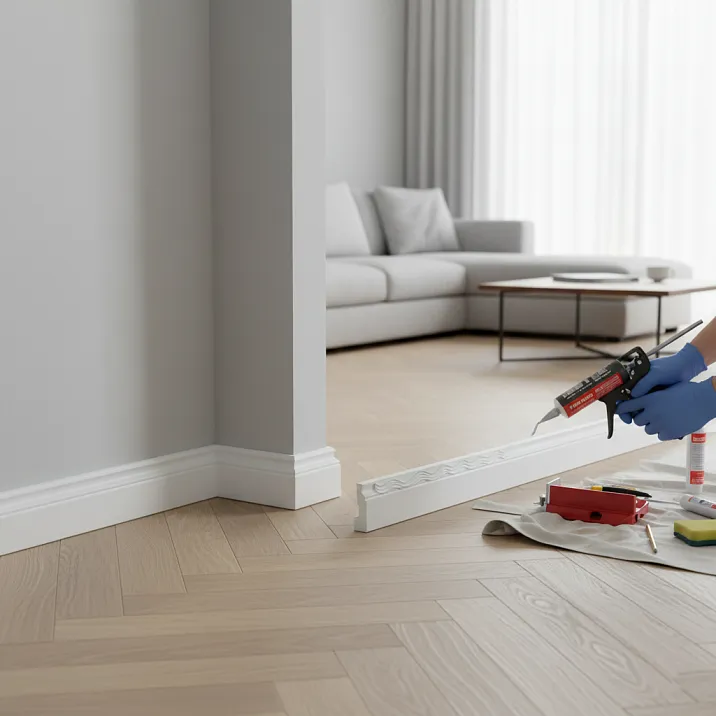
White color in interior design never goes out of fashion. It visually expands space, creates a sense of cleanliness and freshness, and serves as an ideal backdrop for any design solutions. That is whyPolystyrene baseboard whiteit remains the most popular choice among buyers — from owners of modest apartments to designers of luxury apartments. This universal finishing element completes the interior, hides technical gaps, protects walls from damage, and adds architectural completeness to the space.
White polystyrene skirting boards combine practicality, affordability, and aesthetic versatility. Unlike wooden or polyurethane analogs, they are incredibly lightweight, moisture-resistant, easy to install, and cost significantly less for comparable appearance.Polystyrene baseboardcan be installed by yourself in a few hours, without needing professional help or complex tools.
In this article, we will thoroughly examine all aspects of working with white polystyrene skirting boards: from selecting the optimal profile to installation nuances and maintenance. You will learn why white color is the optimal solution for most interiors, how to create perfect joints, what mistakes beginners make, and how to avoid them.


Why exactly white polystyrene skirting boards?
White color is not just the absence of pigment. It is a powerful design tool capable of transforming the perception of space. When it comes to skirting boards, white color becomes a universal solution that works in various contexts.




Visual space expansion
White skirting boards create a sense of continuity, especially when combined with light walls. They do not fragment space but rather unify it. In small rooms, this is critically important: every square meter counts, and dark skirting boards visually 'consume' part of the space, whereas white ones preserve its integrity.
Color perception psychology tells us: light shades recede, dark shades advance. A white skirting board recedes toward the wall, becoming part of the architecture rather than an accent element. This creates a sense of airiness and lightness, especially valuable in standard apartments with limited space.
Our factory also produces:


Design versatility
White polystyrene skirting boards match absolutely everything. Dark walls? White skirting boards will create an elegant contrast. Light pastel tones? The skirting board gently supports the overall palette. Bright accent colors? White will become a neutral background, allowing them to fully express themselves.
This is the versatility that colored skirting boards lack. Painting skirting boards green ties them to a specific color scheme. If you want to change wallpaper or repaint walls, you’ll have to repaint or replace the skirting boards. White, however, remains always current.
Get Consultation
Light reflection
A white surface reflects up to 80% of the light falling on it. This means that white skirting boards make a room brighter — they capture light from windows, lamps, chandeliers, and reflect it, multiplying the light flow. In rooms with insufficient natural lighting, this is a noticeable advantage.
The effect is especially noticeable in rooms with north-facing windows or on the first floors with limited natural light. White skirting boards act as additional reflectors, adding light and life to the room.
Psychological comfort
White color is associated with cleanliness, order, freshness. A room with white skirting boards is subconsciously perceived as neat and well-maintained. This is especially important in bedrooms and children's rooms, where psychological comfort affects the quality of rest.
Studies show that people feel calmer in spaces dominated by light shades. White skirting boards contribute to creating this atmosphere.
Practicality of white color
It seems that white is an impractical color, as any dirt is visible on it. But this is a misconception. While stains are indeed noticeable on a white surface, they are easily removed with a simple damp cloth. Moreover, the visibility of stains is beneficial, as it prompts timely cleaning.
Dark skirting boards are deceptive: dirt on them is not noticeable, accumulates for months, creating an unhygienic environment. White ones, however, encourage maintaining cleanliness, which is ultimately more beneficial.
Technical specifications of white polystyrene skirting board
Understanding the material helps to choose and use it correctly. Let's examine in detail what a white polystyrene skirting board is at a technical level.
Composition and structure
Polystyrene is a synthetic polymer obtained by polymerizing styrene. For producing skirting boards, expanded polystyrene is used, whose structure consists of 98% air enclosed in billions of microscopic closed cells.
White color is the natural color of polystyrene without adding pigments. That is, the skirting board is white by nature, not paint, but a natural property of the material. This is important: whiteness does not fade, does not deteriorate, remains unchanged for decades.
Production is carried out by extrusion or molding: polystyrene granules are heated, foamed with a special gas (usually pentane or carbon dioxide), and the mass is shaped into profiles of the desired configuration. Modern equipment allows creating items with precision down to tenths of a millimeter.
Physical properties
Density: 15-30 kg/m³ depending on the material grade. For comparison - water density is 1000 kg/m³, wood density is 400-700 kg/m³. This explains the incredible lightness of skirting boards.
Weight: one linear meter weighs from 80 to 200 grams depending on height and profile complexity. A 2-meter plank weighs less than a glass of water.
Water absorption: less than 3% by volume after 24 hours of full immersion. Practically, this means absolute moisture resistance.
Thermal conductivity: 0.035-0.040 W/(m·K) - one of the lowest indicators among construction materials.
Operating temperature range: from -50 to +70 degrees Celsius without property changes.
Compressive strength: 50-150 kPa depending on density. Sufficient for household use, but the material requires careful handling.
Service life: 25-50 years with proper use. The material does not rot, does not decompose, is not affected by biological agents.
Ecological indicators
Quality polystyrene is inert and does not emit harmful substances at room temperature. The material does not contain formaldehyde, phenol, heavy metals. It is hypoallergenic, odorless, safe for use in residential spaces, including children's rooms and bedrooms.
Important disclaimer: this refers to quality certified material from reliable manufacturers. Cheap items of unknown origin may contain harmful impurities.
Profile Sizes
White polystyrene skirting boards are available in a wide range of sizes:
Profile height: from 30 mm to 200 mm and more. Most popular sizes for floor skirting boards are 50-80 mm, for ceiling skirting boards - 40-150 mm.
Thickness: usually 8-25 mm depending on profile type.
Plank length: standard - 2 meters, also available in 1.5, 2.5, and 3 meters.
The wide selection allows choosing the optimal variant for any room and interior style.
Advantages of white polystyrene skirting boards
The popularity of this material is explained by its impressive set of advantages.
Lightweight
This is the first thing that impresses when working with the material. A 2-meter plank weighs less than a bag of sugar. One person can easily carry the material to an entire apartment. Installation does not require assistance — all operations are performed alone. The lightness of the skirting board allows using simple water-based glue without additional mechanical fasteners.
This is critically important when working with gypsum board structures, suspended ceilings, lightweight partitions — everywhere where additional load is undesirable.
Affordable price
The cost of white polystyrene skirting boards is 3-10 times lower than that of quality wooden ones and 2-5 times lower than polyurethane analogs. Even with the purchase of glue and sealant, overall costs remain minimal.
To finish a standard two-room apartment, materials costing 3000-5000 rubles will be needed. Wooden skirting boards would cost 15000-25000 rubles. The savings are obvious.
Absolute water resistance
Polystyrene does not absorb water. It can be used in bathrooms, showers, saunas (with temperature caveat), kitchens, laundries, pools — anywhere where humidity is present. The material does not swell, does not deform, does not lose its shape even with prolonged contact with water.
When a apartment is flooded, white polystyrene skirting boards will not be damaged — it is enough to dry them. Wooden skirting boards, in such a situation, are irreversibly ruined.
Ease of Installation
installation of polystyrene baseboardsSo simple that even a person taking up construction tools for the first time can handle it. No self-tapping screws, anchors, perforator, or drill required. Only adhesive and a minimal set of tools: hacksaw, miter box, tape measure, pencil.
The process is intuitively clear: measure, cut, apply adhesive, press against the wall. Even a beginner can install skirting boards in a standard room in 3-4 hours.
Ease of processing
The question 'what to cut polystyrene skirting boards with' is easily solved: any sharp tool. Construction knife, hacksaw with fine teeth, circular saw, jigsaw — all are suitable. The material cuts easily, without effort, and does not require special equipment.
If necessary, the surface can be easily sanded, shaped, and adjusted. Errors in cutting can be corrected without problems — simply cut again.
Biological resistance
Polystyrene is a synthetic material that is not attractive to fungi, mold, bacteria, or insects. Unlike wooden skirting boards, which may be attacked by wood-boring insects or rot, white polystyrene products retain their original appearance for decades.
Even in damp rooms, where mold may appear on walls, the skirting boards themselves will not be affected. It is enough to treat the surface with an antiseptic.
Ability to paint
Although white is universal, sometimes another solution is required. The question 'what to paint polystyrene skirting boards with' is solved by choosing water-based paints. Acrylic, water-dispersed, and latex paints adhere excellently to polystyrene, allowing any shade to be created.
White base — ideal for tinting. It is possible to create an exact match with the wall or floor color, or choose a contrasting shade.
Profile Variety
Manufacturers offer hundreds of profiles for white polystyrene skirting boards — from simple smooth ones to complex multi-level ones with decorative elements. A variant can be selected for any style: minimalism, classic, baroque, high-tech, Provence.
A wide range of sizes allows finding the optimal solution for any room — from a small studio to a spacious mansion.
Disadvantages and limitations
Objectivity requires mentioning the material's weaknesses.
Mechanical strength
Polystyrene is a relatively brittle material. A strong blow from furniture, falling heavy objects, or pressure from sharp objects will leave dents, chips, or punctures. In homes with active children or large dogs, the surface may sustain damage.
However, defects are easily repaired with acrylic putty. And the white color simplifies repair — there is no need to match paint shades.
Sensitivity to solvents
Organic solvents (acetone, gasoline, white spirit, toluene) destroy polystyrene. This limits the choice of adhesives, paints, and cleaning agents. It is necessary to carefully read compositions and avoid products containing solvents.
Flammability
Polystyrene belongs to combustible materials of class G3-G4. It ignites at around 240 degrees Celsius, releasing toxic products. Modern flame retardants reduce flammability, but do not eliminate it completely.
In household conditions, this is not a problem — skirting boards do not come into contact with fire. But in case of fire, they will contribute to the spread of flames.
Whiteness of the color
Any dirt is noticeable on a white surface. In hallways, kitchens, and children's rooms, skirting boards will need to be cleaned more often than dark ones. However, this is more of a psychological aspect — dirt is present on any skirting boards, and on white ones it is simply more noticeable and is promptly removed.
Accumulation of static electricity
The polystyrene surface is prone to accumulating static charge, attracting dust. White skirting boards require regular cleaning — every 2-3 weeks depending on the room. The problem is solved with antistatic agents or regular wet cleaning.
Choosing white polystyrene skirting boards
Correct choice determines 70% of success. Let's consider selection criteria.
Type of skirting board
Floor skirting boards.Polystyrene floor baseboardInstalled at the junction of wall and floor. Height is usually 40-120 mm. Profiles vary — from simple rectangular to decorative ones with relief.
Ceiling skirting boards (cornices, moldings).polystyrene ceiling moldingDecorates the junction of wall and ceiling. Sizes from 30 mm to 200 mm and more. Profiles range from simple concave to complex multi-level ones with ornaments.
Profile Height
For floor skirting boards:
-
40-60 mm: for small rooms with low ceilings (up to 2.5 m)
-
60-80 mm: a universal option for most rooms (ceilings 2.5-2.7 m)
-
90-120 mm: for spacious rooms with high ceilings (from 3 m)
-
150+ mm: for special cases - large halls, commercial spaces
For ceiling moldings:
-
30-50 mm: minimalist moldings for small rooms
-
60-100 mm: standard choice for most rooms
-
110-150 mm: for spacious rooms with ceilings from 3 m
-
160-200 mm and more: decorative moldings for special interiors
Profile Type
Simple and smooth. Rectangular or slightly rounded profiles without decoration. For minimalism, Scandinavian style, modern interiors. Universal solution.
With decorative relief. Grooves, protrusions, geometric patterns. For classic, traditional interiors. Adds architectural expressiveness.
With floral motifs. Imitation of moldings with leaves, flowers, scrolls. For luxurious interiors in Baroque, Rococo, Classicism styles.
With cable channel. Practical moldings with removable strip or groove for wires. Suitable for offices and modern apartments with lots of equipment.
Flexible. Special elastic profiles for decorating curved sections - columns, bay windows, arches.
Quality Assessment
When purchasing, carefully inspect the material:
Geometry. Planks must be perfectly straight. Place against a flat surface - there should be no gaps. Curved planks will create gaps during installation.
Whiteness. The color must be pure white, without yellowing, grayness, or stains. Color variation between strips is not allowed.
Surface. Smooth, without pits, dents, or unevenness. Relief elements must be sharp and clear.
Edges. Sharp, without chips or burrs. Uneven edges will complicate joining.
Density. The material should not be too loose or brittle. Easily check: gently press with your finger - no dent should remain.
Odor. A slight specific odor is acceptable and should dissipate quickly. A sharp chemical smell indicates low quality.
Manufacturer
Trust proven brands and reliable suppliers. The company Stavros works with quality manufacturers, guaranteeing compliance with standards. Request certificates of conformity and sanitary-epidemiological conclusions.
Quantity calculation
Measure the room's perimeter. For a rectangular room: (length + width) × 2. Subtract the width of doorways. Add 10-15% for trimming and potential defects.
Example: room 4×5 meters, one doorway 0.9 m. Perimeter: (4+5)×2 = 18 m. Minus door: 18 - 0.9 = 17.1 m. With 15% allowance: 17.1 × 1.15 = 19.7 m. At standard strip length of 2 m: 19.7 / 2 = 9.85, rounded to 10 strips.
Detailed installation instructions for white polystyrene moldings
Installation is simple but requires attention to detail. Follow the instructions for a professional result.
Room preparation
Surface preparation. Walls and ceiling (for ceiling moldings) or walls and floor (for floor moldings) must be flat, clean, and dry. Significant unevenness (more than 5 mm) will create gaps. Level with putty if necessary.
Cleaning. Remove dust, dirt, and grease stains at the molding installation site. Wipe with a damp cloth and allow to dry completely. This is critically important for reliable adhesive bonding.
Marking. Plan the placement of joints. Ideally, they should be in the least noticeable areas - behind furniture, in corners not visible upon entry.
Acclimatization. Bring the material into the room 24 hours before installation. This is especially important if the material was stored in a cold environment. Temperature acclimatization prevents deformation.
Tools and materials
-
Miter saw for cutting 45-degree angles (critical quality!)
-
Fine-toothed hacksaw or circular saw
-
Sharp utility knife
-
Tape measure and pencil for marking
-
SpecializedAdhesive for polystyrene skirting boardswater-based
-
Narrow putty knife for applying adhesive
-
Medium-grit sandpaper (120-180)
-
White acrylic sealant
-
Sealant caulking gun
-
Ladder (for ceiling skirting)
-
Painter's tape
-
Clean cloth for removing excess adhesive
Cutting technique
The question 'what to cut polystyrene skirting' is resolved by choosing the right tool.
Straight cut. To cut the plank in half, use a fine-toothed hacksaw. Mark the cut line with a pencil. Cut slowly, without heavy pressure, holding the tool strictly perpendicular. The white color of the skirting requires special care — any irregularities are visible on it.
Angular cut. Use a high-quality miter box with clear 45-degree slots. This is critically important for creating perfect corner joints, which are especially noticeable on white skirting.
For inside corners:
-
Left plank: bottom edge (at floor/ceiling) is longer than top edge
-
Right plank: top edge is longer than bottom edge
-
Both at 45 degrees
For external corners — mirror image.
Ends finishing. After cutting, обязательно зашлифуйте торец мелкой наждачной бумагой. On white skirting, all irregularities are visible, so the cut must be perfectly smooth.
Choosing and Applying Adhesive
For white polystyrene skirting, use only water-based adhesives:
Acrylic construction adhesives. Specialized formulations for polystyrene. Rapid setting (30-60 seconds), create strong white bonds, do not yellow over time.
Liquid nails. Choose variants labeled 'for polystyrene' or 'universal solvent-free'. Check that the adhesive dries white, not yellow.
Acrylic spackling compound. Finish white spackling compound can be used as adhesive. Advantage — simultaneously bonds and fills irregularities. Color will match the skirting exactly.
Apply adhesive in a thin line to both sides of the skirting that will be pressed against surfaces. For floor skirting — to the side against the wall and floor. For ceiling skirting — against the wall and ceiling.
Adhesive application process
Start work. Begin at the corner most visible upon entering the room. If all corners are equally visible, start with the farthest one for practice.
Installation. Place the plank at the installation site, press firmly against both surfaces simultaneously. Hold for 30-60 seconds for initial adhesive setting. Check for gaps.
Plank joints. Install the next plank butt-joint to the previous one. Apply adhesive to the end of the first plank to seal the joint. Place the second plank, carefully align, press. The joint should be practically invisible — on a white background, any gap will be noticeable.
Remove excess. Immediately wipe away squeezed-out adhesive with a damp white cloth. On white skirting, adhesive marks are especially noticeable, so work carefully.
Working with corners
Corners — the most noticeable element, especially on white skirting. Pay maximum attention to them.
Internal corners. Prepare two planks with 45-degree cuts. Place them dry — check fit. If there is a gap, lightly sand the ends with fine-grit sandpaper until perfect alignment is achieved.
First, adhere one plank, let it set for 2-3 minutes. Then apply the second, carefully aligning at the joint. The white color does not forgive mistakes — any gap will be visible.
External corners. Less common but more complex to install and always visible. Carefully measure the angle, make an accurate cut. Try fitting dry several times before final installation.
Filling joints and gaps
After the adhesive has fully dried (24 hours), inspect the work under bright lighting. All defects are visible on white skirting.
Joints between planks. Fill with a thin line of white acrylic sealant. Extrude precisely into the joint, smooth with a finger or rubber putty knife moistened with soapy water. Immediately wipe away excess with a damp cloth.
Gaps at walls. Fill small gaps (up to 5 mm) with white sealant. For larger gaps, first fill with white acrylic spackling compound, then seal after drying.
White sealant and spackling compound will create a monolithic white appearance — joints will be practically invisible.
Application of white polystyrene skirting in various interiors
The universality of the white color allows using skirting in the most diverse styles.
Minimalism
White skirting — the quintessence of minimalism. Simple smooth profiles 40-60 mm high, no decoration, only clean lines. White on white — walls, ceiling, skirting create a unified monochromatic space, where the main elements are form, light, proportions.
Scandinavian style
For Scandinavian interiors, white skirting is a mandatory element. They create contrast with wooden floors, emphasizing the naturalness of the material. Height 50-70 mm, simple profiles without excess. The whiteness of the skirting reflects the sparse northern light, making the room brighter.
Modern style
In modern interiors, white polystyrene skirting boards act as a neutral element, allowing other details to stand out. Smooth profiles of medium height, possibly with one groove for geometry. The contrast of the white skirting board with dark walls or floors creates a graphic effect.
Classic style
For classic styles, choose white skirting boards with relief decoration — grooves, protrusions, imitating moldings. A height of 80–120 mm will create the desired monumentality. The white color will emphasize the relief, play of light and shadow. A light patina or gilding may be used for luxury.
Provence
White skirting boards are the soul of Provence. Profiles with soft relief, possibly slightly aged. The white color creates the feeling of a French house weathered by the sun. Height 60–80 mm, delicate decoration.
High-tech
For high-tech, a white skirting board can be enhanced with metallic inserts or LED lighting. Smooth profiles, clear geometry. White contrasts with chrome and glass surfaces.
Loft
In loft interiors, white skirting boards create an unexpected contrast with brick walls and concrete surfaces. Simple profiles, no decoration. Whiteness highlights the industrial aesthetic, making it feel more homey.
Combining white skirting boards with floor coverings
White skirting boards are versatile, but there are nuances in combining them with different types of flooring.
Dark floor
White skirting board on a dark floor — a classic solution that visually expands the space. The contrast emphasizes boundaries, creating clear geometry. Especially effective in small rooms.
Light floor
White on light creates a monochromatic palette, visually unifying walls and floor. The space appears larger, boundaries blur. Ideal for Scandinavian style and minimalism.
Wooden floor
With natural wood, a white skirting board creates an elegant combination. Whiteness highlights the texture and color of the wood without competing with it. Works with any wood tone — from light beech to dark wenge.
Laminate and parquet flooring
White skirting board is a standard solution for laminate. It covers the compensatory gap required for this covering. Universal for any laminate decor.
Tile
In rooms with ceramic tile (bathroom, kitchen, hallway), white skirting boards create a clean, hygienic look. Complements tile of any color and texture.
Cast-in-place floor
With solid-color poured floors, white skirting boards create a minimalist look. Especially harmonious with gray, beige, or black poured floors.
Care for white polystyrene skirting boards
White color requires regular care, but it’s simpler than it seems.
Regular cleaning
Weekly dry cleaning. Wipe skirting boards with a dry soft cloth or a special dust cloth. This takes a few minutes and prevents the accumulation of dirt.
Monthly wet cleaning. Wipe with a slightly damp cloth soaked in warm water with a few drops of dishwashing liquid. This will remove more stubborn stains.
Stain removal. Wipe fresh stains (footprints, splashes, marks from furniture) immediately with a damp cloth. For old stains, soak in warm water with soap and wipe with a soft sponge.
Cleaning agents
For regular cleaning: water with dishwashing liquid, universal cleaning agents without abrasives.
For whitening: hydrogen peroxide solution (1 tablespoon per liter of water) will restore whiteness to yellowed skirting boards.
For protection: anti-static plastic polishes will reduce dust attraction.
Forbidden: abrasive powders, stiff brushes, solvents, concentrated chlorine bleach.
Fighting yellowing
Over time, white polystyrene may slightly yellow from sunlight, tobacco smoke, or age. Ways to combat this:
Whitening. Wipe with hydrogen peroxide solution or a special plastic whitener.
Painting. Radical solution — paint with white acrylic paint. This will refresh the appearance and protect against further yellowing.
Repair of damage
Scratches. Fill minor scratches with white acrylic putty, then sand with fine-grit sandpaper.
Dents. Fill with putty, then sand smooth once dry.
Chips. Restore shape with putty, sand, and if necessary, touch up with white paint.
Delamination. Remove remaining adhesive, apply fresh adhesive, press firmly, and secure with tape for 24 hours.
Frequently Asked Questions (FAQ)
Do white polystyrene baseboards yellow?
Quality polystyrene from reliable manufacturers practically does not yellow under normal use. Light yellowing may occur after 7–10 years due to prolonged exposure to direct sunlight or cigarette smoke. The issue is resolved by whitening or repainting.
Can white polystyrene baseboards be used in the bathroom?
Yes, they can and should. Polystyrene is completely moisture-resistant. The white color creates a clean, hygienic look and visually expands the space. The key is to ensure proper ventilation and use a quality adhesive with antiseptic additives.
How to clean white baseboards from dirt?
For ordinary dirt, warm water with dish soap and a soft cloth is sufficient. For stubborn stains, use a melamine sponge (works like an eraser) or specialized plastic cleaning agents. Avoid abrasives — they scratch the surface.
How much do white polystyrene baseboards cost?
Price depends on size and profile complexity. Simple floor baseboards 60–80 mm tall cost 50–150 rubles per linear meter. Ceiling coves — 40–200 rubles per meter. Decorative cornices with complex profiles — up to 300–400 rubles per meter. This is 3–10 times cheaper than wooden equivalents.
Can white baseboards be painted?
Yes, you can. Use water-based paints — acrylic, water-dispersed, or latex. Before painting, clean the surface and prime with acrylic primer. Apply paint in thin layers — usually two coats are sufficient for even coverage.
How to choose the height of white baseboards?
For ceilings up to 2.5 m, choose 40–60 mm baseboards. For standard ceilings 2.5–2.7 m — 60–80 mm. For high ceilings over 3 m — 90–120 mm and above. Also consider room size: in small rooms, wide baseboards look excessive.
Do you need to remove baseboards when replacing wallpaper?
It depends on the situation. If baseboards are glued to the wall before wallpaper — no need. If installed over wallpaper — they must be removed. It is recommended to glue baseboards after wallpapering, but to the wall, not to the wallpaper — this way they remain in place during future renovations.
How to join white baseboards in corners without gaps?
Use a quality miter saw to cut at exactly 45 degrees. Carefully sand the ends with fine-grit sandpaper. Dry-fit before gluing. If a small gap remains, fill with white acrylic caulk and smooth with a wet finger.
Can white baseboards be glued with liquid nails?
Yes, but choose liquid nails labeled "for polystyrene" or "universal solvent-free". Check that the adhesive remains white after drying — not yellowed. Apply in a thin layer — excess on white surfaces will be visible.
How long does it take to install white baseboards?
For a beginner, a standard 15–20 m² room will take 4–5 hours including preparation, cutting, installation, and sealing joints. An experienced person can complete it in 2–3 hours. Most time is spent on precise corner fitting — any imperfections are noticeable on white baseboards.
How to care for white baseboards in the hallway?
In hallways, baseboards get dirty faster — shoe marks, street splashes. Wipe with a damp cloth once a week. Use plastic cleaning agents. You can also apply a protective acrylic lacquer — this simplifies care and protects against stains.
Do white baseboards from different manufacturers differ?
Yes, they differ in white shade, material density, profile clarity, and surface quality. Cheap baseboards often have grayish or yellowish tones, loose structure, and uneven surfaces. Quality products are pure white, dense, and smooth.
Conclusion
White polystyrene baseboards are the optimal solution for modern interiors, combining practicality, affordability, and aesthetic versatility. The white color visually expands space, reflects light, and complements any finishing materials and color schemes. This is not just room trim — it’s an architectural element capable of transforming spatial perception.
Polystyrene baseboard whiteAvailable at a good price, easy to install, durable and low-maintenance. The lightweight material allows for self-installation without professional help. Moisture resistance expands its application to even the most demanding rooms. The variety of profiles ensures a solution for any style—from strict minimalism to luxurious classic.
Yes, white requires regular care. But this is not a drawback, but an advantage—maintaining clean white skirting boards encourages overall room hygiene, making it fresh and well-kept. The simplicity of the material allows for easy removal of any dirt or damage.
When selecting materials for renovation, consult reliable suppliers. STAVROS offers a wide range of high-quality white polystyrene skirting boards from trusted manufacturers. Years of experience in the decorative materials market, strict product quality control, partnerships with leading producers, and professional advice from specialists will help you make the right choice for your project.
Remember: a white skirting board is not just a decorative detail, but a powerful design tool capable of changing the perception of a space, making it brighter, more spacious, and more elegant. Properly selected, correctly installed, and carefully maintained white polystyrene skirting boards will last for decades, preserving their flawless whiteness and fulfilling their decorative and functional purposes. Invest in quality, follow installation technology, and pay attention to maintenance—and your interior will be flawless from floor to ceiling!


