Article Contents:
- 1. Baseboard as an important interior detail
- 1.1. Functional and aesthetic role of the baseboard
- 1.2. What makes a straight baseboard advantageous?
- 2.1. Ecological friendliness and natural beauty
- 2.2. Strength and durability
- 2.3. Variety of wood species and shades
- 3.1. Universality of format
- 3.2. Thickness and height
- 3.3. Method of mounting
- 4.1. Assess room dimensions and ceiling height
- 4.2. Select color and texture to match the floor
- 4.3. Check surface finish quality
- 4.4. Consider the possibility of concealed wiring
- 5.1. Preparing tools and materials
- 5.2. Marking and trimming
- 5.3. Mounting
- Method using self-tapping screws:
- Method using adhesive:
- Method using clips:
- 6. Care for wooden baseboard
- 6.1. Daily and periodic cleaning
- 6.2. Protection against mechanical damage
- 6.3. Repair and restoration
- 7. Styles and interiors: where is a straight wooden baseboard appropriate?
- 7.1. Scandinavian minimalism
- 7.2. Loft
- 7.3. Classic interior
- 7.4. Modern and art deco
- 8. Advantages of Buying Baseboards Online
- 9. Tips from Designers and Masters
- 10. Conclusion

When it comes to interior design, many of us first think about choosing flooring, wall colors, furniture arrangements, and accessories. However, an important element often overlooked is the baseboard. Despite its apparent 'secondary' role, it is the baseboard that adds the finishing touch and gives the room a cohesive, harmonious look. Among various models, the following have gained particular popularity and well-deserved recognition:straight wooden baseboard variants. In this article, we will examine why a straight wooden baseboard is so popular, in which interiors it suits, how to choose and install such a product correctly, as well as what advantages it offers its owner.


1. Baseboard as an Important Interior Detail




1.1. Functional and Aesthetic Role of the Baseboard
Baseboard is not just a decorative strip covering the gap between the floor and the wall. It performs several functions:
- Wall Protection. During cleaning and mopping, water splashes and cleaning agents can reach the lower part of the walls, and accidental contact with a vacuum cleaner or mop can leave marks and dents. The baseboard effectively protects walls from these unpleasant consequences.
- Hiding Imperfections and Gaps. Regardless of how evenly the floor is laid, small gaps often remain between the wall and the flooring. The baseboard covers these gaps, creating the impression of perfectly smooth surfaces.
- Visual Completeness. It forms a smooth transition from the floor to the wall, "assembling" the interior into a unified whole and emphasizing the style of the room.
Our factory also produces:
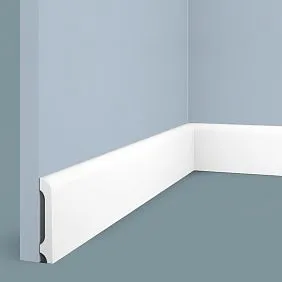
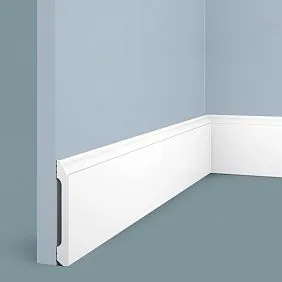
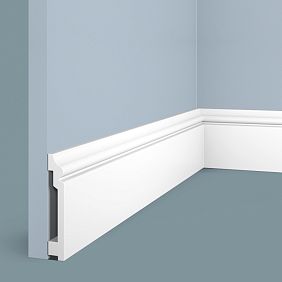
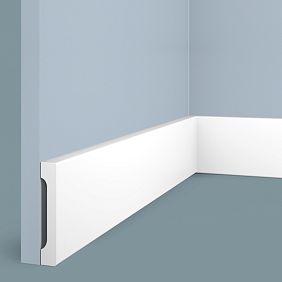
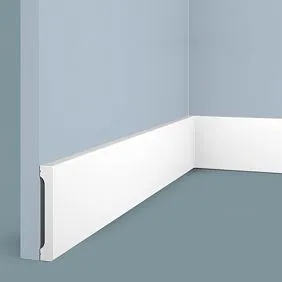
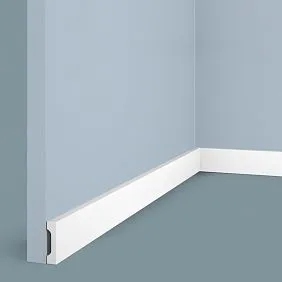
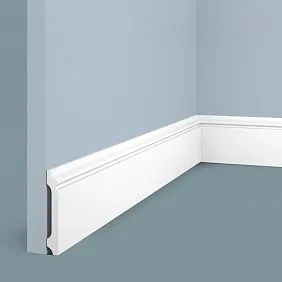

1.2. What Makes a Straight Baseboard Good?
Among various models, there are curved (with wavy or carved lines) and straight variants. A straight baseboard is a classic solution appreciated for:
● Minimalist Design: It does not draw attention to itself and fits perfectly into minimalist, Scandinavian, and modern interiors, while also combining well with classic styles due to its versatility.
● Ease of Installation: The absence of complex curved grooves simplifies installation and corner joints, reducing labor costs.
● Easy Maintenance: Dust and dirt are easier to clean from a flat surface, whereas carved elements require more thorough cleaning.
Get Consultation
2. Why Exactly Wooden Baseboard?
2.1. Ecological and Natural Beauty
Wood is a living natural material that carries warm energy and ecological purity. Natural wood does not emit harmful substances, making it the best choice for living spaces, especially if there are children or allergy sufferers in the household. Moreover, solid wood has a unique texture, creating an atmosphere of coziness and elegance.
2.2. Durability and Longevity
Properly dried and treated solid wood does not fear time: a quality straight wooden baseboard can serve for decades. In case of scratches or minor damage, wood can be restored — sanded and re-coated with varnish, oil, or paint. As a result, you preserve the appearance and properties of the item without needing a full replacement.
2.3. Variety of Species and Shades
The market offers a wide variety of wood: pine, larch, oak, beech, ash, walnut, and others. Each species has its own characteristics and shades. Thanks to this, you can select the ideal baseboard that harmonizes in color and texture with your floor and interior style. If desired, wood can be stained to give it a darker or lighter shade.
3. Features of a Straight Wooden Baseboard
3.1. Universality of Format
A straight baseboard has a flat, straight top edge without additional carving or decorative elements. This makes it suitable for almost any interior style — from classic to high-tech. At the same time, due to its simplicity, it does not "draw attention to itself," preserving the overall balance of the finish.
3.2. Thickness and Height
● Thickness can vary from 10 to 20 mm (and sometimes more, if the baseboard includes a cable channel). The thicker the strip, the more reliably it hides gaps and protects walls. On the other hand, a thick baseboard may protrude excessively if the room is compact.
● Height (profile width) usually ranges from 40–120 mm. A low-profile baseboard (4–5 cm) looks neat in standard apartments and offices, while a higher one (8–10 cm and above) adds a special touch to spacious rooms, especially if ceilings are over 2.7 meters.
3.3. Mounting method
Straight wooden skirting boards can be installed in several ways:
- On self-tapping screws or nails. Provides secure fixation, but screw heads must be filled with putty or covered with decorative caps.
- On 'liquid nails' (adhesive). Simple and 'clean' method, however requires very flat walls. Removal may prove difficult.
- On clips. Convenient solution allowing future removal of skirting board without damage, for example, to replace wiring in a cable channel. Requires flat surface and precise calculations.
4. How to choose a straight wooden skirting board?
4.1. Assess room dimensions and ceiling height
● Low ceilings (2.5–2.6 m): optimal plank height is 5–7 cm. This won't 'eat' space and will add neatness.
● Medium ceilings (2.7–2.8 m): you can choose a skirting board 8–10 cm. It will emphasize elegance without appearing bulky.
● High rooms (from 3 m): a 10–12 cm or larger skirting board will be an elegant solution, especially in classic interiors.
4.2. Match color and texture to the floor
If your floor is made of natural wood (parquet, solid wood, planks), it is recommended to choose a skirting board of the same species or similar structure to ensure harmonious tones. If the floor is laminate, vinyl, or tiled, you can play with contrast, making the skirting board darker or lighter (or selecting a tone that closely matches the floor color).
4.3. Check surface finish quality
● Check geometry: the plank must be flat, without bends.
● Wood moisture: optimal level — 8–12%. If the wood is over- or under-humidified, warping and cracking may occur over time.
● Absence of defects: knots, chips, resin pockets may affect strength and appearance. This is not always critical, but when purchasing, it is important to consider the grade (A, AB, B, etc.).
4.4. Consider the possibility of concealed wiring
If you plan to run wires inside the skirting board, ask the seller if the model has a special cable channel. A straight wooden skirting board may have a small internal cavity, but this is typically characteristic of more modern composite materials. Some manufacturers, however, offer solid wood models with a routed space for cables.
5. Installation process: step-by-step guide
5.1. Prepare tools and materials
You will need:
● Ruler, tape measure, square (for precise measurements).
● Mitre saw or miter block for cutting at an angle (45° or actual room angle).
● Drill, screwdriver, self-tapping screws (or mounting adhesive, if choosing adhesive method).
● Level for checking installation flatness.
● Wood putty (or decorative caps) to cover fasteners (if needed).
5.2. Marking and cutting
- Measure the room: walk around the perimeter, accounting for all internal and external angles, doorways, etc.
- Cutting skirting boards: for corner joints, use a mitre saw or miter block, cutting the end of the plank at 45°. If room angles are not exactly 90°, manual 'adjustment' may be required.
- Numbering parts: mark which section goes where to avoid confusion during installation.
5.3. Fasteners
Screw method:
- Drill holes in the skirting board for fasteners.
- Through these holes, mark points on the wall, drill them, and insert plastic anchors.
- Screw the skirting board with screws.
- Fill the screw heads with wood-colored putty or use small wooden plugs.
Adhesive method:
- Clean the wall and the back of the skirting board from dust and grease.
- Apply adhesive in a zigzag pattern along the entire length.
- Attach the skirting board to the wall and press it for 1–2 minutes (exact time depends on the type of adhesive).
- Temporarily secure with painter's tape to prevent the skirting board from shifting until the adhesive sets.
Clip method:
- Secure clips around the room perimeter at the specified spacing (sometimes the manufacturer indicates the optimal distance — usually 40–50 cm).
- Snap the skirting board onto the clips, carefully aligning them with the grooves on the back of the board.
- Check levelness with a level.
6. Care for wooden skirting board
6.1. Daily and periodic cleaning
A straight skirting board has fewer grooves than decorative models, making dust and dirt easier to clean. Simply wipe it regularly with a dry or slightly damp cloth. When using cleaning agents, ensure they do not contain aggressive chemicals that could damage the varnish or oil.
6.2. Warning against mechanical damage
Try not to hit the skirting board with heavy objects, and when moving furniture, protect the lower part of the wall, for example, by using felt pads on the legs of tables and chairs. If there are pets in the house, their claws may damage the lower part of the wall, but the skirting board will absorb the main impact.
6.3. Repair and restoration
If scratches, chips, or even cracks appear on the surface:
- Small damages can be removed with fine sandpaper (grit 320–400) and covered with a protective finish (oil, varnish).
- Deep chips are repaired with special wood putty. After drying, the surface is sanded and coated with the same finish as the rest of the skirting board.
7. Styles and interiors: where is a straight wooden skirting board appropriate?
7.1. Scandinavian minimalism
Characterized by light flooring (plank, laminate) and white walls. A simple straight skirting board in white or light gray can 'blend' into the wall background, visually increasing the room's height. The natural wood grain will complement the eco-oriented Scandinavian style.
7.2. Loft
Fans of industrial aesthetics often like the combination of brick walls, metal structures, and wood. A straight skirting board made of rough or stained wood can look natural, adding warmth to the rugged environment. This technique softens the harshness of the loft.
7.3. Classic interior
Despite the absence of decorative curves, a straight skirting board works well in a classic setting if it is painted in a suitable shade (for example, milk, beige, white). It will not become the focal point, but neatly complements expensive parquet, tall doors, and elegant curtains.
7.4. Modern and Art Deco
In Art Deco interiors, where non-standard geometric shapes and vibrant color schemes are often present, a detail-light skirting board can serve as a 'background' harmonizing the space. You can emphasize its color, matching the tone of doors or furniture.
8. Advantages of Buying Skirting Boards Online
Many people ask themselves: where to buy — in an offline store or online?straight wooden baseboard Online purchase offers several advantages:
- Time-saving. You don’t need to drive around the city, search for the right color and profile. All this can be done from home, browsing virtual catalogs.
- Wide selection. Online stores usually offer a broader range, including exclusive models and various wood species.
- Promotions and special offers. Many platforms offer discounts, loyalty programs, and free delivery for a certain order amount.
- Reviews. Before purchasing, you can study the experience of real customers, helping you understand the quality of the product and service.
However, it is important to carefully check the seller’s reputation and return conditions, since with online purchases, you cannot physically assess the wood’s texture and color.
9. Tips from Designers and Craftsmen
- Define the role of the skirting board. If you want to emphasize the perimeter, choose a contrasting color. If you aim to visually increase wall height, paint the skirting board to match the walls or make it not too tall.
- Consider the microclimate. In rooms with sharp humidity fluctuations or with 'warm floors,' choose skirting boards made of stable wood species (oak, beech, larch) and monitor the material’s drying quality.
- Think about accessories. If you need transition pieces, corners, or caps, find out in advance whether they are available for purchase or must be custom-made (especially if the profile is non-standard).
- Leave a gap. When laying solid wood planks or parquet, a deformation gap is left against the walls. A straight skirting board hides this gap, but it is important that the plank’s height and thickness are sufficient to cover it.
- Quality of final finish. Factory-applied paint or varnish is applied in multiple layers and is often more durable than DIY finishing. However, if you plan to match the color to existing finishes, you can purchase a 'raw' skirting board and paint it yourself.
10. Conclusion
A straight wooden skirting board is one of the most versatile and popular finishing options. Its straight-line shape suits any style, whether modern, classic, Scandinavian, or loft, and natural wood adds warmth and elegance to the room. The key to success is choosing the right wood species, quality of finish, optimal dimensions (height and thickness), and method of installation. Adhering to these aspects, along with proper installation, ensures that your straight wooden skirting board will serve you for many years, delighting both guests and family with its neat and stylish appearance.
Do not underestimate the importance of the skirting board in the overall interior ensemble: often, it is the details that transform an ordinary room into a unique space with an individual character. May your home or office become a place where every detail contributes to creating an atmosphere of harmony and beauty, and your straight wooden skirting board becomes a reliable companion on this journey!