Article Contents:
- Why wooden skirting is the best solution for Cherepovets
- Types of wooden skirting: advantages and features
- Solid wood
- MDF veneered
- Combined profiles
- Flexible profiles
- Baseboards with cable channels
- Oak
- Ash
- Oak
- Walnut
- Birch and pine (veneer)
- Tool preparation
- Surface Preparation
- Marking
- Dry fitting
- Cutting
- End treatment
- Fastening
- Final finishing

Skirting is an architectural detail that often goes unnoticed during renovation, but it gives the room a finished look, protects the junction between the floor and wall from dust, moisture, and mechanical damage, and also creates a visual frame that highlights the style of your interior. Choosing wooden skirting is especially relevant in cities like Cherepovets, where the combination of a northern climate and diverse styles of residential and commercial spaces requires reliable and eco-friendly materials.
If you are looking for where towooden skirting buy in CherepovetsThis guide will thoroughly explain what to pay attention to when choosing, how to calculate the required amount, what types and species of wood are available, the specifics of installation and maintenance, as well as offer design ideas for various rooms.


Why wooden skirting is the best solution for Cherepovets
Cherepovets' climate is characterized by cold winters, moderately warm summers, and relatively high humidity during the transitional seasons. For finishing materials, this means it is necessary to consider:
- Technical resistance to changes in humidity and temperature. Properly dried and treated wood can "breathe" — absorbing excess moisture and releasing it back, which minimizes deformations of the floor and skirting.
- Ecological safety. In living rooms, children's bedrooms, and offices, it is important that materials do not emit formaldehyde and other volatile organic compounds. Wooden skirting certified to the E0/E1 standard is safe for health, hypoallergenic, and does not cause irritation.
- Thermal and sound insulation. Wood has low thermal conductivity and good sound-absorbing properties. A wide wooden skirting creates an additional "barrier" at the junction of the wall and floor, reducing heat loss and lowering noise levels during walking.
- Durability. Solid hardwood blocks, treated with water-resistant compounds, will last for decades, and if scratches or scuffs appear, they can be sanded and re-coated with protective treatment.
All these factors make wooden skirting the optimal choice for residential and commercial spaces in Cherepovets. To buy quality material without unnecessary hassle, go to the link:wooden skirting buy in Cherepovets.




Types of wooden skirting: advantages and features
There are several main types of wooden skirting, each with its own advantages and disadvantages. When choosing, it is important to consider the type of room, budget, and desired design.
Our factory also produces:
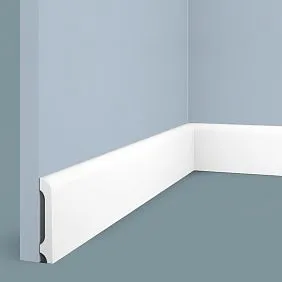
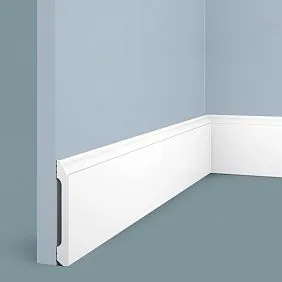
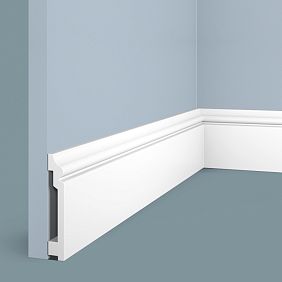
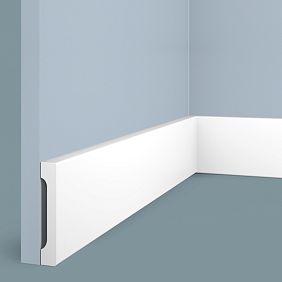
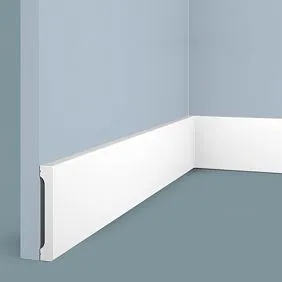
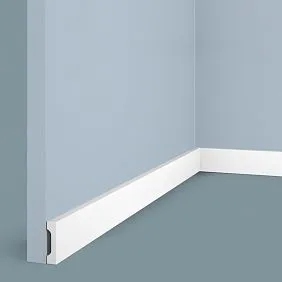
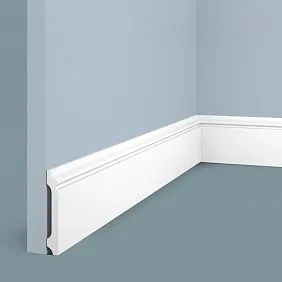

Solid wood
Solid hardwood blocks — this is classic, time-tested. Most commonly used are oak, beech, ash, and walnut.
Advantages of solid hardwood:
● Absolute naturalness and ecological safety;
● High strength and wear resistance;
● Possibility of multiple sanding and full restoration;
● Exceptional grain and rich pattern of annual rings.
Disadvantages:
● High cost (from 1200 ₽ per linear meter);
● Sensitivity to humidity fluctuations (requires maintaining a level of 40–60 %);
● Need to leave a compensatory gap during installation so the wood can "breathe".
Solid wood is ideal for luxury interiors, country homes, and commercial spaces with controlled climate.
Get Consultation
Laminated MDF
Moisture-resistant MDF with natural veneer, 1–3 mm thick — a more affordable option combining the aesthetics of wood and geometric stability.
Advantages:
● Stable shape when humidity changes;
● Wide range of veneer shades (oak, beech, walnut, redwood);
● Price 30–40% lower than solid wood (400–800 ₽ per linear meter).
Disadvantages:
● Veneer is vulnerable to mechanical damage;
● In case of serious scratches, local restoration is not possible — the entire element must be replaced.
Veneered MDF is ideal for city apartments, offices, and spaces with moderate foot traffic.
Combined Profiles
Combined skirting combines the advantages of solid wood and MDF: lower part made of MDF, face part — solid wood or veneer.
Advantages:
● Natural appearance of solid wood at a lower cost;
● Higher moisture resistance and dimensional stability;
● Wide range of profiles.
Disadvantages:
● If the face panel is damaged, the entire skirting must be replaced;
● Installation requires more precise fitting and adherence to technology.
Combined profiles are ideal for modern interiors where the combination of natural appearance and cost-effective solutions is important.
Flexible profiles
Flexible skirting made from elastic composites with wood fibers is used for curved walls, arches, and columns.
Advantages:
● Ability to hide irregularities and radii up to 10 mm;
● Easy installation without complex joints.
Disadvantages:
● Less diverse wood grain;
● Over time, elasticity may decrease and color may change.
Flexible skirting is an indispensable solution for non-standard architectural forms.
Skirting boards with cable channel
This is a convenient option for rooms with many cables (home theater, office, studio).
Advantages:
● Concealed and neat cable routing;
● Easy access to cables without wall cutting.
Disadvantages:
● The channel is sufficient only for a few cables;
● Price is higher than analogs without a channel.
Cable channels are especially relevant in modern media zones and open office spaces.
Selection of wood species for different conditions
The choice of species depends on operational conditions and design.
Oak
Oak is the benchmark for hardness and durability. It handles high traffic well and is moisture-resistant after lacquering.
Used in public areas, hallways, and living rooms. Premium segment pricing.
Ash
Ash is slightly softer than oak but also has good strength. Its light tones are ideal for Scandinavian and modern interiors.
Recommended for bedrooms, offices, and guest rooms. Price is high, but lower than oak.
Beech
Beech is medium-hardness with a uniform pinkish texture. Less expensive, but still durable with proper treatment.
Suitable for living rooms and children's play areas with moderate traffic.
Walnut
Walnut is an exclusive species with a rich dark tone. Creates a luxurious interior but requires careful handling.
Used in offices, lounge areas, and design projects.
Birch and pine (veneer)
Budget option for those planning to paint the skirting board any color. MDF veneer is easily tinted but less durable.
Ideal for auxiliary rooms, corridors, and tight budgets.
How to calculate the required amount of baseboard
To avoid unnecessary expenses and material shortages, follow this simple algorithm:
- Measure the room’s perimeter along the inner corner.
- Subtract the width of door and window openings deeper than 2 cm.
- Add 10% for trimming, defects, and measurement inaccuracies.
- Confirm with the supplier the length of the package (standard 2.4–2.7 m).
- Divide the corrected perimeter by the length of one plank and round up.
For example, with a perimeter of 20 m and an opening of 0.8 m, the final calculation will be: (20−0.8)×1.1≈20.9 m → 20.9÷2.5≈8.36 → 9 packages.
For rooms with complex angles or curved walls, we recommend allocating a reserve of up to 15%.
Installation process: step-by-step instructions
Installing wooden skirting boards is a responsible stage requiring precision.
Tool preparation
Required:
● Level and painter’s string for marking
● Miter saw or miter box for angled cuts
● Tape measure and marker
● Clips and guides or construction adhesive ("liquid nails")
● Screws with caps
● Lacquer or oil for treating ends
Gloves and safety goggles
Surface preparation
Remove the old skirting board, clean the wall of dust and old glue. If the wall deviation exceeds 5 mm per 2 m, fill the surface.
Marking
Using a painter's line, draw a line at the height corresponding to the skirting board's width to lay the planks evenly.
Dry fitting
Lay all segments around the perimeter without fastening, ensuring that angles and lengths match the marking.
Cutting
Use a miter saw or miter gauge to make 45° cuts. For non-standard angles, use adjustable templates.
End treatment
Apply protective varnish or oil to the cut ends immediately after cutting to prevent moisture penetration and delamination.
Mounting
When using clips, attach the guides to the wall and snap the plank into place. When using adhesive, evenly apply adhesive foam and press the plank down, securing it with supports until dry. When using screws, pre-drill holes and plug them with plugs.
Final finishing
Remove excess glue and dust, wipe the surface with a soft dry cloth; if necessary, apply an anti-static agent or a final layer of wax.
Care for wooden skirting boards
Regular care extends service life:
● Wipe with a dry or slightly damp cloth without aggressive substances
● Immediately wipe up spilled water and chemical solutions
● Renew protective coating with varnish or oil every 6–12 months
● Monitor microclimate: humidity 40–60%, temperature +18…+24 °C
● Call professionals for major restoration in case of significant wear
Design techniques with wooden skirting boards
A contrasting skirting board on a light floor creates a striking accent. A monochromatic solution 'dissolves' the transition between floor and wall, visually expanding the space. Built-in LED lighting in wide-profile niches creates a 'floating' floor effect. Different wood species and profiles allow zoning of open layouts without partitions.
To buy wooden skirting board in Cherepovets, go to the link and place your order in the Stavros online store. Wide assortment, affordable prices, expert consultations, fast delivery, and the option to order free veneer samples will make your renovation easy and pleasant.