Article Contents:
- Chelyabinsk Climate and Its Impact on Wooden Products
- Ecological Safety of Natural Wood
- Materials and Manufacturing Technologies
- Solid hardwood
- MDF with Natural Veneer
- Combined profiles
- Flexible baseboards
- Baseboards with cable channel
- Oak
- Ash
- Oak
- Walnut
- Birch and pine (veneer)

In modern interiors, every detail plays an important role, and a wooden skirting board is no exception. It may seem like merely a trim along the lower edge of the wall, but this element provides an aesthetic frame for the floor, protects surfaces from dust and moisture, compensates for wall irregularities, and creates a sense of completion after renovation. In Chelyabinsk, where the climate combines harsh winters and humid summers, choosing and installing a wooden skirting board requires a particularly careful approach: from material selection to installation methods and maintenance. This detailed guide answers all the main questions: why use wood, what types and species are available, how to calculate the required quantity, where to buy wooden skirting board in Chelyabinsk, what to pay attention to during installation, and how to properly care for the product to ensure it lasts for decades.


Chelyabinsk Climate and Its Impact on Wooden Products
Chelyabinsk is located in a zone of sharply continental climate with a long cold winter and a comparatively short but fairly warm summer. The average January temperature is around −15 °C, dropping to −30 °C and below during severe frosts, while in summer it reaches +25–30 °C with humidity of 50–70 %. Such conditions present several challenges for wooden finishing materials:
Due to sharp temperature and humidity fluctuations, wood tends to seasonally expand and contract, which may result in gaps or warping of the profile. To avoid this, a compensatory gap of 2–3 mm must be left between the skirting board and the wall or floor during installation.
Winter indoor humidity may drop to 20–30 % due to heating appliances, causing wood to dry out and develop microcracks. Conversely, in summer, high humidity may cause wood to swell. Optimal microclimate: temperature +18…+24 °C and relative humidity 40–60 %.
During the cold season, the best choice is materials treated with water- and heat-resistant compounds (membranes, primers, infrared-curing lacquers), which reduce the impact of extreme temperatures and humidity.
Considering these features, beforewooden skirting board in Chelyabinskit is necessary to assess the climatic conditions of the apartment or house, plan a ventilation and air conditioning system, and purchase high-quality materials with appropriate moisture resistance certificates.




Ecological Safety of Natural Wood
Natural wood is not only aesthetic but also guarantees ecological safety. Modern manufacturers use adhesive compositions and lacquers of category E0/E1, meaning minimal formaldehyde emissions (< 0.1 ppm) and safe levels of volatile organic compounds. This is especially important for families with young children, allergy sufferers, and people prone to asthma, since:
Wood does not accumulate or emit toxins under heat exposure.
The material 'breathes', regulating humidity: it absorbs moisture when excess is present, and releases it when dry.
Hypoallergenic and has no sharp edges within the profile, eliminating the risk of injury.
When purchasing wooden skirting boards in Chelyabinsk, pay attention to the presence of quality certificates, sanitary-epidemiological conclusions, and appropriate markings in technical documentation.
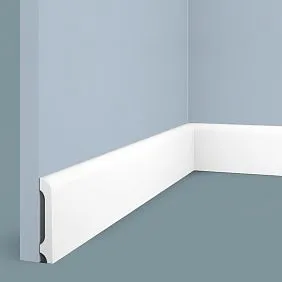
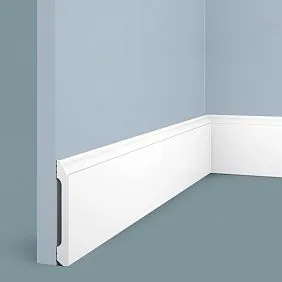
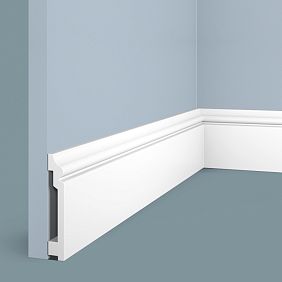
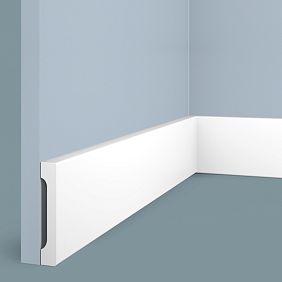
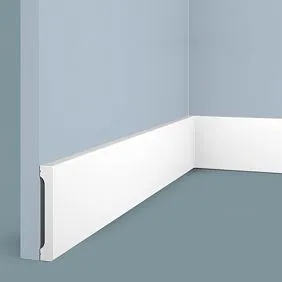
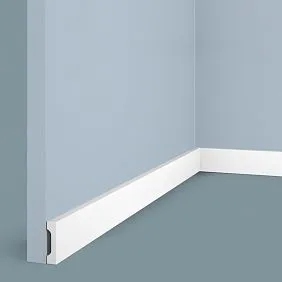
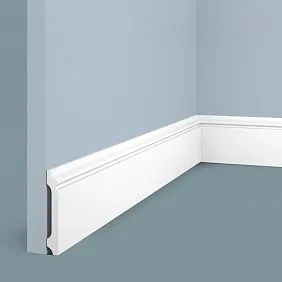
Our factory also produces:

Materials and Manufacturing Technologies
The market for floor skirting boards offers several main structural solutions, differing by material and price segment.
Get Consultation
Solid hardwood
Made from solid boards of oak, ash, beech, or walnut. Such skirting boards are characterized by:
High strength and durability. The surface can be sanded and restored multiple times.
Unique texture and grain pattern — each plank is exclusive.
Ecological safety — absence of synthetic fillers.
However, the cost of solid oak is significantly higher — from 1200 ₽ per linear meter.
Recommendation: choose solid wood for high-traffic areas (hallways, living rooms) and for premium-class projects.
MDF with natural veneer
The core of moisture-resistant MDF is covered with a thin veneer layer (1–3 mm), imitating solid wood. Advantages:
Stable geometry despite humidity fluctuations.
Wide selection of veneer shades: beech, oak, walnut, redwood.
Price is 30–50% lower than solid wood (from 400 ₽/linear m).
However, veneer is easily damaged during improper installation, and local repair is not possible — the damaged strip must be replaced.
Combined Profiles
Combined skirting combines the advantages of solid wood and MDF: front surface made of solid wood or veneer, back and bottom parts made of MDF. Such a construction:
Provides a more affordable price compared to solid wood.
Reduces "play" in dimensions due to humidity changes thanks to the MDF base.
When the front part is damaged, the strip is replaced entirely, as with veneer.
Flexible skirting boards
Made from composite materials with added wood fibers and polymer binders. Distinguished by elasticity:
Easily replicates complex radii and arches.
Conceals wall irregularities up to 10 mm.
Ideal for exclusive architectural solutions.
But have limited decorative finish options and may lose elasticity over time.
Skirting boards with cable channels
Modern solution for concealed wiring:
A channel is provided inside the profile for laying power and multimedia cables.
Simplifies design without visible outlets and cable runs.
Convenient access to cables via a removable panel.
Most often combined with flexible or combined profiles.
Wood species: nuances of selection
When purchasing, pay attention to the characteristics of the most popular species.
Oak
Hard and durable, easily sanded, retains rich color. Price: 1500–2000 ₽/linear m.
Ash
Elastic, light, with interesting texture. Price: 1200–1800 ₽/linear m.
Beech
Economical solid wood option, uniform pinkish texture. Price: 1000–1400 ₽/linear m.
Walnut
Exclusive species with chocolate tones, requires careful maintenance. Price: from 1800 ₽/linear m.
Birch and pine (veneer)
Easy-to-paint species: 400–700 ₽/linear m.
Formats and sizes of profiles
Profile width affects the visual perception of the interior. For rooms with ceilings up to 2.7 m, skirting 60–80 mm is suitable; up to 3 m — 80–100 mm; above 3 m — 100–150 mm. Profile thickness (18–30 mm) and protrusion depth (15–24 mm) determine protective properties and decorative effect. Profile shapes can be straight, beveled, grooved, or with a recess for lighting.
Calculation of required quantity
- Measure the room’s perimeter along the inner corner.
- Subtract the width of large door and window openings (depth over 2 cm).
- Add a 10% allowance for trimming and waste.
- Divide the total length by the length of one plank (usually 2.4–2.7 m) and round up.
For example, with a perimeter of 20 m and two doors each 0.8 m: (20−1.6)×1.1≈20.24 m → 20.24÷2.5≈8.1 → 9 packs.
Installation Methods
Hidden installation using clips and guides ensures ventilation and allows for disassembly without damage. Construction adhesive ("liquid nails") is suitable for flat walls and quick installation, but may damage plaster during removal. Decorative screws provide strong fastening but require careful color matching of caps.
Preparation
Remove old skirting, clean walls of dust and adhesive, level deviations over 5 mm, and prime the surface.
Marking and Fitting
Use painter's tape to draw a clear line, then lay out all planks "dry" and check joints.
Cutting and processing
Use a miter saw or miter box for precise 45° angles. Finish ends with varnish or oil.
Fastening and Finalization
Snap planks into clips or apply construction adhesive, press with supports, then wipe off excess adhesive with a dry cloth.
Maintenance and restoration
Wipe with a soft dry or slightly damp cloth without solvents. Refresh varnish or oil every 6–12 months, and remove minor defects with fine sandpaper. Maintain humidity at 40–60% and temperature at +18…+24 °C.
Design Ideas
Contrasting dark skirting with a light floor makes a room more expressive; monochromatic solutions visually expand space; LED lighting in the niche of a "floating" skirting adds a modern chic to the interior; combining different wood species zones an open space without walls.
Frequently asked questions
Can skirting be painted? Yes, veneered and MDF models suitable for painting are compatible with acrylic and alkyd paints.
What skirting to choose for "warm floors"? Minimum thickness 18 mm, mandatory expansion gap 2–3 mm.
How long will installation take? A professional crew installs skirting in a room up to 25 m² in 3–5 hours.
How to store skirting until installation? Horizontally, in a dry room, in factory packaging.
Wooden skirting is an investment in the longevity, aesthetics, and comfort of your interior. If you are ready to make a choice in favor of quality and natural materials,wooden skirting board in Chelyabinsk you can order it right now in the Stavros online store with delivery, veneer samples, and professional consultation.