Article Contents:
- Engineering philosophy of handrails: more than just support
- Biomechanics of comfortable grip
- Load distribution in the railing system
- Materials science of handrails: from classics to innovations
- Wood — eternal classic
- Metallic solutions: strength and modernity
- Composite materials: technologies of the future
- Connection technologies for handrails and balusters
- Traditional joinery
- Modern Fastening Systems
- Geometry and profiling of handrails
- Straight sections: the foundation of the structure
- Curved elements: the art of bending
- Connecting elements: unseen heroes
- Ergonomic Design Aspects
- Anthropometric data and its application
- Psychological Aspects of Perception
- Stylistic directions in handrail design
- Classic Style: Time-Tested Elegance
- Modern Style: Minimalism and Functionality
- Ethnic styles: cultural heritage in modern interiors
- Manufacturing Technologies
- Material preparation: the foundation of quality
- Mechanical Processing: Precision and Quality
- Assembly and installation: the final stage
- Protective coatings and final finishing
- Surface preparation: guarantee of longevity
- Types of Protective Coatings
- Decorative Effects
- Operation and maintenance of handrails
- Regular care: preserving beauty and functionality
- Preventive maintenance
- Repair and restoration
- Innovations and Development Trends
- Smart technologies in handrails
- Ecological innovations
- Personalization and customization
- Conclusion
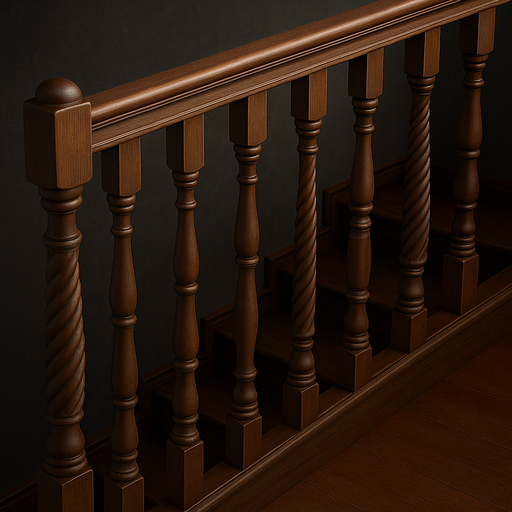
What makes a staircase not just a functional element, but a true work of architectural art? The secret lies in the harmonious combination of all railing components, where handrails under balusters play the role of the final chord in this complex composition. It is precisely the handrails that transform a set of vertical posts into a unified, functional, and aesthetically perfect safety system.
Modern understanding of stair railings goes far beyond simple utility. Today, handrails are complex engineering structures where each element performs multiple functions: from ensuring safety to creating a unique interior accent. In this system, handrails occupy a special place, uniting individual balusters into a monolithic structure and providing a comfortable grip for the hand.


Engineering philosophy of handrails: more than just support




Biomechanics of comfortable grip
The human hand is a remarkable tool capable of adapting to various shapes and sizes. However, there are optimal parameters at which gripping the handrail becomes most comfortable and safe. The width of the handrail should be 40-60 millimeters to ensure a secure grip for an adult's palm.
The cross-sectional shape of the handrail critically affects usability. Round handrails with a diameter of 45-50 millimeters provide even pressure distribution across the entire palm. Oval sections measuring 40x60 millimeters create a more secure grip due to the natural position of the hand. Rectangular handrails with rounded edges combine ergonomic comfort with the ability to create complex architectural forms.
The height of installation of the handrail is determined by the anthropometric data of users. The standard height of 900 millimeters from the stair level corresponds to the average height of an adult. For children, an additional handrail at a height of 500-600 millimeters is recommended, ensuring the safety of the youngest members of the family.
Our factory also produces:


Load distribution in the railing system
Handrails serve as the main load-bearing beam in the stair railing system. Horizontal loads from people leaning on them are transferred through the handrail to the balusters, and then to the load-bearing structures of the staircase. Proper design of this system ensures safe operation for decades.
The section resistance of the handrail must correspond to calculated loads. For residential premises, the normative load is 100 kilograms per linear meter, for public buildings — up to 300 kilograms. These requirements determine the minimum section dimensions and material selection.
The stiffness of the handrail affects the overall stability of the railing. A too flexible handrail creates a sense of unreliability and may lead to the entire structure swaying. Excessive stiffness makes the system brittle and prone to failure under impact loads. The optimal balance is achieved by selecting the right material and section geometry.
Get Consultation
Handrail Materials: From Classic to Innovations
Wood — Eternal Classic
Wooden handrails remain the benchmark for comfort and aesthetic appeal in the world of stair railings. The natural warmth of wood, pleasant tactile sensations, and the ability to create complex profiles make this material indispensable for residential interiors.
The choice of wood species is determined by operating conditions and aesthetic preferences. Oak provides maximum strength and durability, its dense structure withstands intensive loads without deformation. Ash attracts with its light tone and expressive texture, creating a sense of lightness and airiness. Beech has a uniform structure, allowing for the creation of handrails with complex shapes without the risk of cracking.
Coniferous species — pine, spruce, larch — offer an economical solution without compromising quality. Natural resinous properties provide additional protection against moisture and biological influences. Modern processing technologies allow coniferous species to achieve a noble appearance indistinguishable from expensive hardwoods.
Metallic solutions: strength and modernity
Metal handrails open new possibilities for creating modern stair railings. Stainless steel provides exceptional durability and resistance to corrosion, making it an ideal choice for high-humidity environments.
Aluminum handrails combine lightness with sufficient strength for most applications. The possibility of anodizing and powder coating allows for any color and surface texture. Hollow profiles reduce the weight of the structure and simplify the installation of communications — electrical cables for lighting or "smart home" systems.
Brass handrails introduce a touch of luxury and aristocracy into the interior. The natural darkening of brass over time creates a noble patina, highlighting the status and taste of the owner. Special coatings allow maintaining the original shine or creating an aged metal effect.
Composite Materials: Technologies of the Future
Modern composite materials combine the advantages of various components, creating handrails with unique properties. Wood-polymer composites combine the natural beauty of wood with the moisture and UV resistance of polymers.
Glass-reinforced plastic handrails provide exceptional strength at minimal weight. The ability to create complex handrail shapes using pultrusion opens new horizons for designers. Transparent and translucent variants create a sense of weightlessness in the railing.
Carbon fiber handrails represent the pinnacle of technological development. Strength exceeding steel while weighing as much as aluminum makes them ideal for exclusive projects. The ability to integrate sensors and electronic components transforms the handrail into a "smart home" element.
Technologies for Connecting Handrails to Balusters
Traditional joinery
Classic methods of connecting handrails to balusters are based on centuries of carpentry craftsmanship. The "dowel-slot" connection ensures strength and allows for disassembly without damaging the elements. The dowel diameter is usually 12-16 millimeters, with a depth of 20-25 millimeters.
The technology of making slots in the handrail requires high precision. Deviations in size or position of the slots lead to misalignment of balusters and disruption of the railing's geometry. Modern CNC routers ensure accuracy down to fractions of a millimeter, guaranteeing perfect fitting of elements.
Adhesive connections strengthen the mechanical bond between the handrail and balusters. High-quality carpentry glue creates a bond stronger than the wood itself. The setting time of the glue requires precise coordination of assembly operations.
Modern fastening systems
Metal fastening elements ensure disassemblability of connections and allow for adjustment during operation. Threaded connections allow tightening weakened elements without dismantling the entire structure.
Hidden fastening systems preserve the handrail's aesthetics without disrupting its surface with visible elements. Special brackets and clamps ensure secure fixation while maintaining the possibility of disassembly.
Magnetic connections represent an innovative solution for modern interiors. Powerful neodymium magnets ensure secure fixation while allowing for quick disassembly for maintenance or configuration changes.
Geometry and Profiling of Handrails
Straight Sections: The Foundation of the Structure
Straight sections of handrails constitute the main part of the stair railing and define its overall character. Constant cross-section along the entire length ensures manufacturability and uniform perception. Handrails for Balusters straight-line shape allows creating a strict, minimalist staircase design.
The handrail's slope angle must precisely match the staircase's slope angle. Even minor deviations create visual discomfort and disrupt the composition's harmony. Modern measuring tools allow achieving accuracy down to several angular minutes.
The length of straight sections is limited by manufacturing and transportation capabilities. Standard stock lengths are 3-4 meters, requiring jointing of elements on larger staircases. The quality of joint connections determines the overall impression of the structure.
Curved Elements: The Art of Bending
Handrail corner sections require special craftsmanship. Bent elements are created by steaming and forming wood in special fixtures. The bending radius is limited by material properties and may range from 300 to 1500 millimeters.
Glued curved handrails are made from thin laminates glued into the required bend shape. This method allows creating complex shapes with minimal risk of cracking. The quality of adhesive joints is critically important for the product's longevity.
Milled turning elements are cut from solid wood blocks on special machines. This method ensures maximum strength but is limited by the dimensions of the original blanks and results in significant material waste.
Connecting elements: unseen heroes
Joining straight and curved sections requires special connecting elements. The quality of these joints determines the overall impression of the handrail — poorly executed joints immediately reveal low manufacturing quality.
Straight joints are made at a 45-degree angle to minimize the visibility of the joint. The fit must ensure a gap no greater than 0.2 millimeters. Glued joints are reinforced with hidden dowels or laminations.
Angular joints require special craftsmanship. The complex geometry of the joint must ensure a smooth transition between sections of different directions. Computer modeling helps calculate the exact geometry of the joint.
Ergonomic design aspects
Anthropometric data and its application
Handrail design must be based on anthropometric data of various population groups. The average height of an adult determines the standard handrail height of 900 millimeters. However, in households with tall individuals, this height may be increased to 950–1000 millimeters.
The size of the palm determines the optimal cross-sectional parameters of the handrail. The circumference of an adult male’s palm is 180–220 millimeters, corresponding to a handrail diameter of 50–60 millimeters. Female hands are smaller, so the optimal diameter is 40–50 millimeters.
Grip strength affects requirements for surface texture of the handrail. Smooth surfaces require more effort for a secure grip, textured surfaces provide better adhesion with less effort. The balance between comfort and reliability is achieved through proper surface treatment.
Psychological Aspects of Perception
The handrail should convey a sense of confidence and safety. Too thin handrails create a feeling of fragility, overly bulky ones — clumsiness. Optimal proportions are achieved by the relationship between the handrail’s dimensions and the overall staircase dimensions.
The color of the handrail affects the psychological perception of the staircase. Dark colors create a sense of solidity and reliability, light colors — lightness and airiness. Contrast between the handrail and balusters may emphasize architectural features or create visual unity.
Surface texture affects tactile sensations. Smooth surfaces are associated with modernity and technology, textured surfaces — with tradition and craftsmanship. The choice of texture should match the overall interior style.
Stylistic directions in handrail design
Classic style: timeless elegance
Classic handrails are characterized by strict proportions and restrained decorative elements. They are based on the canons of classical architecture, adapted to the scale of staircase structures. The profile of a classic handrail usually has a complex shape with alternating convex and concave elements.
The dimensions of profile elements are strictly regulated by classical proportions. The relationships between different parts of the cross-section must correspond to the golden ratio or other harmonic proportions. Violation of these proportions immediately reveals a non-professional approach to design.
Materials for classic handrails are traditionally limited to noble hardwoods. Oak, beech, walnut create a sense of solidity and respectability. Finishing is limited to transparent coatings that highlight the natural beauty of the wood.
Modern Style: Minimalism and Functionality
Modern handrails are characterized by minimalist forms and emphasis on functionality. Simple geometric cross-sections — circle, oval, rectangle with rounded edges — create a sense of technology and modernity.
Materials for modern handrails are not limited to traditional solutions. Metal, glass, composite materials open up new possibilities for designers. Combining different materials creates interesting visual effects and tactile sensations.
Color solutions for modern handrails can be highly diverse. From classic natural tones to bright accent colors — the choice is determined by the overall interior concept. The possibility of changing color during use adds flexibility to design solutions.
Ethnic styles: cultural heritage in modern interiors
Ethnic styles introduce rich cultural traditions of various peoples into modern interiors. The Russian style implies the use of carved elements imitating traditional wooden architectural ornamentation. Handrails may be decorated with geometric patterns or stylized plant motifs.
Scandinavian style is characterized by simplicity of forms and light wood tones. Handrails have minimalist cross-sections and minimal surface treatment, highlighting the natural texture of the material. Functionality prevails over decoration.
Eastern styles — Japanese, Chinese — require special attention to proportions and symbolic meaning of elements. Handrails may have complex shapes based on philosophical concepts of harmony and balance. Use of exotic wood species emphasizes the authenticity of the style.
Manufacturing Technologies
Material preparation: the foundation of quality
The quality of the handrail is established during the material preparation stage. The moisture content of the wood must be stabilized at 8–12% to prevent deformation during use. Drying must be gradual, with controlled temperature and air humidity.
Selection of blanks requires the professional eye of a craftsman. Knots, cracks, resin pockets in the area of the future handrail are unacceptable. The direction of the grain should be as straight as possible to ensure strength and dimensional stability.
Material acclimatization under future operating conditions allows detection of hidden defects and stabilization of dimensions. Blanks are kept in a room with normal humidity for 2–3 weeks before processing begins.
Mechanical processing: precision and quality
Rough processing of blanks is performed on jointers to obtain basic dimensions with allowance for final processing. The quality of equipment setup determines the accuracy of dimensions and surface quality.
Handrail profiling is performed on special milling machines with a set of cutters corresponding to the required profile. Feed rate and rotational speed must be optimized for each wood species.
Sanding is the final operation of mechanical processing. Sequential application of abrasives ranging from 120 to 320 grit ensures a perfectly smooth surface. Sanding quality is critically important for subsequent finishing.
Assembly and installation: final stage
Preliminary assembly of the handrail with balusters allows checking the accuracy of manufacturing all elements and making adjustments if necessary. All joints must be tight, without gaps or misalignments.
Final assembly is performed using adhesive compositions and mechanical fasteners. The curing time of the adhesive requires precise coordination of operations and use of special fixtures to hold elements in place.
Quality control of assembly includes checking geometry, strength of joints, and surface quality. All defects must be eliminated before applying finish coatings.
Protective coatings and final finishing
Surface preparation: the key to longevity
Proper surface preparation determines the durability and appearance of protective coatings. Final sanding is performed with abrasive grit 240-320 to create optimal roughness for coating adhesion.
Surface dust removal is performed using compressed air and adhesive cloth. Even the smallest particles of dust can lead to coating defects and reduced durability. Special attention is given to hard-to-reach areas of profiled handrails.
Degreasing removes oil residues, fingerprints, and other contaminants. Special solvents must not damage wood or leave marks on the surface. The solvent must be allowed to dry completely.
Types of Protective Coatings
Varnish coatings provide maximum protection for the handrail while preserving the natural beauty of wood. Polyurethane varnishes are characterized by high wear and chemical resistance. The number of layers is determined by operating conditions and may range from 2 to 5.
Oil-based coatings penetrate deeply into the wood structure, highlighting its texture and creating a pleasant tactile surface. Handrails with balusters with oil-based coating require periodic renewal but are easily restorable.
Wax coatings create a matte surface with natural gloss. Wax provides good moisture protection and creates pleasant tactile sensations. The drawback is the need for regular maintenance and coating renewal.
Decorative Effects
Staining allows changing the color of wood while preserving its texture. Water-based stains provide even coloring, alcohol-based stains penetrate deeply, and oil-based stains create rich tones. Combining different stains allows achieving complex color transitions.
Patination creates an aged wood effect, emphasizing relief and texture. Different techniques — dry brush, sponge, cloth — produce different visual effects. Contrast patination highlights profiled handrail elements.
Brushing reveals the structure of annual rings, creating an expressive surface texture. Soft fibers are removed with metal brushes, while hard fibers remain, forming a relief surface. Subsequent staining enhances contrast between layers.
Operation and maintenance of handrails
Regular care: preserving beauty and functionality
Daily care of handrails involves removing dust and dirt with soft cloth. Abrasive materials are not allowed, as they may damage protective coatings. For wooden handrails, use of specialized wood care products is recommended.
Periodic cleaning includes removing more stubborn contaminants with specialized cleaning agents. The choice of agent must match the type of handrail coating. Aggressive chemicals may damage the coating and require complete renewal.
Monitoring the condition of the coating allows timely identification of areas requiring restoration. Minor damage can be repaired by local application of coating, while extensive damage requires complete surface renewal.
Preventive Maintenance
Inspection of fasteners should be performed regularly, especially during the first months of operation. Natural wood shrinkage may weaken joints. Timely tightening of fasteners prevents serious problems.
Monitoring handrail geometry allows identifying deformations at an early stage. Minor deviations can be corrected by adjusting fasteners. Significant deformations require replacing damaged elements.
Seasonal maintenance includes renewing protective coatings and preventive repairs. The optimal time for such work is between seasons, when air humidity is stable. Quality maintenance extends the handrail’s service life several times over.
Repair and Restoration
Local coating repair is performed when scratches, scuffs, or other minor damage appear. The damaged area is cleaned with fine abrasive, dusted, and coated with the appropriate compound. Repair quality depends on precise color and coating type selection.
Replacement of individual elements may be required for severe damage or wear. New elements must exactly match original ones in size and profile. Differences in color and texture can be minimized through special treatment.
Full handrail restoration includes disassembly, repair or replacement of damaged elements, reassembly, and finishing. Such work requires high skill and may cost as much as manufacturing a new handrail.
Innovations and development trends
Smart technologies in handrails
Integration of LED lighting transforms the handrail into part of the staircase lighting system. Hidden LED strips provide soft lighting, enhancing safety during nighttime movement. Motion sensors automatically activate lighting when a person approaches.
Sensory elements allow integrating the handrail into a "smart home" system. Touching specific areas can activate lighting, music, or other systems. Such solutions are especially relevant for modern high-tech interiors.
Handrail condition monitoring systems include load, vibration, and other parameter sensors. Information is transmitted to the building’s central control system, enabling monitoring of structural condition and planning preventive maintenance.
Ecological Innovations
The use of certified wood from sustainably managed forests has become a standard for responsible manufacturers. FSC and PEFC certificates guarantee that the wood is obtained without harm to the environment.
Biodegradable coatings based on natural components replace traditional synthetic compositions. Such coatings are safe for human health and do not harm the environment during disposal.
Recycling technologies allow the use of handrail production waste to manufacture other products. Sawdust and shavings are processed into particleboard, fuel briquettes, or other useful products.
Personalization and Customization
Custom handrail design based on the client's sketches is becoming increasingly popular. Modern CAD systems enable the creation of complex 3D models and their optimization for production.
3D printing of prototypes allows the client to evaluate the appearance and ergonomics of the future handrail before production begins. This minimizes the risk of misunderstanding and allows adjustments at an early stage.
Modular handrail systems allow easy configuration changes during operation. Standardized connecting elements ensure compatibility of different modules and enable the creation of unique compositions.
Conclusion
The world of stair railings represents a remarkable combination of engineering thought, artistic craftsmanship, and modern technologies. Each element of this system, from the simplest straight section to the most complex curved joint, requires a deep understanding of materials, technologies, and human needs.
A properly designed and high-quality handrail serves not only as a guarantee of safety but also as a source of daily aesthetic pleasure. The touch of a smooth, warm surface of a quality wooden handrail creates a sense of reliability and comfort that no modern materials can replace.
Choosing a handrail is an investment in safety, comfort, and home beauty for many years. High-quality products from reputable manufacturers pay for themselves many times over due to durability, minimal maintenance costs, and positive impact on property value.
In the world of architectural solutions and quality materials, STAVROS has established itself as a reliable partner, offering not only superior products but also deep expertise in staircase construction design. Years of experience, continuous technological improvement, and commitment to flawless quality make STAVROS the optimal choice for those who value professionalism and perfection in creating architectural masterpieces.