Article Contents:
- Why slat panels have become the main tool of modern interior design
- What the market offers today
- Material matters: MDF, solid wood, or flexible base
- MDF: precision, stability, clean lines
- Solid oak and beech: living texture and natural character
- Flexible base: freedom of form without compromise
- Interior slat: complete freedom of spacing and orientation
- Vertical vs. horizontal: how orientation changes space
- Vertical slat panels on the wall
- Horizontal slat panels on the wall
- Slat panels on the wall in the living room: TV area, accent wall, and more
- Slat panel behind the TV
- Accent wall in the living room
- Niche in the living room
- Slat panels on the wall in the bedroom: headboard area and atmosphere of tranquility
- Slat panel at the head of the bed
- Material and color for the bedroom
- Slat spacing in the bedroom
- Slat panels on the wall in the hallway and corridor
- Why use slatted panels in the hallway
- How to choose material for the hallway
- Slat orientation in the corridor
- Slatted wall panels in the kitchen
- Slatted panels for non-standard surfaces: columns, arches, niches
- How to choose slat spacing: visual effect and practical calculation
- Small spacing (5–15 mm)
- Medium spacing (15–30 mm)
- Large spacing (30–50 mm and more)
- Installation of slatted panels: basic principles
- Foundation Preparation
- Mounting with adhesive
- Mounting on frame
- Medium-thickness pieces are attached using a combined method - with adhesive and additional mechanical fixation.
- Interior Styles and Slatted Panels: What Works with What
- Minimalism
- Scandinavian Style
- Modern classicism
- Loft and Industrial Style
- How to Properly Combine Slatted Panels with Other Interior Elements
- Acoustic Properties: The Bonus Everyone Forgets
- FAQ: Answers to Popular Questions
- Conclusion
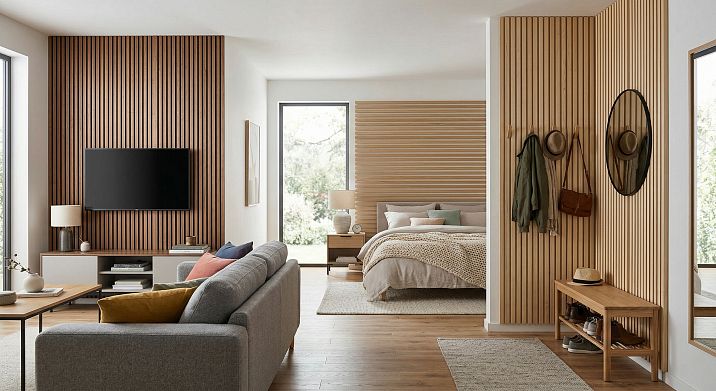
A wall is not just a room boundary. It's a statement. It sets the tone for the entire space, forms the first impression, and determines whether a person feels comfortable inside. When it comes to modern finishing,slatted panels for wallsslatted panels become one of the most precise tools: they work as decor, as an accent, and as an architectural element simultaneously. But choosing the right option means understanding the specific task of the room, not just buying 'something wooden for the wall'.
This article is written precisely for those who want to understand in detail: which material to choose, what orientation to set for the slats, where flexible solutions are appropriate, and where rigid modular constructions are needed. And most importantly — what works in the living room, what is ideal for the bedroom, and what optimally solves the task in the hallway or corridor.

Why Slatted Panels Have Become the Main Tool of Modern Interior Design
There are solutions that stay on trend because they are backed by clear logic. Slatted wall cladding is exactly such a case. It appeared not as a tribute to fashion, but as a response to a demand: to create texture, depth, and rhythm without overloading the space.
A flat painted wall is good, but neutral. Wallpaper with a pattern is interesting, but debatable. But vertical or horizontal slats, laid with a precise spacing, create a visual effect that cannot be achieved in any other way: play of light and shadow, surface depth, a sense of volume. At the same time — no overload. That is whyslatted panels for the wallfit so organically into minimalism, Scandinavian style, modern classic, and loft.
But there is another argument that is stronger than any aesthetics: practicality. Decorative wall panels made of slats are installed quickly, hide base irregularities, and allow for the replacement of individual elements without dismantling the entire cladding. For living spaces, this is significant.




What the market offers today
Today, the term 'slat wall panels' encompasses several fundamentally different constructions:
-
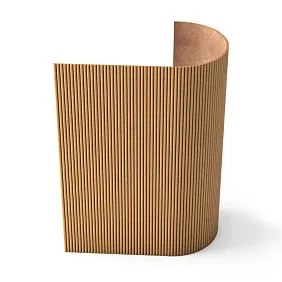
Flexible panels on a fabric base – slats with a semi-circular profile are fixed on an elastic fabric, allowing them to wrap around columns, arches, radius walls, and curved surfaces without distorting the pattern.
-
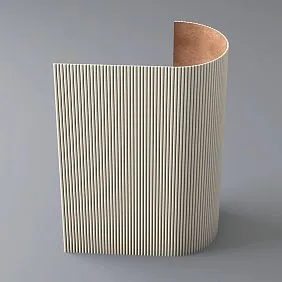
Primed MDF panels on a fabric base – MDF battens with deep milling, coated with two layers of insulating primer, are completely ready for final painting without additional preparation.
-
Panels made of solid oak or beech – natural material with a pronounced wood grain texture, revealed through tinting and transparent varnishes.
-
Individual interior slats – MDF or MDF with oak veneer for independently creating slatted structures with any spacing and orientation.
Each of these types addresses a specific need. And before discussing room-by-room application, it's worth understanding the material itself – because everything else depends on it.
Our factory also produces:



Material decides: MDF, solid wood, or flexible base
When a person first encounters the choice of slat panels, they typically think in terms of 'wood or not.' In reality, the question is different: what task does the panel need to fulfill in a specific space?
Get Consultation
MDF: precision, stability, purity of lines
MDF is not a compromise. It is an engineering solution that provides what natural wood cannot: absolute geometric stability. MDF battens do not warp with changes in humidity, they do not crack, and they do not change color under light as drastically as solid wood. At the same time, the surface is well-suited for mechanical processing and painting.
Slat panel for wall made of MDF— the optimal choice for spaces with strict color requirements. If the interior is built on monochrome — white, graphite, deep gray — it is precisely MDF slats for painting that deliver the desired result. The final color is applied over the manufacturer-applied insulating primer, resulting in a dense, matte surface without the extra texture of wood — only the rhythm of the ribs and the play of shadows from artificial or natural light.
Model PAN-002 is supplied primed, with MDF battens of deep milling on a flexible fabric base. The primer is applied in two layers and is completely ready for finishing — this eliminates the stage of self-priming, saves time, and ensures predictable painting quality.
Solid oak and beech: living texture and natural character
Where naturalness is required — not an imitation, but real wood with a living texture — the choice falls on solid wood. Oak provides a pronounced grain pattern, tactile warmth of the surface, and a deep tone that changes depending on the angle of light. Beech is more uniform, light, Scandinavian in character.
decorative panels made of slats made of solid wood create a completely different feeling in the interior than MDF. This is not just finishing — it is a material with a biography. Oak on an accent wall in the living room or behind the headboard in the bedroom works as an independent statement: here lives a person who values authenticity.
It is important to consider: solid oak and beech require a normal microclimate in the room. With sharp fluctuations in humidity — especially in hallways where cold is brought in from outside in winter — slats made of solid wood may behave less predictably than MDF. This does not mean they cannot be used in a hallway — they can, but taking this characteristic into account.
Flexible foundation: freedom of form without compromise
This is the most technologically interesting solution in the slat panel category.Flexible slat panelIt is built on a fabric base: half-round profile battens are fixed to an elastic fabric at a certain pitch, allowing the entire structure to bend without deformation of individual elements.
Why is this needed? The answer is obvious as soon as you encounter non-standard architecture. Round columns, arched openings, semicircular niches, radius walls in corner rooms — all of this cannot be clad with a rigid module without complex cutting and unsightly joints. The flexible panel wraps around the form like a second skin, preserving the rhythm of the slats and the integrity of the pattern. Individual modules join together, forming a single decorative covering without visible transitions.
Model PAN-001 is available in three versions: deeply milled MDF for painting with enamels, solid oak and solid beech for tinting and clear varnishes. It is mounted with contact adhesive with recommended additional fastening using micro-pins. For convenient transportation, the panels are supplied rolled into compact rolls.
Interior slat: complete freedom of pitch and orientation
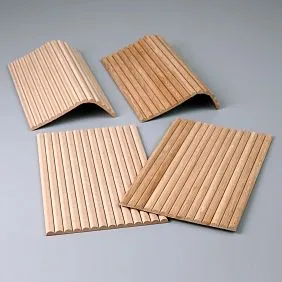
Worthy of separate discussion isInterior Rail RK-002— a solution for those who want to create a slat structure themselves, fully controlling the pitch, orientation, and pattern. The slat is made from deeply milled MDF or MDF with oak veneer, has a length of 2750 mm, and maintains stable geometry even with temperature and humidity fluctuations. It is mounted on a backing with subsequent fixation using adhesive or mechanical fasteners. This format is optimal for ceiling structures, space zoning, and decorative partitions — where precise authorial calculation of pitch and pattern is needed.
Vertical vs. Horizontal: How Orientation Changes Space
One of the most underestimated factors when choosing slat panels is the direction of slat installation. Vertical and horizontal slat panels for walls produce fundamentally different visual results, and confusing them means achieving an effect opposite to the desired one.
Vertical slat panels for walls
Vertical slat rhythm works on height. If the ceiling feels low, if the room seems squat—vertical slats stretch the space upward. The eye automatically glides along the vertical lines and meets the ceiling, perceiving it as higher than it actually is. This solution is especially effective in bedrooms with low ceilings, in corridors that stretch lengthwise, and in living rooms where you want to create a feeling of spacious, 'breathing' space. Vertical slat panels also work perfectly behind a bed headboard—they form an architectural frame, giving the sleeping area a special character.
Horizontal slat panels for walls
Horizontal orientation works differently. It doesn't pull upward—it expands. If a room is narrow and elongated, horizontal slats on the end wall visually push it apart to the sides, making the proportions more balanced. Horizontal panels also provide a calmer, 'flowing' rhythm. They are associated with natural horizons, water, landscapes—this contributes to an atmosphere of relaxation. That's why horizontal slat wall panels are often chosen for bedrooms in the style of Japanese minimalism or meditative Scandinavian interiors. In living rooms, horizontal slats work well on long walls—especially if a sofa is placed there: such cladding creates a 'backrest' for the lounge area, structuring the space without physical partitions.
Slat panels for walls in the living room: TV area, accent wall, and more
The living room is the most complex room in terms of finishing tasks. Here, several issues need to be solved simultaneously: highlight functional zones, create a focal point, set the atmosphere, and at the same time not overload it visually.slatted panels for the wallSlat panels handle this better than many alternatives.
Slat panel behind the TV
The TV area is a typical pain point in the living room. A TV on a white wall looks like a black void. Shelves around it create chaos if not meticulously arranged. But slat cladding behind the TV is an elegant and functional solution. The slats create a textured background against which the TV doesn't get lost but integrates into the overall picture. With vertical orientation, the area becomes more formal; with horizontal orientation, it becomes more cinematic, widescreen.
Important point: slat panels in the TV area are best mounted from floor to ceiling—this creates completeness. Partial cladding (only behind the screen itself) looks less professional. The optimal material for the TV area is paintable MDF or solid oak with a lacquered finish.Decorative slat panelon a fabric base is also appropriate here, especially if the wall has minor irregularities or a curve.
Accent Wall in Living Room
An accent wall is a zoning tool through color and texture. In the living room, it is most often opposite the entrance or behind the sofa. Slat panels on such a wall work in multiple ways: they provide texture, depth, and rhythm without the need to add anything else. For an accent wall in the living room in a modern interior or minimalist style, vertical slats in dark tones—graphite, anthracite, dark walnut—are ideal. In Scandinavian style, an accent wall made of slat panels should be light—white, milky, soft gray. Then it works not as a contrast, but as a textural detail in the overall light palette.
Niche in the living room
Decorative slat panels on the wall in a niche are a separate story. The niche itself is already an accent, but without working on the background, it looks unfinished. Slat cladding on the back wall of the niche adds depth and turns an ordinary wall recess into a full-fledged architectural element. If the niche is used as shelving space—slats on the back wall create a beautiful backdrop for objects. If the niche is decorative—slats with lighting between them create an effect that is hard to put into words.
Slat panels on the wall in the bedroom: headboard area and atmosphere of tranquility
The bedroom is the most personal space in the home. This is where a person recovers, and that is why atmosphere is more important than functionality. Slat panels in the bedroom create that very cocoon atmosphere, which is so hard to describe but easy to feel.
Slat panel at the head of the bed
The wall behind the headboard is the focal point of the entire room. It is what a person sees upon entering the room. It is what shapes the first impression.Slat panel for curved wallsor a primed MDF construction in this area — both solutions work but yield different results. The primed PAN-002 panel on an MDF base provides perfect geometry and clean lines, and is immediately ready for painting in any shade. The flexible PAN-001 panel allows for a smooth transition from wall to ceiling if the bedroom has a non-standard shape.
The width of the headboard panel is usually taken wider than the bed — by about 40–60 centimeters on each side. For height — two approaches: from floor to ceiling (maximum architectural effect) or from the bed headboard to the ceiling (a more intimate, cozy feel). The short PAN-002 format with a height of 950 mm creates exactly that accent rectangle above the bed, which reads as an independent, complete composition.
Material and color for the bedroom
Warm tones are optimal for the bedroom: natural oak, walnut shades, dusty pink, terracotta, beige. Cool colors — gray, blue, white — also work but require more subtle adjustment.Batten panels for paintingallow for the implementation of any shade — this is important if the wall color in the bedroom is already determined and you need to match a specific tone. Natural oak pairs well with linen, cotton, woolen textiles — all those that traditionally make up the bedroom's textile palette.
Batten spacing in the bedroom
The wider the spacing between battens — the lighter and more airy the pattern appears. The narrower the spacing — the denser and more substantial. A medium spacing works well for the bedroom: about 20–30 millimeters between the half-round profile battens. This rhythm doesn't overload perception but also doesn't seem too sparse.
Batten panels on the wall in the hallway and corridor
The hallway is a transitional space. It's small, often windowless, operates under conditions of high traffic and sharp temperature fluctuations. It might seem, why use expensive finishes here? But it's precisely the hallway that forms the first impression of the home.
Why use slatted panels in the hallway
Slatted wall panels in the hallway serve several purposes at once:
-
Visual expansion of space — vertical slats raise the ceiling, horizontal ones widen the walls.
-
Concealing defects — slatted cladding covers cracks, unevenness, and traces of previous finishes.
-
Creating character — a narrow corridor with slatted panels is no longer just a passageway and becomes part of the interior.
-
Practicality — MDF slats are easy to wipe, not afraid of accidental touches, and damaged elements can be easily replaced if needed.
How to choose material for the hallway
Material stability is important in the hallway. MDF wins over solid wood here: it reacts less to humidity fluctuations.Slatted wall panelsMDF slats for painting are the optimal solution: you can choose a dark tone (practical, hides marks) or a light one (visually expands). If the hallway is spacious and well-heated — solid oak is also appropriate. It adds status and warmth, turning the entrance into a small architectural gesture.
Orientation of slats in the corridor
A long corridor is a classic problem: its length feels oppressive. Horizontal slats on a long corridor wall will worsen the situation: they further emphasize the length. Therefore, a vertical orientation is more logical for corridors. Slatted wall panels in a corridor are best installed as an accent: on one long wall or at the end of the corridor — this creates a focal point and 'stops' the gaze, preventing it from drearily sliding over empty surfaces.
Slatted wall panels for the kitchen
The kitchen is a room with an aggressive environment: moisture, grease, temperature fluctuations. Slatted panels here require a special approach. The best solution for the kitchen is MDF panels for painting with moisture-resistant enamel or varnish coating. They are easy to clean and do not swell under normal use. The backsplash area is usually not covered with slatted panels. However, the wall with the dining area or a decorative wall opposite the work surface is an excellent place for slatted cladding.Slatted panels for interiorin the kitchen fit organically into Scandinavian style (light slats, white upper part, wooden lower part), modern classic (slats for painting to match the furniture), and industrial loft (dark slats with metal accents).
Slatted panels for non-standard surfaces: columns, arches, niches
It is precisely non-standard surfaces that most often become problematic areas during renovation. How to clad a round column in the living room? How to beautifully finish a radius wall in the staircase area? How to work out an arched opening?
Rigid panels handle this task poorly: cutting for a radius takes time, joints remain visible, and geometry is compromised.Flexible slat panelis a solution that allows working with curved surfaces without loss of quality. The fabric base provides the necessary flexibility, the slats maintain an even spacing even on a curve, and installation with contact adhesive is fast and reliable. This is especially relevant in modern apartments and houses with non-standard architecture, where there may be fewer straight walls than curved ones.
How to choose slat spacing: visual effect and practical calculation
Slat spacing is the distance between battens. This is not just a technical parameter: the spacing determines the density of the pattern, the intensity of the play of light and shadow, and the overall impression of the panel.
Fine spacing (5–15 mm)
Frequent slats create a dense, almost monolithic pattern. With side lighting, pronounced chiaroscuro is achieved. Such panels work well in spacious rooms where a rich visual accent is needed. In small rooms, fine spacing can overwhelm perception.
Medium spacing (15–30 mm)
A universal solution. Works in most spaces, does not overwhelm and does not look empty. For bedrooms, living rooms, hallways — an optimal choice.
Large spacing (30–50 mm and more)
Sparse slats give a light, airy rhythm. Works well in minimalist interiors where lack of clutter is important. Also appropriate in spaces with high ceilings, where fine spacing would visually get lost.
Installation of slat panels: basic principles
Foundation Preparation
The base must be level, dry, and clean. For MDF panels, this is critical: any irregularities in the base will transfer to the panel and be noticeable. For flexible panels, minor unevenness is acceptable — the fabric backing partially compensates for them.
Mounting with adhesive
Mostslat panels made of MDF and oakare mounted with contact adhesive. This is quick, requires no special equipment, and provides a reliable result. For models PAN-001 and PAN-002, the manufacturer recommends additional fastening with micro-pins using a pneumatic gun — the fastening points are puttied and sanded if necessary.
Mounting on frame
The interior rail RK-002 is mounted differently: first, a mounting insert is attached to the surface, then the rail is fixed to it with adhesive or mechanical fasteners. This method allows for perfect geometry even on curved walls and simultaneously creates an air gap for laying sound-absorbing material.
Trimming and jointing
During installation, the need for trimming always arises — near the ceiling, near the floor, in corners. MDF cuts well with a hand saw or jigsaw. Solid wood also does, but requires a sharper tool. Flexible panels on a fabric base are cut with ordinary scissors or a utility knife — this is one of their undeniable advantages.
Interior styles and slatted panels: what works with what
Minimalism
In minimalism, clean lines and the absence of excess are important. Slatted panels here are not decoration, but architecture. Vertical slats in a dark tone on one wall, without cornices or moldings. They work perfectlyslatted panels for walls for painting— they allow achieving a monochrome surface with texture in any shade from the palette.
Scandinavian style
Scandinavia is about light, natural materials, functionality. Slatted panels in a Scandinavian interior should be light: whitewashed oak, beech, ash. The spacing — medium or large. In this style, the PAN-001 panel made of solid beech with light tinting or PAN-002 in white enamel is a perfect match for the look.
Modern classic
Here, slatted panels work as an element replacing traditional moldings and panel cladding. Warm oak tones, fine slat spacing, combination with stucco or cornices — all this creates an interior that is simultaneously modern and not devoid of historical dignity.
Loft and industrial style
Dark slats — almost black, charcoal, dark brown — against concrete or brick walls. Large spacing, rough texture, metal accents. Slatted panels in a loft are not about coziness, they are about character. RK-002 rails made of MDF with dark paint fit perfectly into such a scenario.
How to properly combine slatted panels with other interior elements
Slatted wall cladding works in conjunction with flooring, furniture, textiles, and lighting. Several practical rules to help create a cohesive look:
Floor. If the slats are wooden — choose flooring of the same wood species or a similar tone. Dark oak slats + light concrete floor — works. Light beech slats + dark parquet — also works. But slats and floor in the same tone without transition can blend together.
Furniture. Slatted panels pair well with furniture made of natural wood, metal, and fabric. If the furniture is bright — the slats should be neutral (white, gray, natural wood without tinting).
Lighting. Hidden lighting along the slatted surface is one of the most effective techniques in modern interiors. A strip of LED tape in the groove between the slats creates soft, diffused glow that works both as decor and functional lighting.
Textiles. Heavy drapery next to slatted panels creates visual overload. It's better to choose light, structured textures — linen, cotton, fine jersey.
Acoustic properties: a bonus that's often forgotten
The slatted structure has documented acoustic effects. Vertical battens scatter sound waves, disrupting their reflection from flat walls and reducing reverberation. The result — reduced echo, a more comfortable sound environment, improved speech intelligibility. This is precisely whydecorative panels made of slatsthey are often used in meeting rooms, home theaters, and open-plan living rooms. The effect is enhanced when sound-absorbing material is installed behind the fabric backing of the panel: mineral wool or acoustic foam in the wall cavity turns a decorative panel into a full-fledged acoustic screen.
FAQ: Answers to popular questions
Can slat panels be installed independently?
Yes. PAN-001 and PAN-002 fabric-backed panels are designed for DIY installation. You'll need: tape measure, level, contact adhesive, pneumatic pin nailer (recommended), and a knife or saw. Surface preparation is the key stage.
Do I need to prime the panel before painting?
The PAN-002 model comes with a pre-applied two-layer polyurethane-based insulating primer — no additional priming is required. For PAN-001 panels in MDF finish, the manufacturer recommends priming the surface before installation by applying two coats of primer with intermediate sanding of the raised fibers.
What slat spacing should I choose for low ceilings?
For ceilings up to 2.5 meters, vertical orientation of slats with medium spacing is recommended. This visually stretches the space upward. Horizontal slats are not the best choice for low ceilings.
How much material is needed for one wall?
The width of one PAN-001 and PAN-002 panel is 1010 mm. Divide the wall width by 1010 and round up. Add 10–15% for cutting. For curved surfaces, it's better to increase the margin to 20%. Order the entire volume from one batch — shades may vary.
What size of PAN-002 should I choose — 950 or 2700 mm?
For a local accent (headboard, niche, panel) — 950 mm. For continuous vertical cladding from floor to ceiling — 2700 mm. In standard rooms with a 2.7 m ceiling, the long format goes without cutting.
Are slatted panels suitable for rental housing?
Yes, if using double-sided mounting tape instead of contact adhesive. Flexible PAN-001 panels are more convenient in this regard: they are easier to remove without damaging the base.
How to care for slatted panels?
A dry or slightly damp soft cloth is sufficient for removing dust and household dirt. Do not use aggressive cleaning agents. Lacquered and painted surfaces wipe easily. Solid oak is recommended to be periodically treated with oil (e.g., Rubio Monocoat) every 3–5 years.
Can the panels be painted after installation?
Yes. The PAN-002 panel is specifically designed for finishing painting after installation: the primed surface is ready for the application of water-based acrylic or latex paints directly during renovation without the smell of solvents.
Is there an acoustic effect from slatted panels?
Yes. Vertical slats scatter sound waves and reduce reverberation. The effect is enhanced if mineral wool or acoustic foam is placed behind the fabric backing of the panel.
Where is it better to order slatted panels with delivery throughout Russia?
Slatted panels for walls buycan be ordered from the manufacturer with delivery via SDEK throughout Russia and CIS countries. The production time for custom orders is 5–10 working days. When ordering a sample of the OPAN-001 model, you can evaluate the actual color and texture of the material before placing the main order.
Conclusion
Slatted panels for walls are not just a trend. It is a proven architectural technique that works in the living room and bedroom, in the hallway and kitchen, on straight walls and on curved surfaces. They provide rhythm, depth, texture, and atmosphere—everything that flat painted walls lack so much. The main thing is to understand the task. If you need a monochrome accent—choose MDF for painting. If naturalness is important—solid oak. If the wall is non-standard—a flexible panel on a fabric backing. And always think about the orientation of the slats: it changes the space more than color.
STAVROS Company is a Russian manufacturer with over twenty years of experience in the field of wood and MDF decor. The history of STAVROS began in 2002, when two artists created a workshop for carved wood products, and a year later participated in the reconstruction of the Konstantinovsky Palace in Strelna. The STAVROS catalog features flexible slatted panels PAN-001 on a fabric backing (MDF, solid oak and beech), primed panels PAN-002 for painting, as well as interior slats RK-002 for creating slatted structures independently. All products are made to order with a lead time of 5–10 working days and are delivered throughout Russia. STAVROS is interior materials where precision meets character.