Article Contents:
- Bedroom as a key zone for material combination
- Functional specificity: place for rest and recovery
- Perception psychology: influence of materials on emotional state
- Aesthetic flexibility: from classic to modern
- Economic rationality: budget optimization
- Beech as the basis of bedroom harmony
- Visual calmness: texture without aggression
- Color neutrality: universal base
- Tactile warmth: material for touch
- Ecological and microclimate: breathing walls
- Polyurethane as an architectural accent
- Geometric organization: space structure
- Relief depth: play of light and shadow
- Practicality of use: lightness and durability
- Accessibility of complex forms: decorative freedom
- Color symphonies: harmony of tones and lighting
- Monochromatic harmony: tonal proximity
- Contrast elegance: play of light and dark
- Pastel accents: softness of colors
- Lighting as an atmosphere tool
- Stylistic embodiments: from classic to Scandinavian
- Classic bedroom: traditional elegance
- Scandinavian bedroom: minimalism and light
- Neoclassic bedroom: light luxury
- Contemporary: modern eclecticism
- Installation and maintenance: durability without defects
- Preparation of base: guarantee of durability
- Installation of beech panels: precision and reliability
- Installation of polyurethane decor: ease and neatness
- Final finishing: protection and beauty
- Care for combined finishes: simplicity of everyday life
- Conclusion: symbiosis of naturalness and technology

The bedroom is a space where a person spends one-third of their life, restoring strength, falling asleep, beginning a new day. The quality of this space directly affects well-being, mood, energy.Bedroom panels- not just a decorative solution, but a tool for creating an atmosphere conducive to deep rest, full recovery, harmonious awakening. Combinationof beech panelsandpolyurethane decorcreates an interior where naturalness meets technology, the warmth of wood is complemented by the practicality of synthetic materials, classical forms acquire a modern embodiment. Birch brings visual calmness, tactile warmth, ecological properties of a living material. Polyurethane provides architectural expressiveness, ease of installation, moisture resistance. Together, they create a bedroom where it is comfortable to fall asleep and pleasant to wake up.
Bedroom as a key zone for material combination
Among all rooms in the house, the bedroom requires a particularly careful approach to the selection and combination of finishing materials. Functional, psychological, and aesthetic factors make the bedroom an ideal space for implementing the philosophy of rational combination.




Functional specificity: place of rest and recovery
The bedroom is a space with minimal activity but maximum duration of stay. Eight hours of sleep, one to two hours before falling asleep and after waking up, weekends spent in bed — in total, a person spends 9–12 hours daily in the bedroom. There are practically no active actions that create contamination, mechanical damage to walls. There is no cooking like on the kitchen, no constant movement like in the hallway, no water procedures like in the bathroom.
This specificity allows usingdecorative wooden panelswithout concern for their preservation. Wooden panels are not exposed to risks typical for active zones — they won’t be touched by bags, won’t be splashed with water, won’t be stained with grease. Birch, with its moderate hardness and sensitivity to moisture, is in optimal conditions in the bedroom — stable temperature, moderate humidity, absence of aggressive influences.
At the same time, the bedroom requires visual comfort — the gaze should not encounter irritating elements, colors, textures. Monotony tires, but excessive variety hinders relaxation. The combination of calm, uniform birch texture and elegant polyurethane decor creates visual balance — enough interest without overload, enough simplicity without boredom.
Our factory also produces:


Psychology of perception: influence of materials on emotional state
Natural wood affects the subconscious, activating ancient mechanisms of perceiving the natural environment as safe and friendly. Millennia of evolution in forests have formed a positive reaction to the texture of wood, its color, scent.Wooden panels for the bedroomcreate a sense of protection, stability, connection with nature at an instinctual level.
Birch, with its soft pinkish-yellow hue, uniform texture without sharp contrasts, matte surface, is perceived as a calming, soothing material. Unlike oak with its dark tone and expressive stripes, creating visual tension, birch is soft, neutral, unobtrusive. For a resting space, this is the optimal choice.
Polyurethane decor, painted in light tones, adds elegance without the coldness of synthetic materials. Raised moldings create play of light and shadow, visual depth, architectural organization. Geometry of polyurethane frames structures the space, provides the eye with anchor points, prevents the feeling of emptiness on large wall surfaces.
The combination of warm natural wood and neutral polyurethane creates an emotional balance — enough warmth for coziness, enough purity for fresh perception. The bedroom does not become sterile or overloaded — it is balanced.
Get Consultation
Aesthetic flexibility: from classic to modern
The bedroom is a personal space where stylistic choice is determined exclusively by the owner’s preferences, without regard to status or fashion trends. Here, one can realize a classic interior, Scandinavian minimalism, neoclassical elegance, contemporary contemporary — any direction resonating with the inner world.
The stylistic flexibility of birch and polyurethane is universal. Birch panels, coated with natural tone oil, with simple polyurethane decor of minimal complexity, create a Scandinavian bedroom. The same birch panels, painted in white or pastel tones, with more complex polyurethane decor, form neoclassicism. Birch in natural color with polyurethane painted in contrasting dark tones, gives a modern interior.
This stylistic flexibility allows the interior to evolve alongside changes in taste without complete redecoration. Repainting polyurethane elements in another color, replacing textiles, changing lighting transforms perception while preserving the birch base. The bedroom adapts to life stages — youth, maturity, old age — each with its own aesthetic preferences.
Economic rationality: budget optimization
Full wooden cladding of the bedroom — an expensive solution. The cost of birch panels is 3000–8000 rubles per square meter depending on quality and processing method. A 15–18 square meter bedroom with 2.7-meter ceiling height has wall area of approximately 40 square meters excluding windows and doors. Full cladding would cost 120,000–320,000 rubles just for materials.
A combined solution — birch panels on an accent wall behind the bed, 8–10 square meters, other walls with minimal polyurethane decor — reduces cost to 24,000–80,000 rubles for birch panels plus 15,000–30,000 for polyurethane decor of the entire room. Total 40,000–110,000 versus 120,000–320,000 for visually comparable result. Savings of 50–70 percent.
Concentrating wood in the zone of maximum visual attention — behind the bed, where the gaze falls upon entering and from the bed — creates the feeling of a wooden bedroom using wood on a quarter of the wall area. Other walls, painted or covered with wallpaper with minimal polyurethane decor, become a background supporting the accent wooden wall.
Oak as the foundation of bedroom harmony
Oak panelsThey possess qualities making them an ideal choice for a bedroom - light neutral color, uniform soothing texture, eco-friendliness, tactile warmth. Understanding these properties allows for the full potential of the material to be realized.
Visual calmness: texture without aggression
Oak's texture fundamentally differs from other popular species. Oak displays a contrasting pattern with dark stripes of large vessels on a light background - visually active, attention-grabbing, creating tension. Ash shows wide light and dark stripes forming expressive waves - dynamic, energetic material. Walnut has a complex play of brown tones with dark veins - rich, but visually heavy.
Oak lacks this visual activity. Its texture is uniform, fine-grained, with minimal color variations. On radial cuts, a characteristic fine checkered pattern from narrow heartwood rays is visible - a delicate pattern noticeable upon close inspection but not eye-catching. On tangential cuts, thin light streaks add liveliness without creating contrast.
This uniformity is critical for a bedroom. The gaze gliding over oak panels before sleep or after waking does not encounter visual irritants, does not cling to contrasts. The texture is perceived as a calm background on which more active elements - paintings, lamps, textiles - can be placed. But on its own, it is unobtrusive, meditative.
Oak's growth rings are discernible but not contrasting. They create a barely noticeable rhythm, which the eye subconsciously interprets, finding in it natural order. This natural rhythm soothes, unlike the geometric monotony of artificial materials or the chaos of random patterns.
Color neutrality: universal base
The color of freshly cut oak is white with a slight pink or yellowish tint. After drying and stabilization, it acquires a characteristic warm rose-yellow tone, described as honey, peach, or light beige. This color lies in the middle range of lightness - lighter than walnut and oak, but more saturated than white or bleached species.
This color position makes oak an ideal base for any color scheme. Light cool tones - white, light gray, pale blue - harmonize with oak, creating a fresh Scandinavian interior. Warm pastels - cream, peach, light yellow - resonate with oak's warmth, enhancing a cozy atmosphere. Even dark and saturated colors - emerald, sapphire, burgundy - work with oak, using its lightness as contrast.
Oak's neutrality is manifested in the absence of a pronounced core. Many species have a dark core and light sapwood, creating color inconsistency in products. Oak is practically uniform throughout the trunk's thickness - all the wood is light rose-yellow tone. An oak panel has no dark or light areas, the entire surface is one shade.
This simplifies element selection - all oak panels in the room are visually identical in color, do not create patchiness. For a bedroom, where visual monolithism is important, this is an advantage. Unlike oak panels, where each board may differ by several tones due to differences in core and sapwood, oak panels form a uniform surface.
Tactile warmth: material for touch
The bedroom is a space where touching walls is more likely than in other rooms. Placing a hand on the wall when getting out of bed, leaning against it while passing by, accidentally brushing against it - all this happens regularly. Tactile sensations from the wall material influence the overall perception of comfort.
Wood is warmer than most finishing materials due to its low thermal conductivity. Touching a wooden surface does not cause a sensation of cold - wood does not draw heat away from the hand. Oak, with its density of 710-730 kg/m³, has a thermal conductivity of about 0.15 W/(m·K) - one of the lowest among common materials.
Oiling oak preserves its natural tactile quality. The surface remains slightly velvety, warm to the touch, pleasant for contact. One can feel the direction of fibers, slight roughness even on carefully sanded wood. This living texture contrasts with perfectly smooth synthetic surfaces, adding tactile richness.
Lacquering oak creates a smoother surface, but even under a lacquer layer, wood is warmer than ceramic, glass, metal, most plastics. For a bedroom, where tactile comfort is important, even lacquered oak is preferable to cold materials.
Ecological and microclimate: breathing walls
Natural wood continues to participate in gas exchange even after processing - absorbs excess moisture from the air at high humidity, releases it at low humidity. This natural regulation creates a stable comfortable microclimate. A bedroom with wooden panels has more even air humidity compared to a room with synthetic finishes.
Oak does not emit harmful substances. Properly dried and correctly processed oak wood is ecologically neutral. Natural oil and wax finishes are also safe. This is critical for a bedroom, where a person spends one-third of their day inhaling air that contacts surfaces.
The absence of synthetic resins, adhesives, plasticizers, typical of composite materials, makes solid oak panels a preferred choice for people sensitive to chemical odors, suffering from allergies, concerned about home eco-friendliness. Especially important for children's bedrooms, where material safety requirements are maximum.
Polyurethane as an architectural accent
polyurethane decorIn the bedroom, it performs a role opposite to oak panels - it does not create a material base, but adds architectural expressiveness, geometric organization, elegant relief.polyurethane panelsAnd decorative elements transform a simple room into a structured, elegant space.
Geometric organization: structure of space
Empty painted walls in the bedroom are perceived as indifferent planes. The eye has nothing to grasp onto, the space seems unstructured, temporary. Polyurethane moldings create a geometric structure - frames, horizontal and vertical divisions, borders, transforming walls into an organized composition.
Rectangular frames from polyurethane moldings on walls not covered with oak panels structure the plane. Three vertically oriented frames, 120 cm high, 70 cm wide, equally spaced on the wall opposite the bed, create rhythm, symmetry, visual interest. Inside the frames, the same wall color or contrasting colors - light gray on white, beige on cream - can be used.
A horizontal molding at 100-120 cm height around the bedroom perimeter separates the lower zone from the upper one - classic three-part wall division. If the lower zone is painted in a darker tone or covered with small-patterned wallpaper, and the upper zone is lighter and cleaner, the molding becomes a visual boundary structuring the vertical.
Polyurethane moldings framing door and window openings integrate them into the overall composition. The opening ceases to be a technical break in the wall, becoming a decorated architectural element. The width of the framing moldings, 8-12 cm, creates solidity without heaviness, corresponding to the scale of the bedroom.
Relief Depth: Play of Light and Shadow
Flat painted walls are one-dimensional — light falls evenly, shadows are absent, depth is not perceived. Relief polyurethane elements transform the plane into volume. A molding with a 1-2 cm protrusion casts a shadow, creating a dark line along the lower edge. This shadow changes throughout the day as the angle of light changes.
In the morning, when the sun shines from the side, shadows are long, and the relief is emphasized to the maximum. During the day, under overhead light, shadows are shorter, and the relief is read more softly. In the evening, under artificial lighting, shadows depend on the position of the fixtures — directional light from wall sconces creates dramatic shadows, while diffused light from ceiling chandeliers creates soft shadows. The composition lives, changes, and never becomes boring.
Complex molding profiles with alternating protrusions and recesses, ornamental elements create a multi-level relief. Each protrusion casts its own shadow, recesses remain in half-shadow — forming a gradient from light to dark. Under side lighting, this gradient transforms a simple molding into a sculptural composition.
Practicality of Use: Lightness and Durability
Practicality of use: ease and durability
Ceiling decoration in the bedroom — cornices, rosettes around chandeliers — experiences minimal loads, but is installed at a height where weight is critical. A polyurethane cornice 12 cm wide weighs 1.5–2.5 kg per linear meter — it adheres with standard mounting glue without additional fastening. A wooden cornice of the same width weighs 6–10 kg — requires mechanical fastening with self-tapping screws and creates load on the ceiling structure.
Polyurethane is easy to install. Cutting with a saw or knife, gluing in hours, painting in a day — decorating the bedroom with polyurethane is achievable by oneself over the weekend. Wooden decoration requires professional skills, powerful tools, and several days of work.
Maintenance is minimal — wiping with dry or slightly damp cloth once a month removes dust. Polyurethane does not absorb dirt, does not darken from touch, does not require re-coating. A painted surface retains its freshness for 10–15 years without changes. For busy people who value free time, this care-free operation is significant.
Maintenance is minimal - wiping with a dry or slightly damp cloth once a month removes dust. Polyurethane does not absorb dirt, does not darken from touch, does not require re-coating. The painted surface retains its freshness for 10-15 years without changes. For busy people who value free time, this care-free operation is significant.
Accessibility of Complex Forms: Decorative Freedom
Polyurethane is cast, allowing reproduction of any complexity of forms. A rosette around a chandelier with a 60–80 cm diameter featuring concentric circles of various ornaments, corner inserts with floral motifs, consoles with capitals — all of this is available as ready-made elements priced at 1000–5000 rubles each. Wooden carving of similar complexity costs 10000–50000 rubles and requires a week of the carver’s work.
The ability to paint polyurethane in any color expands decorative possibilities. White elements on light walls create relief panels where the play of light is important. Gilded or patinated elements on a neutral background add luxury. Elements painted to match the wall color become delicate textural accents, noticeable only under specific lighting.
The ability to paint polyurethane in any color expands decorative possibilities. White elements on light walls create relief panels where light play is important. Gilded or patinated elements on a neutral background add luxury. Elements painted to match the wall color become delicate textural accents, noticeable only under specific lighting.
Color Symphonies: Harmony of Tones and Lighting
Color solution for a bedroom with birch panels and polyurethane decor requires understanding of material interaction, light, and psychological perception. The correct combination creates an atmosphere conducive to rest.
Monochromatic Harmony: Tonal Proximity
Monochromatic solution — all elements in one color range, differing only in saturation — is a safe path to harmony. Birch panels in natural honey tone. Other walls painted in light beige, close to birch color but 2–3 tones lighter. Polyurethane moldings painted white with a slight beige undertone — the lightest element in the composition.
Vertical gradation from saturated to light creates visual stability. Birch panels on the wall behind the headboard from floor to ceiling — the most saturated color. Painted walls of medium saturation. Polyurethane ceiling cornice and rosette — the lightest. The eye moves from saturated birch to light polyurethane, making the space feel light and airy.
The warmth of the monochromatic range in beige-honey tones creates a cozy, sleep-inducing atmosphere. Absence of cold and bright colors does not stimulate but calms. Such a bedroom is especially suitable for people with demanding work schedules, needing maximum relaxation.
Textiles — bedding, curtains, rug — in the same beige-honey range with varying saturation intensifies monochromaticity. Natural material accents are allowed — linen curtains in natural gray-beige, wool rug in cream, cotton bedding in ivory. Unity of natural tones of natural materials creates organic harmony.
Contrastive Elegance: Play of Light and Dark
Contrast solution — light birch and dark accents or dark stained birch and white decor — creates a more expressive, structured interior. Birch panels stained with gray-brown on the wall behind the headboard. Other walls are white. Polyurethane moldings are white, forming frames on white walls and outlining dark birch panels.
Contrast between dark and light structures the space, creating clear geometry. Dark wall behind the bed becomes a focal point, attracting the gaze. White walls around — neutral background, visually expanding the room. White moldings — light lines, organizing planes.
Inversion — light natural birch with dark polyurethane elements — a modern solution. Birch panels in natural honey tone. Walls are light gray. Polyurethane moldings painted dark gray, almost graphite. Dark lines on a light background create graphic clarity and modernity.
Contrast solutions require precise balance of dark and light areas. Dark should not dominate in the bedroom — maximum one wall plus furniture. The rest is light, compensating for the visual weight of dark. A proportion of approximately 30% dark to 70% light is comfortable for perception.
Pastel Accents: Softness of Colors
Neutral base of natural birch and white polyurethane allows introduction of pastel colors to create a specific mood. Birch panels in natural tone. Walls painted in pale blue, mint, lavender, peach — any pastel shade resonating with the owner’s preferences. Polyurethane decor is white.
Pale blue creates freshness, coolness, associated with sky and water. Suitable for sunny bedrooms where visual coolness is desired. Psychologically perceived as calming, conducive to sleep. Combination of warm birch and cool blue creates a temperature balance — neither hot nor cold.
Lavender adds elegance, romance, and gentle melancholy. Associated with lavender fields, Provence style, calm sunset. For feminine bedrooms or marital ones where feminine preferences dominate, lavender creates the desired atmosphere. Birch with its pinkish undertone harmonizes with lavender, enhancing softness.
Apricot continues the warmth of beech, creating a fully warm palette. Associated with dawn, warm summer, ripe fruits. For bedrooms where maximum warmth, coziness, and a sense of security are important, apricot is optimal. Especially good for northern rooms with insufficient sunlight - artificially creates a feeling of warmth.
Lighting as an atmosphere tool
Lighting as an atmosphere tool
Bedroom lighting is critical for perceiving colors and materials. Warm light (2700-3000K) enhances the warmth of beech, making it more golden, amber. White polyurethane takes on a cream tone under warm light. The entire composition becomes warmer, cozier. Warm light is optimal for evening relaxation.
Multi-level lighting creates flexibility. Main light from a ceiling chandelier at 2700K for evening relaxation. Nightstands with neutral light (4000K) for reading. Hidden backlighting behind beech panels or behind a ceiling cornice with adjustable color temperature for creating various moods.
Multi-level lighting creates flexibility. Main light from the ceiling chandelier is warm 2700K for evening relaxation. Bedside lamps with neutral 4000K light for reading. Hidden backlighting behind book panels or behind ceiling molding with adjustable color temperature to create various moods.
Directional lighting highlights the relief of polyurethane elements. Side light from wall sconces positioned above eye level creates long shadows from moldings, emphasizing their volume. Diffused overhead light from a ceiling chandelier produces soft, short shadows, delicately indicating relief. The combination creates visual depth.
The ability to adjust brightness (dimmers) allows adapting lighting to the situation. Bright light in the morning for an alert awakening. Dimmed light in the evening for preparing to sleep. Minimal light at night as a nightlight. A bedroom with flexible lighting is comfortable at any time of day.
Stylistic interpretations: from classic to Scandinavian
The combination of beech panels and polyurethane decor is realized in various stylistic directions, each with its own characteristics, proportions, and color solutions.
Classic bedroom: traditional elegance
The classic approach implies symmetry, hierarchy, decorative completeness, use of traditional ornaments and proportions. The wall behind the bed headboard is clad with beech panels from floor to ceiling. Panels are paneled - frames and panels with slight relief. Beech is stained to a medium brown tone or coated with natural honey-colored varnish.
The bed is positioned strictly at the center of this wall, symmetry is critical. Nightstands are identical on both sides. Lamps on the nightstands are also identical. Above the headboard, a polyurethane decorative element - a cartouche, a rosette, a horizontal ornamental strip - can be placed, emphasizing the central axis.
Other walls are painted in a saturated color - burgundy, emerald, dark blue - or covered with classic damask-patterned wallpaper. Polyurethane moldings 8-10 cm wide form vertically oriented rectangular frames. The number of frames is odd for the central axis. The molding profiles are classic with vegetal ornamentation - acanthus leaves, rosettes, interlacing patterns.
Ceiling cornice 15-18 cm wide with complex profile and rich ornamentation. Central rosette around the chandelier, 80-100 cm in diameter, multi-level. Polyurethane decor is painted white with optional gilding of protruding elements - classic luxury without excess.
Furniture is wooden with classic proportions. A dressing table with carved legs and mirror. A chest of drawers with carved fronts. A wardrobe with pilasters and cornice. Textiles are heavy - velvet drapes, patterned coverlet, cushions with tassels. Rug with classic pattern. Lighting is warm from crystal chandelier and table lamps.
Scandinavian bedroom: minimalism and light
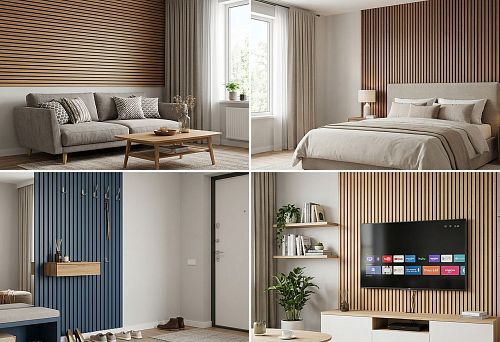
The Scandinavian approach is opposite to classicism - minimal decoration, maximum light, simple forms, natural materials, white as the dominant color. The wall behind the headboard is clad with vertical beech battens 4 cm thick, spaced 10 cm apart from floor to ceiling. The battens are coated with natural-tone oil, revealing the pinkish-yellow texture of beech.
Other walls are painted with matte white paint. No wallpaper, patterns, additional textures. Polyurethane decor is minimal - a 7 cm wide cornice with a simple smooth profile without ornamentation, painted white. Rosettes are absent. Wall moldings are absent or limited to a thin 3-4 cm frame surrounding the battened wall.
The bed is a simple low platform without a high headboard - beech battens on the wall perform this function. Nightstands are minimalist cubes without visible handles or entirely absent - shelves attached to the battened wall. Lighting is functional - pendant lights with simple forms, wall sconces on swivel brackets for reading.
Textiles are minimal and natural. Linen bedding in white, light gray, natural beige. Curtains are simple straight ones in linen or cotton in light tones. Rug is absent or a small bedside one made of natural wool. Color palette - white, light gray, natural beech, with one pastel accent in cushions or throw.
Philosophy - nothing extra, only necessary, maximum light and air. Beech battens - the only visual accent, adding warmth of natural material to the white space. Polyurethane decor is present but unnoticed - a simple white cornice on a white ceiling. For people who value cleanliness, spaciousness, and minimalist lifestyle, such a bedroom is ideal.
Neo-classic bedroom: light luxury
Neo-classicism preserves the principles of classicism while simplifying forms, lightening the palette, and reducing decorative saturation. The wall behind the headboard is clad with beech panels 150-180 cm high - not to full height, but to two-thirds. Panels are flat or with slight relief. Painted in light tones - white, cream, light gray - or coated with natural-tone oil.
Above the panels, the wall is painted or covered with wallpaper in light pastel tones - pale blue, lavender, apricot, mint. Polyurethane molding 8 cm wide with simple profile frames the top edge of the panels. Above the bed, on the painted portion of the wall, a medium-sized polyurethane decorative applique - an ornamental rosette 40-50 cm in diameter - may be placed.
Other walls are painted in the same tone as the wall behind the headboard. Polyurethane moldings 6-8 cm wide form several frames, but do not overload the space - two or three frames per wall instead of five to seven in classic style. Molding profiles are of moderate complexity - geometric ornamentation without elaborate vegetal motifs.
Ceiling cornice 12-15 cm wide with medium profile. Rosette around the chandelier, 60-70 cm in diameter, restrained design. Polyurethane is painted white or cream, gilding is absent or minimal - only on the central rosette.
Mixed furniture - wooden structural elements, painted facades. Bed with beech or oak frame, soft headboard upholstered in light-colored fabric. Nightstands with wooden legs and painted bodies. Chairs with wooden backs and soft seats.
Medium-density textile in light and pastel tones. Curtains made of heavy cotton or light silk. Quilted or patterned coverlet. Decorative pillows with embroidery or print. Rug with simple geometric ornament or solid color. Soft lighting from an elegant modern chandelier, wall sconces with fabric shades.
Neoclassical philosophy - elegance without excess, luxury without heaviness, tradition interpreted in a modern context. Beech panels create a noble base, polyurethane decor adds architectural detail, but everything is restrained, airy, light. For those who appreciate classicism but are not ready for its fullness, neoclassicism is the optimal compromise.
Contemporary: modern eclecticism
Contemporary mixes elements of various styles, creating a unique space without strict adherence to canons. Beech panels are used non-standardly - not the entire wall, but a headboard zone 120-150 cm high, width equal to the bed width plus 30-40 cm on each side. Panels may be horizontal slats, creating a striped pattern.
The rest of the wall behind the headboard and other walls are painted in modern colors - graphite, deep blue, terracotta, olive. Polyurethane moldings are selectively applied - perhaps only a simple-profile ceiling cornice and one or two large frames on free walls. Or moldings are absent altogether, geometry is created by color blocks.
Beech panels can be painted in unexpected colors - dark gray, black, even saturated colors while preserving visible texture. Or part of the slats are painted, part left natural, creating a pattern. Polyurethane decor is painted to match wall color or in contrast - black on gray, white on blue.
Modern design furniture, possibly vintage elements. Low platform bed or conversely high bed with a massive headboard. Nightstands vary - contemporary allows asymmetry. Vintage armchair as an accent. Designer lighting - pendant lamps of unusual shapes, floor lamp as an art object.
Textile with varied textures. Velvet coverlet, linen pillows, silk curtains - mixing textures creates richness. Graphic rug with modern pattern or solid bright color as an accent. For creative people, designers, those who are not afraid of experiments, contemporary offers freedom of self-expression.
Installation and maintenance: durability without defects
Quality project implementation requires adherence to installation technologiesof wood panelsand polyurethane decor, as well as understanding rules of operation and maintenance.
Foundation preparation: guarantee of durability
Beech panels require a flat, dry, strong foundation. Wall is checked for verticality - deviations exceeding 5 mm per 2 meters require leveling. An uneven wall will create gaps behind panels, possible deformations during mounting. Leveling with plaster or gypsum board on a frame provides an ideal flat surface.
Foundation humidity is critical. Concrete or brick walls must be dry - residual moisture no more than 4%. A wet wall will transfer moisture to beech panels, causing swelling and deformation. Moisture meter check is mandatory. In case of high humidity, a drying pause is required or use of hydro-isolation primers.
Wall priming strengthens the surface, improves adhesive bond of the glue, prevents dusting. Acrylic deep-penetration primer is applied in two layers with intermediate drying. After drying, the wall is ready for panel installation.
Beech panels after delivery acclimate in the room for at least one week. Packaging is opened, panels are laid horizontally with spacers for air circulation. Wood equalizes humidity with the environment, undergoing micro-size changes. Installing immediately after delivery may lead to deformations after 2-4 weeks.
Mounting beech panels: precision and reliability
Wall marking determines panel placement. Vertical or horizontal lines are drawn using a laser level. The first panel is critical - its verticality (or horizontality) determines the entire composition. It is checked with a level multiple times before final fixation.
Mounting on a frame - traditional reliable method. 40x40 mm beams are mounted to the wall with anchors spaced 50-60 cm apart perpendicular to panel direction. For vertical panels, the frame is horizontal; for horizontal panels, it is vertical. Beams are leveled to a single plane using spacers. Panels are mounted to the frame using screws or clips.
Mounting directly to the wall with glue is possible only with an ideal flat foundation. Special wood mounting glue is applied to the back of the panel in strips or dots. Panel is pressed against the wall, aligned, and fixed with supports until the glue sets. This method is faster than framing but requires an ideal foundation.
Panel joints must be tight but not stretched. Wood continues to react to humidity, minor size changes are inevitable. A 1-2 mm gap between panels is acceptable, allowing wood to 'breathe'. Gaps are filled with acrylic putty matching wood tone after installation and acclimatization.
Mounting polyurethane decor: ease and neatness
Marking for polyurethane elements is done after mounting beech panels. Lines for cornices, moldings, and outlets are drawn with pencil or laser level. Symmetry is critical - elements on opposite walls must be at the same height, frames on the same wall must be equally spaced.
Polyurethane cutting is done with a fine-toothed hacksaw or sharp knife. Angles are cut at 45 degrees using a miter box for perfect joints. Edges are sanded with fine sandpaper, removing burrs. Dry fitting before glue application reveals errors.
Polyurethane glue is applied to the back of the element in a zigzag or dot pattern depending on size. Element is pressed against the wall according to marking, excess glue is squeezed out and immediately wiped with a damp sponge. Lightweight elements are secured with painter's tape until glue sets (24 hours). Heavy elements are additionally secured with finish nails without heads.
Polyurethane element joints are filled with acrylic putty. After drying, they are sanded with fine sandpaper until smooth. Goal - invisibility of joints after painting. A well-filled and sanded joint is truly invisible on painted surfaces.
Final Finishing: Protection and Beauty
Beech panels are finished according to selected technology. Oil is applied generously with brush or roller, excess is wiped off with cloth after 20-30 minutes. Wood absorbs necessary amount. After 24 hours, second layer. Oil protects, enhances texture, leaves surface breathable and warm to the touch. Refresh every 2-3 years depending on usage.
Lacquer creates a durable protective film, glossy or matte surface. First layer raises fibers, requires intermediate sanding. Second and third layers create final finish. Drying between layers according to manufacturer's instructions. Lacquer lasts longer than oil - refresh every 5-8 years. But repairing damaged area is more complex - requires recoating entire surface.
Wax applied over oil provides a light sheen, additional protection, and a pleasant silkiness. Solid wax is rubbed into the oiled surface with a cloth in a thin layer, polished to a shine. Wax finish highlights texture and creates depth of color. Wax renewal once a year is simple — apply a new layer over the old one.
Polyurethane decoration is painted after filling joints. Priming improves paint adhesion, but many elements come with factory primer. Interior acrylic paint is applied with a roller on flat areas and with a brush on textured areas. Two to three coats with intermediate drying. Textured areas are carefully painted, brush penetrates all recesses.
Care for combined finish: simplicity of everyday use
Oak panels coated with oil are wiped with dry or slightly damp cloth once a week. Dust does not penetrate the oiled surface and is easily removed. Spills from accidental stains are wiped immediately with slightly damp cloth. Stubborn stains are sanded with fine sandpaper, and the area is re-oiled.
Lacquered panels are cleaned with a damp cloth and neutral cleaning agent. Lacquer film protects the wood, allowing more active care. Do not use abrasive agents or stiff brushes — they will scratch the lacquer. Periodic polishing with special furniture polishes restores shine.
Polyurethane decoration is wiped with dry cloth or broom to remove dust. Textured areas accumulate dust in recesses — soft brush or vacuum cleaner with attachment helps. Once a month, a slightly damp cloth refreshes the surface. Painted surface does not absorb dirt and is easily cleaned.
Controlling humidity in the bedroom extends the life of wooden panels. Optimal is 40–60% relative humidity. Below 30% in winter with intensive heating — wood dries out, gaps may appear between panels. Humidifier solves the problem. Above 70% — wood swells, possible deformations. Dehumidifier or frequent ventilation normalizes humidity.
Conclusion: symbiosis of naturalness and technology
Bedroom withoak panelsandpolyurethane decorCombined finish — space where each material occupies its optimal niche, performs its role, complements its partner. Oak creates a material base — tactilely pleasant, visually calm, eco-friendly. Its soft texture, neutral color, warmth to the touch form an atmosphere conducive to rest.
Polyurethane adds architectural expressiveness — geometric organization, textured depth, elegant accents. Its lightness, water resistance, and ability to accommodate complex forms solve problems where wood is excessively expensive or functionally suboptimal. Polyurethane moldings, cornices, and rosettes transform a simple bedroom into a structured, elegant space.
Color solutions from monochromatic harmony to contrasting elegance, from pastel accents to modern color experiments are realized on the basis of oak-polyurethane combination. Lighting reveals materials, creates atmosphere, changes perception throughout the day. Warm light in the evening for relaxation, bright light in the morning for alertness — the bedroom adapts to life’s rhythms.
Stylistic flexibility allows implementing any direction. Classic bedroom with latticed oak panels and rich polyurethane decoration for traditionalists. Scandinavian minimalism with oak planks and minimal white cornice for lovers of simplicity. Neoclassicism with painted panels and restrained moldings for admirers of refined elegance. Contemporary style with unconventional material use for creative experimenters.
Installation technologies are accessible for self-implementation with basic skills and tools. Or performed by professionals at reasonable cost due to refined processes. Care is simple, requiring no special products or significant time. Bedroom retains freshness and beauty for years with minimal effort.
Economic rationality of combined solution makes quality interior accessible. Concentration of expensive oak in zones of maximum visual attention, use of affordable polyurethane for architectural framing creates effect of expensive finish at moderate budget. Investment in quality bedroom pays off through daily comfort, full rest, and pleasure from staying in harmonious space.
Wooden panels for the bedroomfrom STAVROS ensure material quality, proper drying, and wide assortment.polyurethane panelsand decorative elements are presented in styles from classic to modern. Professional consultants help select elements, calculate quantities, and compose optimal combination schemes.
Create a bedroom where falling asleep is easy, sleeping is deep, waking up is refreshed. Where the naturalness of wood soothes instinctively, elegance of decoration pleases aesthetically, thoughtful details ensure functionality. Oak panels and polyurethane decoration — not a compromise between desired and possible, but optimal solution where each material is fully expressed. Your bedroom deserves such an approach.