Article Contents:
- Evolution of Wooden Finishing: From Primitive Huts to Designer Masterpieces
- Historical Retrospective of Wood Usage
- Modern Technological Revolution
- Anatomy of Wood: Understanding the Material for a Perfect Result
- Structural Features of Different Species
- Influence of Growing Conditions on Wood Quality
- Species Classification: From Affordable Pine to Exclusive Ebony
- Coniferous species: accessibility and universality
- Hardwood Species: Beauty and Elegance
- Exotic Species: Exclusivity and Uniqueness
- Technological Processes: From Log to Ready-Finish
- Modern drying and stabilization methods
- Decorative Possibilities and Finishing Technologies
- Protective Treatment and Finishing Coatings
- Application Areas: From Floor to Ceiling
- Floor Coverings: The Foundation of Coziness
- Wall Coverings: Vertical Symphony
- Ceiling Structures: Sky Within the Home
- Innovative solutions and technologies of the future
- Thermally Modified Wood
- Composite Materials Based on Wood
- Digital technologies in design
- Ecological Aspects: Responsibility Toward the Planet
- Certification of sustainable forestry
- Carbon Footprint and Climate Benefits
- Biodegradability and reuse
- Design Trends: Styles and Directions
- Scandinavian Aesthetics
- Loft and Industrial Style
- Classic and Neoclassical Styles
- Installation and Mounting: The Art of Professionals
- Preparatory work
- Joining technologies
- Final Processing on Site
- Operation and Maintenance: Preserving Beauty for Decades
- Usage Modes
- Maintenance and Service Systems
- Restoration and renewal
- Economic Efficiency: Investment in Quality
- Initial Costs and Long-Term Return
- Impact on property value
- Conclusion: The Art of Creating a Perfect Space

What transforms an ordinary room into a dream space? What force makes us pause in awe, stepping through the doorway? The answer lies in the details — in the materials that surround us every day. This is not just a design solution, it is a philosophy of creating a living space where every board, every panel breathes the history of century-old forests and preserves the warmth of natural energy. Evolution of wooden finishing: from primitive huts to designer masterpieces
Historical retrospective of wood usage


Wood has accompanied humanity since the dawn of civilization. The first shelters, primitive dwellings, majestic temples — everywhere wood was the primary construction and finishing material. Each era introduced its own techniques for processing, decorating, and applying this remarkable natural resource.




Ancient Egyptians created stunning interiors with inlays of precious woods. Romans developed complex systems of wooden panels for room temperature regulation. Medieval masters perfected the art of wood carving, turning walls into true works of art.
Trees have accompanied humanity since the dawn of civilization. The first shelters, primitive dwellings, majestic temples — everywhere wood was the primary building and finishing material. Each era introduced its own techniques for processing, decorating, and utilizing this remarkable natural resource.
Ancient Egyptians created stunning interiors with inlays of precious wood species. Romans developed complex systems of wooden panels for room temperature regulation. Medieval masters perfected the art of wood carving, transforming walls into true works of art.
Our factory also produces:


Modern technological revolution
The 21st century brought revolutionary changes in wood processing and application technologies. Computer design, laser cutting, thermal modification, nanocoatings — the modern craftsman’s toolkit includes solutions that previous generations could only dream of.
Digital technologies allow creating three-dimensional models of future interiors, accurately calculating loads, optimizing material usage. Artificial intelligence helps select ideal combinations of species, colors, and textures for each specific project.
Get Consultation
Anatomy of wood: understanding the material for perfect results
Structural characteristics of different species
Each wood species has unique characteristics determining its application areas in finishing. Density, hardness, dimensional stability, decorative qualities — all these parameters influence the choice of specific material for various interior elements.
Coniferous species are characterized by resin content, which provides natural protection against moisture and pests. Deciduous species demonstrate greater variety in textures and colors. Exotic species impress with unique properties not found in local species.
Influence of growing conditions on wood quality
Origin geography significantly affects wood properties. Northern forests produce denser and more stable wood due to slow growth in harsh conditions. Tropical species are distinguished by vibrant colors and unusual textures.
Tree age also plays a key role. Young wood is lighter and softer, while older wood is darker and denser. Understanding these nuances allows craftsmen to create finishes with desired characteristics.
Species classification: from affordable pine to exclusive ebony
Coniferous species: accessibility and versatility
Pine remains the most popular species for finishing due to its optimal price-to-quality ratio. Light-colored wood with characteristic resin streaks creates an atmosphere of coziness and freshness. Natural antiseptic properties of resin ensure the longevity of the finish.
Spruce differs with a more uniform structure and lighter shade. Absence of pronounced resin content makes spruce wood ideal for painting and staining. Larch impresses with its hardness and moisture resistance, allowing its use even in rooms with high humidity.
Deciduous species: beauty and nobility
Oak finishing is synonymous with respectability and longevity. Dense wood with pronounced texture creates a sense of solidity and stability. High content of tannins provides natural protection against biological damage.
Ash demonstrates a unique combination of strength and elasticity. Light-colored wood with a contrasting pattern of annual rings is ideal for modern interiors. Ash’s ability to accept various finishes expands design possibilities.
Beech is valued for its uniform structure and ability to be steamed, which dramatically changes the color of the wood. Birch finishing brings a Scandinavian touch with its characteristic silver-white shade.
Exotic species: exclusivity and uniqueness
Teak has earned a reputation as the king of moisture-resistant species. Natural oils in the wood structure provide phenomenal resistance to moisture and temperature fluctuations. Golden-brown color with dark veins creates a luxurious visual effect.
Wenge impresses with its contrasting black-brown texture and exceptional hardness. This African species has become a symbol of modern luxury in interior design. Mahogany is classified as the standard of red wood, with its rich red-brown color and dimensional stability.
Technological processes: from log to ready finish
Modern drying and stabilization methods
Quality This is not just a design solution, it is a philosophy of creating a living space where every board, every panel breathes the history of century-old forests and preserves the warmth of natural energy. It begins with proper material preparation. Kiln drying under controlled conditions allows reducing wood moisture to optimal 6-8% for finishing materials. This is critically important to prevent deformation after installation.
The process includes several stages with different temperature regimes. The initial phase involves slow heating to remove surface moisture. The main stage occurs at 60-80°C with controlled air humidity. Final conditioning removes internal stresses in the wood.
Vacuum drying — an innovative technology that reduces processing time several times while preserving all material quality characteristics. Low pressure facilitates intensive moisture removal at relatively low temperatures.
Mechanical processing and profiling
Modern woodworking equipment ensures ideal surface quality of finishing materials. Four-sided planers create elements with precision down to tenths of a millimeter. CNC milling centers allow manufacturing profiles of any complexity.
Sanding — a critically important operation determining the quality of the final finish. Sequential use of abrasives of different grits allows achieving ideal surface smoothness. Calibrating sanders ensure uniform thickness across the entire material surface.
Protective Treatment and Final Coatings
Selection of protection and finishing systems determines the operational characteristics and appearance of wooden finishes. Antiseptic treatment protects against biological damage, fire retardants increase fire resistance, and hydrophobic agents provide water protection.
Oil-based finishes penetrate into the wood structure, highlighting its natural beauty. Modern oil systems contain UV filters preventing fading. Lacquer finishes create a durable protective film with various gloss levels.
Wax finishes provide maximum natural appearance while offering sufficient protection against dirt. Applying wax becomes a ritual of care for wooden finishes, allowing full enjoyment of the material's tactile qualities.
Applications: from floor to ceiling
Floor coverings: the foundation of coziness
Wooden floors remain the benchmark of quality and comfort for floor coverings. Solid boards from premium species create a sense of solidity and durability. Parquet allows creating complex decorative patterns, transforming the floor into a work of art.
Modern lock-joint technologies simplify installation and ensure a perfectly flat surface. Floating floor systems compensate for natural wood movement without creating gaps or squeaks.
Engineered wood combines the beauty of natural wood with technological stability. Multi-layer construction minimizes deformation while preserving all aesthetic qualities of solid wood.
Wall coverings: vertical symphony
Wooden wall panels transform space, creating a cozy atmosphere and improving room acoustics. Plank remains a classic solution for country homes and country-style interiors in urban settings.
Modern wall systems offer numerous mounting and decorative options. Horizontal, vertical, and diagonal layouts create various visual effects. Combining different wood species by color allows creating unique compositions.
3D volumetric panels add dynamism and modernity to interiors. Play of light and shadow on textured surfaces creates a lively, ever-changing decor that never gets boring.
Ceiling structures: sky within the home
Wooden ceilings create a unique atmosphere of coziness and warmth. Beam structures highlight architectural features of the room, creating a sense of height and spaciousness. Suspended ceilings with wooden panels provide a perfectly flat surface with the option for concealed installation of utilities.
Coffered ceilings — the pinnacle of craftsmanship in wooden finishes. Complex systems of beams and panels create a volumetric decorative effect, transforming the ceiling into an architectural focal point of the room.
Innovative solutions and technologies of the future
Thermally modified wood
Thermomodification — a revolutionary technology that alters wood properties at the molecular level. Treatment at 160–230°C in steam environment dramatically improves material performance.
Thermally treated wood demonstrates increased dimensional stability, moisture resistance, and resistance to biological damage. The material acquires a noble dark tone throughout its thickness, eliminating restoration issues upon damage.
Wood-polymer composites
Wood-polymer composites combine the beauty of natural wood with improved technical properties. Addition of polymer binders increases water resistance, wear resistance, and color stability.
These materials are ideal for finishing spaces with extreme operating conditions: bathrooms, saunas, terraces, balconies. Visually, the composite is indistinguishable from natural wood.
Digital Technologies in Design
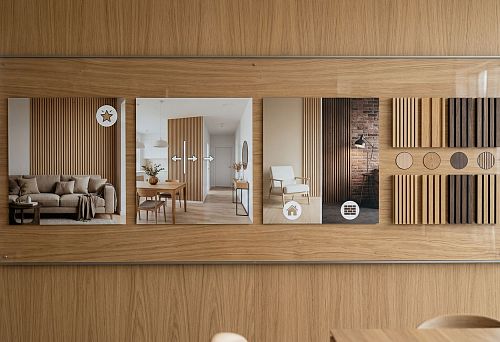
Augmented reality technologies allow "trying on" various wooden finishes in real interiors. Special applications create photorealistic visualizations of future designs, taking into account lighting, color combinations, and proportions.
Artificial intelligence analyzes client preferences and suggests optimal combinations of species, colors, and textures. Machine learning enables systems to improve, creating increasingly accurate recommendations.
Ecological aspects: responsibility toward the planet
Certification of sustainable forestry
Modern wooden finish is unthinkable without adherence to sustainable development principles. Certification systems FSC and PEFC guarantee that wood is sourced from forests managed according to ecological standards.
Certification covers the entire chain from logging to finished product. Each batch of material has documentation confirming the legality of its origin and compliance with environmental standards.
Carbon footprint and climate advantages
Wood is the only building material that actively absorbs carbon dioxide from the atmosphere during growth. Wooden finishes continue to store bound carbon throughout their service life, contributing to the fight against climate change.
Producing wooden finishing materials requires significantly less energy compared to alternative materials. This reduces the overall carbon footprint of construction projects and supports achieving environmental goals.
Biodegradability and reuse
Unlike synthetic materials, wood is fully biodegradable and does not create disposal problems. Old wooden finishing materials can be recycled into new products or used as biomass fuel.
The circular economy concept implies maximum utilization of every piece of wood. Production waste is recycled into pellets, wood flour, composite materials.
Design Trends: Styles and Directions
Scandinavian aesthetics
Scandinavian style in wooden finishes is based on principles of functionality, eco-friendliness, and connection with nature. Light wood species create a sense of spaciousness and purity. Minimal processing preserves the natural beauty of the material.
Key features of Scandinavian style: use of birch, pine, and spruce in natural colors; simple geometric shapes; matte finishes; combination with white and natural textiles.
Loft and industrial style
Industrial aesthetics imply a rough, unprocessed wood texture. Preserving marks of processing, natural defects, and irregularities creates an authentic appearance.
Artificial aging, brushing, surface burning — techniques that allow creating an effect of time and use. Combining wood with metallic elements emphasizes the industrial character of the interior.
Classic and neoclassical styles
Traditional wooden finishes involve using noble species with rich texture. Carved elements, moldings, and panels create an atmosphere of luxury and respectability.
Modern interpretation of classic style simplifies forms while preserving overall stylistic unity. Use of modern processing technologies allows creating complex elements with perfect surface quality.
Installation and Mounting: Art of Professionals
Preparation Work
Quality installation of wooden finishes begins with careful preparation of the substrate. The surface must be flat, dry, and free of contaminants. Moisture content of the substrate must not exceed regulatory limits.
Material acclimatization is a critically important stage often underestimated. Wooden finishes must adapt to room conditions for 48–72 hours before installation.
Mounting technologies
Modern fastening systems provide secure fixation while allowing natural wood movement. Hidden fastening systems do not compromise surface aesthetics, ensuring a perfect appearance.
Floating mounting systems compensate for temperature and humidity deformations without creating gaps or unevenness. Use of damping tapes prevents sound transmission through the structure.
Final finishing on-site
Final surface treatment after installation includes sanding joints, removing defects, and applying finish coatings. Use of professional equipment ensures perfect surface quality.
Control of humidity and temperature in the room during work is critically important for achieving quality results. Violation of technological regimes may lead to coating defects.
Operation and Maintenance: Preserving Beauty for Decades
Operating Modes
Wooden finishes require adherence to specific operating conditions to maintain their original appearance. Optimal room temperature is 18–24°C, relative humidity — 40–60%.
Sudden changes in climatic parameters may lead to deformations, cracks, and geometric distortion of the finish. Use of humidifiers and air conditioners helps maintain stable conditions.
Maintenance and Service Systems
Regular care extends the service life of wooden finishes and preserves their attractive appearance. Dry cleaning should be performed at least 2–3 times per week using soft materials.
Wet cleaning is performed using specialized products designed for wooden surfaces. Ordinary cleaning agents may damage protective coatings and alter the wood’s color.
Restoration and renewal
One of the main advantages of wooden finishes is the possibility of restoring the original appearance. Local sanding removes minor damage, scratches, and scuffs.
Complete re-coating allows for a radical change in the finish’s appearance, adapting it to new design solutions. Modern materials ensure simplicity and efficiency of restoration work.
Economic efficiency: investment in quality
Initial costs and long-term return
Quality wooden finishing requires significant initial investment, but demonstrates excellent long-term return. Service life is 25-50 years with proper maintenance.
Ownership cost calculation shows the economic efficiency of wooden finishing compared to alternative materials requiring more frequent renewal.
Impact on property value
Quality wooden finishing significantly increases property market value. Potential buyers are willing to pay a premium for natural materials, eco-friendliness, and prestige.
For commercial real estate, wooden finishing creates additional competitive advantages, allowing premium rental rates to be set.
Conclusion: the art of creating a perfect space
This is not just a design solution, it is a philosophy of creating a living space where every board, every panel breathes the history of century-old forests and preserves the warmth of natural energy. Represents a unique combination of natural beauty, technological sophistication, and ecological responsibility. In a world of synthetic materials and fleeting trends, natural wood remains a symbol of authenticity, quality, and connection to nature.
Modern technologies allow us to fully unleash the potential of this remarkable material, creating finishes that blend centuries-old traditions with innovative solutions. Each project becomes a unique work of art, reflecting the owner's individuality and the craftsman's skill.
The ecological advantages of wooden finishing gain particular relevance in the context of global climate change. Choosing natural materials means investing not only in the beauty and comfort of one's own home, but also in the sustainable future of the planet.
The psychological impact of natural wood on humans is confirmed by numerous scientific studies. Wooden surfaces create a cozy atmosphere, reduce stress, and improve quality of life. In today's urban world, these qualities become especially valuable.
The economic justification for investing in quality wooden finishing is evident with long-term planning. High initial costs are repeatedly offset by durability, restoration potential, and positive impact on property value.
STAVROS combines the best woodworking traditions with modern technologies and innovative solutions. Years of experience working with various wood species, deep understanding of the material, and use of advanced equipment enable the creation of top-quality finishes.
STAVROS philosophy is based on respect for the natural material and striving for perfection in every project. Individual approach to each client, attention to detail, quality control at all production stages — principles that make STAVROS a leader in wooden finishing.
STAVROS masters understand: wooden finishing is not just a construction material, but a means of creating a unique atmosphere and realizing the dream of an ideal home. Each element is crafted with love for the craft and understanding of responsibility toward the client.
Choosing STAVROS means choosing quality proven over time, ecological responsibility, individual approach, and limitless possibilities for realizing the boldest design ideas. It is a partnership with professionals who transform ordinary spaces into dream spaces, creating interiors capable of delighting and inspiring for years.