Article Contents:
- Why 'finishing with flexible panels' is not one product, but an entire market
- Market map: what types of flexible panels exist and how they differ
- Flexible slatted panels on fabric backing
- Flexible stone and flexible slate
- Flexible marble and decorative sheet panels
- Flexible polyurethane 3D coatings
- Self-adhesive decorative panels
- Comparative table of flexible panel types
- Why slatted texture holds a special place among flexible panels
- Where finishing with flexible panels works best
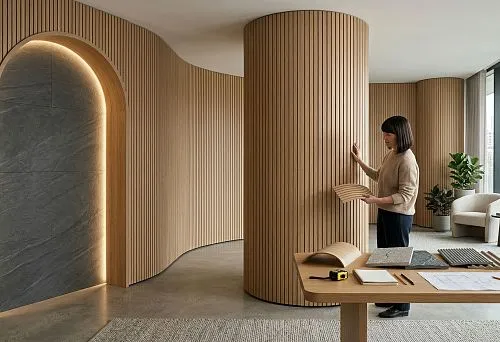
- Radius and curvilinear walls
- Columns: a problem that turns into an accent
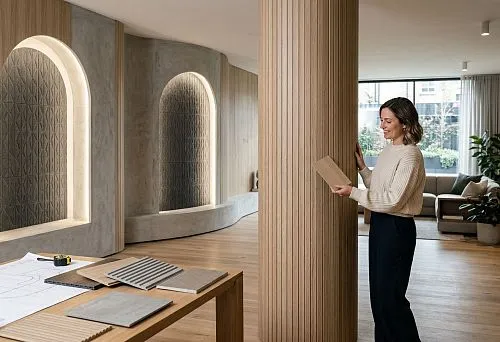
- Arches: Completeness of Details
- Decorative Niches
- Rounded Corners
- Furniture fronts and kitchen islands
- Partitions in Open Layouts
- How to Choose Flexible Panels by Material
- MDF for Painting: A Kingdom of Color
- Solid Oak: Natural Texture Without Replacement
- Slat profile
- How to Choose Flexible Panel Finishing Based on Interior Design Task
- Residential Interior: Living Room, Bedroom, Hallway
- Commercial Interior: Restaurant, Hotel, Office, Boutique
- Furniture Projects
- Complex Architectural Plasticity
- What to check before buying: eight key parameters
- 1. Base type — rigid or fabric
- 2. Minimum working radius
- 3. Slat material
- 4. Bead profile
- 5. Slat spacing
- 6. Module format
- 7. Mounting method
- 8. Finish treatment
- Step-by-step flexible panel finishing technology
- Step 1. Surface Diagnostics
- Step 2. Priming
- Step 3. Marking
- Step 4. Cutting
- Step 5. Dry Fitting
- Step 6. Adhesive Application and Installation
- Step 7. Seaming
- Step 8. Finishing
- Errors That Lead to Redoing Work
- Select Panel Type Without Surface Analysis
- Not Checking the Radius
- Skipping Primer on Curved Surfaces
- Do not secure with tape
- Select slat spacing without considering room scale
- Ignore lighting
- Finishing with flexible panels in different interior styles
- Modern minimalism
- Scandinavian Style
- Neoclassicism and Modern Classicism
- Loft and Industrial Style
- Japanese minimalism and wabi-sabi
- Flexible panels and acoustics: what catalogs don't talk about
- FAQ: answers to main questions about finishing with flexible panels
- What is finishing with flexible panels?
- Why are flexible slat panels better than other types?
- Is special preparation needed for installation?
- How to care for slatted panel finishing?
- Are flexible panels suitable for bathrooms?
- Can flexible panels be installed independently?
- How much does finishing with flexible slatted panels cost?
- Where to view the catalog and order panels?
- STAVROS: The Manufacturer Trusted by Professionals
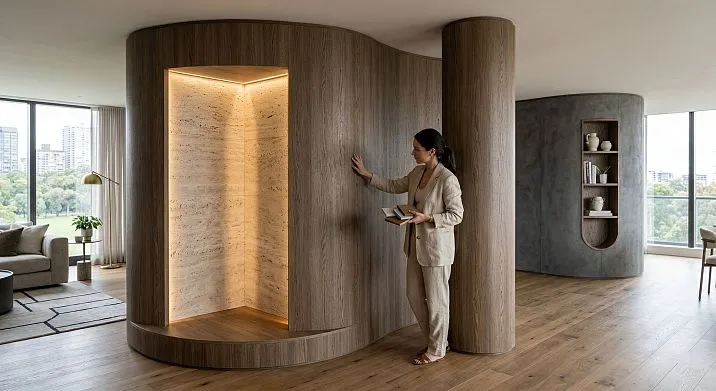
There is a question that begins most interior projects with complex geometry: what to clad a surface that isn't straight? A round column. A bay window wall with a soft curve. An arched opening with a rounded end. A niche with rounded transitions. The curved end of a kitchen island.
The answer most often heard in professional circles today: finishing with flexible panels. But this is precisely where confusion begins that costs time, money, and nerves. Because under the word 'flexible,' the market has lumped together products that look similar in description but fundamentally differ in construction, visual result, and suitability for specific tasks.
This article is not advocacy for one material nor a catalog with a list. It's an honest market breakdown: what types of flexible panels exist, how they differ, where each works well and where it doesn't, and how to choose what will truly solve your task.


Why 'finishing with flexible panels' is not one product but an entire market
Before moving further, it's worth acknowledging one inconvenient truth: there is no single product called 'flexible panel.' It's a marketing umbrella under which several completely different materials with different properties have fallen.
When you search for 'flexible panel finishing,' the search engine honestly reflects market reality: next to each other are wooden slat modules on a fabric base, thin mineral-polymer sheets imitating natural stone, elastic three-dimensional polyurethane reliefs, and self-adhesive PVC coverings with decorative printing.
They are all 'flexible.' But their suitability for a specific task varies. And the price varies. And the result varies.
That's why the first step in choosing is not comparing prices or selecting a color. The first step is to understand which type of flexible material you need for your specific surface and your specific aesthetic task.




Market map: what flexible panels exist and how they differ
Let's break it down. Without unnecessary words—just the essence of each type.
Our factory also produces:
Flexible Slat Panels on Fabric Backing
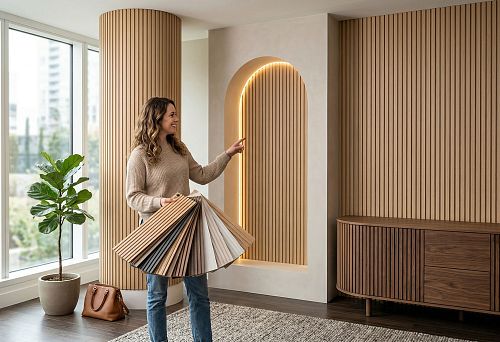
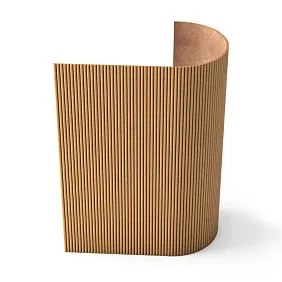
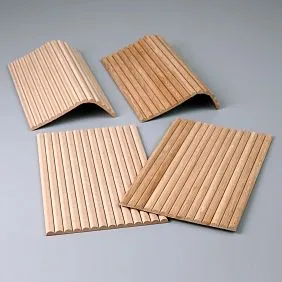
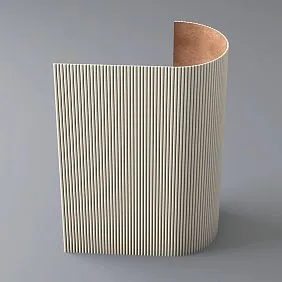
These are wooden or MDF battens with equal spacing, fixed to a reinforced fabric backing. The fabric base is the key structural solution: it is what allows the module to bend along a radius without breaking or deforming individual slats, while maintaining precise batten spacing along the entire length of the bend.
The visual effect is an architectural rhythm of parallel lines with expressive chiaroscuro. On curved surfaces, this effect works especially strongly: each slat casts a shadow on the next, and the surface gains volume and depth that a painted wall cannot reproduce.
Main applications: radius walls, columns, arched openings, niches, furniture fronts. Installation—with adhesive. Cutting—with a utility knife. Finish—painting (MDF) or oil/varnish (solid oak).
Get Consultation
Flexible stone and flexible slate
A thin slice of natural or artificial stone, 1–3 mm thick, glued onto a polymer base. Allows bending along gentle radii. Creates an authentic stone texture with a natural pattern.
Advantages: natural material, authentic stone texture. Limitations: heavier than slatted panels, requires special adhesive, poorly tolerates sharp bends (radius less than 50–70 cm). Visual result — stone, not slats.
Flexible marble and decorative sheet panels
Thin mineral-polymer sheets with imitation of marble, onyx, travertine. Well suited for straight and slightly curved surfaces. Lightweight, mounted with adhesive, create a luxurious visual effect. For sharp bends — radius limitations apply.
Flexible Polyurethane 3D Coatings
Relief modules made of elastic polyurethane with geometric or ornamental patterns. Bend well, mounted with adhesive. Create a three-dimensional sculptural surface. Visual language — relief ornament, not the linear rhythm of slats.
Self-adhesive decorative panels
Thin PVC or foamed polyethylene with self-adhesive backing and imitation of wood, stone, or brick. Budget-friendly, quick installation. Minimal durability, superficial imitation. Not a suitable choice for serious projects.
Comparative table of flexible panel types
| Type | Flexibility | Visual effect | Best application | Installation |
|---|---|---|---|---|
| Slatted (fabric-backed) | High | Linear rhythm of slats | Columns, radius walls, arches | Glue |
| Flexible stone | Medium | Stone texture | Flat and slightly curved walls | Special adhesive |
| Flexible Marble | Medium | Marble Pattern | Accent Walls, Surfaces | Glue |
| Polyurethane 3D | High | Volumetric relief | Flat and Curved Walls | Glue |
| Self-Adhesive PVC | Medium | Various imitations | Budget decor | Self-Adhesive |
Why Slatted Texture Holds a Special Place Among Flexible Panels
Let's be direct: among all the listed types, Flexible slatted panels are the most versatile for solving architectural tasks in modern interiors. And this isn't a matter of taste—it's a conclusion from structural logic.
Reeded surface is the only format that:
-
Creates a continuous linear rhythm without interruptions on any geometry
-
Works with light dynamically: the same interior looks different in the morning and evening because the lighting angle changes the character of the shadows
-
Applicable simultaneously on flat and curved surfaces without changing the material
-
Allows any color of finish (with MDF base) or natural texture (with oak base)
-
Seamlessly joins through several modules—the rhythm of the reeds continues without interruption
Flexible stone gives a stone texture. Marble sheets—a luxurious pattern. Polyurethane 3D—sculptural relief. All these are worthy materials for their tasks. But it is preciselyWall slat panels in interiorthat give what designers call an 'architectural surface'—living, changing, expressive in any light.
Where flexible panel finishing works best
This is not an abstract list. These are specific scenarios with specific logic.
Radius and curved walls
Rounded walls, smooth transitions, bay windows, rounded piers — all these surfaces have one thing in common: rigid panels won't work on them without complex manual fitting, and the result will still have visible seams and gaps.
Finishing with flexible slat panels solves this in one motion: the module is applied to the surface, the fabric backing conforms to the curve, and the adhesive sets it. The next module is joined edge-to-edge — and along the entire length of the radius wall runs a continuous rhythm of slats without a single gap.
For sheet flexible materials (stone, marble) — the same possibilities for gentle curves, limitations for sharp bends.
Columns: A problem that turns into an accent
A load-bearing column in the center of an open space is an architectural given that's hard to argue with. But you can work with it. Cladding a column with flexible slat panels is one of the most effective and yet technically simple techniques: the module wraps around the circumference, the slats run vertically along the entire perimeter, and the column transforms from a nondescript concrete pillar into a sculptural element of the space.
Neither flexible stone nor marble sheets will achieve such an effect on a column: stone cladding on a cylindrical surface is a different structural story with completely different labor intensity.
Arches: Completeness of details
The arch is where most interiors reveal incompleteness. The walls are finished, but the edge of the arched opening is left bare or simply painted — and the transition is visible. Because a curved reveal is non-standard.
Flexible slat panels close this issue: the module is mounted on the edge of the arch, wraps around the rounding, and the texture of the wall smoothly transitions into the texture of the arch. This is the kind of detail that experienced designers put a separate line item in the estimate for — and which, with the right material choice, is solved within the standard installation.
Decorative niches
A niche is one of the most popular architectural techniques in modern apartments. Its back wall always aspires to be an accent.Decorative wall panels for apartment interiors— and especially slatted panels — transform a niche from a wall recess into an independent visual object.
A back plane with dark slats and bottom lighting creates depth and mystery. A back plane with oak slats finished with natural oil brings warmth and naturalness. The choice depends on the interior concept.
For niches with right angles — both rigid and flexible panels are suitable. For niches with rounded transitions — only flexible ones.
Rounded corners
The angle between two walls, finished without a break in the slatted texture — this is a professional detail. A flexible panel wraps around the transition from one plane to another, and the rhythm of the slats continues across the corner without visible seams. This technique is especially important in corridors and halls where the finish covers several adjacent walls.
Furniture fronts and kitchen islands
A separate story worth examining in more detail. Curved furniture fronts — the ends of kitchen islands, rounded corner sections of cabinets, curved bar counters — traditionally required milling or custom production.
A flexible slatted panel changes this logic: it is mounted directly onto the front with adhesive, wraps around the curve, and the finished front gains a continuous slatted texture without technological seams and expensive custom processing. In combination withideas for decorating furniture fronts— slats as the main textural background, decorative overlays as accent elements — the result is a furniture story with architectural scale.
Partitions in open-plan layouts
Slatted partitions are now almost a mandatory element of a modern open space.Slat panels for space zoningwith a flexible base allow building partitions with a curved top edge or a smooth transition to the ceiling, maintaining a uniform slat texture across the entire surface.
How to choose flexible panels by material
MDF for painting: a kingdom of color
MDF with a density of 750–850 kg/m³ is a surface without natural defects, specially created for finish painting. Uniform density throughout the cross-section ensures the same absorption of primer and paint by each slat. No 'spotting', no color variation between adjacent slats.
The range of finish colors — from RAL 9003 (white) to RAL 7021 (dark gray), from dusty pink to rich emerald. This is complete freedom in color choice — a unique opportunity that neither oak nor stone provides.
For accent zones where color is the main expressive tool — MDF is optimal.Slatted panel for the wall made of MDF— is a precise color tool in the designer's arsenal.
Solid oak: natural texture without substitution
Oak 700–750 kg/m³ — a dense, mechanically stable species with a pronounced natural grain pattern. No two slats are alike — this is a natural uniqueness that no film or print can reproduce.
Clear oil — honey-golden warm tone. Pigmented oil — Scandinavian gray or rich tobacco. Lacquer — a hard protective surface with a choice of gloss level.Wood-look slatted panels made from solid wood— the choice of those for whom the natural material itself is important, not the imitation of it.
Profile of the slat
Rectangular glazing bead: sharp edges, clear architectural chiaroscuro. Geometrically strict, modern, precise. Semicircular glazing bead: a soft light dome on each slat, smooth shadows, natural warmth. Choosing between profiles is a choice between architectural rigor and organic softness.
How to choose flexible panel finishing based on the interior design task
Not by material. Not by photo. By task. This is exactly how professionals work.
Residential interior: living room, bedroom, hallway
For a living room with an accent TV wall — rigid or flexible slatted panel (depending on the wall geometry). For a bedroom with a bed headboard in a niche — flexible panel with warm wood texture or MDF in a muted color. For a hallway with a column or rounded wall — flexible slatted panel on a fabric base.
Slatted panels in the living room interior— it's not necessarily the entire wall. Often one accent zone is enough: behind the sofa, around the fireplace, in the niche for the TV.
Commercial interior: restaurant, hotel, office, boutique
The main requirement is durability under high traffic. Lacquered oak is mechanically stable and easy to maintain. For objects with non-standard geometry (bar counters, columns, radius walls) — flexible slatted panel as the primary solution for curved surfaces.
Furniture projects
Curved fronts, corner sections, bar counters — only flexible panel. Flat fronts — rigid or flexible (as preferred). Oak is preferable to MDF on edges under regular mechanical loads.
Complex architectural plasticity
Projects with multiple surfaces of non-standard geometry, where the finish must be uniform — from a straight wall to a radius wall, from a wall to a column, from the end of an arch to a reveal. Flexible slatted panel ensures visual continuity where other materials require a change of format or visible transitions.
What to check before purchase: eight key parameters
1. Base type — rigid or fabric
This is the main question. Rigid backing — only for flat surfaces. Fabric — for any surfaces.
2. Minimum working radius
For fabric base — check with the manufacturer. Different modules have different maximum bending radii depending on the thickness and width of the slats.
3. Slat material
MDF (for painting) or solid oak (for tinting/varnishing). Determined by the design concept and durability requirements.
4. Glazing bead profile
Rectangular — architectural strictness. Semicircular — natural softness.
5. Slat spacing
Frequent (15–20 mm) — dense, 'warm' surface. Medium (25–30 mm) — balanced. Sparse (35+ mm) — airy, lightweight structure.
6. Module format
Standard panel PAN-001: 1010×8×950 mm. For quantity calculation — surface area plus 10–15% cutting allowance.
7. Mounting method
Directly on the wall (adhesive) or on a metal frame with leveling. A frame is needed for significant base irregularities or when acoustic underlay is required.
8. Finishing
MDF — primer and enamel after installation. Oak — oil or varnish. Plan the color before installation, not after.
Step-by-step technology for installing flexible panels
Professionals don't improvise. They have a sequence that works every time. Here it is.
Step 1. Surface diagnosis
Inspect, tap, measure. Look for: peeling, cracks, dampness, grease stains, height variations. All of this must be fixed before installation — not during, not after. Only before.
For columns and curved walls — pay special attention to base evenness: unevenness will prevent the panel from fitting tightly along its entire length. For strong variations — frame mounting.
Step 2. Priming
Apply primer over the entire surface. For concrete — deep penetration. For drywall — standard. For previously painted surfaces — adhesion primer.
Don't skip this step. Especially for curved surfaces: the panel experiences constant stress on the adhesive seam due to bending, and without primer, the adhesive loses strength over time precisely where the stress is maximum.
Step 3. Marking
Horizontal zero line – using a laser level. Vertical axes – for controlling the straightness of the slats. For a column – mark the start and end of the module vertically. Check the marking three times: a one-millimeter error at the marking stage becomes a centimeter by the end of the surface.
Step 4. Cutting
Back side of the panel – marking for trimming. Utility knife and metal ruler – for straight cuts. For shaped forms (arches, rounded edges) – contour marking and gradual cutting along the curve. Flexible fabric base cuts cleanly – no special tool needed.
Step 5. Dry fitting
A critically important step that saves rework. Place the module: ensure it lays correctly, there are no unexpected gaps, and it's clear where adjustments are needed. Better to spend five minutes here than an hour after applying the adhesive.
Step 6. Applying adhesive and mounting
Mounting adhesive – in a zigzag or horizontal strips on the back side. For curved surfaces – additional adhesive along the edges: these are the areas that tend to lift when bent before the adhesive sets.
Press from one edge to the other – gradually, controlling the adhesion with your palm along the entire height. On a column – wrap around the circumference smoothly, pressing along the entire length simultaneously.
Secure with painter's tape along the edges – until fully set (2–4 hours). This is not an optional step – it's insurance against an unpleasant surprise in the morning.
Step 7. Joining
Next module – butted against the previous one. Precisely align the slat pattern: the slats should continue without shifting. With proper joining, the seam disappears into the overall rhythm of the panel – it's not visible even up close.
Step 8. Final finishing
MDF: remove the tape after 4–6 hours. Apply primer. After drying — first coat of enamel. After complete drying — second coat. Edges and joints — with a narrow brush.
Oak: apply oil in two to three coats with intermediate matting using a Scotch-Brite pad. For varnish — at least two coats with interlayer sanding.
Mistakes that lead to rework
Choosing panel type without surface analysis
The most common mistake. Buying 'beautiful slats' from a photo without clarifying the base type means getting rigid panels for a curved wall. Or flexible panels with a minimal radius for a column with high curvature.
Not checking the radius
'Flexible' does not mean 'infinitely flexible'. Each module has a maximum working radius. For thin slats it is smaller. For thick ones — larger. Buying without this information is a gamble.
Skipping primer on a curved surface
After three to six months, the edges on the column will start to peel — exactly where the curved surface creates constant stress on the adhesive seam. Primer solves this in twenty minutes. Re-gluing takes half a day.
Not securing with tape
On a flat wall — usually no fixation is needed. On a column or arch — it's not allowed. The elasticity of the fabric base when bent creates pressure on the edges until the adhesive sets. Without tape, the edges separate.
Choosing the slat spacing without considering the room scale
Close spacing in a small room — visual overload. A small room starts to feel oppressive. Rule: the smaller the room, the more delicate the spacing and lighter the tone.
Ignoring lighting
The slatted surface only reveals itself with side or directional lighting. In a room without side light sources — no chiaroscuro effect. This is not a panel flaw — it's a lighting design issue. If the room lacks suitable lighting, it must be created — before installation.
Finishing with flexible panels in different interior styles
Modern minimalism
MDF in wall color. The slats create only texture — without color contrast. A column clad to match the space ceases to be an accent and becomes an architectural detail. This is the highest level of minimalism: things exist, but are not seen — only the quality is felt.
Scandinavian style
Oak under clear oil. Semi-circular profile. Delicate spacing. White walls, linen textiles, natural wood — all in a unified natural key. A slatted column in such an interior looks like a detail from a wooden house that found its way into a modern apartment — and this is precisely the effect sought in Scandinavian style.
Neoclassicism and modern classicism
Batten panels combined withbatten panels and moldingscreate a layered surface with architectural character. Slatted background + molding frames = a modern classical wall without the heaviness of traditional classicism.
Loft and industrial style
Dark MDF — anthracite, graphite, iron-gray. Background — exposed concrete or brick. The slatted structure on round reinforced concrete columns creates an architectural contrast that enhances, rather than smooths over, the industrial character.
Japanese minimalism and wabi-sabi
Oak with dark tinting or natural gray. Wide slat spacing. A surface that appears intentionally 'imperfect' — the living texture of oak is precisely what's needed for this. A column in such an interior is almost a sculptural object, meditative and calm.
Flexible panels and acoustics: what catalogs don't talk about
A slatted surface is not just a visual tool. Parallel slats scatter sound waves, breaking up direct reflection from a flat wall. This reduces reverberation — that unpleasant echo in large spaces with high ceilings.
With frame mounting and a 5–10 cm air gap, the effect is enhanced. If acoustic mineral wool or special acoustic foam is added to the gap, sound absorption becomes noticeable. One material solves two problems at once: aesthetic and acoustic.
For restaurants, meeting rooms, open-plan offices — this is an argument that often proves decisive when choosing between slatted panels and other finishing solutions.
FAQ: answers to the main questions about flexible panel finishing
What is flexible panel finishing?
It is the use of decorative and finishing panels capable of bending to the shape of a curved surface, for cladding walls, columns, arches, niches, and furniture fronts. It includes several fundamentally different types of materials.
What makes flexible slatted panels better than other types?
They provide a continuous linear rhythm of slats on any geometry: columns, radius walls, arches. Other formats create a different visual effect—stone, relief, marble. If you specifically need a slatted texture on a curved surface—only a flexible slatted module will do.
Is special preparation required for installation?
Yes: cleaning, degreasing, priming. For significant level differences—frame mounting. These steps are critical for the durability of the fastening, especially on curved surfaces.
How to care for slatted panel finishes?
MDF under enamel: regular wet cleaning, without abrasive agents. Oak under oil: periodic renewal of the oil coating (every 2–3 years). Oak under varnish: wet wiping, without stiff brushes.
Are flexible panels suitable for the bathroom?
Standard slatted panels made of MDF—not recommended in areas of direct contact with water. In the bathroom with good ventilation and without direct wetting—use of MDF under water-repellent enamel is possible, but this is not the primary application.
Can flexible panels be installed independently?
Yes, for flat surfaces—no special skills required. For columns and steep bends—it is advisable to involve an experienced installer: working with curved surfaces requires understanding the nuances of fixation and pressure during bending.
How much does flexible slatted panel finishing cost?
The cost depends on the material (MDF or solid oak), module format, and surface area. Check current prices in the STAVROS catalog.
Where can I view the catalog and order panels?
The full range of flexible and rigid slatted panels made of MDF and solid oak is on the pagestavros.ru/products/izdeliya-iz-massiva/reechnye-paneli/.
STAVROS: a manufacturer trusted by professionals
Behind every quality interior project is a manufacturer who understands the task more precisely than just 'making a panel.' STAVROS produces slatted panels from paintable MDF and solid oak in rigid and flexible versions—for any surfaces, from straight walls to steep curves.
The STAVROS flexible slatted panel on a fabric base ensures precise slat spacing through all curves, seamless module connections, easy cutting with a utility knife, and adhesive installation without special tools. Two materials: MDF—for those working with color; solid oak—for those choosing natural texture. Two profiles: rectangular and semicircular—for different lighting solutions and styles.
STAVROS is a laureate of the 'Industry Leader of Russia' title, with over twenty years of producing wooden decor for interiors. Own production, delivery across all of Russia, full range onstavros.ru/products/izdeliya-iz-massiva/reechnye-paneli/.
When your task goes beyond a right angle—STAVROS knows the answer.