Article Contents:
- Evolution of Balcony Railing: From Function to Art
- Historical Legacy of Balusters
- Philosophy of Safety in Beauty
- Material Science: Choosing the Foundation for Perfection
- Grandeur of Natural Stone
- Warmth and Coziness of Wood
- Innovations in Composite Materials
- Architectural styles and design solutions
- Classical Harmony
- Modernist Experiments
- Modern minimalism
- Technical Aspects and Regulatory Requirements
- Construction Standards and Safety
- Load capacity
- Wind Loads
- Manufacturing Technologies
- Traditional Processing Methods
- Modern Technologies
- Quality Control
- Installation and mounting
- Preparatory work
- Mounting methods
- Final finishing
- Operation and maintenance
- Regular maintenance
- Preventive Inspections
- Repair and restoration
- Economic Aspects
- Cost of Various Solutions
- Pricing factors
- Long-Term Economic Efficiency
- Trends of development
- Ecological Aspects
- Digital technologies
- Smart materials
- Conclusion
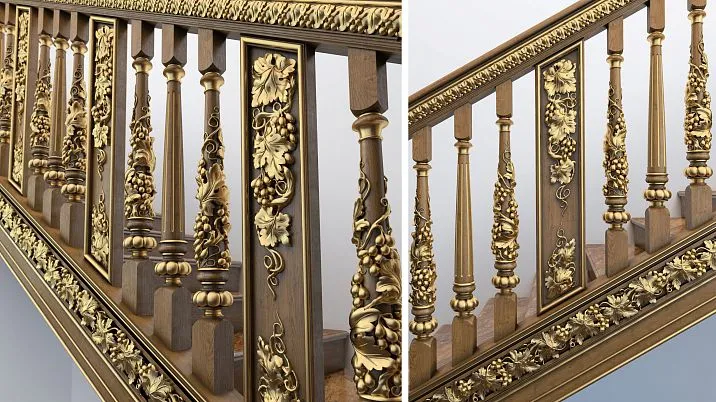
A balcony is not just an architectural element, it is an extension of living space, a place where the home meets the sky. And precisely balcony railing balusters they transform this encounter into true poetry of stone and wood. Each baluster is a vertical note in the symphony of the facade, an element that simultaneously protects and decorates, creating safety and offering aesthetic pleasure.
When we speak of balcony railings with balusters, we refer to a centuries-old tradition of architectural craftsmanship. From the majestic palazzi of Venice to modern country residences — balusters remain a symbol of refined taste and understanding of harmony. But behind the external beauty lies a complex engineering challenge: to ensure maximum safety while preserving the airy and elegant structure.


Evolution of Balcony Railing: From Function to Art




Historical Legacy of Balusters
The history of balusters traces back to antiquity, but they truly developed during the Renaissance. Italian masters were the first to understand that a functional element could become a work of art. Each baluster was crafted as a miniature sculpture, capable of bearing load while delighting the eye with the perfection of proportions.
Modern balusters for balcony railings preserve the spirit of tradition, yet are enriched by new technological possibilities. Today, masters use high-precision equipment to create ideal geometric forms, without losing the soul of handcrafted work. Computer modeling allows creating the most complex ornaments, previously accessible only to the greatest carvers.
Our factory also produces:


Philosophy of Safety in Beauty
Why are balusters the preferred choice for balcony railings? The answer lies in their unique combination of functionality and aesthetics. Unlike solid panels, balusters provide necessary safety without creating a sense of enclosure. They allow air to circulate freely and enable the eye to glide between elements, creating a visual connection with the surrounding space.
Each baluster in the railing is a precisely calculated element of the safety system. The distance between adjacent elements is strictly regulated: no more than 120 millimeters between axes. This standard ensures protection even for the smallest inhabitants of the house, while preserving the airy nature of the structure.
Get Consultation
Material Science: Choosing the Foundation for Perfection
Grandeur of Natural Stone
Stone balusters are classics, tested over centuries. Marble, granite, travertine, sandstone — each material possesses unique characteristics that determine not only the appearance but also the longevity of balcony railings with balusters. Marble balusters impress with their elegance and ability to convey the finest details of carving. Each vein in the stone tells a story, creating a unique pattern.
Granite balusters impress with their monumentality and practically eternal durability. This material can withstand any climatic influences, preserving its original beauty for centuries. Processing granite requires special equipment and the highest craftsmanship, but the result exceeds all expectations.
Warmth and Coziness of Wood
Wooden balusters bring a special warmth and coziness to architecture. Oak, beech, larch — each species has its own character and application area. Oak balusters are renowned for their strength and noble texture, which only becomes more beautiful with time. Beech elements are distinguished by flexibility and resistance to deformation.
Modern wood processing technologies allow creating balusters of incredible complexity and beauty. Thermal modification increases the material's resistance to moisture and biological damage. Special impregnations protect against ultraviolet rays and atmospheric influences, extending the service life of wooden elements to 50-70 years.
Innovations in Composite Materials
Modern composite materials open new horizons in creating balcony railings. Polymer concrete combines the strength of stone with the ease of plastic processing. Glass-fiber balusters have high strength at minimal weight, are resistant to corrosion, and require no special maintenance.
Wood-plastic composites (WPC) combine the beauty of natural wood with the practicality of modern materials. Such balusters for balcony railings do not rot, crack, or fade under sunlight, while retaining the warm texture of wood.
Architectural styles and design solutions
Classic Harmony
Classic architectural style for balcony railings implies strict adherence to canons developed over centuries. Classic balusters are characterized by proportionality, symmetry, and noble simplicity. They often take the form of miniature ancient columns, with clearly defined bases, shafts, and capitals.
Creating classic balcony railings requires a deep understanding of the golden ratio proportions. Each element is carefully calibrated and harmonizes with other architectural details. The height of a baluster is typically 8-10 times its diameter, creating optimal visual perception.
Modernist Experiments
Modernism brought a fundamentally new approach to baluster design. Rejecting strict classical canons, modern architects drew inspiration from natural forms. Balusters could imitate plant stems, ocean waves, or flames.
This style opened new creative possibilities, allowing architects to experiment with forms and materials. Modernist balusters often became central compositional elements, drawing primary attention. Asymmetrical shapes, smooth transitions, organic lines — all these characterize the modernist approach to balcony railings.
Modern minimalism
Modern architecture leans toward simplicity and functionality. Minimalist balusters are distinguished by clean lines and the absence of decorative excesses. Their beauty lies in perfect proportions and high-quality execution.
This approach requires special craftsmanship, as any inaccuracy becomes noticeable. Minimalism leaves no room for chance — every detail must be thought out and justified. Balcony railings with balusters in modern style are often made from high-tech materials: stainless steel, aluminum, composites.
Technical aspects and regulatory requirements
Construction Standards and Safety
Design of balcony railings is governed by strict regulatory documents. The height of the railing should be at least 1000 millimeters for buildings up to 30 meters and 1100 millimeters for taller structures. These requirements ensure user safety on balconies.
The distance between balusters is a critically important safety parameter. The maximum allowable gap is 120 millimeters between the centers of elements. This distance prevents a child from slipping between balusters, which is especially important for families with children.
Load-Bearing Capacity
Each element of balcony railing balusters must withstand strictly defined loads. Horizontal load on one meter of railing is at least 100 kilograms for residential buildings. For public buildings, this figure may reach 150 kilograms per meter.
Vertical load-bearing capacity of individual balusters depends on the material and method of mounting. Stone and concrete elements can withstand loads of several tons, wooden ones — from 200 to 800 kilograms depending on species and cross-section.
Wind Loads
Balcony railings are subjected to significant wind loads, especially in high-rise buildings. Wind load calculations take into account the geographical location of the structure, installation height, and railing configuration. Balusters, with their vertical orientation, create less wind load compared to solid panels.
Manufacturing Technologies
Traditional finishing methods
Hand carving remains the pinnacle of craftsmanship in creating balusters. Each element is made individually, making it a unique work of art. The master carver works with live material, feeling its structure, adapting the design to the specific characteristics of a particular piece of stone or wood.
Turning is a classic method for creating symmetrical balusters. Modern CNC lathes allow achieving the highest precision while preserving the individuality of each item. An experienced turner can create a baluster of the most complex profile with accuracy down to fractions of a millimeter.
Modern technologies
3D milling has revolutionized the production of balusters for balcony railings. Computer control allows creating items of any complexity with perfect repeatability. Multi-axis milling centers can process balusters with complex spatial geometry, inaccessible to traditional methods.
Laser cutting opens new possibilities for creating delicate elements from metal and composite materials. The precision of the laser beam allows creating the finest details that cannot be achieved by mechanical processing.
Quality control
Each baluster undergoes a multi-stage quality control. Incoming material inspection includes checking physical and mechanical properties, absence of defects, and compliance with technical requirements. Operational control is performed at every processing stage.
Final control includes checking geometric dimensions, surface quality, and strength characteristics. Modern measuring complexes allow controlling dimensions with precision down to micrometers, ensuring perfect fitting of elements.
Installation and Mounting
Preparation Work
Quality installation of balcony railings with balusters begins with careful preparation of the foundation. The balcony slab must be leveled, cleaned of contaminants, and reinforced if necessary. Marking installation locations is performed using high-precision measuring instruments.
Creating mounting holes requires special precision. Deviation from verticality exceeding 2 millimeters may cause problems during handrail installation. Modern drills with laser indicators ensure the required drilling accuracy.
Methods of mounting
Anchor mounting is the most reliable method for fixing balusters to a concrete base. Chemical anchors provide exceptional connection strength capable of withstanding dynamic loads. Mechanical anchors are easier to install but require precise adherence to installation technology.
Welding is used for metal balusters. Weld quality is critically important for the overall structure's strength. Weld seams must be fully penetrated, cleaned, and protected from corrosion with special coatings.
Final finishing
After installation, all railing elements undergo final finishing. Connection joints are carefully sanded and filled with special compounds. Protective coatings are applied strictly according to technical specifications.
Quality control of installation includes checking vertical alignment, secure fastening, and compliance with project dimensions. Each baluster must be absolutely immovable under calculated loads.
Operation and Maintenance
Regular Maintenance
Proper maintenance extends the service life of balcony railings with balusters and preserves their original appearance. Regular cleaning of dust and contaminants prevents accumulation of aggressive substances capable of damaging the material.
Stone balusters require the use of special cleaning agents that do not contain acids. Wooden elements require periodic treatment with protective compounds. Metal parts require monitoring of protective coatings.
Preventive Inspections
Regular technical inspections allow identifying problems at an early stage. Special attention is paid to the condition of fastening elements, integrity of protective coatings, absence of cracks and deformations.
Seasonal inspections after the winter period are especially important in climates with sharp temperature fluctuations. Freeze-thaw cycles may lead to weakening of connections or the formation of microcracks.
Repair and Restoration
Upon detecting damage, immediate measures must be taken to address it. Minor chips on stone balusters can be repaired using special repair compounds. Damage to protective coatings requires local restoration.
Serious damage may require replacing individual elements. Modern technologies allow manufacturing exact replicas of damaged balusters, indistinguishable from original components.
Economic Aspects
Cost of Various Solutions
The cost of balcony balusters varies widely depending on selected materials and complexity of execution. Simple concrete balusters cost from 500-800 rubles each, wooden ones — from 1000-3000 rubles, stone ones — from 3000-15000 rubles and more.
Handcrafted exclusive items may cost tens of thousands of rubles per piece. However, such investments are justified by the uniqueness and artistic value of the items. Antique balusters only increase in value over time, becoming collectible items.
Pricing Factors
The cost of balusters is influenced by numerous factors: design complexity, material quality, manufacturing technology, batch size, and production timelines. Custom orders always cost more than mass production.
Transportation costs may constitute a significant portion of the total project cost, especially for heavy stone items. Installation cost depends on the complexity of the structure and working conditions.
Long-term economic efficiency
Quality balusters are a long-term investment. Natural stone items may serve for centuries, practically requiring no maintenance. Wooden elements, with proper care, last 50-70 years.
Savings on material quality or violation of manufacturing technology lead to premature failure and costly repairs. Properly selected and correctly installed balcony railings balusters pay for themselves through longevity and aesthetic value.
Trends in development
Ecological aspects
Modern architecture increasingly pays attention to ecological aspects of construction. Use of local materials, renewable resources, and recycled raw materials has become a priority for responsible developers.
Biodegradable composite materials, wood from sustainably managed forests, secondary metal recycling — these technologies are finding wider application in baluster production.
Digital technologies
Virtual and augmented reality revolutionize the design process of balcony railings. Clients can see the future railing in real scale before production begins, make necessary adjustments, and evaluate various design options.
Parametric design automates the creation of working drawings, optimizes material consumption, and accelerates production preparation. Artificial intelligence helps select optimal solutions considering multiple factors.
Smart Materials
Advancements in materials science lead to the emergence of "smart" materials with programmable properties. Self-cleaning surfaces, color-changing materials, shape-memory composites — all these innovations will find application in future balcony railings.
Integrated electronics will allow embedding lighting systems, safety sensors, and "smart home" components into balusters. Such solutions will transform balcony railings into high-tech systems.
Conclusion
balcony railing balusters — is much more than just a safety element. It embodies architectural traditions, technological achievements, and artistic craftsmanship. Each baluster carries the history of the material it is made from, the skill of its creator, and the vision of the architect.
Modern technologies open up boundless opportunities for creativity, but core principles remain unchanged: harmony of proportions, quality of materials, craftsmanship. Properly designed and well-made balusters serve for decades, delighting the eye and ensuring safety.
Choosing balusters for balcony railings is an investment in beauty, safety, and prestige. Each element must be carefully considered and meticulously executed. Only in this way can one create a railing that becomes a facade ornament and a source of pride for the owner.
The future of balcony railings lies in the harmonious combination of tradition and innovation, where timeless principles of beauty are complemented by modern technologies and materials. Ecological sustainability, functionality, and aesthetic perfection — these principles will define the industry’s development in the coming decades.
For many years, STAVROS has remained faithful to the traditions of quality and craftsmanship in creating architectural elements. Combining centuries of experience with modern technologies, STAVROS creates products that not only meet the highest quality standards but also embody beauty and functionality. Choosing STAVROS means choosing reliability proven over time and innovations aimed at the future.