Article Contents:
- Coffee Table: Small Forms with Great Responsibility
- Height Matters: Ergonomics of Low Tables
- Shapes and Structures: From Minimalism to Baroque
- Spindles: Icons of Mid-Century Modern
- Conical Legs: Scandinavian Elegance
- Straight Cylindrical: Minimalism and Rigor
- Square and Rectangular: Geometric Precision
- Cross and X-Shaped: Stability and Decoration
- Polished Balusters: Classic Luxury
- Platform Bases: Wide Stability
- Materials: from solid to composites
- Wood: warmth and nobility
- Metal: Modernity and Durability
- Plastic and Composites: Technological Sophistication
- Acrylic and Glass: Transparent Elegance
- Quantity and Placement: The Mathematics of Stability
- Stylistic Solutions: From Loft to Art Deco
- Scandinavian Style: Simplicity and Functionality
- Loft: metal and brutality
- Mid-Century Modern: Elegance of the 1950s–1960s
- Classic: Carving and Luxury
- Provence: romance of the French countryside
- Rustic and Country: Rural Solidity
- High-tech: chrome and futurism
- Combination with Other Interior Elements
- Coordination with the Sofa
- Coordination with Other Furniture
- Rugs and Textiles
- Installation and Mounting Features
- Mounting to Wooden Top
- Mounting to Glass Top
- Mounting to Stone Top
- Floor Protection: Preserving the Beauty of Floor Covering
- Wool for Parquet
- Silicone for Tiles
- Plastic foot pads
- Wide bases
- Care and Maintenance: Extending Beauty
- DIY: Creativity and Uniqueness
- Frequently Asked Questions
- Conclusion: Legs as the Foundation of Composition

The журнальный столик — это не просто место для чашки кофе и пульта от телевизора. Это композиционный центр гостиной, связующее звено между диваном и креслами, визитная карточка вашего вкуса. И что определяет его характер больше всего? Опоры. ИменноLegs for coffee tablesсоздают настроение, задают стиль, влияют на функциональность всего пространства.
Today we will dive into the world of coffee tables: from elegant mid-century hairpin legs to rustic wooden beams, from minimalist metal constructions to intricately carved neoclassical masterpieces. We will examine materials, proportions, height, placement, combinations with interior design, and answer the main question: how to turn an ordinary table into a work of art?




Coffee Table: Small Forms with Great Responsibility
Why is a coffee table so important? Because it is the center of attention. When you enter the living room, your gaze first falls on the sofa, then glides downward — and there it is, the table. Books, candles, decorative vases, a tray with tea — all of this creates the atmosphere. And the foundation of this composition — the legs.
Coffee tables have a special geometry: they are lower than dining tables (height 35–50 cm vs. 70–75 cm), wider relative to height (tops 60×100, 80×120, 100×100 cm at height 40–45 cm), lighter in weight (15–30 kg vs. 40–80 kg for dining tables). This means thatLegs for coffee tablesmust be elegant yet sturdy, low yet stable, decorative yet functional.
The main task of coffee table legs is not just to hold the top, but to create visual lightness. Heavy, bulky legs 'consume' space, making the room feel cramped. Thin, elegant legs, on the other hand, create a sense of airiness, openness, and elegance.




Height Matters: Ergonomics of Low Tables
The standard height of a coffee table is 40–45 cm from the floor to the top surface. This is the ideal height for comfortable use: sitting on a sofa 42–45 cm high, you can easily reach for a cup, magazine, or remote control without leaning too far.
But standard is not dogma. For high sofas (50–55 cm to seat), tables 45–50 cm high are suitable. For low Japanese sofas (35–40 cm), tables 35–40 cm high are appropriate. The difference between sofa seat height and tabletop height should be 0–5 cm, no more. Otherwise, using the table is inconvenient.
Leg height is calculated simply: total table height minus top thickness. If the top is 3 cm thick and total height is 42 cm, legs should be 39 cm. If the top is 5 cm (e.g., solid oak), legs should be 37 cm.
Important nuance: for glass tops 8–12 mm thick, legs are mounted not from below, but along the edges or corners, and their visible height equals the total table height. Visually, this creates a floating effect — the top seems to hang in the air.
Our factory also produces:
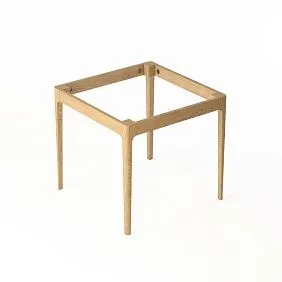


Shapes and Structures: From Minimalism to Baroque
Get Consultation
Hairpin Legs: Icons of Mid-Century Modern
Hairpin legs (hairpin legs) are thin metal rods 10–12 mm in diameter, bent into the shape of an inverted U. They appeared in the 1940s, became symbols of mid-century modernism, and are experiencing a new wave of popularity today.
Hairpin legs come in two-, three-, and four-legged versions. Two-legged versions are the most minimalist, almost invisible. Three-legged versions are classic, offering the optimal balance of strength and elegance. Four-legged versions are for heavy tops, solid wood, or stone.
The height of hairpin legs for coffee tables is usually 30–40 cm. They are mounted to the top via a mounting plate with four screws. Installation takes 10 minutes and requires no special skills.
Hairpin legs are made of steel and coated with powder paint. Colors: matte black, white, gold, copper, chrome. Black hairpin legs are universal and suitable for any interior. Gold and copper legs are accents, luxury, glamour. Chrome legs are retro-futurism, the shine of the 1960s.
Advantages of hairpin legs: visual lightness, modernity, ease of installation, affordable price. Disadvantages: not suitable for classic interiors, thin rods may bend under heavy weight, scratch floors without protective caps.
Conical Legs: Scandinavian Elegance
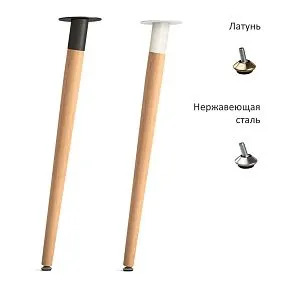
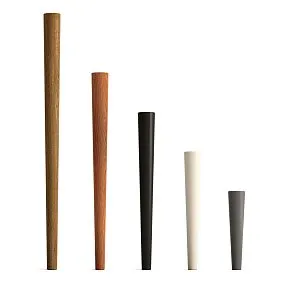
Conical wooden legs are a smooth taper from top to bottom, with a top diameter of 40–50 mm and a bottom diameter of 25–35 mm. They create a sense of lightness, dynamism, and elegance. ConicalLegs for coffee tablesare installed at a slight outward angle (5–10 degrees), which increases stability.
Material — solid beech, ash, oak, birch. Finish: natural oil, lacquer, paint. Natural oil highlights the wood texture, creating a tactile pleasure. Lacquer protects and creates a glossy sheen. Paint hides the texture, allowing for bold color accents — white, gray, black, mint, mustard.
Conical legs are the hallmark of Scandinavian style, mid-century modern, and minimalism. They pair beautifully with wooden, glass, and marble tops. Height for coffee tables — 30–40 cm.
Advantages: elegance, naturalness, warmth of wood, versatility. Disadvantages: wood requires care, can scratch, costs more than metal.
Straight Cylindrical: Minimalism and Rigor
Straight cylindrical supports with a diameter of 30–50 millimeters are minimalism in its purest form. No curves, no decoration, only function. They are made of wood or metal, finished with varnish, paint, or chrome.
Wooden straight supports are often used in Japanese, minimalist, eco-friendly interiors. They create a sense of stability, solidity, and calm. Height of 35–45 centimeters, diameter of 35–45 millimeters — optimal proportions.
Metallic straight supports — steel or aluminum pipes with a diameter of 25–40 millimeters — are characteristic of industrial, loft, and high-tech interiors. They are cold, strict, and technological. Matte black steel, polished aluminum, chrome-plated pipe — each option creates its own atmosphere.
Advantages: simplicity, reliability, versatility, easy maintenance. Disadvantages: may look dull without context, require proper surroundings.
Square and rectangular: geometric precision
Square supports with a cross-section of 30×30, 40×40 millimeters — geometric clarity, constructivism, Japanese minimalism. Straight edges, sharp corners create a strict, orderly aesthetic.
Square supports are made from solid wood (oak, ash, walnut), painted or oiled. They pair beautifully with square or rectangular tabletops, creating visual unity.
Rectangular supports with a cross-section of 30×50, 40×60 millimeters are used less often, but create an interesting visual effect — directionality, dynamism. If rectangular supports are installed with their narrow side facing the viewer, the table appears lighter and more elegant.
Advantages: strictness, modernity, visual unity. Disadvantages: sharp corners may be hazardous, especially for children.
Cross and X-shaped: stability and decoration
Cross supports — two crossed planks forming an X in plan — provide maximum stability. Load is distributed across four points, the structure is rigid and does not loosen.
X-shaped supports are made of wood or metal. Wooden ones — for rustic, country, Provence interiors. Metallic ones — for industrial, loft, modern interiors.
Cross construction can be open (simply two crossed planks) or closed (with a central connecting element). Open is lighter and airier. Closed is stronger and more decorative.
Advantages: high stability, decorative appeal, possibility of creating complex compositions. Disadvantages: visually heavier than four separate supports, more complex to manufacture.
Turned balusters: classic luxury
Turned supports with balusters, fluting, carving — this is classic, neoclassic, Provence, shabby chic. They transform a coffee table into a piece of decorative art. Each support is a symphony of forms: cylinders, spheres, transitions, expansions.
Turned balusters are made on a lathe from solid oak, beech, ash. They are painted white, milk, gray, or patinated with gold or silver, creating an effect of antiquity and luxury.
Height of turned supports for coffee tables — 30–40 centimeters. It is important that the narrowest part is not less than 25 millimeters in diameter, otherwise the support may break under load.
Advantages: luxury, decorative appeal, tradition, possibility of creating unique profiles. Disadvantages: expensive, require handwork, collect dust, not suitable for modern minimalist interiors.
Platform bases: wide stability
Platform supports — wide bases of 80×80, 100×100 millimeters with a central leg. They distribute weight over a large area, providing maximum stability and protecting the floor from sinking.
Platform bases are used for heavy tabletops — marble, granite, thick solid wood. They are made of metal (steel, cast iron) or wood (oak, ash). Metallic ones — for industrial interiors, wooden ones — for rustic, country.
Platform supports are often height-adjustable, allowing compensation for floor unevenness. This is especially important for coffee tables — even a 1–2 millimeter difference is noticeable, and the tabletop rocks.
Advantages: maximum stability, floor protection, adjustability. Disadvantages: visually heavier than thin supports, take up more space.
Materials: from solid to composites
Wood: warmth and nobility
Wooden supports for coffee tables are made from solid hardwoods.Furniture legsOak — the strongest, can withstand up to 150 kilograms per support, which is excessive for a coffee table, but guarantees longevity. Oak has a pronounced texture, beautiful color ranging from light gold to dark brown.
Beech — the golden middle. Slightly less dense and strong than oak, but beech is highly workable, turnable, and paintable. Beech supports are often painted white, gray, or black, creating modern color solutions.
Ash — elasticity and expressive texture. Light with contrasting stripes, it is ideal for Scandinavian interiors. Ash supports are finished with oil or wax, highlighting natural beauty.
Birch — accessibility and versatility. Softer than oak, but for coffee tables, its strength is sufficient. Birch stains beautifully, making it a favorite for colorful interiors.
Walnut — luxury and nobility. Dark with rich texture, walnut creates a sense of solidity and wealth. Walnut supports are finished with varnish or oil, preserving the natural color.
Crucially important: the wood must undergo kiln drying to a moisture content of 8–12%. Green wood is unstable, warps, and cracks. Proper drying is a guarantee of longevity.
Metal: modernity and strength
Metal legs for coffee tables are made from steel, aluminum, or brass.Furniture SupportsMade from steel — the strongest. Steel pipes with a diameter of 25–40 millimeters and wall thickness of 2–3 millimeters can withstand loads of 100–200 kilograms per leg.
Steel is coated with powder paint, chrome-plated, or patinated. Black matte steel — classic industrial style. Chrome-plated — shine and futurism. Patinated copper or bronze — vintage elegance.
Aluminum is three times lighter than steel at comparable strength. Aluminum legs do not rust and are resistant to moisture. They are anodized, painted, and polished. Polished aluminum creates a mirror effect, matte finish — restrained elegance.
Brass — a rare but striking material. Brass legs are heavy (density three times higher than aluminum), but convey a sense of luxury. Brass can be patinated to create a vintage look or polished to a mirror finish.
Combined solutions — wood + metal — combine the warmth of wood and the strength of metal. Wooden upper part of the leg, metallic lower part. Metal frame, wooden cladding. Endless variations.
Plastic and composites: technology
Modern composite materials — reinforced polypropylene, glass fiber polyamide — withstand loads of 50–100 kilograms per leg, sufficient for coffee tables. Plastic legs are lightweight (50–150 grams), moisture-resistant, and do not require painting.
Composites can imitate wood, metal, or stone textures. Modern molding technologies allow creating complex shapes impossible in wood or metal. Plastic legs are inexpensive and functional, but lack the nobility of natural materials.
Acrylic and glass: transparent elegance
Acrylic and glass legs create a floating effect. The tabletop seems to hover in the air, legs almost invisible. Ideal for small spaces where preserving a sense of openness is important.
Acrylic — transparent plastic, stronger than glass, won’t break but scratches. Acrylic legs are made from blocks 30–50 millimeters thick, supporting up to 80 kilograms per leg.
Glass — more fragile, but visually purer and clearer. Glass legs are made from tempered glass 15–20 millimeters thick. They withstand significant loads but require careful handling.
Advantages of transparent legs: visual lightness, modernity, floating effect. Disadvantages: scratch easily, require frequent cleaning, not suitable for classic interiors.
Quantity and placement: the mathematics of stability
A standard coffee table has four legs at the corners. This is the optimal configuration for rectangular and square tabletops up to 100×100 centimeters. Distance from tabletop edge to leg — 5–10 centimeters. Closer — aesthetically unpleasing, farther — reduces stability.
For round tabletops up to 80 centimeters in diameter, three legs evenly spaced around the circumference at 120 degrees apart are sufficient. Three legs ensure absolute stability even on uneven floors — a triangle is always stable.
For large tabletops longer than 120 centimeters, a fifth central leg is recommended to prevent sagging. Glass tabletops 8–10 millimeters thick are especially prone to sagging under the weight of books, vases, or decor.
Central leg — a single substantial post at the center of the tabletop with a wide base. It frees up space under the table, creates a minimalist aesthetic, but requires a larger diameter (80–120 millimeters) to ensure stability.
Stylistic solutions: from loft to art deco
Scandinavian style: simplicity and functionality
Scandinavian interiors require minimalism, naturalness, light tones.Buy legs for furnitureConical legs made of light wood (oak, beech, birch), painted white, gray, or natural. Height 35–40 centimeters, top diameter 45–50 millimeters, bottom diameter 30–35 millimeters, slight outward slope.
Tabletop — light wood, white MDF, light marble. Shape — round, oval, rectangular with rounded corners. Decor minimal: one or two books, candle, plant in ceramic pot.
Loft: metal and brutality
Loft interiors require an industrial aesthetic. Metal legs made of black steel, straight pipes 30–40 millimeters in diameter, square profiles 30×30 millimeters. Rough welding, visible bolts, patina, rust — all contribute to a brutal atmosphere.
Tabletop — rough wood with visible grain, concrete, metal, glass. Shape — rectangular, square, asymmetrical. Decor industrial: metal objects, old books, vintage photos.
Mid-century modern: elegance of the 1950s–60s
Mid-century style — medium-thickness wooden legs, painted in natural or bright colors. Walnut, teak, oak with lacquer finish. Height 35–42 centimeters, outward slope 7–10 degrees, elegant proportions.
Alternative — spikes. Three-legged metal spikes 35–40 centimeters high, painted black, gold, or copper. They create a mid-century cult aesthetic.
Top: walnut veneer, teak, oak, sometimes marble. Shape — oval, kidney-shaped, rectangular with rounded corners. Decor — ceramic vases, vintage magazines, table lamps with shades.
Classic: carving and luxury
Classic interiors require precisely crafted or carved supports made of solid noble woods.furniture legwith balusters, fluting, carving. Oak, walnut, mahogany, lacquered, patinated, gilded.
Top — solid wood, marble, glass in a metal frame. Shape — oval, round, rectangular. Decor — crystal vases, silver trays, expensive albums, antique items.
Provence: romance of the French countryside
Provence — light, carved legs, painted white, milk, lavender, mint. Weathered effect, worn finish, patina. Height 35–40 cm, soft rounded shapes, decorative grips.
Top — light wood, white MDF, sometimes tiles with Provence pattern. Shape — oval, round. Decor — ceramic vases with lavender, linen napkins, candles in candlesticks, vintage boxes.
Rustic and country: rustic solidity
Rustic interiors require massive wooden supports made of rough-sawn solid wood.furniture legssquare cross-section 50×50 mm, slightly shaped, with visible texture, knots, cracks. Stain in dark shades or natural oil.
Top — thick solid (5–8 cm), barn board, slab. Shape — rectangular, square. Decor — woven baskets, ceramic dishes, dried herbs, coarse linen napkins.
High-tech: chrome and futurism
High-tech requires shine, technology, innovation. Chrome metal legs with mirror finish, transparent acrylic legs. Height 35–42 cm, perfectly smooth surfaces without scratches.
Top — tempered glass, white glossy MDF, polished metal. Shape — strictly geometric: rectangle, square, circle. Decor minimal: one or two items in glass, metal, ceramic with geometric shapes.
Combination with other interior elements
Coordination with sofa
The coffee table should harmonize with the sofa in style, color, height. If the sofa has high legs (15–20 cm), the table should also have visible legs (10–15 cm). If the sofa is low, without visible legs, the table can have low hidden legs (5–8 cm).
The color of the table legs can match the color of the sofa legs. Black sofa legs — black table legs. Wooden sofa legs — table legs of the same wood type and shade. This creates visual unity.
Coordination with other furniture
In the living room, there are usually several pieces of furniture: sofa, chairs, shelving, TV stand. If all have visible legs, it is desirable that the legs are in one style. All wooden legs of one shade. All metal legs of one color (black, chrome, gold).
If the furniture is eclectic (mixed style), the coffee table can serve as a unifying element. Its legs can combine elements of different styles: wooden conical legs with metal caps, classic balusters, painted in modern colors.
Rugs and textiles
The coffee table often stands on a rug. Legs should be wide enough to avoid crushing the pile. Base diameter at least 30 mm for short-pile rugs, 40–50 mm for medium- and long-pile rugs.
Alternative — platform legs with wide base 80×80 mm. They distribute weight, do not deform the rug, create a sense of stability.
Installation and mounting features
Mounting to wooden top
Wooden legs are mounted to the top via mounting plates, self-tapping screws, or dowel joints. Mounting plate — a metal or plastic part with holes, screwed to the top with self-tapping screws, and the leg is attached to the plate with a bolt or threaded bushing.
Dowel joint — a dowel is cut at the end of the leg, and a slot is cut into the top. The dowel fits into the slot and is secured with wood glue. Method is reliable, aesthetic, but requires precision.
Mounting to glass top
Glass tops require special mounting. Legs are mounted via rubber pads that protect the glass from cracks. Suction cups, adhesive plates, clamps are used. It is important that the load is distributed evenly, without point pressure.
Alternative — legs with wide top platforms (diameter 80–100 mm), onto which the glass simply rests. The weight of the top presses it onto the legs; additional fixation is not needed. Rubber or silicone pads 2–3 mm thick are mandatory between the glass and legs.
Mounting to stone top
Marble, granite, artificial stone — heavy (30–60 kg). Supports must be strong — wooden with a minimum diameter of 50 mm, metal with a minimum diameter of 30 mm. Mounting via metal plates, epoxy adhesive, or mechanical anchors.
Floor protection: preserving the beauty of flooring
Even a lightweight coffee table weighing 20 kg creates point pressure on the floor. Narrow supports with a diameter of 25–30 mm concentrate weight on a small area, leaving dents on linoleum, laminate, or parquet.
Felt for parquet
Felt pads 3–5 mm thick are glued to the ends of supports. They are soft, do not scratch, and dampen sound when moving the table. Felt wears out within a year and a half and requires replacement. Choose high-quality dense felt with a density of 600–800 g per square meter.
Silicone for tiles
Silicone caps are slipped over the ends of supports. They do not slip, do not scratch, and are chemically inert. Transparent and almost invisible. Suitable for tiles, ceramic tiles, stone. On parquet and laminate, they may leave traces of silicone oil.
Plastic foot pads
Plastic feet are inexpensive and easy to install. However, they may leave dark marks on light floors. For light finishes, choose light-colored soft plastic feet.
For heavy furniture, it is better to choose supports with a wide base of 50–80 millimeters in diameter or platforms of 80×80 millimeters. They distribute weight over a larger area, minimizing the risk of floor indentation.
For heavy countertops (marble, thick slab), choose supports with a wide base of 50–80 mm diameter or platforms 80×80 mm. They distribute weight over a larger area, minimizing the risk of floor damage.
Care and maintenance: extending beauty
Wipe wooden supports with a damp soft cloth; avoid aggressive cleaning agents. Once a year, renew protective coating — oil or varnish. Sand scratches with fine-grit sandpaper (220–320 grit), stain with matching dye, and apply varnish.
Metal supports are less fussy. Polish chrome surfaces with special compounds and remove fingerprints with microfiber. Matte-painted supports wipe with a damp cloth. Remove rust (if it appears on bare steel) with a rust converter and apply a protective compound.
Acrylic and glass supports require frequent cleaning — dust and fingerprints are visible on transparent surfaces. Use glass cleaners and soft microfiber. Avoid abrasives — acrylic scratches easily.
Check fasteners every six months. Coffee tables are moved less often than dining tables, but they are occasionally moved for cleaning. Tighten loose screws. If threads are stripped, replace fasteners.
Replace floor protective pads as they wear out. Felt wears out faster, silicone lasts longer.
DIY: creativity and uniqueness
A coffee table on custom supports — an opportunity to create a unique interior piece.Buy furniture legsYou can separately select or make a countertop and assemble the table yourself.
Choosing supports: determine style, material, height, color. Order four identical supports or three for a triangular configuration.
Choosing countertop: wood, glass, marble, MDF. Sizes 80×80, 90×60, 100×100, 120×60 cm. Thickness 2–5 cm for wood, 8–12 mm for glass.
Marking: flip the countertop and mark support installation locations. For four supports — at the corners with 5–10 cm offset from the edge. Use a tape measure, ruler, and square for accuracy.
Mounting: attach mounting plates with screws (for wood) or adhesive (for glass). Screw or bolt on supports. Check that all are standing vertically.
Finishing: flip the table and place it on the floor. Check stability. Install protective pads. Enjoy the result!
Frequently asked questions
What is the optimal height of a coffee table?
40–45 cm from floor to countertop. This is at or slightly below sofa seat level, convenient for use.
How many supports are needed for a coffee table?
Four for rectangular and square countertops up to 100×100 cm. Three for round countertops up to 80 cm diameter. Five for long countertops over 120 cm.
What material is best for supports in Scandinavian style?
Light wood (oak, ash, birch), conical shape, natural oil or white paint.
Can spikes be used for a heavy marble countertop?
No, the spikes can withstand up to 30–40 kilograms. For marble, you need heavy wooden or steel supports with a minimum diameter of 40 millimeters.
How to protect parquet from scratches?
Wool pads 3–5 mm thick on the ends of supports. Replace once a year.
Can a coffee table be made on a single central support?
Yes, for round or square tabletops up to 80 centimeters in diameter or side length. The support must be substantial (80–120 mm diameter) with a wide base.
What style of supports suits a loft?
Metallic: black steel pipes, square profiles, rough welding. Alternatively — heavy, rough-cut square-section wood.
How to install supports on a glass tabletop?
Through rubber pads, suction cups, or adhesive plates. Alternatively, supports with wide platforms onto which the glass simply rests.
Conclusion: supports as the basis of composition
Legs for coffee tables— this is not an auxiliary detail, but a full-fledged design element that defines the style, mood, and functionality of the entire living room. The right choice creates harmony, elegance, visual lightness. The wrong choice destroys the composition, overloads the space, creates imbalance.
Quality supports serve for decades, withstand loads, preserve aesthetics. Cheap alternatives break, scratch the floor, spoil the impression of the interior.
STAVROS offers an exclusive collection of furniture supports made from solid natural oak, beech, and ash, specifically designed for coffee tables. Over 40 models developed with ergonomic considerations for low tables: height 30–45 cm, diameter 25–50 mm, variety of shapes from classic turned balusters to modern conical profiles. Each item undergoes kiln drying to 8–12% humidity, precise CNC turning, and multi-stage quality control. Dimensional deviation does not exceed 0.3 mm, ensuring perfect table stability without wobble or tilt. The catalog features supports for any interior style: Scandinavian minimalism (light conical), classic luxury (turned baluster designs), mid-century modern (elegant conical with tilt), Provence (patinated white), rustic (heavy square with rough texture). Various finishes are available: natural oil (emphasizes wood texture), matte lacquer (protects and preserves natural color), water-based paints (white, gray, black, graphite), wood stains (oak, beech, wenge, padauk), patina (antique and noble effect). STAVROS works directly with furniture factories, interior designers, and private clients. Flexible discount system, fast delivery across Russia, professional consultations from specialists with 30 years of experience. Visit the showroom in Moscow to see the full range of textures, assess the quality of processing, and select the perfect supports for your coffee table. STAVROS — this is the tradition of cabinetmaker craftsmanship, modern production technologies, attention to every detail, transforming furniture into art and creating the interior of your dreams.