












































































Article Contents:
- Why MDF is the material of choice for architraves
- Structure and physical properties
- Advantages for painting
- Economic feasibility
- Geometry and profiles: the language of shapes in frame design
- Narrow architraves 50-60 millimeters
- Medium architraves 70-90 millimeters
- Wide architraves 100-120 millimeters
- Thickness and projection
- Professional painting technology: from primer to finish
- Preparation stage
- Priming
- Painting
- Decorative techniques
- Installation: precision as the foundation of quality
- Opening preparation
- Marking and Cutting
- Installation
- Joint Processing
- Frequently Asked Questions
- Can MDF architraves be used in wet areas?
- Which paint is better — matte or glossy?
- Paint architraves before or after installation?
- How much do MDF architraves cost?
- How to choose the color of architraves?
- Can architraves be repainted a different color?
- What tools are needed for installation?
- How long do painted MDF architraves last?
- Conclusion: flawless openings with STAVROS
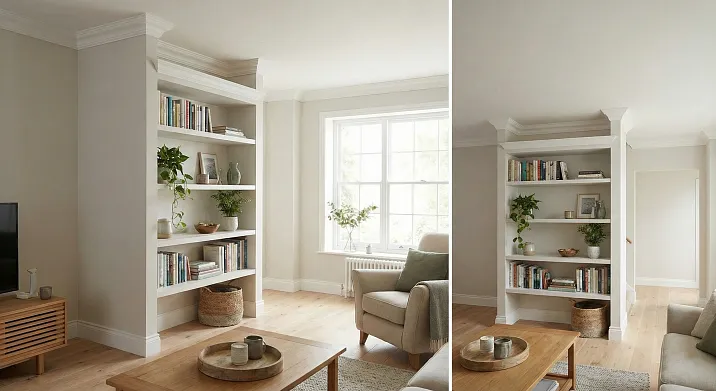
A door opening is a transition between spaces, a boundary between worlds inside a home. The living room flows into the bedroom, the hallway opens to the kitchen, the study separates from common areas. And it is precisely the framing of this transitionMDF skirting board for paintingthat determines whether the opening will be an elegant architectural element or remain a technical necessity with protruding mounting foam and uneven plaster edges.
Why, among thousands of finishing options — plastic overlays, polyurethane profiles, expensive solid wood — does the choice often fall onMDF door and window casings for painting? The answer lies at the intersection of practicality and aesthetics. MDF is stable — it doesn't warp, twist, or crack like solid wood under humidity changes. It is dense and smooth — paints flawlessly, without pores or roughness. It is rigid enough to hold its shape and pliable enough to mill any profile. And most importantly — it is affordable, allowing you to finish all the openings in an apartment with quality decor without critically impacting the renovation budget.


Why MDF is the material of choice for architraves
MDF stands for Medium Density Fiberboard. But behind this boring abbreviation lies a material with a unique set of properties that make it ideal for producing interior decor.




Structure and physical properties
MDF is created by pressing fine wood fibers under 20-30 atmospheres of pressure at 150-200 degrees Celsius. The binding agent is urea-formaldehyde resins of emission class E1, safe for residential spaces. The result is a homogeneous board with a density of 700-850 kilograms per cubic meter, where every square centimeter is identical to another.
The absence of grain direction is a key difference from solid wood. Wood has longitudinal grain orientation, creating anisotropy of properties — the material is stronger along the grain, weaker across it, and prone to chipping. MDF is isotropic — it cuts and mills equally in all directions without chipping or tearing. The architrave profile with fine beads and projections is reproduced with jewelry precision.
The moisture resistance of standard MDF is limited — the water absorption coefficient is 15-20 percent during prolonged immersion. But for interior architraves not in direct contact with water, this is sufficient. Wet cleaning and accidental splashes cause no harm. For bathrooms and other wet areas, moisture-resistant MDF with hydrophobic additives is produced.
Dimensional stability is multiple times superior to solid wood. Wood reacts to seasonal changes in air humidity—it swells in autumn-winter and dries out in spring-summer. An 80-millimeter-wide solid wood casing can change its width by 1-2 millimeters per year, leading to gaps at joints or warping. MDF changes by tenths of a millimeter—visually imperceptible and technically insignificant.
Our factory also produces:


Advantages for painting
The surface of MDF after factory sanding is absolutely smooth, without open wood pores. This is critical for achieving a flawless painted finish. Solid wood has pores—channels through which the tree's sap flowed. When painted, the paint flows unevenly into the pores, creating roughness, matte spots, and unevenness. To achieve a smooth surface on solid wood, multiple rounds of priming with pore filling, intermediate sanding are required—a process that takes days.
MDF is primed once and painted with two coats—the result is perfect. Even gloss or silky matte finish, deep uniform color, no base show-through.Plastic molding to be paintedis inferior to MDF in terms of surface quality after painting—plastic is less dense, paint adheres worse to it, and peeling is possible.
The variety of shades is limitless. Modern tinting systems allow for any color from RAL, NCS, Pantone catalogs—tens of thousands of options. A white casing matching the wall color, a dark one matching the door color, a contrasting bright one as an accent—any designer idea is realized with paint on MDF.
Get Consultation
Economic feasibility
Priceof MDF casing for paintingis two to four times lower than a similar casing made of solid oak or beech. For a standard apartment with seven doorways, the savings amount to 15-30 thousand rubles—a significant sum that can be redirected to other renovation elements.
But low cost does not mean primitiveness. High-quality MDF after professional painting is indistinguishable from painted solid wood from a distance of one meter. The wood grain is not visible under the opaque paint—neither on solid wood nor on MDF. Only the profile shape, painting quality, and installation precision are visible. And here MDF does not fall short.
Geometry and profiles: the language of forms in framing openings
The width of the casing determines its visual weight, ability to structure space, and compatibility with interior styles.
Narrow casings 50-60 millimeters
Minimum width sufficient to cover the installation gap between the frame and the wall. A narrow casing creates a light, almost unnoticeable frame. The opening is perceived as a natural hole in the wall, not as a decorated structure.
The use of narrow casings is justified in minimalist interiors, Scandinavian style, modern spaces with clean lines and minimal decor. They are suitable for small rooms where a massive frame would 'eat up' space and make the room feel cramped.
The profile of narrow casings is usually simple—a flat rectangle or one light bevel (rounding). Complex relief on a narrow strip looks tiny, gets lost, and creates visual noise.
Medium casings 70-90 millimeters
A universal option suitable for most interiors. An 80-millimeter width is an unspoken standard, the golden mean between functionality and decorativeness. Such a casing is wide enough to create a noticeable frame, structure the opening, but not so massive as to dominate.
Profiles of medium width are diverse—from simple ones with one or two bevels to complex ones with coves (concave elements), beads (convex rolls), and astragals (thin protruding beads). This range of profiles allows selecting a casing for any style—from neoclassical to country, from Provence to Art Deco.
Wide casings 100-120 millimeters
Monumental framing for spacious rooms with high ceilings. A wide casing turns the opening into an architectural element, draws attention, and creates solemnity. Characteristic of classic interiors, palace styles, English and French directions.
The profile of wide casings is complex, multi-level—three to four rows of bevels with different radii, protruding and recessed shelves, relief ornaments. Such detailing requires significant width for harmonious perception—on a narrow casing, a complex profile looks overloaded.
Wide casings require proportionality with the rest of the decor. They should match high baseboards of 100-150 millimeters, ceiling cornices of 80-120 millimeters, otherwise imbalance will arise—massive casings and thin baseboards look uncoordinated.
Thickness and projection
The thickness of the casing (the distance it protrudes from the wall) is usually 10-20 millimeters. Thin casings of 8-10 millimeters look elegant but are fragile and break easily from accidental impact. Thick ones of 20-25 millimeters are sturdy, create expressive play of light and shadow on the profile relief, but protrude from the wall and are easy to catch on.
An optimal thickness of 12-16 millimeters combines strength, aesthetics, and safety. The profile is perceived as three-dimensional but does not hinder movement along walls.
Technology of professional painting: from primer to finish
Painting is the process that determines 80 percent of the final impression of theof MDF casings for painting. Quality paint, correct sequence of operations, and patience turn budget MDF into an element of a premium interior.
Preparation Stage
MDF is supplied from the factory sanded, but additional preparation is required before priming. Inspect the casings for defects—chipped ends, dents, contamination. Fill minor defects with acrylic wood filler, let dry, and sand with fine-grit sandpaper P220-P320.
Light sanding of the entire surface with P220 sandpaper creates a micro-texture that improves primer adhesion. Do not overdo it—the goal is not to remove material but to slightly matte the surface. Run the sandpaper along the casing 2-3 times without strong pressure.
Remove dust — a critically important operation that many ignore. Dust interferes with primer adhesion and creates roughness. Use a vacuum with a brush attachment, then wipe with a slightly damp (not wet!) cloth, and allow to dry completely.
Priming
Primer is not an option but a mandatory step. It performs several functions: seals the MDF surface, blocks resin penetration to the surface, creates a uniform base for paint, reduces paint consumption, and improves adhesion.
For MDF, specialized acrylic-based insulating primers are used. They contain components that block the migration of binding resins from the board to the surface. Without an insulating primer, resins may emerge as yellowish stains after several months, especially when painting in white and light tones.
Apply primer with a synthetic bristle brush 40-50 millimeters wide or a short-nap velour roller (4-6 millimeters). The brush paints the profile relief more thoroughly, while the roller works faster on flat areas. The optimal approach is a combination: roller for flat surfaces, brush for profiled parts.
Apply primer in a thin, even layer without drips. Dip the brush into the primer to one-third of the bristle length, wipe off excess on the edge of the can. Move the brush along the molding with long, smooth strokes. One coat is sufficient for quality MDF — the material absorbs primer moderately.
Primer drying time is indicated on the packaging — usually 2-4 hours at a temperature of 20-25 degrees Celsius and relative humidity of 50-60 percent. Do not start painting before it is completely dry — the paint will apply unevenly, and stains may occur.
After the primer dries, inspect the surface. If the primer has raised the nap (rare but possible on low-quality MDF), perform light sanding with fine-grit sandpaper P320-P400, and remove dust. The surface is ready for painting.
Painting
Paint selection depends on operating conditions and the desired effect. For interior moldings, water-based acrylic paints are optimal — eco-friendly, odorless, fast-drying, and forming a durable coating. Alkyd enamels are more durable but have a strong odor, take longer to dry, and require ventilation.
For white color, choose paint of 1st class hiding power — two coats completely cover the base. Cheap paints of 3rd-4th class will require 4-5 coats, which is economically unprofitable and creates a thick film prone to cracking.
For colored finishes, use a white base paint tinted to the desired shade. Perform tinting by machine in specialized stores — color matching accuracy according to the RAL or NCS catalog is 99 percent. Manual tinting does not ensure repeatability — if you need to touch up after six months, matching the color exactly will not be possible.
Apply the first coat of paint with a brush or roller in a thin, even layer. Do not try to cover the base in one go — two thin coats give better results than one thick coat. A thick coat forms drips, sags, takes a long time to dry, and may peel.
Move the brush along the molding with long strokes without lifting it. Paint the profile relief thoroughly, ensuring paint reaches all recesses. Remove excess paint from raised areas with a semi-dry brush.
Allow the first coat to dry completely — the time is indicated on the paint packaging, usually 4-6 hours for acrylic paints. Check for dryness by touching an inconspicuous area — the surface should be dry, not tacky.
Apply the second coat similarly to the first. After the second coat dries, inspect the result. If the hiding power is sufficient, the color is even, and the primer does not show through — the coating is ready. If unevenness is visible, apply a third coat.
To achieve a perfectly smooth premium-level surface, perform intermediate sanding. Allow the first coat of paint to dry completely (preferably for 24 hours), lightly sand with fine-grit sandpaper P400-P600 using gentle motions. Remove dust, then apply the second coat. The surface will be silky smooth, without the slightest roughness, like on expensive furniture.
Decorative Techniques
In addition to solid-color painting, decorative effects that enrich visual perception are possible.
Patination — applying dark patina into the recesses of the relief after the main painting. The molding is painted in a light base color (white, ivory, light gray). After drying, dark patina — golden, silver, brown, black — is applied into the profile recesses. Excess is wiped off with a cloth, leaving patina only in the recesses. The result — emphasized relief, an aged effect, depth.
Two-tone painting — the flat surface of the molding is painted one color, the relief another. For example, the flat surface is white, the raised beads are gold. Or the flat surface is dark blue, the beads are white. This technique requires care — painter's tape is used to protect painted areas.
Metal effect — special paints with metallic pigment create imitations of bronze, copper, steel. Bronze-effect moldings are impressive in classic interiors, steel-effect in loft and industrial styles.
Installation: Precision as the Foundation of Quality
InstallationMDF architravesrequires precision, the right tools, and an understanding of the sequence of operations.
Opening preparation
Check the geometry of the door frame — it must be installed vertically, strictly perpendicular to the floor, and in the same plane as the wall. Deviations of more than 2-3 millimeters will cause problems — the moldings will not fit tightly, and gaps will appear.
The wall around the opening must be even. Bumps and depressions of more than 2-3 millimeters will prevent the molding from fitting tightly. Level unevenness with filler, sand after drying, and prime.
Remove excess mounting foam protruding from the gap between the frame and the wall. Cut the foam flush with the frame using a sharp knife. The foam should not interfere with the installation of the moldings.
Marking and Cutting
Start by measuring the height of the opening. Measure from both sides — the distances may slightly differ if the floor is uneven. Use the larger value.
Vertical moldings are cut at a 45-degree angle at the top (for joining with the horizontal molding) and installed vertically at the bottom. The length of the vertical molding equals the opening height plus the molding width (for extending above the frame) minus the molding thickness (to account for the bevel).
The horizontal molding is cut at 45 degrees on both ends. Its length is determined by the distance between the outer points of the vertical moldings' bevels plus twice the molding width.
Use a miter saw or miter box for 45-degree cuts. A miter saw provides precision and cut cleanliness unattainable with hand tools. If using a handsaw with a miter box, choose a handsaw with fine teeth for a clean cut without chips.
Installation
Fastening is done with a combination of adhesive and mechanical fasteners for reliability. Apply mounting adhesive (liquid nails, polymer adhesive) to the back of the molding in intermittent strips or dots spaced 15-20 centimeters apart.
Place the molding against the opening, align it with the markings (if made) or with the edge of the frame. Press firmly along its entire length, hold for 30-60 seconds until the adhesive sets. Additionally, secure with finishing nails 30-40 millimeters long or thin screws.
Place fasteners in the recesses of the profile where the heads will be invisible. Fastener spacing is 40-50 centimeters. Sink nail heads 1-2 millimeters below the surface using a nail set. Fill the holes with acrylic putty, sand after drying, and touch up with paint.
Joint Treatment
Casing joints at corners (45 degrees) are the most vulnerable spot, requiring thoroughness. Even with a precise cut, a micro-gap of 0.3-0.5 millimeters remains. Fill it with white acrylic sealant (for white casings) or paintable sealant.
Apply sealant from a tube with a thin nozzle, filling the gap. Remove excess with a damp rubber spatula or a gloved finger, smoothing the joint. Work quickly — acrylic sealant sets in 5-10 minutes.
Also fill the gap between the casing and the wall (if the wall is slightly uneven) with sealant. Guide the tube nozzle along the gap, extruding sealant. Smooth with a damp spatula, creating a smooth transition. After drying, the sealant is painted along with the casing, becoming invisible.
Frequently asked questions
Can MDF casings be used in damp areas?
Standard MDF in a bathroom or sauna is not advisable — high humidity will cause swelling. For damp zones, use moisture-resistant MDF with hydrophobic additives and be sure to paint with moisture-resistant paints in several coats. An alternative is polyurethane casings, which are completely moisture-resistant.
Which paint is better — matte or glossy?
Matte paint is noble, hides minor defects, doesn't glare, and creates a calm background. But it is less resistant to washing and gets dirty more easily. Glossy paint forms a durable, shiny coating, is easy to clean, but highlights any unevenness. A compromise is semi-matte (satin) paint, combining the advantages of both types.
Paint casings before or after installation?
Both options have pluses. Painting before installation is more convenient — casings lie horizontally, all surfaces are accessible, paint doesn't run. But joints, ends, and fastener holes remain unpainted, requiring touch-up. Painting after installation gives a monolithic coating but requires protecting walls and floors. Optimal — primer and first coat before installation, final coat after.
How much do MDF casings cost?
Simple flat casings 70 millimeters wide — 80-150 rubles per linear meter. Profiled casings 80-90 millimeters wide — 150-250 rubles. Wide casings 100-120 millimeters with complex profile — 250-400 rubles. For a standard door opening (5 linear meters), 750-2000 rubles will be needed for casings plus paint and consumables.
How to choose casing color?
Classic options: white casings for white walls, casings matching door color (creating a unified opening composition), casings matching baseboard color (linking decorative elements). Modern approaches: contrasting casings as an accent (black on white walls), casings a shade darker than walls (emphasizing the opening without creating sharp contrast).
Can architraves be repainted a different color?
Yes, this is the main advantage of paintable casings. The surface is lightly sanded with fine sandpaper to create adhesion, primed if necessary (if changing color from dark to light), and painted in 2-3 coats. This allows updating the interior without replacing casings.
What tools are needed for installation?
Minimum: tape measure, pencil, square, miter saw or backsaw with miter box, hammer, nail set, mounting adhesive, finish nails 30-40 millimeters, putty, sandpaper, brush for touch-up. Desirable: laser level (checking verticality), screwdriver (if using screws), compressor with pneumatic gun for finish nails (for professional installation).
How long do painted MDF casings last?
With quality painting and normal use — 15-20 years without replacement. The coating may require renewal every 7-10 years — repainting refreshes the look. The MDF itself doesn't rot or deform, lasting for decades. The limiting factor is mechanical damage or the desire to change interior design.
Conclusion: Flawless openings with STAVROS
MDF door and window casings for painting— a solution combining practicality, aesthetics, and affordability. Properly selected in width and profile, quality painted and installed casings transform a door opening from a technical necessity into an architectural element, structuring space and emphasizing interior style.
The company STAVROS offers the widest range of MDF casings for any design tasks and budgets. The catalog includes profiles from 50 to 120 millimeters wide, from concise flat to complex multi-level with classic beads, coves, and ogees.
Production is carried out on high-precision CNC equipment, reproducing the profile with accuracy to tenths of a millimeter. MDF with a density of 760-850 kilograms per cubic meter, emission class E1, is safe for living spaces, including children's rooms. Each casing undergoes multi-stage sanding and is supplied ready for priming and painting.
The STAVROS assortment includes not only casings but also a full range of of MDF moldings— baseboards, cornices, moldings, corner elements. All profiles are designed with compatibility in mind, allowing creation of an integral decorative system with unified styling.
Casing length is 2600 millimeters, optimal for most door openings with minimal waste. Convenient length simplifies transportation, fits in a passenger car.
For professionals, STAVROS offers a factory painting service for casings. Painting is performed in climate-controlled chambers, applying primer and paint by spraying, with intermediate sanding. Factory painting quality surpasses manual — perfectly even coating without runs, streaks, or unevenness. Painting in white or tinting to any shade from the RAL catalog is available.
Warehouse program in Moscow and St. Petersburg ensures availability of popular profiles, shipment on the day of request. Delivery is organized throughout Russia — own logistics and partnership with transport companies guarantee cargo safety and timely delivery to any region.
For construction companies and professional finishers, STAVROS offers special conditions — discounts for volumes from 300 linear meters, deferred payment, priority shipment. Managers will calculate material requirements for the project and recommend optimal profiles for specific tasks.
Technical support includes consultations on selecting casings, painting and installation technology, and selecting related materials — adhesives, fasteners, putties, paints. Experienced STAVROS specialists will help avoid typical mistakes, suggest professional tricks, and ensure results at a premium finishing level.
Over 23 years of operation, STAVROS has completed thousands of projects — from standard apartments to country residences, from offices to restaurants and hotels. STAVROS products are the choice of professionals who value consistent quality, a wide range, reliable supply, and technical support.
Choosing STAVROS means choosing confidence in the geometry of every architrave, material safety, and professional support at every stage. Create interiors where every opening is a work of art, with paintable MDF architraves from STAVROS.


