Article Contents:
- Why architraves and furniture handles should work as one line
- How to choose wood species: oak, beech and other options
- Oak: expressive wood species with character
- Beech: calm wood species for delicate interiors
- Other wood species: when it makes sense to choose them
- How to choose a shade and avoid mixing different wood tones
- Why shades vary even within the same wood species
- Warm and cool oak: why it matters
- How to ensure tone matching
- Coated or uncoated handles: what to choose for a unified palette
- Coated handles: reliability and ready-made tone
- Uncoated handles: freedom of finishing in any tone
- Oil, varnish, wax, enamel: which coating maintains a unified line
- Which trims better support furniture: flat, classic, or accent
- Flat trim: a pair for a laconic handle
- Trim with a classic profile: a pair for a decorative handle
- Wide trim: a monumental frame
- How to link doors, wardrobe, and chest of drawers with one wood species
- Step 1. Choose one wood species and finalize the decision
- Step 2. Set one base tone
- Step 3. Resolve the coverage issue uniformly
- Step 4. Repeat the wood pattern in the handles
- Step 5. Agree on the level of decorativeness
- Step 6. Check everything side by side
- Best scenarios for combining trim and furniture handles
- Classic interior: profiled trim + decorative oak handle
- Neoclassical: wide oak trim + bracket handles
- Calm modern interior: flat beech trim + minimalist beech handles
- Light interior with an emphasis on naturalness: untreated beech
- Dark wood in an accent role: tobacco-colored oak or stained
- Mistakes that cause wood to start clashing
- Mistake 1: oak of different tones
- Mistake 2: different coating sheen
- Mistake 3: overly active trim next to a simple cabinet
- Mistake 4: minimalist trim and overly decorative handles
- Mistake 5: mixing wood species without logic
- Mistake 6: not checking samples under real lighting
- Additional wooden elements that enhance a unified line
- Solid wood skirting board
- Wooden moldings and cornices
- Wooden inserts on furniture fronts
- FAQ: answers to the most common questions
- Conclusion: wood as the language of a cohesive interior
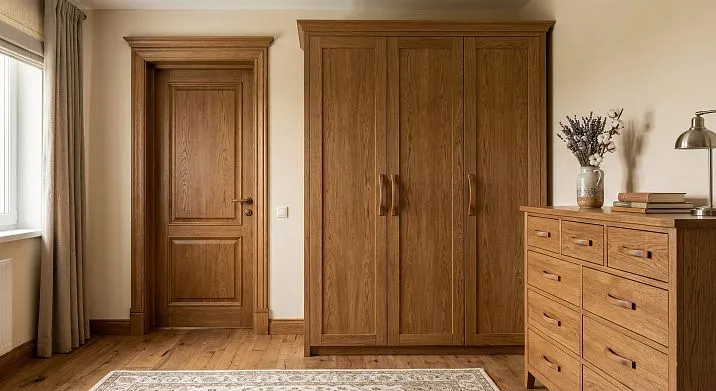
There is one paradox that almost everyone encounters when doing a renovation with a claim to integrity: the doors are beautifully chosen, the wardrobe is worthy, the chest of drawers is excellent. But the interior still doesn't come together. You look at the room — and something is off. The eye catches the discrepancy, but it's hard to articulate.
Most often, the details are to blame. The door architraves are warm oak, the wardrobe handles are cold walnut, the chest of drawers handles are some kind of tinted MDF under 'Mediterranean wood'. Three wood tones, three different textures — and the space falls apart into pieces that coexist but don't communicate.
The solution is not an expensive renovation, not a designer with a consultation for extra money, but a conscious decision: one wood species, one tone, one finish — andWooden casing, andFurniture Handlesare chosen as parts of a single line, not as standalone products. This is exactly what this article is about.


Why architraves and furniture handles should work as one line
Let's try to understand: what is an architrave in an architectural sense? It's not just a decorative overlay. An architrave is the vertical and horizontal frame of a doorway that sets the tone for the entire wall. It's the first thing the eye sees when entering a room: two vertical bodies on the sides of the door and a horizontal one on top. The architrave defines the character of the opening: it can be thin and laconic, wide and imposing, strict or with a profiled relief.
Furniture Handles— a detail of directly opposite scale, but no less significant. It is the tactile point of contact between a person and the interior: a cabinet is opened with hands, a drawer is pulled out, a dresser door is held. The handle is what is felt physically every day. WhenWooden Handleby wood species, tone, and finish matches the door casing — that very 'everything is thought out' effect arises, which is not necessarily consciously perceived but is always read.
Why is this particular combination so important? Because casings and handles work in the same visual plane — the plane of vertical objects at eye level. The casing frames the opening, the handle provides an accent on the furniture nearby. Repeating the material, shade, and character of the finish creates a rhythm: the eye 'recognizes' the same wood in different forms and perceives the space as a unified whole.
It is precisely this logic —molding and furnitureas a unified system — that lies at the heart of a professional approach to interior design. When casings, baseboards, moldings, and furniture handles are executed in the same style and from the same wood species, the interior begins to 'work' as an architectural organism, not as a collection of successful purchases.




How to choose a wood species: oak, beech, and other options
The first practical choice is the species. Everything else depends on the species: tone, texture, character of the finish, behavior in use. And it is precisely the mismatch of species that most often destroys a unified wood line.
Our factory also produces:



Oak: an expressive species with character
Oak is the most popular wood species for wooden interior elements in Russia. Its texture is expressive: noticeable pores, fine rays, a broad annual wave. The tone ranges from light honey to rich dark, depending on the treatment. Oak is heavy, dense, holds its shape well, and practically does not deform with humidity fluctuations.
wooden furniture handlesOak is a choice for interiors where wood should be prominent and have its own character. An oak handle is not 'quiet': it catches the eye, has texture, and is pleasant to touch. An oak wooden architrave follows the same principle: it doesn't blend into the wall but defines the opening.
The main task when working with oak is to coordinate the tone. Oak can be cool (with a bluish or greenish undertone) or warm (with a golden or cognac hue). Mixing two oak tonalities on different elements is a classic mistake, which we will discuss in more detail later.
Get Consultation
Beech: a calm wood species for delicate interiors
Beech is a more uniform wood species. Its texture is delicate: fine-pored, with a subtle pattern, without pronounced pores or wide annual rings. The tone is light pinkish, creamy, or less commonly, warm beige. Beech accepts any finish well: oil gives a natural look, varnish provides a glossy or matte surface, and stain easily changes the tone.
Beech wooden architrave and beech handles are a solution for interiors where wood should be quiet, natural, and unobtrusive. Scandinavian style, Japanese minimalism, light modern classic—beech provides exactly that warmth without excess weight, which is so valued in these styles.
Other wood species: when it makes sense to choose them
Besides oak and beech, interior elements also feature walnut, ash, cherry, and exotic wood species. Each has its own character. Walnut is dark, noble, with a wavy texture. Ash is light, with a pronounced straight-grained structure. Cherry is warm, with a reddish tint that deepens over time.
Crucially important: no matter which wood species you choose, the wooden architrave and wooden handles must be made from the same species. Not 'approximately similar wood,' not 'both light-colored'—but strictly the same type. Only then is a unified wood tone in the interior not an illusion, but a fact.
How to choose a shade and avoid mixing different wood tones
Choosing one wood species is a necessary but not yet sufficient condition. Because the same oak from different manufacturers and with different treatments can look completely different. Light natural oak and dark 'tobacco' oak are formally the same species, but visually they belong to different interiors.
Why shades vary even within the same wood species
Wood tone is determined by three factors: the tree's age and cut zone, drying method, and most importantly, the finish. Oil preserves the natural tone and enhances the wood grain. Lacquer creates a slightly brighter, more saturated effect. Stain fundamentally changes the tone: neutral beech becomes 'dark walnut', light oak turns into deep 'tobacco'.
That's why the same shade name from different manufacturers doesn't guarantee a match. 'Natural oak' from one brand and 'natural oak' from another can differ in tone temperature (cooler/warmer), color depth, and surface sheen.
Warm and cool oak: why it matters
Oak with a warm undertone—golden, honey, cognac—pairs well with warm walls: cream, beige, ochre. Oak with a cool undertone—silvery, smoky, 'ashy'—leans into gray-green or gray-blue tones and works with cool neutral walls.
If the trim is warm honey oak and the furniture handles are cool smoky oak, a conflict arises: both are 'wood', both are 'oak', but they clearly belong to different systems. The eye perceives the mismatch, even if a person can't explain it.
How to ensure tone matching
The ideal option isPogonazh iz massivaand furniture handles from the same manufacturer, from the same wood batch, with identical finishing. Then a match is guaranteed: one species, one batch, one finish—and both the trim and handles look like a single material in different forms.
The second option is DIY finishing: buy trim and handles without a finish and apply the same product (oil from one brand, stain of one shade) to everything. This is labor-intensive but gives absolute control over the result.
The third option is visual side-by-side inspection. Before purchasing, place a trim sample and a handle sample under the same light source. Daylight and incandescent light can 'shift' the same shades differently: what appears similar in daylight may diverge under evening light. Check under the lighting the room actually has.
Coated or uncoated handles: what to choose for a unified palette
Choosing betweencoated handlesanduncoated handles— is not just a question of aesthetics. It's a question of systematic matching with architraves and other wooden interior elements.
Coated handles: reliability and ready-made tone
Coated handles are already processed at the factory: oil, varnish, wax, or paint are applied under controlled conditions. This means a smooth surface without streaks, protection from moisture and mechanical impacts, and a stable tone that does not change over time.
For cabinets and dressers in active areas — kitchen, hallway, children's room — coated handles are preferable: they withstand daily contact, wet hands, and accidental impacts. The coating tone is fixed by the manufacturer, and the designer's task is to select a wooden architrave with a similar shade and finish.
Coated handles from the 'Modern' collection are an example of a ready-made solution focused on matching with neutral wooden architraves without a pronounced profile: laconic forms, clear lines, even wood tone with a protective finish.
Uncoated handles: freedom to finish in any tone
handles without coating— is pure wood, ready to accept any composition. This option is ideal when architraves have already been purchased and finished: knowing the tone and composition of the architrave coating, the handles can be treated with the same composition. The result is a perfect match that cannot be achieved by choosing from ready-made options.
Additionally, unpainted handles are the choice for those who want to keep the wood as natural as possible: without tinting, without varnish, with minimal protective oil. This is a solution for interiors where the naturalness of the wood is not a background, but an accent.
Oil, varnish, wax, enamel: which coating maintains a unified line
-
Oil preserves the natural tactility of wood, enhances texture, and gives a matte natural appearance. The surface 'breathes.' The best choice when naturalness and the warm character of the material are important.
-
Varnish creates a protective film, gives a brighter color and a glossy or satin sheen. Less tactile, but more practical in use.
-
Wax is the most delicate coating: soft shine, pleasant surface, well emphasizes the pores of the wood. Less resistant to water than oil or varnish.
-
Enamel completely covers the wood texture, giving an even color. The choice for monochrome solutions, when architraves and handles should be the same color, not the same wood tone.
It is fundamentally important: the sheen of the architrave and handle coating must match. A matte architrave and a glossy handle are two different 'states' of wood that conflict even with the same shade.
Which architraves better support furniture: flat, classic, or accent
Wooden casings create a frame around the opening, visually highlighting it from the wall plane. A classic casing has a profiled section that corresponds to the profiles of baseboards and moldings.— is not the only category: within the wooden architrave, there is its own hierarchy of forms, and each form dictates a certain scenario for combining with handles.
Flat architrave: a pair for a laconic handle
Flat casing — a profile with minimal relief, straight edges, without pronounced beads or classic coves. It's a choice for modern interiors: Scandinavian, minimalism, Japanese style, calm contemporary classic. Flat wooden casing doesn't claim architectural complexity — it says: 'I'm here, I'm wooden, I'm a frame' — and adds nothing more.
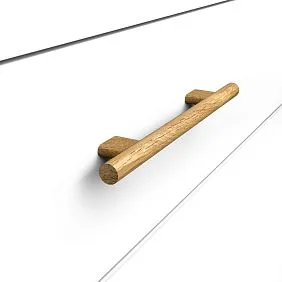
Its pair — a handle of the same laconic philosophy: a straight backplate, a cylindrical knob, a flat cross handle with a geometric profile. No curls, no complex silhouette. Wood — one, form — strict.
Casing with a classic profile: a pair for a decorative handle
Wooden casing with a pronounced profile — beads, shelves, coves — this is already classic or neoclassic. Here handles can be more decorative: with a relief body, rounded silhouette, engraved ornament. Wood remains the common element; the profile complexity of the casing 'permits' the complexity of the handle.
At the same time, the degree of decorativeness should be coordinated. A very ornamental casing + a simple knob creates a mismatch in 'status'. Conversely — an overly decorative handle with a simple casing — the same conflict, just from the other side.
Wide casing: a monumental frame
Wide wooden casing — width from 8–10 cm and above — is an architectural statement. Such casing takes on the function of a full-fledged framing, makes the opening monumental, weighty in a good sense. It is appropriate in rooms with high ceilings, in classic interiors, in studies.
The handle for a wide casing should be substantial: not a thin wire backplate, but a solid horizontal handle with good 'body', or a knob of large diameter. Proportionality is important: a weak handle next to a monumental casing looks like a random detail.
How to link doors, wardrobe, and chest of drawers with the same wood species
This is the main practical block. Let's break it down as an algorithm — from choosing the species to the final check.
Step 1. Choose one wood species and finalize the decision
Before going to the store or catalog — make a decision: oak or beech. This is a fundamental choice that resolves 80% of compatibility questions. Not 'wood', not 'something warm', but a specific species.
If the room already has furniture with wooden fronts — the species is predetermined. Trims and handles are selected to match it. If everything is being chosen from scratch — oak for interiors with character and pronounced texture, beech for calm, delicate, light solutions.
Step 2. Define one base tone
Within the chosen species, determine the tone: natural, honey, tobacco, cognac, smoky. This tone should be the same for all wooden elements — trims, handles, and, if present, for baseboards, moldings, wooden inserts on furniture.
It's better to finalize the tone through a specific finish: oil of a certain brand and shade, stain with a specific article number. Then even if trims and handles are from different batches — the finish will bring them to the same visual result.
Step 3. Resolve the finish issue uniformly
Oil — everywhere or lacquer — everywhere. Mixing matte oil on trims and glossy lacquer on handles creates a conflict of surfaces, even with the same tone. A matte finish everywhere — and the wood reads as one material in different forms.
If the trims are already installed with a finish — purchasehandles without coatingand apply the same composition as on the trims.
Step 4. Repeat the wood in the handles
When the wood species and finish are determined — select Wooden handles from the same species with the same finish. Cabinet handles and dresser handles should be from the same catalog, the same collection — then they are stylistically coordinated not only in color but also in the character of the form.
Step 5. Coordinate the degree of decorativeness
Ask yourself: how 'rich' is the casing? If it is flat and simple — the handles are also strict. If it has a profile and relief — the handles can be more expressive. This is important: not only the tone should match, but also the 'level of complexity' of the details.
Step 6. Check everything side by side
The final and mandatory step before purchase: place a sample of the casing and the selected handle in real lighting conditions. In daylight, in evening light. Look from a distance of 2–3 meters — it is from this distance that a wall with a door and a cabinet standing nearby is perceived.
If the materials look like 'one family' side by side — the decision is correct. If there is a feeling of 'similar, but not quite' — keep searching.
This approach is fully consistent with the philosophy that STAVROS consistently develops in its materials: wooden furniture handles are chosen not as an independent product, but as part of a system where each wooden element — casing, baseboard, handle — follows a unified logic of species, tone, and finish.
Best scenarios for combining architraves and furniture handles
Theory is good. But real-life examples are more convincing. Let's look at a few specific interior scenarios.
Classic interior: profiled architrave + decorative oak handle
Classic style is about strict hierarchy of details. The architrave is wooden with a pronounced profile: for example, a wide shelf, a bevel, a plinth step at the base. Material — oak with a warm hue, finish — satin-gloss varnish. Cabinet handles — oak, horizontal, with a voluminous body and moderate relief. The same oak, the same varnish, the same tone.
Result: the doorway and the cabinet nearby 'speak' the same language. The cabinet doesn't look out of place — it's part of the architectural scenario.
Neoclassical: wide oak architrave + bracket handles
In neoclassicism, details are expressive but not overloaded. A wide wooden architrave without excessive ornamentation, oak of medium saturation — 'cognac' or 'tobacco'. Dresser handles — horizontal oak brackets, wide enough to be proportionate to the architrave. The same matte oil — and the two elements become a single ensemble.
Calm modern interior: flat beech architrave + minimalist beech handles
Modern interiors value restraint. A flat wooden architrave made of beech, coated with matte oil with a neutral composition — almost natural tone, quiet texture. Cabinet and dresser handles — flat horizontal beech with the same oil. No extra relief, no contrasts. Walls are light — beige or gray-white — and beech in this environment provides exactly the warmth that is not aggressive.
Light interior with an emphasis on naturalness: beech without tinting
If the interior is built on almost white or cream tones, wooden elements should be so light that they are 'almost invisible'—yet felt as a warm natural accent. Untinted beech with minimal protective oil is the ideal option. Natural beech wooden trims and beech furniture handles provide exactly that: a barely noticeable but warm accent that a light interior carries without overload.
Dark wood in an accent role: tobacco-colored oak or stained.
Dark oak is a bold solution. Stained, tobacco, dark cognac-colored—a wooden trim with such a shade immediately becomes an accent detail on a light wall. Oak handles in the same dark tone continue the accent on furniture. Important: dark wood requires minimalism in other details—walls and floors should be calm so the wood reads clearly and doesn't drown in competition with other accents.
Mistakes that cause wood to start conflicting.
Knowing how to do it right, it's useful to know how to do it wrong—to recognize your own mistakes before they materialize in the interior.
Mistake 1: oak of different tonalities.
The most common mistake. Trim—light honey oak from one collection, handles—dark 'tobacco' oak from another. Formally both are oak, in reality—two different materials. The eye senses a mismatch: 'something's off with the wood,' even if the person can't explain why.
How to avoid: choose trims and handles from the same place, from the same collection—or check samples side by side before purchase.
Mistake 2: different coating sheens.
Glossy handles + matte trims—the same oak, same tone, but different surface 'temperatures.' A matte surface scatters light softly, a glossy one reflects sharply. They create different sensations from the same material.
How to avoid: fix the finish type (matte/satin/glossy) as a system parameter and do not deviate from it for either architraves or handles.
Error 3: overly active architrave next to a simple cabinet
A wide, profiled wooden architrave with a rich silhouette — and next to it, a cabinet with simple flat handles without pronounced body. The architrave 'shouts,' the handles 'whisper' — the balance is broken. The architrave looks like architectural decor that accidentally ended up next to furniture from the budget segment.
How to avoid: coordinate the 'level of complexity' — if the architrave is decorative, the handles should be substantial enough to maintain a visual dialogue with it.
Error 4: minimalist architrave and overly decorative handles
The opposite situation: a flat, quiet beech architrave — and handles with ornamentation, carved body, and shaped overlays. The handles pull the focus onto themselves, the architrave gets lost. The furniture looks 'richer' than the door — this breaks the unified line.
Error 5: mixing wood species without logic
Oak architraves, beech handles on the cabinet, and walnut handles on the chest of drawers. Three species, three textures, three tones — and each element claims the role of an independent material. There is no unified wood tone, there is a collection of samples.
When several wood species are mixed in one interior without a system — it's not 'richness,' it's 'chaos.' The only exception is intentional contrast, where one species dominates and another is introduced as a point accent. But that is a conscious decision, not an accidental one.
For more details on how to build a unified systemic concept — from door architraves to furniture handles — you can read in the article about molding and furniturewhere this logic is broken down with specific scenarios.
Mistake 6: not checking samples under real lighting
Buying based on a picture or description is a path to disappointment. The photo on the website and the actual sample under evening lighting in the room are two different things. Always check samples under real operating conditions: in the light in which the space lives.
Additional wooden elements that reinforce the unified line
Casing and handles are the core of the system. But the wooden line in the interior shouldn't stop at two elements. The more wooden details are united by one species and tone, the more cohesive the space becomes.
Solid wood baseboard
Pogonazh iz massivaincludes not only casings but also wooden baseboards. A baseboard made from the same species as the casing and handles is a horizontal line that closes the wooden contour of the room: casings are vertical, baseboard is horizontal. Together they create a wooden 'frame' for the interior.
Wooden moldings and cornices
If the interior has wooden moldings or ceiling cornices, use the same species, the same tone. An oak cornice above the door + oak casings + oak handles = a wooden system that reads from top to bottom as a single vertical axis.
Wooden inserts on furniture fronts
If the fronts of a wardrobe or chest of drawers have wooden inserts, slats, or decorative overlays, they should also be made from the same species. When handles and inserts are made from the same wood, the furniture stops being a 'front with handles' and becomes a cohesive object.
FAQ: answers to the most common questions
How to match wooden handles to architraves?
Determine the wood species of the architrave, its tone, and finish. Choose handles from the same species with an identical finish. Check samples side by side under real lighting. If the architraves are already finished — buy handles without a finish and treat them with the same composition.
Can doors and a chest of drawers be tied together with the same wood species?
Yes, and this is precisely what creates a cohesive interior. One species — oak or beech — for architraves and chest of drawers handles ensures a visual rhyme between the doorway and the furniture. Even if they are on different walls — the eye catches the repetition.
What is better for a unified palette: handles with a finish or without a finish?
It depends on the situation. If the architraves are already finished — handles without a finish for a perfect match after self-finishing. If everything is being chosen from scratch — handles with a finish from the same collection as the architraves, without the risk of tone discrepancy.
Which wooden architrave to choose for modern furniture?
A flat architrave without a pronounced classic profile. It does not compete with minimalist furniture but supports it. Material — beech or light oak, finish — matte oil.
How to combine oak architraves and oak handles?
Ensure both elements are warm or cool oak (same temperature tone), both with the same type of finish (matte/satin). Check samples side by side. If tone and sheen match — the system works.
What to do if furniture is already in place, and door trims are only being selected?
Take a sample of the furniture handle or front. Select a wooden door trim next to this sample: species, tone, and finish should match. If furniture handles are wooden with a finish — clarify the finish composition with the manufacturer and look for a trim with a similar finish.
Can different wood species be used intentionally?
Yes, but as a deliberate contrast, not random mixing. For example, oak door trims + beech handles in the same tone with identical finish — this is a delicate material contrast that works subtly. But three different species without common logic — that's chaos, not design.
How to choose a handle shape to match the door trim?
Focus on the 'level of complexity': flat simple trim — a strict, laconic handle. Profiled trim with relief — a more voluminous or decorative handle. Proportionality of details is the key criterion.
Are wooden handles suitable for the kitchen?
Yes, if you choose handles with a finish: varnish or oil with increased durability protects against moisture and grease. In the kitchen, it's especially important for the tone of wooden handles to match wooden door trims on nearby doors — the kitchen and hallway are often visually connected.
Where to view the full assortment of handles and door trims?
In the STAVROS catalog:Furniture Handleswith separation into handles with coating and without coating, andWooden casings create a frame around the opening, visually highlighting it from the wall plane. A classic casing has a profiled section that corresponds to the profiles of baseboards and moldings.with filtering by material, profile, and collection.
Conclusion: wood as the language of a cohesive interior
An interior whereWooden casingandFurniture Handlesthey speak the same language—this is not a luxury or a complexity. It is consistency: one wood species, one tone, one finish. Doors, a wardrobe, and a chest of drawers unite not because they are identical in shape, but because each is made of the same wood. The architrave frames the opening, the handle provides a tactile accent on the furniture, and both echo each other without words.
This is how a true architectural interior works: in details that do not catch the eye, but if they disappeared—something important would fall apart.
STAVROS is a Russian manufacturer of wooden architectural decor and furniture hardware made from solid oak and beech. The STAVROS catalog offers a complete line for a unified wood concept:Wooden casingswith filtering by profile and material,Furniture Handlesmade of oak and beech with separation intoHandles with Finishandhandles without coating, as well as allPogonazh iz massiva— Skirting boards, moldings, cornices. STAVROS products are manufactured using 3D milling, undergo multi-stage processing, and are available in stock in Moscow. One wood species, one system, one character — with STAVROS, it's not a task, but a ready-made solution.