Article Contents:
- Technological features of modern wooden decor
- Innovative methods of solid wood processing
- Specialized material preparation
- Variety of stylistic solutions
- Baroque motifs in modern interpretation
- Ethnic motifs and regional traditions
- Functional aspects of application
- Zoning Space Using Decoration
- Accentuating architectural features
- Psychological impact of natural wood
- Biophilic design and human perception
- Aromatherapeutic effect
- Technical requirements for installation
- Preparation of load-bearing surfaces
- Selection of adhesive compositions
- Modern design trends
- Minimalist approach to decoration
- Color solutions
- Production Technologies
- Durability and stability
- Maintenance and care
- Regional specificity of application
- Climate characteristics
- Architectural traditions
- Economic aspects of selection
- Price-to-Quality Ratio
- Possibilities of staged decoration
- Professional Secrets of Designers
- Working with proportions
- Combination with lighting
- Innovative solutions and technologies
- Digital Modeling
- Integration with Smart Systems
- Ecological Aspects
- Sustainable forestry
- Restoration and recycling
- International trends
- Scandinavian minimalism
- Japanese aesthetics
- Conclusion
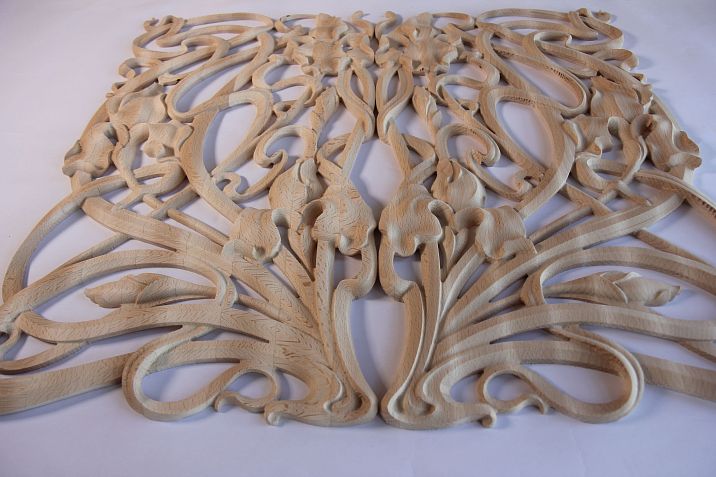
What makes a space truly alive and spirited? Certainly, contact with nature. And if, at one time, wooden decor was considered exclusively a classic solution, then today wooden appliqué decor experiences a true renaissance, becoming the main trend of modern design. Isn't it amazing how a single carved element can transform the most mundane surface into a work of art?
Wooden appliqué elements are not just decoration. They are a philosophy of life, where every line tells a story, every curve carries emotion, and every texture gives a sense of authenticity. In an era of synthetic materials and virtual reality, natural wood becomes a symbol of truth and connection to roots.


Technological features of modern wooden decor




Innovative methods of solid wood processing
Modern technologies have fundamentally changed the approach to manufacturing wooden decor. If previously carved elements required months of meticulous handwork, now high-precision equipment allows creating perfectly symmetrical compositions with mathematical accuracy. At the same time, machine processing does not exclude the human factor — final finishing of each element is still performed manually by experienced craftsmen.
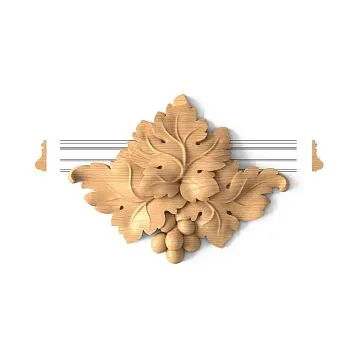
Oak and beech remain favorites among wood species for creating appliqué decor. Oak impresses with its monumentality and noble texture, capable of highlighting the status of any interior. Beech, however, attracts with its fine-grained structure and excellent suitability for detailed carving, making it indispensable for creating elegant ornaments.
Our factory also produces:


Specialized material preparation
The process of creating high-quality applied wood decor begins long before the first contact with the saw. Indoor drying of wood is an entire science requiring precise adherence to time and temperature regimes. Only properly prepared material guarantees dimensional stability over decades of use.
The unique lamination technology allows creating appliqués of any size without limitations imposed by natural tree dimensions. This opens boundless possibilities for implementing large-scale design projects requiring elements of impressive scale.
Get Consultation
Variety of stylistic solutions
Baroque motifs in modern interpretation
Baroque style in applied wood decor Today, it undergoes a remarkable transformation. Traditional floral ornaments acquire more streamlined forms while retaining their full expressiveness. Modern designers have learned to use classical motifs sparingly, creating accents rather than full-scale decoration.
Angular appliqués with asymmetrical compositions, where traditional leaves and scrolls combine with geometric elements, are especially popular. Such a solution allows incorporating classical decor into minimalist interiors without losing stylistic integrity.
Ethnic motifs and regional traditions
Russia is rich in woodworking traditions, and each region has contributed to the development of decorative carving. Northern motifs, with their simplicity and functionality, harmonize beautifully with modern eco-design trends. Central regions have gifted the world with traditions of Bogorodskaya toys and Abramtsy-Kudrin carving, elements of which are actively used in contemporary applied wood decor.
Animal motifs are especially interesting, where stylized animal images create a unique atmosphere of closeness to nature. Such elements look particularly harmonious in country houses and eco-oriented interiors.
Functional aspects of application
Zoning space with decor
Applied wood decor is not only decoration but also a powerful tool for architectural planning. Vertical appliqués can visually increase ceiling height, which is especially relevant for standard apartments with low ceilings. Horizontal elements, on the contrary, expand space and create a sense of openness.
Moldings and planks perform an important function of concealing technical elements — material joints, transitions between different finishes, areas for communication installation. In doing so, they do not merely hide flaws but transform them into decorative elements.
Accentuating Architectural Features
Properly placed applied decor can highlight the strengths of a room and conceal its weaknesses. Central wall appliqués create focal points that attract attention and divert focus from less favorable zones. Decorating door and window openings with decorative elements gives them a finished, noble appearance.
Psychological impact of natural wood
Biophilic design and human perception
Scientific studies repeatedly confirm the beneficial effect of natural materials on human psycho-emotional state. Applied wood decor does not merely decorate space — it creates a unique atmosphere of coziness and security that cannot be achieved with artificial materials.
Tactile sensations play an important role in perceiving wooden decor. Even visual contact with textured wood surfaces activates brain regions responsible for touch, creating a sense of "warm" material.
Aromatherapeutic effect
Many forget that natural wood possesses its own, barely perceptible aroma, which lasts for years. Oak emits barely noticeable vanilla notes, beech evokes the feeling of fresh forest coolness. These aromas are so delicate that they are perceived subconsciously, creating an additional level of comfort.
Technical requirements for installation
Preparation of load-bearing surfaces
The quality of applied decor installation directly depends on proper surface preparation. The surface must be perfectly flat, with no more than 2 mm deviations per meter of length. Any irregularities will be visible after installation and may lead to cracks at mounting points.
The moisture content of the base should not exceed 12% — this is a critical indicator for ensuring reliable adhesion of adhesive compositions. If this value is exceeded, additional drying or application of special deep-penetration primers is recommended.
Selection of adhesive compositions
Modern polyurethane adhesives provide the strongest connection between wooden elements and various types of bases. Their advantage lies in the elasticity of the cured layer, which compensates for natural wood deformations caused by changes in humidity.
For particularly critical areas, combined fastening is used — a combination of adhesive bonding and mechanical fasteners. Self-tapping screws are selected so that their heads are fully embedded into the thickness of the appliqué, and the resulting recesses are masked with special wax pencils.
Modern design trends
Minimalist approach to decoration
Modern approach to use applied wood decor Differently from traditional approaches. Previously, the goal was to maximize space coverage with decorative elements, but today, restraint and selectivity are valued. A single large accent element can make a greater impression than numerous small details.
Geometric shapes are gaining increasing popularity. Simple rectangles, squares, and rhombuses combined with natural wood texture create a striking contrast between technology and nature.
Color Solutions
Traditional natural wood tones remain relevant, but experiments with color are becoming more common. Staining allows any shade to be applied to overlays while preserving the natural texture. Grey tones — from light silver to deep anthracite — are especially popular.
Contrasting solutions are also gaining popularity. Dark overlays on light walls or vice versa — this technique allows creating striking accents without using bright colors.
Operational characteristics
Durability and stability
Properly manufactured and installed wooden overlay decor can serve for decades without losing its appearance. Kiln-dried and specially treated wood ensures dimensional stability even with significant humidity fluctuations.
Restoration possibilities are another important advantage of wooden decor. Unlike polymer materials, wood can be repaired, sanded, and re-coated with protective finishes. This makes investments in quality wooden decor especially worthwhile in the long term.
Care and Maintenance
Modern protective coatings significantly simplify maintenance of wooden decor. Quality varnishes and oils create a reliable barrier against dirt and moisture, while still allowing the wood to "breathe".
Regular maintenance reduces to gentle dry cleaning and periodic renewal of protective coating every 3-5 years. This is incomparably simpler than replacing synthetic decorative materials, which cannot be restored after damage.
Regional application specifics
Climate Characteristics
Russia's climate, with its sharp temperature and humidity fluctuations, imposes special requirements on wooden decor. Northern regions, with their dry, frosty winters and humid summers, require especially careful selection of protective coatings.
In the middle belt, the main issue is spring and autumn periods with high humidity. Here, proper room ventilation and maintaining a stable microclimate are critically important.
Southern regions, with their hot summers and mild winters, present different challenges — protection against ultraviolet radiation and high temperatures is required.
Architectural traditions
Different regions of Russia have their own architectural features that must be considered when choosing the style of overlay decor. The Pskov-Novgorod tradition leans toward strict, minimalist forms. Moscow Baroque implies more ornate decoration. Siberian carving is distinguished by particular practicality and functionality.
Economic aspects of selection
Price-to-quality ratio
Investments in quality overlay decor pay off many times over. The service life of quality wooden elements is measured in decades, whereas cheap imitations require replacement every few years.
Impact on property value is another important factor. Professionally executed decorative finishing significantly increases the attractiveness of a property to potential buyers or tenants.
Step-by-step decoration possibilities
It is not necessary to decorate the entire space simultaneously. A phased approach allows distributing costs over time, beginning with the most important zones — accent walls, fireplace surrounds, entryways.
Professional Designers' Secrets
Working with proportions
The golden ratio remains the foundational principle for placing decorative elements. Overlays should relate to room and furniture dimensions in specific proportions, creating a harmonious composition.
Rhythm and repetition are another important principle. Repeating elements create a sense of order, but it is important not to overdo it, to avoid creating a "nagging" effect.
Combining with lighting
Directional lighting can dramatically alter the perception of carved decor. Side lighting emphasizes relief and creates play of light and shadow. Frontal lighting makes elements appear flatter, but allows better viewing of ornament details.
Hidden backlighting behind overlays creates a "floating" effect of decor above the wall surface, adding mystery and modernity to the interior.
Innovative solutions and technologies
Digital modeling
Modern CAD systems allow creating three-dimensional models of future decorative elements with photorealistic accuracy. This enables clients to preview the result before production begins and make necessary adjustments.
Parametric modeling allows creating families of elements with different sizes while maintaining stylistic unity. This is especially important when decorating large spaces, where numerous elements of varying sizes are required.
Integration with smart systems
wooden appliqué decor Decorative elements are increasingly integrated with smart home systems. Hidden motion, temperature, and humidity sensors can be seamlessly embedded into decorative elements without compromising their aesthetic appeal.
Built-in lighting with adjustable color and intensity transforms static decor into a dynamic interior element capable of adapting to mood and time of day.
Ecological aspects
Sustainable Forestry
Responsible manufacturers of decorative elements are paying more attention to eco-friendly production. Using wood from certified forestry ensures that valuable forest areas are not felled for decor production.
Zero-waste production is another important principle. Modern technologies allow using almost all wood, converting waste into fuel briquettes or raw materials for other industries.
The ability to restore makes wooden decor one of the most eco-friendly materials. Unlike plastic or MDF, natural wood can be restored multiple times, extending its lifespan by decades.
At the end of its life cycle, wooden elements can be fully recycled or safely disposed of without harming the environment.
International trends
Scandinavian trends significantly influence the Russian market for decorative materials. Simplicity of forms, natural colors, functionality — these principles are increasingly applied in creating applied decor.
Scandinavian minimalism
Minimalism does not mean primitiveness. The Scandinavian approach implies perfect refinement of every detail, flawless execution quality, and thoughtful design of each element.
Japanese aesthetics
The Japanese philosophy of wabi-sabi, which recognizes the beauty of imperfection, is reflected in the modern approach to wooden decor. Natural imperfections of wood and its inherent asymmetry are increasingly viewed not as flaws, but as unique characteristics.
Represents a unique synthesis of ancient woodworking traditions and advanced manufacturing technologies. This is not merely a way to decorate interiors — it is an opportunity to create a space filled with natural energy and authentic beauty.
Conclusion
Modern wooden appliqué decor In a world where artificial is increasingly replacing natural, wooden decor becomes a symbol of returning to roots, to understanding the true value of materials created by nature. Each applique is a fragment of living wood that continues to breathe and live in your home, creating an irreplaceable atmosphere of coziness and harmony.
For many years, the company STAVROS has remained faithful to the principles of quality and authenticity, creating decorative elements that become true family heirlooms, passed down from generation to generation. Choosing STAVROS products means investing not only in the beauty of your home, but also in the future — a future where natural materials and traditional craftsmanship retain their relevance and value.
Balusters on the second floor: creating a safe and elegant staircase in the house